This guide is general education for pet owners. If your pet has urgent symptoms, possible poisoning, injury, breathing trouble, collapse, severe pain, or sudden decline, contact a licensed veterinarian or local emergency service.
Editorial standard
How this guide was prepared
Pacing after a departure is an observation. Separation anxiety is a diagnosis. Between those statements are important questions about timing, severity, confinement, noise, toileting needs, pain, medication, and what happens when a particular person leaves. The first job is to collect evidence without making the dog endure a longer absence for the camera.

Clinical Quick Answer & Immediate Actions
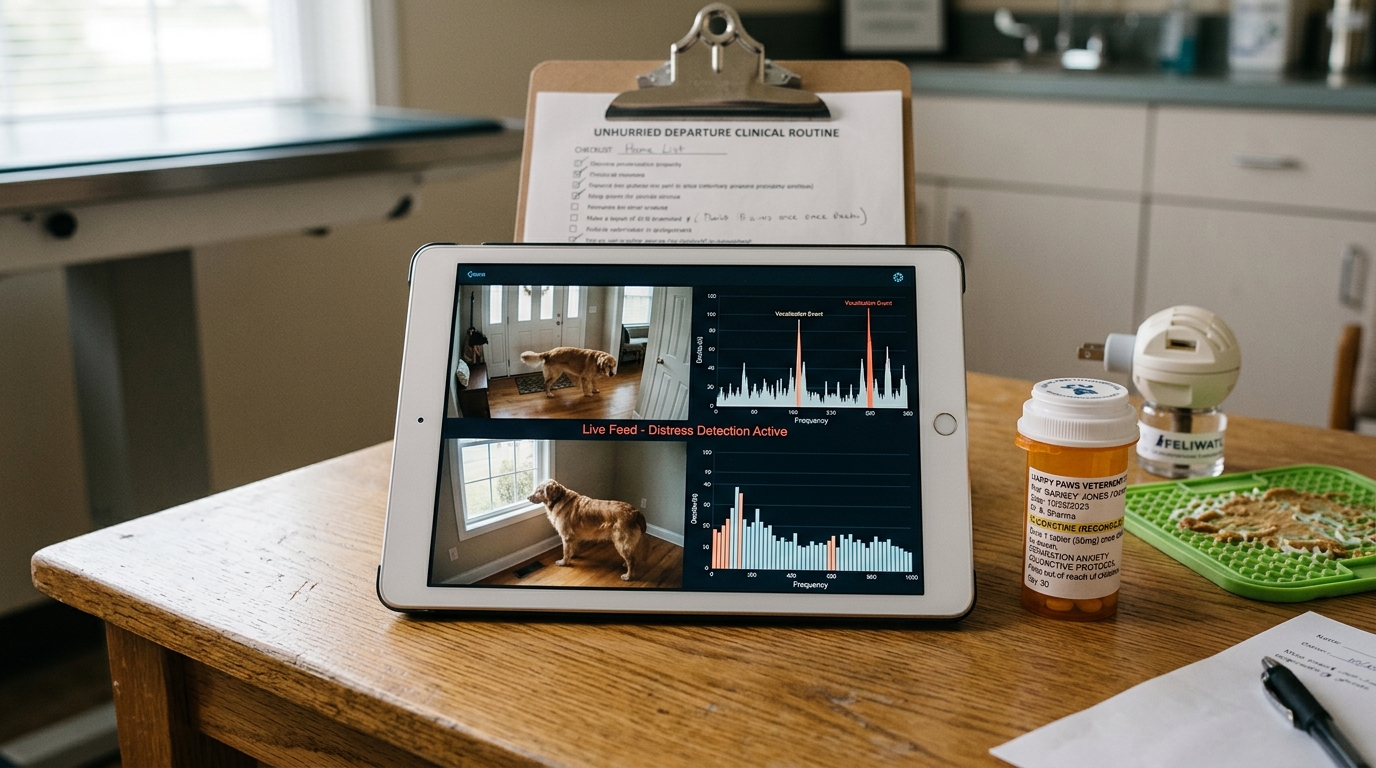
True canine separation anxiety is a severe panic disorder triggered by real or perceived isolation from attachment figures. Dogs experiencing separation distress suffer acute neuroendocrine surges (hypercortisolemia, tachycardia, tachypnea) leading to vocalization, inappropriate elimination, and frantic escape destruction focused on exit points (doors and windows). Management requires veterinary evaluation to exclude medical causes, desensitization to pre-departure cues, gradual absence conditioning below the panic threshold, and veterinary-prescribed behavioral medication.
If a dog causes self-injury by biting doors or breaking nails during an absence, contact an emergency veterinarian immediately to treat physical trauma and discuss medical management.
Separate what you saw from what it might mean
Write “barked for eight minutes after the door closed” rather than “was manipulative” or “has anxiety.” Departure-related destruction, vocalizing, drooling, panting, toileting, escape behavior, refusal of food, and inability to settle can be consistent with serious distress, but other medical and behavioral explanations remain possible.
Note whether the pattern occurs only when alone, when confined, after particular departure cues, during outside noise, or after ordinary needs were missed. A dog calm behind a gate while a person remains home may respond differently to an empty house.
Collect evidence that changes the plan
| Record | Why it matters |
|---|---|
| Video from before departure through the first signs and recovery | Shows onset, sequence, and whether the dog ever settles |
| Exact absence length and earliest stress sign | Prevents guessing from the state of the home on return |
| Location, confinement, exits, sounds, weather, and other animals | May reveal confinement distress, trigger events, or safety hazards |
| Food offered and whether it was used | Loss of food interest can indicate the exercise is already too difficult |
| Sleep, appetite, toileting, pain signs, medication, and recent changes | Supports veterinary assessment and differential questions |
Record an ordinary necessary absence if it can be done safely. Do not extend the duration until panic appears, knock on windows, or repeat departures solely to capture a dramatic example.
Start the baseline while the household is still following an ordinary routine, ideally early enough to capture resting location, breathing, movement, attention to people, and response to everyday sounds. Record who is home, which person will leave, the time since toileting, food, exercise, medication, and sleep, plus unusual weather or building noise. This shows whether stress starts with shoes, a bag, movement toward the door, confinement, or the actual absence.
Keep the camera angle wide enough to include the main exit and the dog’s chosen resting or hiding places. Check the timestamp and audio before a necessary absence rather than repeating the departure after discovering that the camera failed. A pre-departure baseline makes later change visible; it is not a reason to perform an extra test.
Keep the baseline comparable across necessary absences. Use the same camera position when practical, note who remains home, and distinguish pre-departure changes from behavior that begins after the door closes. This makes a later improvement or setback interpretable in practice without manufacturing another unnecessary test.
Reduce severe rehearsals
Every unavoidable absence is a welfare and logistics decision. Where possible, use a trusted caregiver, adjusted work pattern, suitable dog-friendly arrangement, or another option that keeps the dog below severe distress while assessment and training begin. This is not “giving in”; it prevents repeated panic and injury while building a workable plan.
Check doors, windows, balconies, crates, barriers, collars, and chew hazards. A dog attempting to escape can damage teeth, nails, skin, or the home. Remove equipment that can snag when the dog is unsupervised unless a veterinarian or qualified professional has provided a specific safety plan.
Turn management into a coverage calendar for the next one or two weeks. Mark every essential absence, its real duration, which part can be shortened or moved, who has confirmed coverage, and what happens if that person cancels. Verify access, equipment, feeding and medication instructions, known triggers, and the full time promised; a name on a calendar is not prevention until the handoff works.
Prepare a backup for illness, traffic, key failure, or a sitter cancellation. Share the veterinarian’s contact, an emergency clinic, building access, and the safest room or barrier setup. Tell the caregiver what early distress looks like and what not to do, including crating a dog who panics in confinement or staging departures as practice.
Before relying on a new caregiver, run a handoff while the owner remains available. Check entry, greeting, leash or gate use, toileting route, feeding, medication, and how the dog settles with that person. Then use video for the first necessary covered absence. A caregiver who is safe and familiar in the owner’s presence may still change the departure pattern, so the arrangement needs evidence rather than assumption.
The bridge should reduce the most severe episodes while evidence and professional guidance shape treatment. If no available arrangement keeps the dog safe for essential absences, say that plainly to the veterinarian or behavior professional; the logistics are part of the clinical and welfare problem.
Practice below the observed threshold
Sub-threshold practice begins at a duration the dog can experience without escalating: sometimes a person touching keys, moving behind a gate, opening and closing the door, or stepping out for seconds. Return while the dog remains able to settle. Increase only one variable and use video to check the response that the person cannot see.
A fixed daily schedule such as adding five minutes is unsafe because thresholds vary with sleep, noise, previous absences, illness, and the specific departure. If panting, pacing, vocalizing, drooling, frantic following, escape behavior, or food refusal appears, the next repetition should be easier, not longer.
Food toys and crates have limited roles
A food toy can provide an ordinary activity for a dog who remains relaxed enough to use it. It does not prove the dog is comfortable, and it does not treat panic. Some dogs finish the food and then become distressed; others cannot eat after departure. Review the full video instead of counting an empty toy as success.
Use measured food appropriate to the dog’s diet and supervise new items before leaving them. Do not introduce a swallow or destruction hazard as an attempt to keep the dog occupied.
Crate training and separation-related treatment answer different questions. A dog may enjoy a crate while people are home and panic when left, or tolerate being alone loose and panic only when confined. Forcing a distressed dog into a crate can increase escape injury and obscure the actual pattern.
Use the positive crate guide only to decide whether voluntary crate comfort is appropriate. Stop closed-door work if the dog freezes, pants, drools, vocalizes persistently, bites the crate, throws the body at the door, or cannot recover.
Departure cues are evidence, not a universal exercise
Keys, shoes, bags, a work uniform, closing blinds, or a particular morning sequence may predict absence. Record whether the dog reacts to the cue itself and whether the reaction continues if the person does not leave. Some plans include neutral repetitions of a cue, but randomizing departure signals is not automatically useful and can make the whole day unpredictable.
Work on one cue only when video and professional guidance show it belongs in the sequence. The larger goal remains comfortable absence below threshold, not making every household movement meaningless.
Returns should provide information, not drama rules
There is no need to ignore a distressed dog to prove independence. Return calmly, address toileting and safety, and allow the dog to settle. Avoid punishment for damage or elimination discovered after the absence; the dog cannot connect delayed punishment to a useful alternative behavior.
Review the recording before planning another session. If distress began early, shorten. If the dog remained relaxed but a noise caused a brief startle, adjust the environment. If the camera failed, do not assume success from a quiet doorway.
Different household patterns need different questions
A newly adopted dog may have no established alone-time history in this home. An older dog with new nighttime or absence distress needs a medical and cognitive review. A dog who panics only in a crate needs a confinement assessment. A dog who becomes distressed when one specific person leaves despite others remaining presents another pattern. These are reasons to avoid a DIY label.
Housing pressure can push families to increase duration too quickly. Tell the veterinarian or behavior professional about complaints, work obligations, and the maximum management the household can sustain. A technically ideal plan that cannot prevent severe rehearsals needs practical revision.
Compare timing and trigger sequence across naturally occurring absences. A reaction at keys or shoes differs from one that starts only after corridor noise, confinement, or a long quiet interval. Note which element changes onset and recovery without staging extra departures. The comparison narrows questions for the veterinarian or behavior professional; it does not establish a diagnosis.
Medical and care variables belong in the comparison. New house-soiling, nighttime waking, pain signs, increased thirst, gastrointestinal change, sensory decline, or medication timing can alter absence behavior. Write these as questions for the veterinarian. Pattern differences narrow the next investigation; they do not let the household name a diagnosis from video alone.
Welfare improvement is broader than silent video
Judge progress across several necessary absences, not from one quiet recording. Look for the dog to choose rest, resume ordinary movement after a cue or startle, maintain normal sleep, appetite, and toileting, and move flexibly among resting, drinking, eating, and social behavior rather than remaining fixed on the exit.
Also compare recovery: how soon ordinary behavior returns, whether a harder day is followed by a workable easier absence, and whether the dog can cope across different but necessary household schedules. A dog can be silent while rigid or shut down, so improvement means a broader return of safe, flexible behavior, not merely fewer sounds.
Veterinary care and medication discussions
A veterinarian can assess pain, gastrointestinal or urinary problems, cognitive change, medication effects, and other conditions that influence behavior. Bring one short timeline and a few representative clips showing onset, earliest stress sign, peak behavior, recovery if any, confinement, food use, injuries, physical changes, medications and supplements, and unavoidable absence demands. Ask which medical differentials need assessment and whether referral is appropriate.
For significant separation-related distress, medication may be discussed as one part of a broader plan; it is neither a moral failure nor a substitute for management and behavior work. Ask about the goal, start and timing, monitoring plan, review point, adverse effects or changes that require a call, and how medication fits the below-threshold plan. Do not use another animal’s prescription or change a dose without veterinary direction.
At follow-up, bring the dated observation record, representative clips, medication administration times, and any suspected adverse effects or new physical signs. Report what changed, when it began relative to treatment or schedule changes, and whether the current safety plan remained workable. Confirm which changes require an earlier call, what the next review should decide, and when referral or a revised plan is appropriate.
When to Get Veterinary Help Urgently
Immediate welfare concerns include self-injury, collapse, breathing difficulty, severe escape attempts, ingestion of dangerous material, inability to urinate, uncontrolled vomiting or diarrhea, or distress so intense that the dog cannot be kept safe. Contact an emergency clinic when the signs or injuries warrant urgent care.
Prompt behavior and veterinary coordination is also needed when the dog cannot be left for essential periods, the threshold is only seconds, neighbors or housing are at risk, or the household cannot prevent repeated severe episodes. The aim is a diagnosis-informed plan, not a longer test of endurance.
Handoff & Exercise Support: When leaving your dog with a caregiver, document separation triggers in your Pet Sitter Instructions Checklist, and establish decompression through calm leash walking without pulling before departure.
Clinical Practice Tool: Daily Pet Care Routine Tracker
Monitor your dog’s departure desensitization steps and calm recovery intervals with our free printable Daily Pet Care Routine Tracker. Download and print your copy of the Daily Pet Care Routine Tracker, or explore all practical pet care guides in the NewsPet Resource Center.
Frequently Asked Questions
What is the clinical difference between true separation anxiety and boredom or lack of enrichment?
True separation anxiety triggers intense sympathetic autonomic distress, including frantic vocalization, destructive escape attempts at entry points, hypersalivation, and self-trauma occurring within 15 minutes of caregiver departure, whereas boredom manifests sporadically later in the day.
Should caregivers punish a dog for destructive behavior committed while alone?
Never. Destructive chewing or house soiling during separation stems from panic, not defiance. Punishment upon returning home associates the caregiver’s arrival with fear, drastically worsening the underlying panic response.
What initial departure routines help reduce separation stress in dogs?
Desensitize pre-departure cues (like picking up keys or putting on shoes without leaving), practice micro-absences lasting seconds, provide frozen lick mats before departure, and consult your veterinarian for behavioral medications if panic is severe.
Sources
Sources checked: September 8, 2026.
- VCA: Separation Anxiety in Dogs
- ASPCA: Separation Anxiety
- AVSAB: Humane Dog Training Position Statement
- AAHA: Canine Life Stage and Behavior Guidelines
- Tufts Cummings School of Veterinary Medicine: Animal Behavior Clinic
Emergency Triage Matrix: Clinical Presentation & Required Response
| Triage Level | Clinical Signs & Presentation | Immediate Action Protocol |
|---|---|---|
| Tier 1: Immediate Emergency (0–2 Hours) | Self-inflicted physical trauma: fractured canine teeth, lacerated footpads, torn claws, or severe oral hemorrhage resulting from frantic door/crate escape attempts during owner absence. | Immediate emergency veterinary transport; wound debridement, analgesia, dental stabilization, and suspension of all unmonitored crating or confinement. |
| Tier 2: Urgent Veterinary Care (Same-Day) | Severe distress upon departure: continuous frantic barking, hypersalivation soaking the chest, vomiting, anorexia when left alone, or repeated urination/defecation exclusively during absences. | Veterinary clinical evaluation; complete bloodwork, urinalysis to exclude UTI, and initiation of multimodal behavioral therapy with FDA-approved behavioral psychopharmacology. |
| Tier 3: Home Monitoring & Scheduled Care | Mild whining or pacing for 2 to 3 minutes following departure, followed by calm settling, sleeping, or engaging with food puzzle toys during the owner’s absence. | Practice low-key departures and arrivals, provide engaging enrichment toys upon leaving, and monitor absence behavior via home video recordings. |
Rule S1 Boundaries & Separation Anxiety Protocols
Managing separation-related distress requires strict adherence to behavioral medicine boundaries:
- NEVER punish a dog upon returning home to destructive messes or elimination: Dogs cannot associate delayed punishment with behaviors performed hours earlier; scolding an already panicked dog creates profound conflict anxiety, worsening subsequent departure distress.
- NEVER crate a dog exhibiting frantic confinement distress: Confining a panicked dog in a wire or plastic crate escalates claustrophobia and barrier frustration, resulting in shattered teeth, facial lacerations, and hyperthermia.
- NEVER use bark collars (shock, citronella, ultrasonic) for separation vocalizations: Aversive stimulation punishes involuntary panic expressions, causing severe physiological stress escalation, redirected aggression, and generalized environmental phobias.
- NEVER administer human psychotropic medications without veterinary prescription: Human dosages and pharmacokinetics differ radically in canines; unregulated human benzodiazepine or antidepressant use induces paradoxical excitation, hepatotoxicity, and respiratory collapse.
Caregiver Departure Management Action Checklist
- Set up a video camera (e.g., smartphone or pet monitor) to record your dog’s immediate reaction within the first 15 minutes of departure.
- Identify and desensitize pre-departure cues (jiggling keys, putting on coats, picking up bags) multiple times daily without actually leaving.
- Establish a secure, dog-proof open room or gated area with comfortable bedding rather than restrictive crating.
- Keep departures and home returns completely neutral, calm, and low-key; avoid prolonged emotional farewells or exuberant greetings.
- Schedule a clinical consultation with your veterinarian to assess whether short-acting or daily behavioral medications are indicated.
Related Clinical Guides & Tools
Peer-Reviewed Clinical References & Evidence Grounding
- PMID: 30846383: Canine Cognitive Dysfunction: Pathophysiology, Diagnosis, and Treatment (Vet Clin North Am Small Anim Pract, 2019) (opens in new tab)
- PMID: 36790884: Scientific Validation of Cannabidiol for Management of Dog and Cat Diseases (Annu Rev Anim Biosci, 2023) (opens in new tab)
- PMID: 37997233: Dog-assisted therapy for control of anxiety in pediatric dentistry (J Clin Pediatr Dent, 2023) (opens in new tab)
- cliniciansbrief.com (opens in new tab)
Printable tools
Download the matching worksheet
Source transparency
Reference mix for this guide
Source labels describe the type of organization behind each reference; they are not a claim that any outside organization reviewed this article.
- VCA: Separation Anxiety in Dogs Reference source · vcahospitals.com
- ASPCA: Separation Anxiety Animal welfare nonprofit · aspca.org
- AVSAB: Humane Dog Training Position Statement Veterinary organization · avsab.org
- AAHA: Canine Life Stage and Behavior Guidelines Veterinary organization · aaha.org
- Tufts Cummings School of Veterinary Medicine: Animal Behavior Clinic Academic or extension · vet.tufts.edu
- Puppy Socialization Without Overwhelm: A Vet-Safe Reference source · newspet.net
- Dog Body Language Chart: 9 Stress Signs Before a B Reference source · newspet.net
- Reward-Based Dog Training: Force-Free Steps & Reference source · newspet.net