
Editorial standard
How this guide was prepared
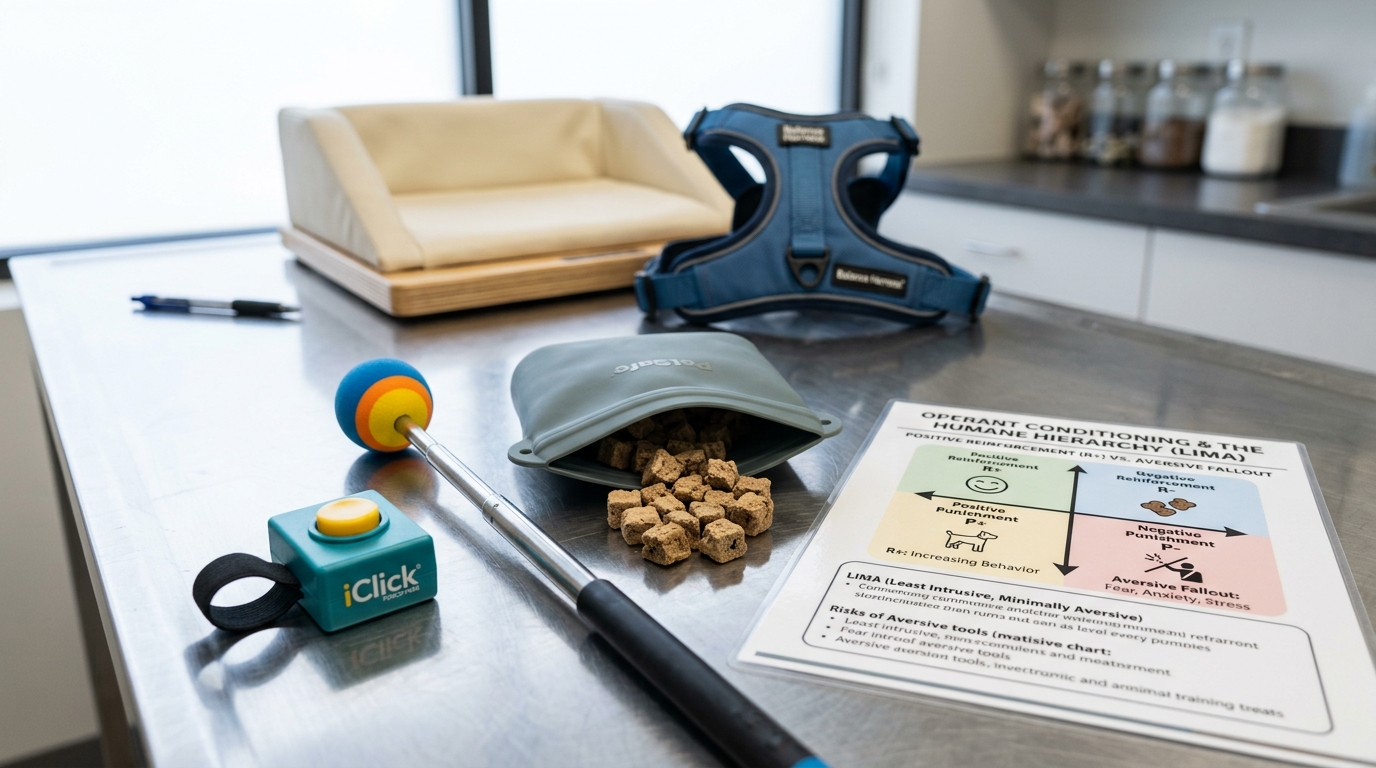
Reward-based dog training is an evidence-based behavioral framework that utilizes positive reinforcement to teach, shape, and maintain desirable canine behaviors while preserving emotional trust and cognitive engagement. By systematically marking desired actions with a precise acoustic or verbal signal and delivering outcomes the dog genuinely values–such as high-protein treats, interactive play, or environmental sniffing–handlers achieve durable compliance without invoking physical intimidation, pain, or psychological distress.
Clinical Quick Answer & Immediate Actions
Modern veterinary behavioral medicine unequivocally endorses reward-based training (positive reinforcement, R+) as the gold standard for canine learning and welfare. Outdated dominance-based training methodologies and aversive tools (choke chains, prong collars, electric shock collars, physical corrections) rely on positive punishment (P+) and negative reinforcement (R-); peer-reviewed clinical studies prove that aversive tools elevate systemic cortisol, induce acute learned helplessness, and increase the risk of defensive fear-based aggression toward family members. In contrast, reward-based training utilizes applied operant conditioning: marking desirable behaviors with precise timing (using a clicker or distinct verbal marker) and immediately delivering high-value reinforcers. Recognizing early subtle canine stress cues on the ‘Ladder of Aggression’ (lip licking, yawning, whale eye, head turning, body freezing) allows caregivers to de-escalate situations before fear escalates into defensive bites.
Modern veterinary clinical behavior recognizes that training stalled by confusion, hesitation, or sudden resistance often stems from physical discomfort, confusing cue delivery, or excessive environmental criteria rather than willful defiance. Contact a veterinarian immediately if your dog displays sudden aggression, vocalization upon touch, acute reluctance to sit or lie down, or persistent refusal of high-value food during standard training sessions.
Operant Conditioning and the Science of Reinforcement
All animal learning is governed by operant conditioning, formalized by B.F. Skinner and refined by modern behavioral neuroscientists. The four operant quadrants describe whether a stimulus is introduced (positive) or removed (negative), and whether the future frequency of the behavior increases (reinforcement) or decreases (punishment).
| Operant Quadrant | Mechanism & Everyday Training Example | Impact on Canine Welfare & Emotional State |
|---|---|---|
| Positive Reinforcement (+R) | Adding a pleasant stimulus immediately following the behavior. Example: Clicking as the dog’s hips touch the mat, followed by a liver treat. | Enhances cognitive problem-solving, dopamine secretion, optimism, and strong human-canine attachment. Forms the primary foundation of modern veterinary training. |
| Negative Reinforcement (-R) | Removing an aversive stimulus once the desired behavior occurs. Example: Applying continuous collar pressure or electric shock until the dog sits, then releasing tension. | Creates stress, avoidance learning, and anxiety. The dog complies solely to escape discomfort rather than seeking voluntary cooperation. |
| Negative Punishment (-P) | Removing access to a pleasant stimulus to reduce an unwanted action. Example: Handler turns around and crosses arms when a puppy jumps up, removing social attention. | Mild, humane correction when paired immediately with +R for an alternate behavior (such as four paws on the floor). Low emotional fallout if managed without frustration. |
| Positive Punishment (+P) | Delivering an aversive stimulus to suppress a behavior. Example: Jerking a prong collar, kneeing a dog’s chest, or utilizing an electrostatic shock collar for barking. | Significantly elevated cortisol, fear conditioning, suppressed warning signs (growling), and an established statistical correlation with increased owner-directed bite incidents. |
The Diagnostic Training Loop: Cue, Behavior, Marker, Consequence, Reset
Precision training operates like a closed feedback circuit. When a training session stalls, human handlers often misattribute the failure to canine “stubbornness” or “dominance.” In reality, a breakdown almost invariably occurs within one of the five sequential stages of the learning loop:
- The Cue (Information): A cue must be a distinct, singular sensory prompt (a single spoken word or subtle hand signal). Present the cue only when the dog is physically capable of attending. Avoid repeating cues (“sit, sit, sit, come on, sit”) which teaches the dog that the first four vocalizations are meaningless background noise.
- The Behavior (The Target Action): The observable physical movement performed by the dog. During early shaping, accept small approximations (such as looking toward the mat or lifting a paw) before requiring the finished final behavior.
- The Marker (The Bridge): A clicker sound or crisp verbal word (“yes”) that marks the exact nanosecond the desired action occurs. The marker operates as a secondary reinforcer, informing the dog precisely which movement earned the payout.
- The Consequence (The Payoff): Deliver the reinforcer within 1 to 2 seconds of the marker. Reinforcer placement is critical: feed on the mat to reward staying on the mat; feed beside your pant seam to reinforce walking in heel position.
- The Reset (Setting the Next Repetition): Toss a low-value treat a few feet away with a release cue (“find it” or “free”) so the dog breaks position naturally. This cleanly demarcates the end of one repetition and resets the dog to offer the behavior again voluntarily.
Troubleshooting Session Stalls: Diagnostic Table
When your dog stops responding, disengages, or displays sudden agitation, consult this diagnostic matrix before altering your reinforcement strategy or assuming lack of intelligence.
| Observed Training Breakdown | Underlying Behavioral or Physiological Cause | Actionable Handler Solution |
|---|---|---|
| Dog responds accurately indoors but completely ignores cues outside. | Environmental criteria increased too rapidly; sensory competition (odors, wildlife, traffic) overwhelms working memory. | Step backward along the distraction gradient. Train on a quiet porch or driveway before attempting neighborhood sidewalks or public parks. |
| Dog takes one treat and wanders away or sniffs the floor. | Reinforcer value is insufficient for the current environmental challenge, or session has exceeded cognitive stamina. | Upgrade reinforcer value (switch dry kibble to freeze-dried liver, hot dog slivers, or squeaky toy play). Cap sessions at 3 to 5 minutes. |
| Dog anticipates and offers behaviors rapidly without waiting for cues. | Predictable reward patterns created gambling arousal; handler is moving hands toward treat pouch before cueing. | Anchor your hands still behind your back or flat against your hips. Cue first, pause for physical response, mark, and only then reach for the treat. |
| Responses become progressively slower over 4 to 6 repetitions. | Cognitive fatigue, physical discomfort, muscle strain, or early satiety. | End the session immediately on a high-value jackpot. Provide fresh water and uninterrupted rest. Check for orthopedic stiffness or soreness. |
| Dog complies with hand gestures but ignores verbal cues completely. | Visual cues naturally overshadow acoustic signals in canine neurology (the overshadowing effect). | Say the verbal word clearly, pause for a distinct 1.0-second delay, then provide the hand gesture. Over 15 to 20 pairings, the dog anticipates the gesture from the word. |
| Dog growls, freezes, or snaps when reached toward or prompted to move. | Underlying physical pain, resource guarding arousal, or acute fear conditioning from prior physical discipline. | Stop all handling instantly. Do not correct or scold the growl. Contact a veterinarian immediately to assess musculoskeletal or abdominal pain. |
The Three Dimensions of Difficulty: Distance, Duration, and Distraction
Generalization is not automatic for canines. A dog that reliably sits when standing 2 feet in front of you in a quiet hallway does not automatically understand how to sit when you are 20 feet away, when a doorbell rings, or when an unfamiliar dog walks past. Professional trainers systematically manipulate the “3 Ds” one at a time:
1. Distance
Refers to both the physical gap between the handler and the dog, and the distance between the dog and an environmental trigger. When increasing distance from the handler (such as a stay or remote drop), temporarily decrease duration and eliminate all distractions. Only once the dog succeeds at distance should other dimensions be reintroduced.
2. Duration
The length of time a dog maintains an action before receiving the release marker. When building a 30-second stay on a mat, use variable interval reinforcement (rewarding at 3 seconds, then 7 seconds, then 4 seconds, then 12 seconds) rather than a rigid linear progression, which causes anticipatory frustration and breaking position.
3. Distraction
The sensory complexity of the environment, including auditory, visual, and olfactory stimuli. When introducing a significant novel distraction (such as a bouncing tennis ball or a passing cyclist), reduce both distance and duration requirements to zero, rewarding simple orientation toward the handler.
The Premack Principle and Functional Real-World Rewards
Food treats are essential for initial acquisition and conditioning, but real-world life rewards provide immense motivational utilize once a dog understands basic impulse control. Formulated by psychologist David Premack, the Premack Principle states that a higher-probability behavior can reinforce a lower-probability behavior: “Grandma’s Rule: Eat your vegetables before you get dessert.”
In applied canine training, things your dog naturally desires in the moment can serve as the ultimate consequence for offering a calm polite behavior:
- The Sniff Safari: When a dog pulls eagerly toward an intriguing scent post on a walk, stop moving. Wait for the dog to turn around and offer slack in the leash or make eye contact. The instant the leash goes loose, mark (“yes!”) and run together with the dog to let them thoroughly sniff the scent mark. Sniffing becomes the functional reinforcer for walking politely.
- Doorway Threshold Manners: Rather than physically blocking a doorway, ask for an autonomous sit or polite wait. The physical opening of the door and permission release cue (“okay, go!”) acts as the reward for holding position calmly.
- Greeting Canine or Human Friends: If an excitable dog lunges toward a familiar family member, step back. Mark and release the dog to greet only when all four paws remain flat on the floor. Calm posture earns social access; jumping removes social access.
The Humane Hierarchy: LIMA Framework in Veterinary Practice
Ethical animal training adheres to the Least Intrusive, Minimally Aversive (LIMA) operational hierarchy. Developed by Dr. Susan Friedman and formally adopted by the International Association of Animal Behavior Consultants (IAABC), the Association of Professional Dog Trainers (APDT), and the American Veterinary Society of Animal Behavior (AVSAB), this systematic protocol mandates that handlers exhaust non-invasive, positive modalities before considering any intrusive measures.
| Hierarchy Level | Intervention Category | Practical Clinical Application |
|---|---|---|
| Level 1 (Foundation) | Wellness, Nutrition & Medical Evaluation | Rule out underlying pain (osteoarthritis, dental disease, otitis), hormonal imbalances (hypothyroidism), nutritional deficits, and sleep deprivation before training. |
| Level 2 | Antecedent Arrangement & Environmental Management | Alter the physical setting to prevent rehearsal of unwanted actions. Use frosted window film for barkers, baby gates, secure exercise pens, and increased distance from triggers. |
| Level 3 | Positive Reinforcement (+R) & Differential Reinforcement | Teach and generously reinforce an incompatible replacement behavior (DRI). Example: Reinforcing a dog for lying on a mat prevents them from physically jumping on guests. |
| Level 4 | Differential Reinforcement of Alternative / Other Behaviors (DRA/DRO) | Reinforce any acceptable alternative behavior while allowing the unwanted action to extinguish through lack of reinforcement. |
| Level 5 | Negative Punishment (-P) & Extinction | Briefly remove a desirable stimulus (e.g., turning away to withdraw attention when a puppy mouths). Must always be combined with immediate +R for correct actions. |
| Level 6 (Last Resort) | Positive Punishment (+P) & Negative Reinforcement (-R) | Physical corrections, shock, or prong collars. Explicitly condemned by the AVSAB for routine training due to profound documented behavioral risks and welfare harms. |
Why Aversive Tools and “Dominance” Myths Fail Modern Science
For decades, popular media promoted outdated theories of canine “dominance” and “pack leadership,” claiming domestic dogs constantly strive to dominate human caregivers. Behavioral science has thoroughly debunked these concepts:
- Captive Wolf Misconception: The original dominance theory stemmed from Rudolph Schenkel’s 1947 study of unrelated captive wolves forced into unnatural, confined pens. Dr. L. David Mech, the world’s foremost wild wolf researcher, later repudiated these conclusions, demonstrating that natural wolf packs are simply cooperative family units led by breeding parents, not violent dominance hierarchies.
- Domestic Canines Are Not Wolves: Dogs separated from wild wolves over 20,000 to 40,000 years of evolutionary domestication. Domestic canines do not view humans as members of a canine pack, nor do they seek status through sofa access, doorway priority, or eating order.
- The Dangerous Trap of Suppressed Warning Signals: When a dog is shocked, choked, or struck for growling, the aversive tool punishes the warning signal without resolving the underlying fear or panic. The growl extinguishes, but the emotional distress remains. The tragic result is a “silent biter”–a dog that attacks without preliminary vocalization because their warning system was suppressed through punishment.
- Elevated Cortisol and Chronic Stress: Peer-reviewed studies published in the Journal of Veterinary Behavior demonstrate that dogs trained with electronic collars, pinch collars, or verbal intimidation show significantly elevated salivary cortisol levels, frequent lip-licking, lowered postures, and persistent states of behavioral inhibition (learned helplessness).
Cooperative Care: Preparing for Low-Stress Veterinary Procedures
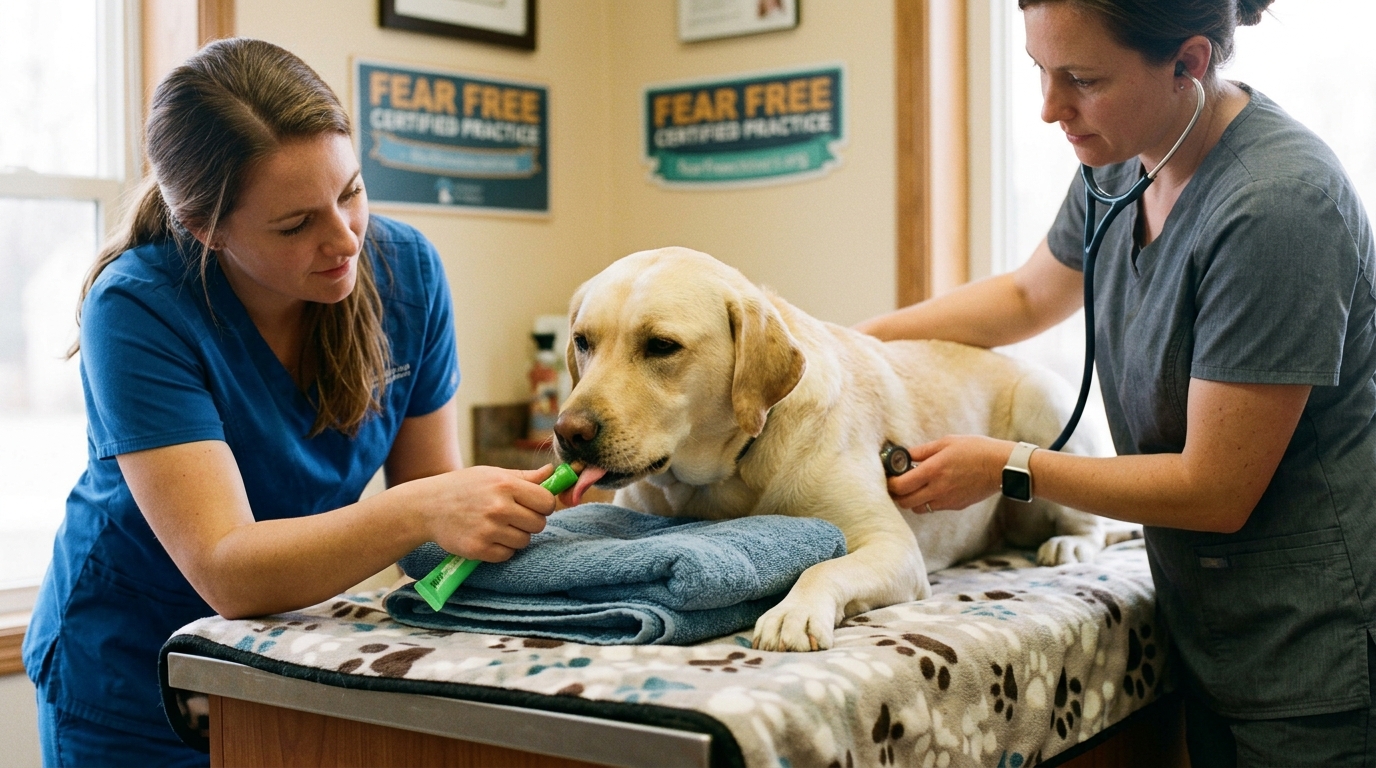
Reward-based training shines brightest when applied to husbandry and medical care. Cooperative care empowers dogs to participate willingly in their own medical treatments through clear consent signals:
- The Chin Rest Bucket Routine: Train the dog to rest their chin voluntarily on your open hand, a towel, or a chair cushion. The rule of the game is clear: as long as the dog’s chin remains resting, ear drops, eye examination, or gentle palpation continues while treats are delivered steadily.
- The Two-Way Consent Signal: If the dog lifts their chin from the target, all handling stops immediately for 5 seconds. This guarantees the dog has total agency, eliminating the panic of physical restraint. Over several repetitions, dogs willingly hold the chin rest longer because they know they control the process.
- Paw Presentation for Nail Care: Shape a voluntary paw touch to a textured board or your hand. Introduce clippers or nail grinders initially as neutral objects that predict chicken, advancing only when the dog maintains a relaxed, loose body posture.
When to Contact a Vet or Certified Behavior Professional
Behavior and physical health are inextricably linked in domestic dogs. Contact a veterinarian immediately if your dog displays sudden aggression, vocalization upon touch, acute reluctance to sit or lie down, or persistent refusal of high-value food during standard training sessions. Musculoskeletal pain (such as hip dysplasia, cruciate tears, or spondylosis), subclinical pancreatitis, dental abscesses, and endocrine disorders frequently manifest first as training reluctance or irritability.
Seek prompt veterinary advice for any sudden behavioral regression, severe distress, or suspected infectious exposure during training sessions. If your dog exhibits resource guarding of food bowls or stolen items, severe separation anxiety (destructive scratching at exit doors, self-harm, frantic howling), or reactive lunging toward humans or dogs on leash, do not attempt punitive corrections. Seek professional assistance from a qualified, certified positive reinforcement behaviorist (such as an IAABC Certified Dog Behavior Consultant or a clinical specialist DACVB veterinary behaviorist).
To further refine your training mechanics, explore our in-depth protocol for teaching loose-leash walking without pulling and our veterinary-backed guide on recognizing canine stress signals before a bite occurs.
Clinical Practice Tool: Daily Pet Care Routine Tracker
Track training reinforcement schedules, reward values, and daily enrichment sessions using our printable Daily Pet Care Routine Tracker. Download and print your copy of the Daily Pet Care Routine Tracker, or explore all practical pet care guides in the NewsPet Resource Center.
Frequently Asked Questions
Why does modern veterinary behavior reject dominance and alpha-roll training methods?
Dominance theories were based on flawed studies of captive unrelated wolves. Aversive methods like alpha rolls and choke collars elevate stress hormones and increase fear-based aggression and owner bites without teaching alternative behaviors.
How does positive reinforcement establish reliable long-term dog obedience?
Positive reinforcement uses operant conditioning to reward desired behaviors with high-value treats, play, or praise. Animals repeat rewarded actions, creating resilient neurological habits that hold up reliably under high-distraction environments.
What is the ideal reward timing when shaping a new behavior in dogs?
Deliver the marker (clicker or verbal cue) within 0.5 to 1 second of the exact behavior, followed immediately by the primary reinforcer. Precise timing ensures the dog connects the specific action with the positive outcome.
Sources
Sources checked: September 8, 2026.
- American Veterinary Society of Animal Behavior (AVSAB): Humane Dog Training Position Statement
- American Animal Hospital Association (AAHA): Canine Life Stage Guidelines
- International Association of Animal Behavior Consultants (IAABC): The LIMA Guiding Principles
- Merck Veterinary Manual: Behavioral Modification and Training Protocols in Canines
- Royal Society for the Prevention of Cruelty to Animals (RSPCA): Evidence-Based Dog Training and Welfare
Emergency Triage Matrix: Clinical Presentation & Required Response
| Triage Level | Clinical Signs & Presentation | Immediate Action Protocol |
|---|---|---|
| Tier 1: Immediate Emergency (0–2 Hours) | Dog displays sudden explosive aggression, resource guarding with deep bite wounds to a human caregiver, or acute severe panic attack with self-injury while wearing an electronic shock collar. | Immediate medical care for human bite wounds; immediately remove all aversive equipment from the dog, place dog safely in a separated room with positive barriers, and contact a board-certified veterinary behaviorist (DACVB). |
| Tier 2: Urgent Veterinary Care (Same-Day) | Dog exhibits escalating defensive growling, teeth baring, severe separation anxiety with destructive panic, or sudden behavioral aggression following physical touch or collar handling. | Veterinary physical exam to rule out underlying somatic pain (osteoarthritis, dental abscess, hip dysplasia); medical behavioral consultation and prescription psychopharmacology if indicated. |
| Tier 3: Home Monitoring & Scheduled Care | Dog is happy, socially responsive, and energetic, but exhibits minor training challenges: jumping up to greet visitors, slow recall in the yard, or mild attention barking. | Implement reward-based differential reinforcement (DRI): teach incompatible behaviors (e.g., sitting to greet), utilize clicker training, and reward generously with high-value food reinforcers. |
Rule S1 Boundaries & Behavioral Medicine Rules
Canine behavioral training requires adherence to strict welfare standards:
- NEVER use physical dominance, ‘alpha rolls’, scruff shakes, or hitting: Physical confrontation validates the dog’s perception of threat, triggering acute fight-or-flight sympathetic overdrive and precipitating severe retaliatory defensive bites.
- NEVER punish or scold a growling dog: Growling is a vital early communication warning sign on the canine Ladder of Aggression; suppressing growling through punishment creates a dog that bites without any prior warning.
- NEVER use electronic shock collars, bark collars, or prong collars: Aversive electronic and pinch devices induce chronic physiological stress, unpredictable aggressive redirection, and severe localized tissue burns and cervical neck trauma.
- NEVER withhold meals or water to create artificial food motivation: Starvation-based training induces severe physiological distress and dangerous resource guarding; training must rely on positive reward incentives, not caloric deprivation.
Caregiver Force-Free Training & Stress Assessment Checklist
- Establish a distinct, unambiguous behavioral marker (such as a handheld clicker or sharp verbal ‘yes!’) to pinpoint the exact millisecond of correct behavior.
- Deliver high-value food rewards within 1 to 2 seconds of the marker to solidify clean classical and operant conditioning associations.
- Monitor your dog’s subtle body language cues: look for lip licking, yawning out of context, averted gaze, whale eye, or sudden body freezing.
- If your dog displays stress signals, immediately increase distance from the trigger and lower your training criteria to keep the dog below threshold.
- Keep daily training sessions brief, fun, and highly successful: conduct 3 to 5 minutes of focused practice 2 to 3 times daily rather than grueling 1-hour sessions.
- End every single training session on a positive, successful repetition paired with a generous jackpot treat and enthusiastic praise.
Related Clinical Guides & Tools
Peer-Reviewed Clinical References & Evidence Grounding
- PMID: 25251020: Why do adult dogs ‘play’? (Behav Processes, 2015) (opens in new tab)
- PMID: 33263542: Small animal cardiopulmonary -resuscitation (CPR) in general practice (Schweiz Arch Tierheilkd, 2020) (opens in new tab)
- PMID: 7817487: Pathogenesis and treatment of feline rhinitis (Vet Clin North Am Small Anim Pract, 1994) (opens in new tab)
- Merck Veterinary Manual — Small Animal Clinical Medicine & Emergency Reference (opens in new tab)
Printable tools
Download the matching worksheet
Source transparency
Reference mix for this guide
Source labels describe the type of organization behind each reference; they are not a claim that any outside organization reviewed this article.
- American Veterinary Society of Animal Behavior (AVSAB): Humane Dog Training Position Statement Veterinary organization · avsab.org
- American Animal Hospital Association (AAHA): Canine Life Stage Guidelines Veterinary organization · aaha.org
- International Association of Animal Behavior Consultants (IAABC): The LIMA Guiding Principles Reference source · iaabc.org
- Merck Veterinary Manual: Behavioral Modification and Training Protocols in Canines Veterinary organization · merckvetmanual.com
- Royal Society for the Prevention of Cruelty to Animals (RSPCA): Evidence-Based Dog Training and Welfare Reference source · rspca.org.uk
- Puppy Socialization Without Overwhelm: A Vet-Safe Reference source · newspet.net
- Dog Body Language Chart: 9 Stress Signs Before a B Reference source · newspet.net
- Separation Anxiety in Dogs: What to Do First (Calm Reference source · newspet.net