Editorial standard
How this guide was prepared
A crate is appropriate only when the dog can use it safely and the household has a reason beyond stopping unwanted behavior. It may become a voluntary resting place, a transport skill, or short-term management tool. It is not suitable when confinement triggers panic, escape injury, overheating, pain, or prolonged unmet needs.
Clinical Quick Answer & Immediate Actions
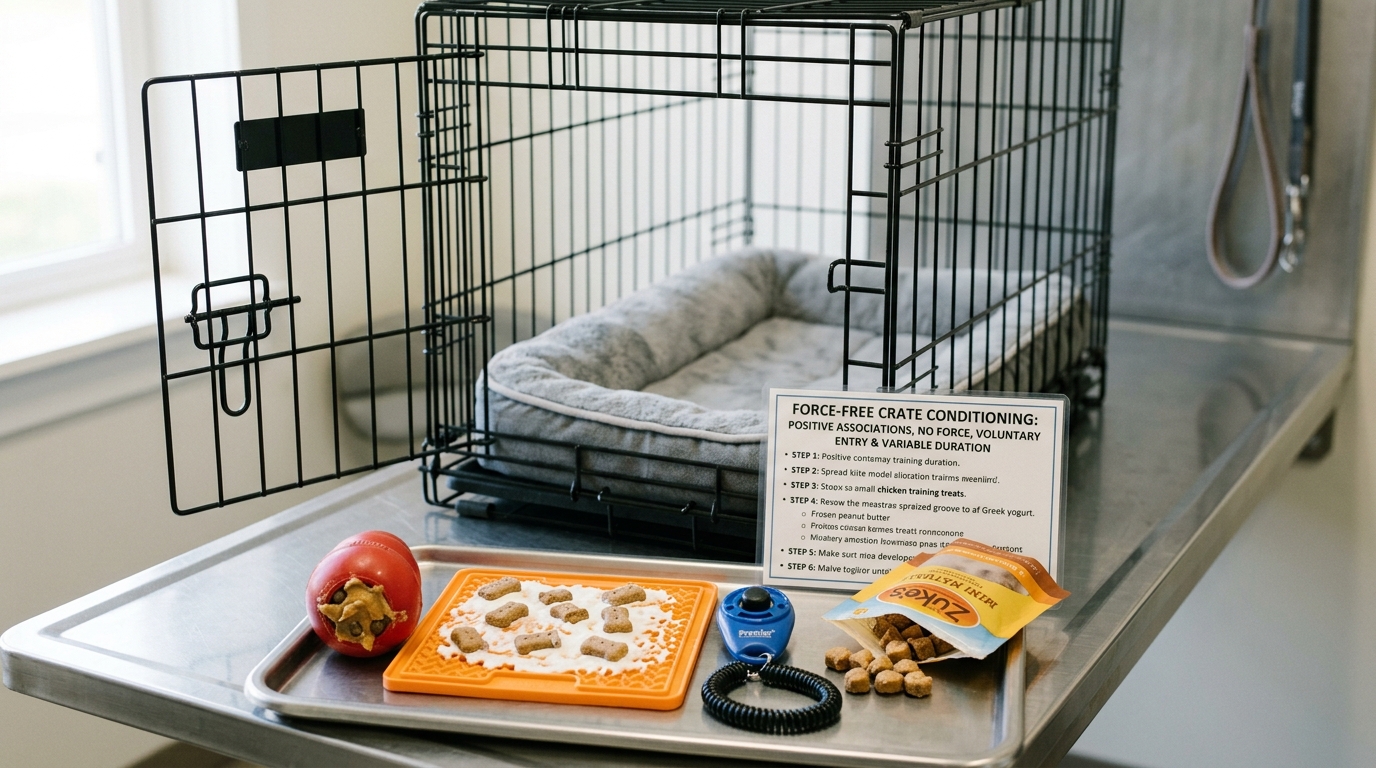
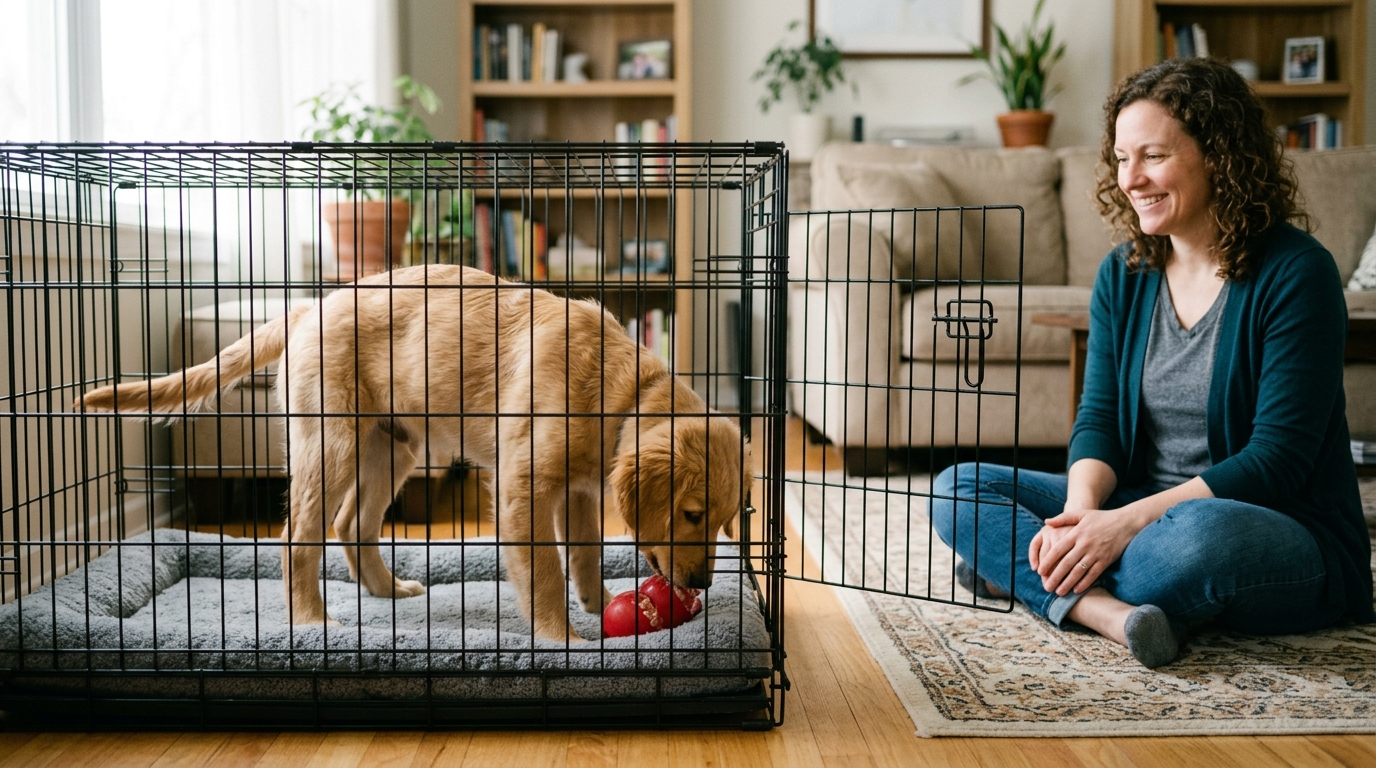
A crate should function as a secure, voluntary sanctuary den rather than a punitive isolation box. Successful, fear-free crate training pairs the crate with high-value food rewards, chew toys, and comfortable bedding with the door initially propped wide open. Age-appropriate confinement limits must be respected (a puppy can only hold their bladder for their age in months plus one hour; adult dogs should never exceed 4 to 5 hours of daytime confinement). If a dog exhibits frantic escape attempts or self-injury, immediately stop crating and evaluate for clinical separation anxiety.
If a dog shows severe panic, frantic escape attempts resulting in bleeding or broken teeth, or extreme distress during confinement, contact a veterinarian or certified behavior consultant immediately to evaluate physical trauma and separation anxiety.
Appropriateness and stop conditions come first
Choose another setup when the dog repeatedly bites bars, throws the body at the door, drools heavily, pants out of context, soils despite appropriate toilet access, vocalizes without recovery, or cannot take food it normally values. Also reconsider the crate for a dog whose medical condition, mobility, temperature regulation, or equipment makes entry and turning unsafe.
Crating must not replace toileting, movement, social contact, sleep outside confinement, or treatment. Remove collars, tags, harnesses, leads, and other snag risks when the dog is unattended unless a specific professional safety plan says otherwise.
A dog who naps in an open crate is showing evidence about voluntary rest, not about travel or alone time. A carrier needed for veterinary transport may justify practicing brief entry, door closure, lifting, and movement even when it is not the dog’s everyday bed. Short visitor management asks whether the dog can rest while household activity continues. Each use has a different trigger, duration, supervision level, and exit condition.
Do not combine the hardest versions. Closing the door, leaving the room, starting a vehicle, and extending duration in one trial cannot show which part failed. When the crate is considered mainly because the dog destroys property or vocalizes after departure, stop and assess the absence pattern; suitability for confinement has not been established.
Set up for voluntary use
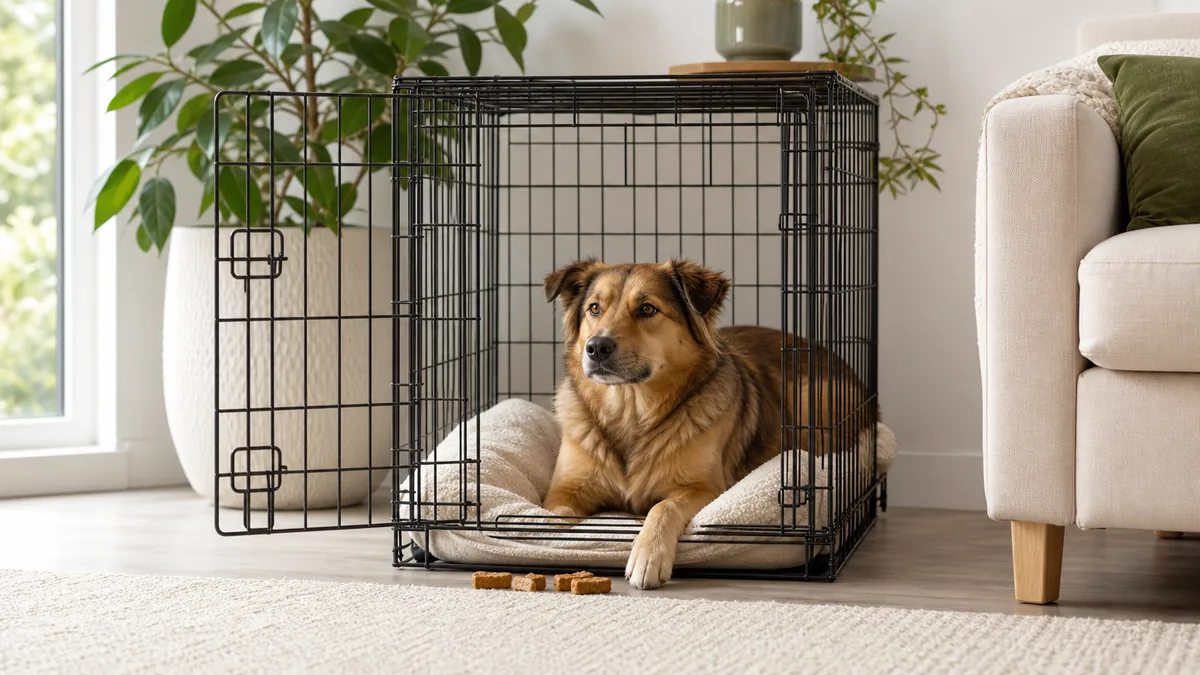
The crate should allow the dog to stand, turn, lie comfortably, and change position. Place it away from direct heat, unstable surfaces, constant household traffic, and isolation that the dog finds distressing. Secure the door open at first so it cannot swing against the dog.
Use non-slip comfortable bedding only when the dog does not shred or ingest it. Water access, temperature, ventilation, and cleaning depend on duration and context; the setup must remain safe if the person is not beside it.
Progress one variable at a time
| Stage | Practice | Move on when |
|---|---|---|
| Voluntary entry | Reward looking in, approaching, placing paws, entering, and turning around; release freely | The dog chooses to enter without luring or pressure |
| Door movement | Touch or move the door a fraction, reward, and open fully | The body remains loose and the dog re-enters willingly |
| Closed duration | Close for a second while the person stays near, then open before concern | The dog can rest or remain calmly engaged |
| Distance | Take one step away and return; vary position separately from time | The dog stays comfortable rather than tracking frantically |
| Out of sight | Disappear for a moment only after nearby distance is easy | Video or observation shows continued calm and recovery |
If a stage fails, return to the last easy version. Do not wait for the dog to stop protesting through exhaustion.
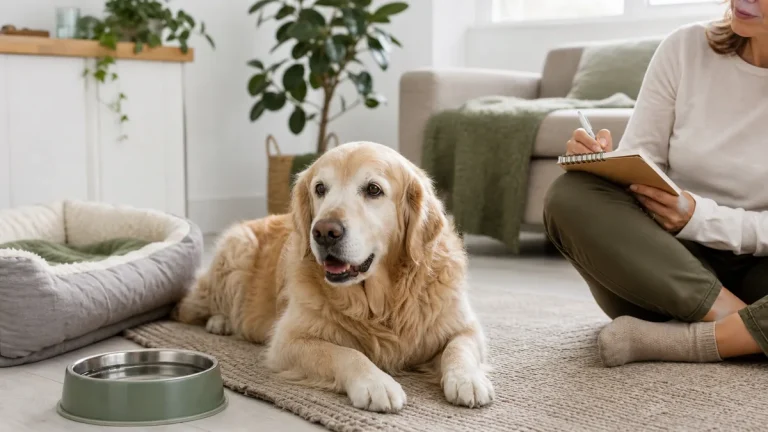
Record the setup, door position, person’s distance, duration, food or bedding used, the dog’s first concern signal, release point, and whether the dog chose to re-enter. Next-repetition reluctance matters: a dog who stayed quiet for thirty seconds but avoids the crate afterward did not provide the same evidence as a dog who returns to rest.
Write the next easier step before ending. That may be an open door, a shorter latch sound, the person seated again, or practice in the home rather than the vehicle. The note should prevent accidental jumps, not become a record for increasing time every day.
Night use depends on what the dog needs
A puppy may need nighttime toilet access and proximity that allows the caregiver to notice waking. An adult dog may prefer an open crate, bed, or another safe sleep area. Crying can reflect toileting need, fear, pain, temperature, isolation, or learned expectation; assuming every sound is attention-seeking can delay the correct response.
Place the crate where the dog can settle, not where silence is easiest for people. Gradually move it only if the dog remains comfortable.
After a difficult night, record which need changed the outcome rather than repeating the same duration. A toilet break, closer sleeping location, open alternative, or veterinary assessment answers a different question from simply waiting longer. Make the next confinement repetition easier and separate nighttime care from daytime door or duration practice.
Travel practice is a separate context
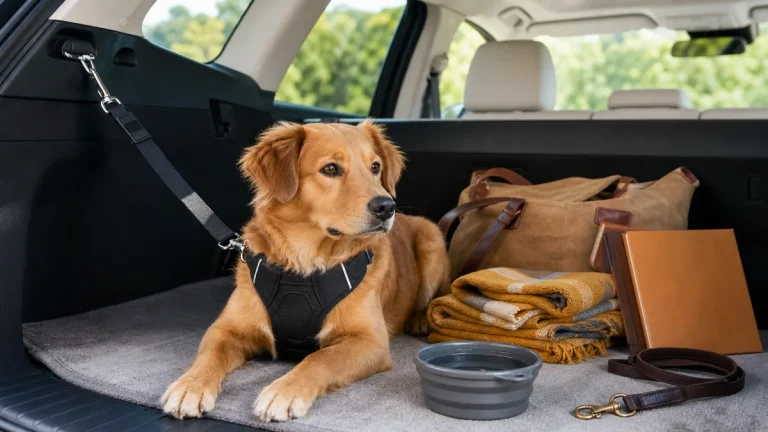
A familiar home crate does not automatically prepare a dog for vehicle motion, airport noise, handling, or an unfamiliar room. Practice entering the secured travel carrier, brief stationary vehicle sessions, door movement, lifting only when appropriate, and short journeys before a demanding trip. Follow the carrier or restraint rules for the vehicle and destination.
Never leave a dog in a vehicle or travel crate where heat, cold, ventilation, delay, or escape risk cannot be controlled. For relocation or a complex travel day, use the moving-with-pets checklist for records, carrier readiness, route preparation, and handoff checks; it is not a complete dog-travel guide.
Drooling, vomiting, whining, restlessness, or reluctance around vehicle travel can occur with motion sickness or travel-related distress. Stop increasing journey duration and ask the veterinarian about motion sickness and an appropriate travel plan. Comfort in a home crate does not establish comfort in a moving vehicle, so vehicle practice and medical questions remain a separate progression.
Practice entry, door movement, duration, and distance
Toss one piece just inside and allow the dog to leave after eating. Gradually place rewards farther in, then reward turning and remaining briefly with the door open. If the dog stretches in while keeping rear feet outside, the criterion is too difficult or the setup feels unsafe. Reinforce the partial approach instead of pushing from behind.
Meals may be served in an open crate when the dog is comfortable, but closing the door during eating is a separate step. Eating does not guarantee comfort with confinement.
Door movement deserves its own repetitions
Some dogs startle at the latch, metal sound, or visual movement. Touch the door, mark calm, and release. Move it a centimeter, open, and reset. Practice latch sound separately if needed. The dog should continue choosing entry after each repetition; reluctance on the next attempt is feedback.
Do not lure the dog inside and close the door before the reward is finished. That teaches the food predicts loss of exit control.
Duration grows unevenly
Mix very short easy repetitions among slightly longer ones. One second, three seconds, one second, then five may be clearer than a strict climb. Open the door while the dog is calm rather than waiting for vocalizing and then arguing about whether opening reinforces it. Preventing distress is the priority.
Before a longer rest period, provide appropriate toileting, movement, water, and social contact. A tired dog is not automatically a comfortable dog, and exhaustive exercise should not be used to make confinement unavoidable.
Distance begins with body movement
Shift weight, stand, sit again, take one step, or move briefly around the crate. Reward calm after each change. Walking directly out of the room is a large jump for a dog who has only seen a seated person. Use video when out of sight so quiet freezing is not mistaken for relaxation.
Practice people returning and releasing the dog in a calm, predictable way. Household members should use the same cue and door routine.
Use a crate alongside other safe options
When management allows, keep the door open and provide another bed or resting area. Voluntary use across quiet daytime periods is useful evidence that the crate has resting value. A dog who never chooses it may still learn transport skills, but the household should not assume it is a preferred bedroom.
For visitors or maintenance, a separate room, gate system, or trained station may be safer than a crate if the dog reacts to people near the door. Match the management tool to the risk.
A dog-proofed room, baby gate with comfortable distance, pen, trained mat, separate visitor area, or sitter may meet the management need with less confinement. Choose by the dog’s behavior and the actual hazard, and verify that the option does not create escape, ingestion, or access risks. Recheck the choice as mobility, chewing, visitors, and household access change. None of these arrangements is a separation-anxiety treatment; departure-related distress needs its dedicated assessment path.
Inspect the setup as the dog changes
Puppies grow, bedding shifts, latches wear, and chewing patterns change. Recheck size, sharp edges, rust, bent wire, ventilation, floor traction, and nearby cords or curtains. Clean with products used according to label directions and allow the area to dry and air before use.
After illness, injury, travel, or a frightening confinement event, return to an easier open-door stage. Previous training does not obligate the dog to tolerate a changed context.
There is no universal confinement limit
Age, health, bladder and bowel needs, recent exercise, sleep, temperature, crate comfort, and the total pattern across the day all change what is reasonable. A duration that avoids an accident can still be too long for welfare. Plan regular toilet, movement, social, and free-choice rest opportunities rather than treating the crate as storage between walks.
Crate training is not separation-anxiety treatment
A dog can be crate-trained and still panic when alone. Another may cope alone in a room but panic when confined. If distress follows departure, collect video and use the dog body-language observation sheet to record departure and confinement context, stress signals, and recovery; do not make the crate smaller, cover it more heavily, or extend duration as a test.
When to Contact a Vet or Behavior Professional
Veterinary assessment is needed for pain, breathing change, repeated soiling despite suitable access, injury, sudden crate avoidance, or distress that may involve illness or medication. Seek qualified reward-based behavior help for panic, escape attempts, self-injury, guarding of the crate, or a dog that cannot progress beyond seconds without fear.
Clinical Practice Tool: Dog First 90 Days: A Calm Owner Roadmap
Incorporate safe crate habituation into your long-term household routine using our printable Dog First 90 Days Roadmap. Download and print your copy of the Dog First 90 Days: A Calm Owner Roadmap, or explore all practical pet care guides in the NewsPet Resource Center.
Frequently Asked Questions
What is the primary psychological purpose of crate training a dog?
A crate provides a secure, den-like retreat that taps into natural instincts to keep sleeping quarters clean, facilitating housetraining, preventing destructive ingestion, and providing safety when unsupervised.
How should caregivers determine the correct crate dimensions for a growing dog?
The crate should allow the dog to stand fully erect without head contact, turn around smoothly, and stretch out flat on their side. Crates with adjustable divider panels accommodate growing puppies without excess space.
What is the maximum time a puppy can be safely crated during the day?
Puppies can generally hold their bladders for their age in months plus one hour (e.g., a 3-month-old puppy caps at 4 hours). Crating beyond physical bladder capacity causes severe distress and undermines housetraining.
Sources
Sources checked: September 8, 2026.
- AVSAB: Humane Dog Training Position Statement
- ASPCA: Weekend Crate Training and Confinement Guide
- Fear Free Happy Homes: Positive Crate Training Steps
- Humane Society of the United States: Crate Training 101
- VCA Animal Hospitals: Crate Training in Dogs
Emergency Triage Matrix: Clinical Presentation & Required Response
| Triage Level | Clinical Signs & Presentation | Immediate Action Protocol |
|---|---|---|
| Tier 1: Immediate Emergency (0–2 Hours) | Crate entanglement: head or jaw trapped between metal wire bars, fractured canine teeth, collar strangulation, or bleeding paw lacerations from frantic escape clawing. | Immediate physical rescue (wire cutters if needed); emergency veterinary transport for soft tissue, dental, or asphyxiation stabilization; cease crating immediately. |
| Tier 2: Urgent Veterinary Care (Same-Day) | Severe confinement phobia: hyperventilating, drooling soaking the crate pad, frantic howling, or self-soiling while trapped inside the crate. | Urgent veterinary behavioral consultation; diagnostic evaluation for clinical claustrophobia or separation anxiety, and formulation of an open-space confinement plan. |
| Tier 3: Home Monitoring & Scheduled Care | Puppy or dog whining for 1 to 2 minutes upon initial entry, then settling down calmly to chew a stuffed Kong or sleep comfortably. | Continue progressive incremental door-closure practice, reward quiet resting behaviors, and maintain strict adherence to age-appropriate confinement schedules. |
Rule S1 Boundaries & Crate Safety Rules
Canine confinement requires strict adherence to physical and behavioral safety rules:
- NEVER use the crate as a tool for punishment or anger: Forcibly banishing a dog to the crate transforms the sanctuary into a terrifying punishment chamber, causing permanent negative conditioning and acute resistance.
- NEVER leave collars, choke chains, or prong collars on a crated dog: Tags and collar loops frequently snag on wire crate intersections; as the dog twists to free themselves, fatal strangulation occurs within minutes.
- NEVER force, drag, or shove an unwilling dog into a crate: Physical coercion triggers claustrophobic panic and defensive biting; all entry must be conditioned voluntarily through high-value reinforcement.
- NEVER exceed biological bladder retention capacities: Confinement exceeding physiological limits forces the animal to urinate and defecate in their bedding, permanently destroying their instinctive cleanliness inhibition.
Caregiver Positive Crate Conditioning Checklist
- Select a crate sized appropriately: the dog must be able to stand fully erect, turn around easily, and stretch out on their side without touching the walls.
- Place the crate in an active family area (living room or kitchen corner) with a plush orthopedic pad and the door secured open with a bungee cord.
- Feed all daily meals inside the crate with the door wide open for the first 5 to 7 days.
- Introduce high-value frozen lick mats or stuffed Kongs inside the crate, closing the door briefly while the dog is actively licking, then reopening before they finish.
- Gradually extend closed-door durations in 5-minute increments only when the dog remains completely calm and relaxed.
Related Clinical Guides & Tools
Peer-Reviewed Clinical References & Evidence Grounding
- NCBI PubMed (PMID: 33769611) — International veterinary canine dyskinesia task force ECVN consensus statement: Terminology and classification (J Vet Intern Med, 2021) (opens in new tab) (Peer-reviewed veterinary clinical study indexed in NCBI PubMed (J Vet Intern Med, 2021).)
- NCBI PubMed (PMID: 38351524) — Defining sepsis in small animals (J Vet Emerg Crit Care (San Antonio), 2024) (opens in new tab) (Peer-reviewed veterinary clinical study indexed in NCBI PubMed (J Vet Emerg Crit Care (San Antonio), 2024).)
- NCBI PubMed (PMID: 38474142) — Canine Mammary Tumors: Classification, Biomarkers, Traditional and Personalized Therapies (Int J Mol Sci, 2024) (opens in new tab) (Peer-reviewed veterinary clinical study indexed in NCBI PubMed (Int J Mol Sci, 2024).)
- AVMA: Positive Reinforcement Confinement and Canine Behavioral Husbandry Guidelines (opens in new tab) (Verified clinical reference retrieved via Antigravity Ground-Truth Search (avma.org).)
Printable tools
Download the matching worksheet
Source transparency
Reference mix for this guide
Source labels describe the type of organization behind each reference; they are not a claim that any outside organization reviewed this article.
- AVSAB: Humane Dog Training Position Statement Veterinary organization · avsab.org
- ASPCA: Weekend Crate Training and Confinement Guide Animal welfare nonprofit · aspca.org
- Fear Free Happy Homes: Positive Crate Training Steps Reference source · fearfreehappyhomes.com
- Humane Society of the United States: Crate Training 101 Reference source · humanesociety.org
- VCA Animal Hospitals: Crate Training in Dogs Reference source · vcahospitals.com
- Puppy Socialization Without Overwhelm: A Vet-Safe Reference source · newspet.net
- Dog Body Language Chart: 9 Stress Signs Before a B Reference source · newspet.net
- Reward-Based Dog Training: Force-Free Steps & Reference source · newspet.net