Editorial standard
How this guide was prepared
Loose-leash walking is easiest to teach where the dog can still notice the handler. If the skill disappears at the front door, beside traffic, or near another dog, the lesson is not automatically forgotten. The environment may be paying more, the trigger may be too close, the equipment may be uncomfortable, or the reward may arrive in a position that sends the dog forward again.
Clinical Quick Answer & Immediate Actions
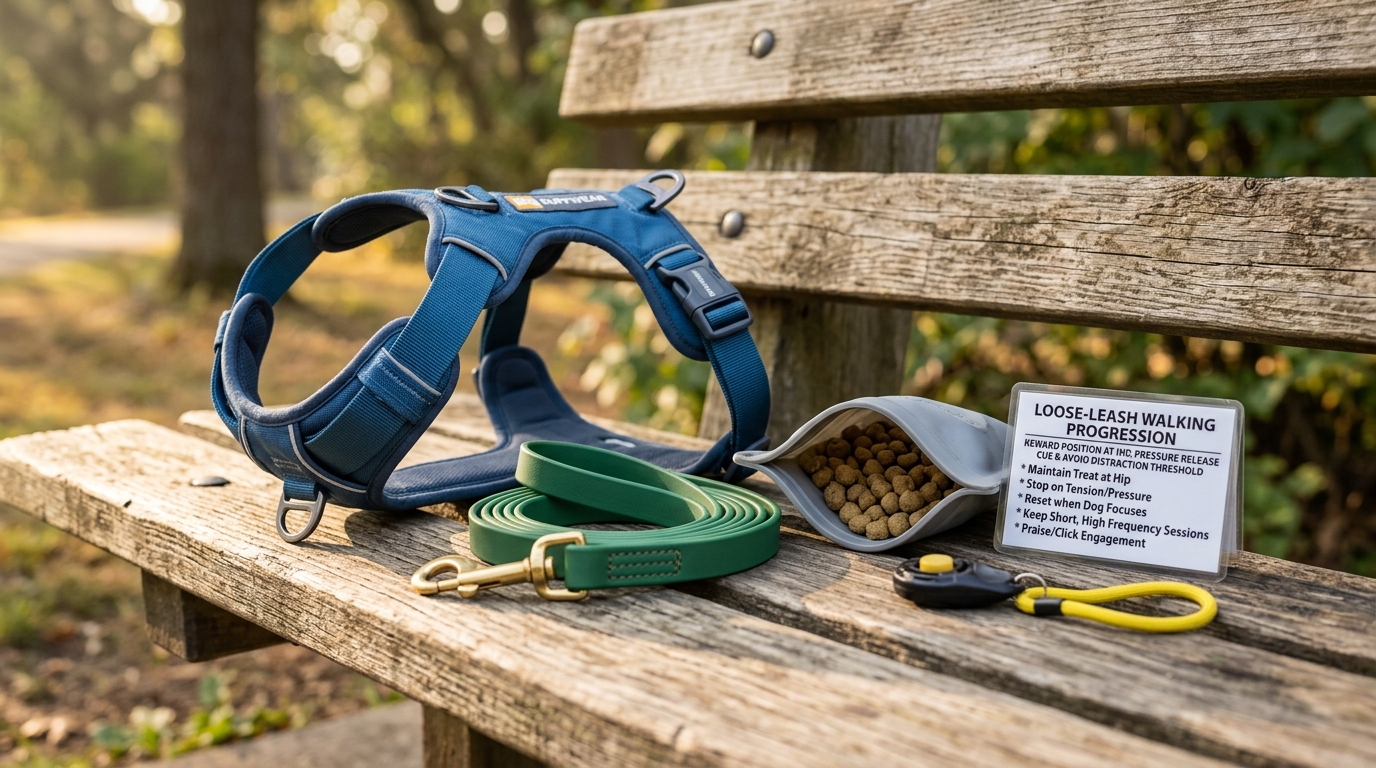
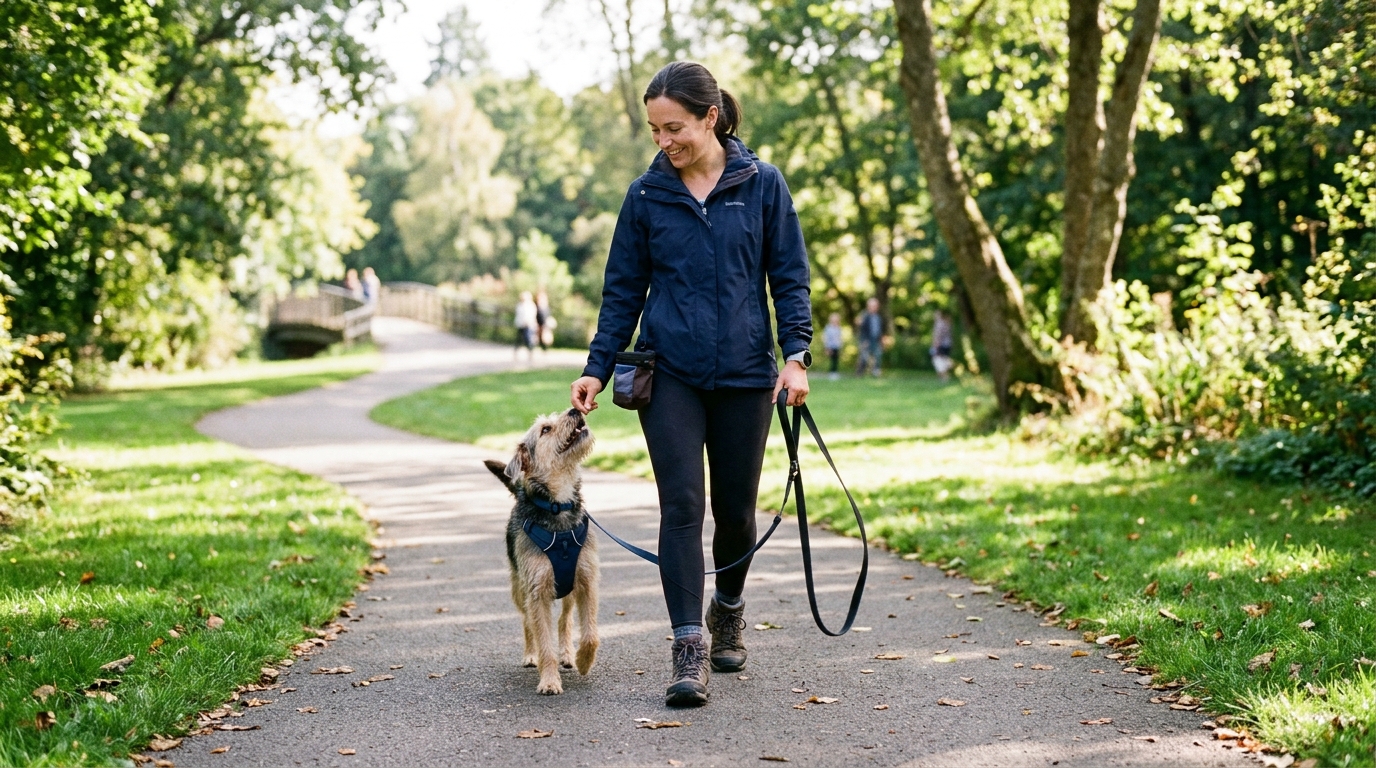
Training loose-leash walking is an essential clinical intervention to preserve canine cervical biomechanics and eliminate walking frustration. When a dog pulls against leash tension, an innate physiological response called the ‘opposition reflex’ (thigmotaxis) causes the dog to lean harder into the pressure. Attempting to stop pulling through leash pops, choke collars, or prong collars applies severe, concentrated kinetic impact to the cervical vertebrae, compressing the thyroid gland, jugular veins, and tracheal rings, and frequently causing permanent laryngeal nerve damage. True loose-leash mastery relies on force-free operant conditioning: pairing an ergonomic Y-shaped front-clip harness with positive reinforcement marker training (clicker or verbal marker ‘yes’). By treating leash tension as a cue to stop (‘be a tree’) and heavily reinforcing the ‘reinforcement zone’ immediately beside the caregiver’s hip, dogs learn that a slack leash is the exclusive pathway to environmental exploration.
How to Train a Dog to Walk on a Leash Without Pulling: 5 Steps
To teach a dog loose-leash walking using force-free positive reinforcement, follow this 5-step training sequence:
- Fit a front-clip Y-harness: Attach your leash to a chest-clip harness to gently redirect pulling momentum sideways toward you without choking or tracheal damage.
- Stop walking the instant tension appears (“Be a tree”): Stand completely still whenever the leash tightens so your dog learns pulling halts forward motion.
- Mark and reward when the leash slackens: The moment your dog turns back or creates slack, mark with a clicker or “yes” and reward right at your hip seam.
- Practice in zero-distraction zones first: Build muscle memory in a quiet indoor hallway or backyard before transitioning to busy neighborhood sidewalks.
- Reinforce at high frequency: Deliver small, high-value treats every 2 to 3 paces initially, gradually stretching intervals as loose-leash walking solidifies.
Troubleshoot the walk that is actually happening. The goal is not a dog glued to one leg; it is a leash that stays comfortably slack while dog and handler move safely, pause, and use sniffing access as part of the reinforcement.
Establish a workable baseline
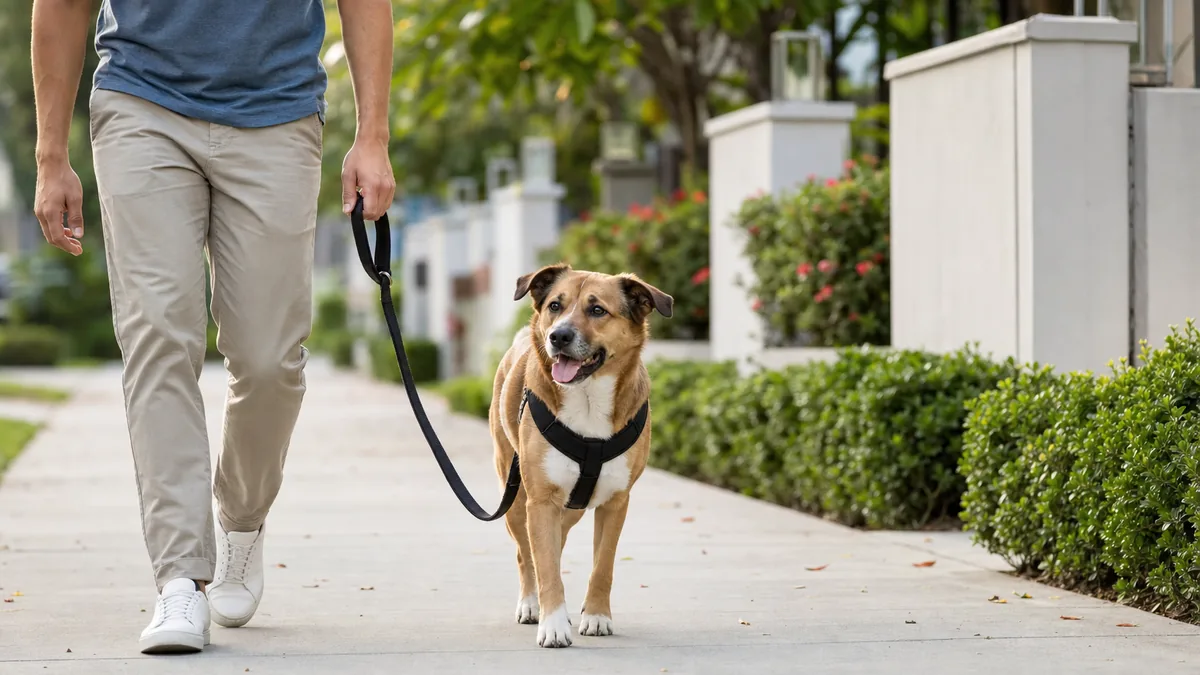
Use a well-fitted harness or collar appropriate to the dog and a fixed-length leash that allows ordinary movement without dragging. Check for rubbing, restricted shoulder movement, coughing, gait change, or escape risk. Equipment cannot teach the skill, but poor fit can make every repetition harder.
Begin in a low-distraction area. Mark or praise the moment the dog is beside you with slack in the line, then deliver the reward close to the position you want to maintain. Take one or two steps and repeat. Release the dog to sniff after a short successful section so moving together and exploring are not competing goals.
Find the variable that is breaking the walk
| What changes | What it suggests | Adjustment for the next repetition |
|---|---|---|
| Loose indoors, pulling immediately outside | The environment jump is too large | Practice at the doorway, quiet building edge, or least busy part of the route |
| Pulling starts near a dog, person, vehicle, or smell | Trigger distance or value is dominating | Increase distance before asking for the skill; do not wait for full tension |
| Dog scratches, coughs, changes gait, or tries to back out | Fit, comfort, or safety needs review | Stop and inspect equipment; use the harness-fit guide and veterinary advice for physical signs |
| Dog eats, then surges ahead | Reward placement is launching the next pull | Feed by your leg or slightly behind the forward line, then move together |
| Handler keeps walking on a tight leash | Tension still reaches the destination | Pause, soften the setup, or turn onto an easier line the instant tension begins |
| Performance fades late in the walk | Fatigue, stress load, or too few sniff breaks | Shorten the training portion and finish on an easier route |
The instant the leash tightens
Respond early and without a jerk. Stop forward progress, or make a smooth change of direction if standing still would trap the dog near a trigger. Wait for a small release in tension or invite the dog back with a practiced cue. Mark the slack, reward in position, and take an easier step.
If this cycle repeats every few seconds, the answer is not greater force. Move farther from the attraction, shorten the segment, use more frequent reinforcement, or switch to management and leave. A training walk can become a decompression walk when the learning conditions are gone.
Use distance before cues fail
A dog who can glance at another dog from across the road and return attention is in a different learning state from a dog lunging at the end of the leash. Cross early, turn down a side route, use a parked vehicle as a visual barrier, or wait in a wider space. Distance is part of teaching, not a reward for bad behavior.
Do not require greetings. Many dogs walk better when they learn that passing at a comfortable distance is normal. If the dog freezes, growls, lunges, or cannot recover after triggers, loose-leash mechanics are no longer the only question.
Turn real walks into short training sections
Divide the outing into ordinary travel, a few planned loose-leash repetitions, sniff access, and recovery. In the training section, choose a visible landmark only a few steps away. Reward several moments of slack before reaching it, then release to sniff. Gradually add distance only while the leash remains loose and the dog can eat or engage.
Vary one difficulty at a time. A longer section on the same quiet pavement is different from two steps beside a playground. Treat location, duration, trigger distance, and reward interval as separate variables.
Design the route before testing the skill
A useful training route has more than a destination. Mark the narrow sections, blind corners, dog-heavy entrances, road crossings, quiet sniff areas, and places where you can turn away without stepping into traffic. Begin with a short loop that offers at least two exits from the hardest segment. An out-and-back path can leave the team forced to repeat a trigger that was difficult on the first pass.
Assign jobs to sections. The lobby may be managed travel with frequent food, the quiet pavement a loose-leash practice area, and the grass verge a release to sniff. Near a construction site or school exit, the job may simply be safe distance. A walk can meet toileting and decompression needs even when only twenty meters are used for formal practice.
Two real walks, two different changes
A dog appears at the end of a narrow block. The learner can still eat but begins leaning into the leash and stops checking back. Rewarding in place while the other dog approaches would keep both dogs on a closing line. Cross early or turn into a driveway with permission, use a parked vehicle as a visual break, and feed beside or slightly behind the handler while increasing distance. Resume loose-leash repetitions only after the body loosens; distance changed the plan before the cue failed.
A scent trail pulls the dog toward a hedge on an open path. There is no immediate safety risk, and the dog can orient to the handler. Mark one step of slack, deliver the reward next to the handler’s leg rather than toward the hedge, then release forward to sniff after two or three connected steps. Here the attraction can reinforce the skill. If food is tossed ahead, reward position may accidentally pay the surge the handler is trying to change.
After a startle, close encounter, or several minutes of repeated tension, stop trying to recover the planned distance on that outing. Choose the shortest calm exit, allow a familiar sniff or toilet opportunity, and make the next walk easier at the outset. A setback changes the starting conditions; it does not require proving the previous level immediately.
Keep one progression record
- Setting: note the route and time, not merely “walk.”
- Hardest trigger: record the distance at which the dog could still disengage.
- Equipment: note fit changes, rubbing, escape attempts, or gait concerns.
- Reinforcement: record what worked and where it was delivered.
- Tension response: write whether you paused, changed direction, or increased distance.
- Next step: change one variable, such as five more quiet steps or a slightly busier location.
The record is for adjusting the lesson, not scoring the dog. Progress may look like earlier check-ins, faster recovery, or fewer moments of full tension before it looks like a whole street walked loosely.
Reward position shapes the next step
Delivering food in front of the dog’s nose while continuing forward can create a cycle of eat, surge, tighten. Mark the slack and place the reward beside the handler’s leg or slightly behind the forward line. Then move together before the dog reaches full extension. For a small dog, delivery height and handler posture should not force jumping or twisting.
Reinforcement rate is part of difficulty. One reward per minute may be plenty in a familiar corridor and far too sparse near a busy market. Pay more often before the dog fails, then increase the interval in that same environment. Do not simultaneously lengthen the route and reduce rewards.
Equipment checks belong inside training
Inspect straps before each walk, especially after washing or growth. Confirm that the dog cannot back out, that buckles close fully, and that the leash connection does not change gait. A front attachment may alter mechanics for some teams but does not replace careful fit or teaching. Retractable leads change tension and distance continuously, making the loose-leash rule less clear in crowded settings.
Choose leash length for the environment. More room can support sniffing in open safe areas; a shorter working length may be necessary beside traffic. Avoid wrapping the leash around the hand, and maintain enough slack that “shorter” does not mean constant pressure.
Progress across locations deliberately
List settings from easiest to hardest: room, hallway, entrance, quiet pavement, familiar green space, then busier routes or greater trigger proximity. Move up only when the dog can produce several loose repetitions and recover. On a difficult day, step down without treating it as regression.
Weather, pain, poor sleep, visitors, and a previous trigger encounter can change capacity. A progression record is useful because it explains why one street worked on Tuesday and failed on Friday. It prevents the vague conclusion that the method stopped working.
Fade reinforcement without making it disappear
Reduce food only after the dog is fluent in the same setting, not on the first harder route. First vary the number of loose steps before a reward while keeping the average rate generous. Then use safe real-life outcomes–sniffing, forward movement, greeting a familiar person when appropriate–for some repetitions. Keep food available for difficult transitions and unexpected triggers.
If latency increases, tension returns, or the dog stops checking in, restore the previous reinforcement rate and shorten the section. Fading is successful when the behavior remains clear because worthwhile consequences still occur, not when the handler can leave rewards at home.
Tools that add pain or fear are outside this plan
Leash pops, intimidation, and equipment designed to cause pain may suppress behavior without teaching the dog where to move or how to cope with the setting. Reward-based guidance from AVSAB and animal-welfare organizations supports teaching the desired behavior and changing the environment rather than relying on aversive corrections.
For equipment selection, review harness fit and safety checks. If pulling happens with freezing, hard staring, growling, or lunging, read the stress-signal and distance guide before attempting closer practice.
When to Contact a Vet or Qualified Trainer
Pain, coughing, breathing difficulty, exercise intolerance, sudden pulling, gait change, or sensitivity to equipment needs veterinary assessment. Behavior support is appropriate when fear, aggression, or intense reactivity prevents the dog from working at a safe distance. Choose a professional who uses reward-based methods, can explain the plan, and coordinates with the veterinarian when health may contribute.
Related Dog Training & Travel Guides
Loose-leash walking skills connect directly with broader handling, travel, and emotional wellness routines:
- Travel Safety: Applying leash manners during road trips? See our Traveling With Dogs Checklist.
- Reading Subtle Cues: Prevent reactivity before tension escalates with our Dog Body Language Stress Signals Chart.
- Departure Routine: Balance outdoor walks with home calm using our Dog Separation Anxiety First Steps.
Clinical Practice Tool: Dog First 90 Days: A Calm Owner Roadmap
Support your loose-leash foundation skills and positive reinforcement training walks with our step-by-step Dog First 90 Days Roadmap. Download and print your copy of the Dog First 90 Days: A Calm Owner Roadmap, or explore all practical pet care guides in the NewsPet Resource Center.
Frequently Asked Questions
How do I train my dog to walk on a leash without pulling?
To train a dog to walk on a leash without pulling, use positive reinforcement and the “stop and go” method: stop walking the instant the leash goes taut (“be a tree”), wait for your dog to turn toward you or slacken the leash, then immediately mark with a clicker or word and reward them beside your hip. Consistency across every single walk is the foundation of loose-leash walking.
Why does my dog pull on the lead during walks?
Dogs pull on the lead because their natural walking pace is much faster than human walking speed, and their environment is filled with enticing sensory stimulation. When pulling allows a dog to reach a scent or forward destination, the pulling behavior is reinforced. Using a well-fitted Y-shaped front-clip harness prevents forward utilize and redirects their momentum.
How long does it take to train a dog to walk on a leash?
Most dogs show marked improvement within 2 to 3 weeks of daily 10-minute training sessions in low-distraction environments (such as an indoor hallway or backyard). Gradually transitioning to outdoor sidewalks with higher distractions requires 4 to 8 weeks of consistent positive reinforcement.
Can you train an older dog to stop pulling on the leash?
Yes, dogs of any age can learn loose-leash walking. Senior dogs and adult rescues often respond rapidly to reward-based clicker training and front-clip harnesses because force-free methods build collaborative focus without causing neck strain or tracheal compression.
Sources
Sources checked: September 8, 2026.
- AVSAB: Humane Dog Training Position Statement
- RSPCA: How to train your dog to walk nicely on the lead
- Dogs Trust: How to stop your dog pulling on the lead
- Best Friends: How to stop a dog from pulling on leash
- ASPCA: Teaching Your Dog Not to Pull on Leash
Emergency Triage Matrix: Clinical Presentation & Required Response
| Triage Level | Clinical Signs & Presentation | Immediate Action Protocol |
|---|---|---|
| Tier 1: Immediate Emergency (0–2 Hours) | Dog experiences sudden airway collapse, cyanotic purple tongue, choking unconsciousness, or acute spinal neck trauma from a violent leash jerk; or dog snaps leash or slips walking gear into active vehicular traffic. | Immediate emergency veterinary transport; emergency oxygenation, evaluation for acute tracheal rupture or cervical disc herniation, and shock stabilization. |
| Tier 2: Urgent Veterinary Care (Same-Day) | Dog develops persistent hacking or honking cough following leash walks, visible chafing or bleeding sores in the axillary (armpit) skin from ill-fitting gear, or progressive reluctance to walk with head held low. | Veterinary clinical examination; cervical and thoracic radiographs to evaluate tracheal collapse, orthopedic assessment of shoulder joints, and transition to ergonomic walking equipment. |
| Tier 3: Home Monitoring & Scheduled Care | Dog pulls eagerly toward novel scents or sights on walks, but breathes normally with pink gums, clear eyes, and zero physical coughing or distress. | Transition to a front-attachment Y-shaped harness, carry high-value soft treats, implement the 5-step force-free loose-leash protocol, and practice in low-distraction indoor environments. |
Rule S1 Boundaries & Canine Leash Safety Rules
Leash walking requires adherence to strict anatomical and behavioral rules:
- NEVER use choke chains, prong collars, or electronic shock collars to stop pulling: Aversive walking devices exert crushing focal pressure over the trachea, thyroid, and cervical vertebrae, inducing severe soft-tissue trauma and escalating defensive fear-aggression.
- NEVER deliver sharp leash corrections (‘pops’) to a dog’s neck: Repetitive kinetic shock to the cervical spine accelerates disc degeneration, causes whiplash-like micro-trauma, and significantly spikes intraocular pressure, risking retinal damage.
- NEVER use retractable flexi-leads in urban or high-traffic environments: Retractable leads maintain constant baseline tension that reinforces pulling (thigmotaxis), cause friction finger amputations, and frequently jam, allowing dogs to bolt into traffic.
- NEVER pull or drag a reluctant or terrified dog by their walking gear: Dragging a resisting animal causes intense emotional flooding, destroys behavioral trust, and triggers severe neck and shoulder musculoskeletal sprains.
Caregiver 5-Step Force-Free Loose-Leash Walking Checklist
- Equip your dog with an ergonomic Y-shaped harness featuring a front chest attachment ring and a 6-foot fixed-length flat nylon or leather leash.
- Load a treat pouch with high-value, pea-sized soft rewards (freeze-dried meat, cooked chicken, or low-fat cheese) before stepping outside.
- Establish the ‘Reinforcement Zone’: deliver treats exclusively at your seam line (beside your hip) so your dog learns that staying beside you is rewarding.
- Execute the ‘Be a Tree’ rule: the instant the leash goes taut, freeze immediately in place with zero forward movement until the dog loosens the tension.
- Mark and reward: the moment the dog turns back, glances at you, or softens the leash, mark with ‘yes!’ and reward generously at your side.
- Practice initially in zero-distraction environments (living room, hallway, quiet driveway) before progressing to high-distraction neighborhood sidewalks.
Related Clinical Guides & Tools
Peer-Reviewed Clinical References & Evidence Grounding
- NCBI PubMed (PMID: 27404640) — Does Dog Walking Predict Physical Activity Participation: Results From a National Survey (Am J Health Promot, 2016) (opens in new tab) (Peer-reviewed veterinary clinical study indexed in NCBI PubMed (Am J Health Promot, 2016).)
- NCBI PubMed (PMID: 38579750) — Leash-related injuries associated with dog walking: an understudied risk for dog owners? (J Am Vet Med Assoc, 2024) (opens in new tab) (Peer-reviewed veterinary clinical study indexed in NCBI PubMed (J Am Vet Med Assoc, 2024).)
- NCBI PubMed (PMID: 36600525) — Study of dog control strategies (Inj Prev, 2023) (opens in new tab) (Peer-reviewed veterinary clinical study indexed in NCBI PubMed (Inj Prev, 2023).)
- American Veterinary Society of Animal Behavior (AVSAB): Humane Dog Training and Leash Handling (opens in new tab) (Verified clinical reference retrieved via Antigravity Ground-Truth Search (avsab.org).)
Printable tools
Download the matching worksheet
Source transparency
Reference mix for this guide
Source labels describe the type of organization behind each reference; they are not a claim that any outside organization reviewed this article.
- AVSAB: Humane Dog Training Position Statement Veterinary organization · avsab.org
- RSPCA: How to train your dog to walk nicely on the lead Reference source · rspca.org.uk
- Dogs Trust: How to stop your dog pulling on the lead Reference source · dogstrust.org.uk
- Best Friends: How to stop a dog from pulling on leash Reference source · bestfriends.org
- ASPCA: Teaching Your Dog Not to Pull on Leash Animal welfare nonprofit · aspca.org
- Puppy Socialization Without Overwhelm: A Vet-Safe Reference source · newspet.net
- Dog Body Language Chart: 9 Stress Signs Before a B Reference source · newspet.net
- Reward-Based Dog Training: Force-Free Steps & Reference source · newspet.net