
Editorial standard
How this guide was prepared
Canine aggression rarely emerges without warning; in the overwhelming majority of domestic incidents, a dog bite is the culmination of an escalating physiological and behavioral sequence that was either misinterpreted or ignored by surrounding humans. Subtle micro-behaviors–including momentary lip licking, gaze aversion, body stiffening, out-of-context yawning, and rigid freezing–serve as a dog’s primary communicative repertoire for expressing emotional conflict, social discomfort, and defensive apprehension. Recognizing these subtle markers along the canine escalation ladder allows caregivers, family members, and veterinary professionals to intervene proactively by creating physical space and relieving environmental pressure long before a dog feels forced to growl, snap, or bite.
Clinical Quick Answer & Immediate Actions
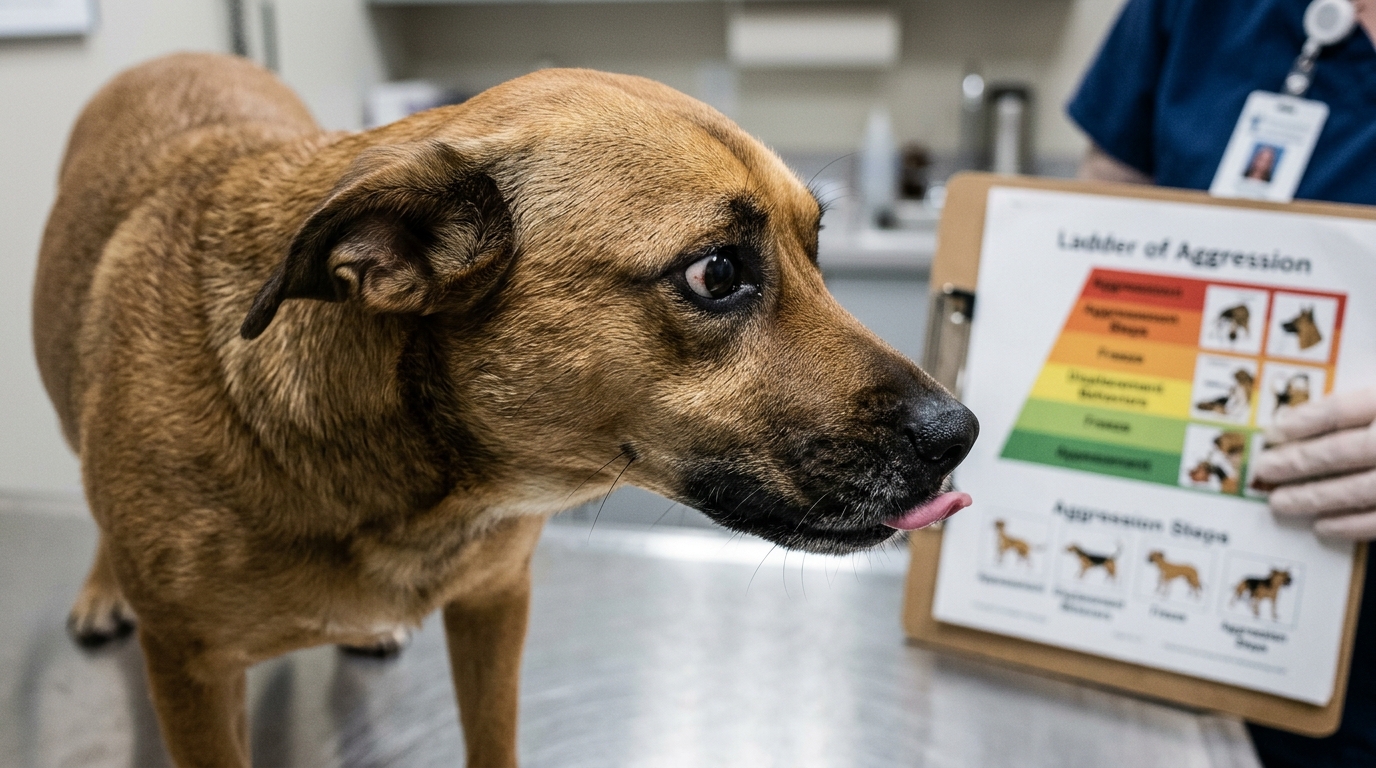
Canine bites are rarely sudden, unprovoked events; dogs communicate distress through a predictable sequence called the Canine Ladder of Aggression. Initial rungs feature subtle displacement gestures (lip licking, yawning, turning the head away), progressing to avoidance, bodily freezing (stiffening), hard staring (‘whale eye’), growling, snapping, and finally biting. Recognizing early tension and giving the dog immediate physical space prevents escalation to dangerous defensive aggression.
When humans fail to notice early stress indicators, or worse, verbally or physically punish a dog for early defensive communication like growling, they inadvertently suppress the animal’s warning system. A dog taught that growling results in punishment will often skip communicative warnings in future stressful encounters, transitioning directly from a silent freeze into a defensive bite. Understanding the biological and behavioral stages of stress escalation is the cornerstone of bite prevention and humane canine guardianship.
Phase 1: Kendal Shepherd’s Ladder of Aggression Explained
Developed by veterinary behaviorist Kendal Shepherd, the Canine Ladder of Aggression provides a clinical framework for understanding how dogs manage perceived threats and escalating social pressure. The ladder conceptualizes canine responses as a graded staircase rather than an unpredictable switch. A dog ascends the rungs only when lower-level appeasement gestures fail to diminish the perceived threat.
The ladder is divided into three distinct operational zones:
- Green Zone (Mild Appeasement & Social Calming): Yawning, blinking, nose licking, turning the head away, turning the entire body sideways, and slow, deliberate sniffing of the ground. These behaviors communicate: “I am uncomfortable and mean no harm; please increase our distance.”
- Yellow Zone (Defensive Tension & Displacement): Crouching low, pulling ears flat against the skull, tucking the tail tightly between the hocks, panting with tense labial commissures, displaying whale eye (sclera exposure), and rigid motor freezing. These behaviors signal: “My coping mechanisms are failing; I feel cornered or trapped.”
- Red Zone (Overt Warning & Defensive Strikes): Stiff-legged forward posturing, fixed pupillary dilation with a hard glassy stare, snarling with muzzle wrinkling, guttural low-frequency growling, lunging, snapping into empty air, and bite contact. These actions state: “I must defend my physical integrity or resource immediately.”
Critically, dogs do not manage this ladder identically in every encounter. Prior learning history, chronic orthopedic or systemic pain, genetic predispositions, and “trigger stacking” (the compounding accumulation of multiple stressors over hours or days) can compress the timeline, causing a dog to escalate through multiple rungs in fractions of a second.
Phase 2: Subtle Appeasement & Displacement Signals
First identified extensively by Norwegian canine ethologist Turid Rugaas, “calming signals” are instinctive appeasement gestures used by canines to pacify potential social conflict and reduce their own autonomic nervous system arousal. In domestic settings, these signals frequently appear as displacement behaviors–normal maintenance actions performed out of context when a dog experiences emotional conflict.
1. Displacement Lip Licking and Nose Flicks
Unlike post-prandial licking after consuming food, stress-induced lip licking consists of rapid, repetitive upward flicks of the tongue toward the rhinarium (nose). The tongue may barely protrude past the incisors or may flick straight upward toward the eyes. This behavior reflects acute sympathetic nervous system activation, accompanied by transient xerostomia (dry mouth) caused by catecholamine release.
2. Out-of-Context Yawning
A stress yawn differs dramatically from a sleepy morning stretch. A stress yawn is typically brief, intense, and executed with wide jaw extension, often accompanied by a distinct vocal squeak or accompanied by tense facial muscles. Dogs yawn when physically crowded, hugged by children, or placed on veterinary examination tables to lower their internal hypothalamic-pituitary-adrenal (HPA) axis arousal.
3. Head Aversion and Gaze Avoidance
Direct frontal eye contact is perceived in canine ethology as an assertive, potentially threatening social challenge. When approached by a looming human or an unfamiliar animal, a stressed dog will deliberately turn their head 45 to 90 degrees to the side, breaking visual alignment. If the person follows the dog’s gaze or leans closer, the dog may turn their entire torso away, presenting their shoulder or flank.
4. The “Shake-Off” Decompression Gesture
Often observed immediately after a tense interaction ceases (such as being hugged, examined, or approached by another dog), the dog performs a vigorous whole-body shake-off starting at the ears and terminating at the tail, resembling a dog drying off after swimming. This motor action serves as a neurological reset, releasing somatic muscular tension once the acute stressor recedes.
Phase 3: The Danger Zone: Whale Eye, Rigid Freezing, and Jaw Clamping
When appeasement signals are disregarded and the perceived threat continues to encroach, a dog enters the defensive yellow-to-red transition zone. At this stage, subtle displacement gives way to visible autonomic rigidity.
5. Whale Eye (Ocular Sclera Exposure)
Whale eye occurs when a dog holds their head angled downward or away from a trigger while tracking the approaching person or object with their eyes. As the eyeballs rotate laterally within the bony orbit, a distinct crescent or ring of white sclera becomes visible. Whale eye reflects intense apprehension, adrenaline-induced pupillary dilation (mydriasis), and high defensive conflict.
6. The Rigid Motor Freeze
Freezing is the single most widely misunderstood canine behavioral cue. Pet owners frequently misinterpret immobility as submission, obedience, or calm tolerance. Biologically, the freeze represents sudden motor inhibition–the final assessment pause of the sympathetic fight-or-flight response. The dog’s entire musculature locks; breathing suspends or becomes extremely shallow; the mouth snaps shut tightly; and the tail becomes rigid. A freeze is not compliance–it is the direct precursor to a defensive strike. Any continued approach, reach, or physical contact during a freeze will almost invariably trigger a snap or bite.
7. Labial Commissure Puckering and Snarling
Canine facial expressions change dynamically with emotional valence. During relaxed panting, the commissures (corners) of the lips are retracted caudally toward the ears in a loose “C” shape. Under defensive stress, the commissures move forward into an oval or “C” shape pointing cranially, wrinkling the dorsal muzzle and exposing the canines and premolars in an overt warning snarl.
Phase 4: High-Risk Domestic Contexts and Resource Guarding
Domestic dog bites do not happen randomly in open spaces; they cluster predictably around specific household resources, physical pinch-points, and developmental mismatches.
- Possessive Aggression (Resource Guarding): Dogs possess hardwired evolutionary instincts to safeguard high-value nutritional assets, including marrow bones, raw chews, food bowls, stolen trash items, or favored resting platforms (sofas, human beds, enclosed dog crates). Approaching, reaching into the bowl, or attempting to physically wrest an item from a dog’s jaws accounts for a high percentage of severe domestic bite incidents.
- Confined Pinch-Points and Leash Trapping: When a dog is restrained on a 6-foot leash or cornered in a narrow hallway, doorway, or beneath furniture, their natural flight option is mechanically eliminated. Deprived of the ability to create physical distance, even an inherently gentle dog will escalate directly into defensive fight responses.
- Child-Canine Interactions: Children under 9 years of age suffer the highest incidence of severe dog bites, predominantly directed toward the face, lips, and neck. Young children move erratically, vocalize at high auditory pitches, frequently misunderstand canine freezing as an invitation to pet, and tend to hug dogs around the neck–an action dogs perceive as predatory restraint. Adults must actively supervise all child-dog interactions and establish strict physical barriers (baby gates, playpens) during feeding, chewing, and sleep.
- Undetected Medical Pain: Orthopedic conditions (hip dysplasia, cranial cruciate ligament tears, cervical or lumbar spondylosis), chronic otitis externa (ear infections), and periodontal slab fractures cause acute pain spikes when dogs are touched or lifted. Any sudden, uncharacteristic emergence of touch sensitivity warrants full veterinary analgesia evaluation.
Phase 5: De-escalation Protocol: How to Create Space Without Confrontation
When you recognize that a dog is stiff, displaying whale eye, or ascending the ladder of aggression, how you move in the subsequent three seconds determines whether the incident resolves peacefully or erupts into physical trauma.
Execute the following de-escalation steps immediately:
- Freeze Your Forward Momentum: Stop approaching instantly. Do not lean forward, do not reach out your hand for the dog to “sniff” (a dangerous myth that thrusts vulnerable human fingers directly into the dog’s strike zone), and do not make sudden hand gestures.
- Turn Your Torso Sideways: Slowly pivot your body 90 degrees to present your side rather than your full frontal torso. Avoid direct eye contact by softening your gaze and looking toward the floor or a neutral wall. In canine communication, presenting a sideways profile signals non-threatening neutrality.
- Lower Your Arms and Drop Tone: Keep your hands relaxed against the seams of your trousers. Do not raise your hands above your shoulders. If you speak, use a calm, low, matter-of-fact tone; avoid high-pitched baby talk or sharp disciplinary reprimands.
- Open the Physical Exit Pathway: Ensure that you are not standing between the dog and their escape route. Step diagonally backward to widen the exit doorway or corridor. A dog that realizes an escape path has opened will almost always choose flight over fight.
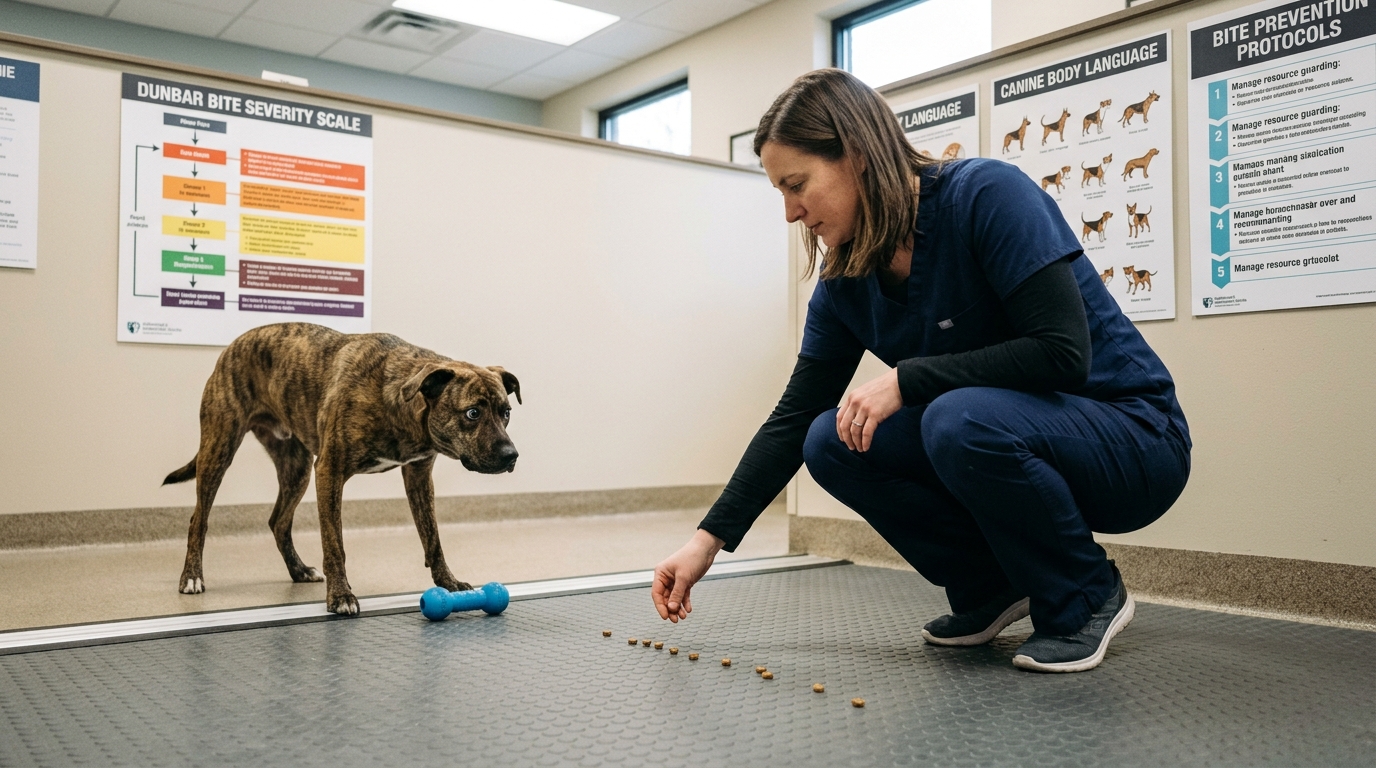
- Redirect with Distance and High-Value Value: If the dog is guarding an item, do not attempt to grab it. Step back several yards, toss a handful of exceptionally high-value treats (cut hot dogs, roast chicken) far across the room away from the guarded object, and allow the dog to voluntarily choose to investigate the food while you secure a barrier.
Phase 6: The 9-Stage Canine Bite Escalation Matrix
This structured reference matrix aligns canine observable postures with underlying neuroendocrine risk states and mandatory human safety actions.
| Stage | Observable Canine Posture | Neuroendocrine & Emotional State | Mandatory Human Action |
|---|---|---|---|
| 1. Appeasement | Flicking tongue, lip licking, blinking, turning head away | Mild social discomfort; low cortisol elevation | Pause approach, soften body posture, increase social distance |
| 2. Displacement | Yawning out of context, sudden sniffing of ground, brief shake-off | Internal conflict; sympathetic nervous system priming | Remove environmental pressure; do not intensify demands or touch |
| 3. Avoidance | Turning entire body away, walking to another room, hiding behind furniture | Active desire to escape; moderate anxiety | Allow the dog to leave; never pursue or corner a retreating dog |
| 4. Postural Tension | Crouching low, ears pinned back, tail tucked tightly, panting with tight lips | Fearful apprehension; coping capacity deteriorating | Stop all interactions immediately; instruct children to walk away calmly |
| 5. Whale Eye | Crescent of white sclera visible; pupils dilated; head turned but tracking | High defensive anxiety; acute adrenaline surge | Halt movement; turn sideways; avoid direct eye contact completely |
| 6. The Freeze | Total muscular rigidity; locked jaw; suspended breathing; fixed stare | Extreme defensive threat assessment; motor inhibition | Do not touch, do not reach; back away slowly along a diagonal line |
| 7. Vocal Warning | Low guttural growling; deep rumbling; baring incisors/canines | Active boundary defense; communication of imminent strike | Never punish the growl; thank the dog for warning and create 10+ feet of space |
| 8. Air Snap | Audible tooth clapping in mid-air; rapid lunge with zero skin contact | Inhibited defensive strike; final physical warning | Place solid barrier (door, baby gate) between dog and human; seek safety |
| 9. Bite Contact | Physical contact with teeth; level 1-6 bite injury | Complete behavioral breakdown; full fight activation | Disengage immediately, treat wounds, isolate safely, contact professionals |
Phase 7: Immediate Post-Bite First Aid and Clinical Incident Documentation
If an escalation sequence results in an actual bite that breaks human skin, proper wound hygiene and objective clinical documentation must be initiated immediately.
Medical First Aid Protocol
- Copious Irrigation: Immediately wash the bite wound under warm running water with antibacterial soap for a minimum of 5 to 10 minutes. Mechanical flushing is the single most effective method for reducing bacterial inocula (such as Pasteurella multocida and Capnocytophaga canimorsus).
- Disinfection and Dressing: Apply povidone-iodine or chlorhexidine if available, apply a sterile dressing, and elevate the injured extremity above heart level to minimize localized edema.
- Seek Medical Evaluation: Puncture wounds caused by canine canine teeth inject oral bacteria deep into subcutaneous fascial planes, tendon sheaths, and joint capsules. Consult an urgent care or emergency room physician promptly; antibiotic prophylaxis (such as amoxicillin-clavulanate) and tetanus booster administration are standard standards of care.
The Dunbar Bite Severity Scale
Developed by veterinary behaviorist Dr. Ian Dunbar, the Dunbar Scale classifies bites based on objective physical trauma rather than emotional intent:
- Level 1: Aggressive posturing and air snap with zero tooth contact on skin.
- Level 2: Tooth contact on skin without puncturing the dermis (bruising, mild surface abrasion).
- Level 3: One to four distinct punctures from a single bite, all shallower than the length of the canine tooth.
- Level 4: Deep punctures (deeper than half the canine tooth length), severe bruising, or lateral tearing caused by head shaking.
- Level 5: Multiple bites with deep punctures (at least two Level 4 bites) in a single attack.
- Level 6: Fatal bite resulting in human death or severe flesh consumption.
Phase 8: When to Involve a Veterinary Behaviorist (DACVB)
Managing canine aggression requires professional behavioral medicine rather than generic obedience training or outdated dominance techniques. Aggression rooted in fear, pain, or resource guarding will be aggravated by aversive training tools like prong collars, choke chains, or electronic shock collars.
Schedule a professional consultation if your dog displays:
- Any bite incident that punctures skin (Dunbar Level 3 or higher).
- Repeated rigid freezing, snarling, or growling directed toward family members or children.
- Escalating possessive aggression over common household items.
- Sudden behavioral shifts or intolerance of normal handling, which warrants a full veterinary physical examination, orthopedic evaluation, thyroid screening (free T4 by dialysis), and complete blood panel to rule out medical triggers.
Seek credentials through the American College of Veterinary Behaviorists (ACVB) for clinical specialist veterinary behaviorists (DACVB), the Animal Behavior Society for Certified Applied Animal Behaviorists (CAAB), or the International Association of Animal Behavior Consultants (IAABC).
Clinical Practice Tool: Dog Body Language Observation Sheet
Sharpen your observation of subtle stress signals and displacement behaviors by printing our practical Dog Body Language Observation Sheet. Download and print your copy of the Dog Body Language Observation Sheet, or explore all practical pet care guides in the NewsPet Resource Center.
Frequently Asked Questions
Why is my dog licking their lips when there is no food around?
Lip licking in the absence of food is a classic canine displacement and appeasement behavior. It indicates that the dog is experiencing social uncertainty, mild stress, or apprehension about an approaching person or situation. It is an early signal asking for distance.
What does “whale eye” mean in dogs?
Whale eye occurs when a dog turns their head away from a trigger while continuing to watch it, exposing the white crescent of their sclera. It signals intense emotional conflict, fear, and defensive arousal, often seen during resource guarding or tight physical restraint.
Should I scold or punish my dog for growling?
Never punish a dog for growling. A growl is a critical, peaceful warning signal indicating that the dog has reached the limit of their comfort. Punishing a growl teaches the dog that communicating discomfort is dangerous, leading them to suppress the warning and bite without notice in future encounters.
What is the most dangerous sign of stress to miss?
The sudden rigid motor freeze. People often misinterpret a frozen, motionless dog as calm or submissive. In reality, freezing represents the final neurological pause before a defensive bite strike occurs.
Sources
Sources checked: September 8, 2026
- American Veterinary Society of Animal Behavior (AVSAB): Position Statement on Humane Dog Training and Dominance Theory
- Dogs Trust: Guide to Canine Body Language and Ladder of Aggression
- Best Friends Animal Society: Decoding Dog Body Language Signs
- International Association of Animal Behavior Consultants (IAABC): Principles of Canine Behavioral Assessment
- American College of Veterinary Behaviorists (ACVB): Canine Aggression and Behavioral Medicine Guidelines
- National Health Service (NHS): Clinical Management of Animal and Human Bites
Emergency Triage Matrix: Clinical Presentation & Required Response
| Triage Level | Clinical Signs & Presentation | Immediate Action Protocol |
|---|---|---|
| Tier 1: Immediate Emergency (0–2 Hours) | Skin-breaking canine puncture wound or laceration (human or animal), active hemorrhage, intense unyielding resource guarding with lunging, or acute predatory aggression. | Immediate medical attention for human bite wounds (antimicrobial therapy, tetanus prophylaxis); isolate the dog in a safe barrier room without physical confrontation, and contact a veterinary behaviorist. |
| Tier 2: Urgent Veterinary Care (Same-Day) | Sudden onset of growling, snapping, or defensive posturing when touched in a previously docile dog; stiff gait, vocalization when handled, or guarding a specific body quadrant. | Urgent veterinary clinical examination; orthopedic and neurological assessment to identify occult physical pain (spinal disc pathology, arthritis, otitis, dental abscess). |
| Tier 3: Home Monitoring & Scheduled Care | Mild displacement yawning or lip licking during high-stimulation situations (crowded rooms, active children) that ceases immediately when given distance. | Implement proactive space management, instruct family members on low-stress interaction rules, and avoid forcing the dog into high-arousal social settings. |
Rule S1 Boundaries & Bite Prevention Safety Protocols
Interpreting canine body language requires strict adherence to bite-prevention boundaries:
- NEVER punish a dog for growling, snarling, or barking: Growling is an essential vocal warning signal; punishing the growl extinguishes the warning while preserving underlying panic, teaching the dog to bite without warning next time.
- NEVER perform ‘alpha rolls’, scruff shakes, or physical dominance maneuvers: Force-based confrontation triggers acute survival fight-or-flight responses, substantially increasing the statistical incidence of severe defensive facial bites.
- NEVER physically force a retreating or stiff dog into social interaction: When a dog turns their head, exposes the white of their eye (‘whale eye’), or freezes, attempting to hug, kiss, or physically restrain them forces defensive biting.
- NEVER leave infants or young children unsupervised with any dog: Toddlers display unpredictable motor movements and cannot interpret canine displacement signals; active adult supervision with physical barrier management is mandatory.
Caregiver De-escalation & Safety Action Checklist
- Freeze and immediately halt all forward movement, physical contact, reaching, or direct eye contact when a dog displays stiffening or a hard stare.
- Turn your body sideways to present a non-threatening profile, drop your gaze toward the floor, and remain completely still and quiet.
- Allow the dog a clear, unobstructed retreat pathway; never corner an anxious or fearful animal against walls, furniture, or fences.
- Scatter high-value treats gently away from your feet to redirect canine focus and safely create physical distance.
- Schedule a clinical evaluation with a veterinarian to rule out pain before beginning behavioral desensitization.
Related Clinical Guides & Tools
Peer-Reviewed Clinical References & Evidence Grounding
- PMID: 24766702: Canine aggression toward people: a guide for practitioners (Vet Clin North Am Small Anim Pract, 2014) (opens in new tab)
- PMID: 30525045: Teaching Children and Parents to Understand Dog Signaling (Front Vet Sci, 2018) (opens in new tab)
- PMID: 33226285: Readability and content of online pet obesity information (J Am Vet Med Assoc, 2020) (opens in new tab)
- Merck Veterinary Manual — Small Animal Clinical Medicine & Emergency Reference (opens in new tab)
Printable tools
Download the matching worksheet
Source transparency
Reference mix for this guide
Source labels describe the type of organization behind each reference; they are not a claim that any outside organization reviewed this article.
- American Veterinary Society of Animal Behavior (AVSAB): Position Statement on Humane Dog Training and Dominance Theory Veterinary organization · avsab.org
- Dogs Trust: Guide to Canine Body Language and Ladder of Aggression Reference source · dogstrust.org.uk
- Best Friends Animal Society: Decoding Dog Body Language Signs Reference source · bestfriends.org
- International Association of Animal Behavior Consultants (IAABC): Principles of Canine Behavioral Assessment Reference source · iaabc.org
- American College of Veterinary Behaviorists (ACVB): Canine Aggression and Behavioral Medicine Guidelines Veterinary organization · dacvb.org
- National Health Service (NHS): Clinical Management of Animal and Human Bites Reference source · nhs.uk
- Puppy Socialization Without Overwhelm: A Vet-Safe Reference source · newspet.net
- Reward-Based Dog Training: Force-Free Steps & Reference source · newspet.net