
Editorial standard
How this guide was prepared
The first 30 days with an adopted dog are a series of safety and household decisions, not a countdown to a fully settled pet. A quiet first weekend does not prove that the dog is comfortable, and a difficult third week does not mean the adoption has failed. Behavior changes as health, sleep, familiarity, and access change.
Clinical Quick Answer & Immediate Actions
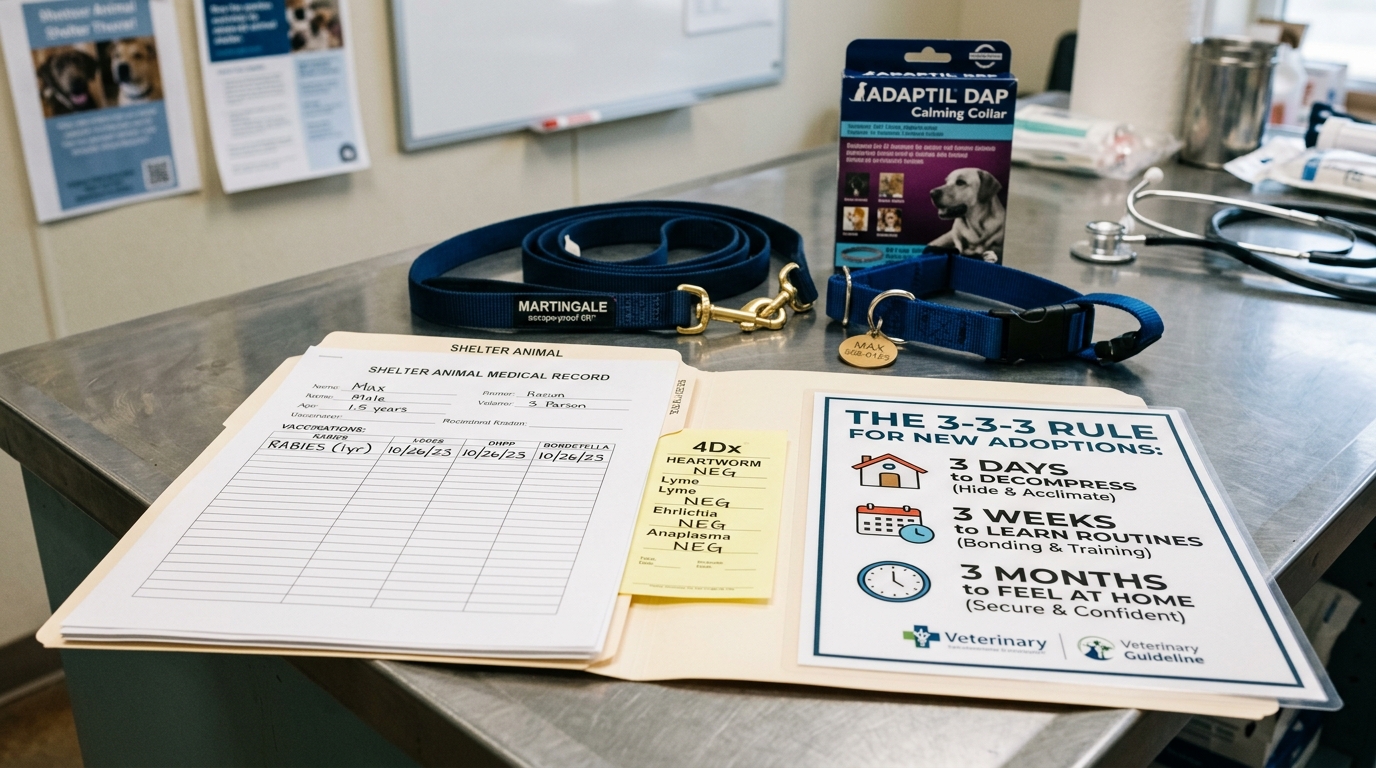
Successfully integrating an adopted shelter or rescue dog requires structured biological decompression following the clinical 3-3-3 Rule. During the first 3 days, the dog is in high neuroendocrine shock (elevated cortisol, shutdown, appetite hesitation). Over the first 3 weeks, daily routines emerge, and the dog begins testing boundaries. By 3 months, true trust, behavioral stability, and secure attachment solidify. Maintain a low-stimulation home, avoid overwhelming novel exposures, and schedule an initial veterinary intake exam within the first week.
If an adopted dog shows severe distress, vomiting, continuous diarrhea, or signs of acute injury, contact an emergency veterinarian promptly to assess physical health before assuming behavioral causes.
Before arrival and the first night: remove preventable risk
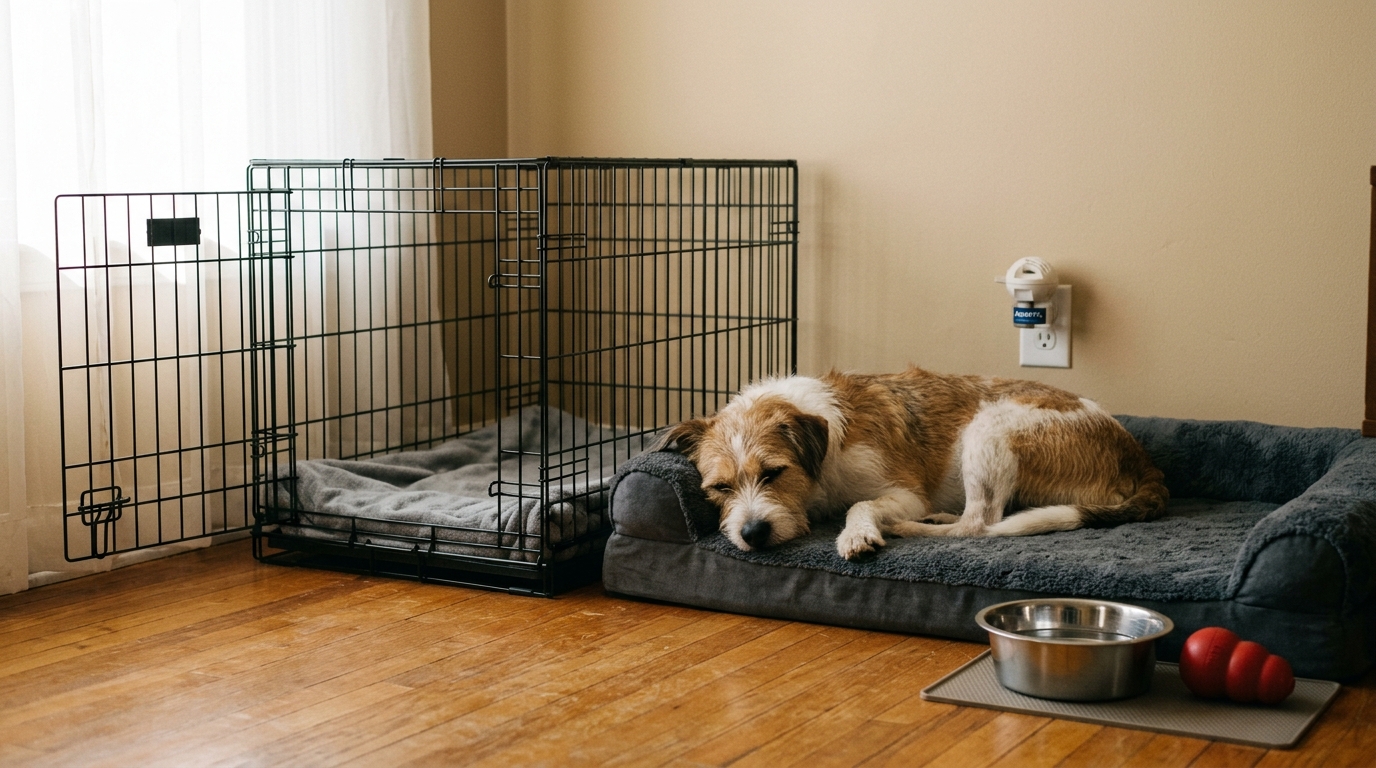
Prepare one low-traffic resting zone with water, a bed or open resting choice, and barriers that do not trap the dog. Secure doors, gates, fences, windows, balconies, bins, medication, food, cords, and chewable hazards. Check the fit and condition of the lead, harness or collar, identification, and transport setup before the dog arrives.
Ask the rescue, shelter, foster, or previous caregiver for diet, medication, vaccination, parasite, microchip, sleep, toilet, handling, escape, bite, guarding, child, dog, cat, and travel information. Record “unknown” where necessary. Unknown history calls for conservative separation and observation; it is not evidence that a situation is safe.
On arrival, go from transport to the toilet area and then to the prepared zone. Keep greetings quiet and give the dog a route away from people. Offer the familiar meal on the previous schedule when appropriate. Avoid a whole-house tour, bath, crowded welcome, dog park, or test of paws, bowls, toys, hugs, and restraint. Remove leads or equipment that could snag during unsupervised rest.
Safety baseline for days 1-7
The first review period is for learning what normal rest, intake, elimination, movement, and recovery look like for this dog. Keep waking, toilet access, measured meals, water, short low-pressure movement, and protected sleep predictable while responding to signs of pain, fear, or a need for more distance.
Start a dated safety baseline before adding household tests. Use the same short record each day for food offered and eaten, urine and stool, sleep blocks, mobility, medication, outdoor startle, handling needed for care, and time to recover after an ordinary event. Note which person, route, room, child barrier, or resident-animal separation was in place. The baseline is useful only when the household can tell what changed.
| Domain | Keep stable | Observe without testing |
|---|---|---|
| Food and elimination | Known diet, separate feeding, frequent quiet toilet opportunities. | Amount eaten, vomiting, stool, urine, straining, accidents, and guarding signals. |
| Rest | Low traffic, predictable lights and noise, no disturbance while sleeping. | Pacing, panting, startling, preferred location, night waking, and recovery. |
| Outdoor safety | Secured equipment and a short familiar route away from crowding. | Freezing, scanning, pulling home, chase behavior, startle, and escape attempts. |
| Contact | Brief necessary handling and voluntary social contact. | Approach, retreat, turning away, tension, lip licking, growling, or seeking touch. |
Arrange the veterinary visit on the schedule advised by the rescue and clinic, sooner when history is incomplete or symptoms appear. Bring records and notes on appetite, stool, urine, mobility, skin, sleep, coughing, medication, and behavior. Ask about body and dental condition, pain, vaccination, parasites, reproductive status, microchip registration, diet, and local disease risks. Do not explain a physical change as “just settling.”
Use redundant escape prevention for a known flight-risk dog where professionally advised. A new recall cue is not a substitute for a secured lead or fence. Verify identification contacts now, not after an escape.
Household rhythm and cooperative skills for days 8-14
Once the dog is eating, eliminating, sleeping, and recovering predictably enough for the household to spot changes, introduce one manageable change. Choose a new room, route, handling task, or training context, leave the other variables familiar, and judge the result by the dog’s ability to recover rather than obedience or the date.
Write the change before trying it: starting distance or duration, equipment and barrier setup, the behavior that permits one small increase, and the response that ends the repetition. If sleep, appetite, elimination, or recovery worsens later that day, restore the previous routine and review the full trigger load instead of treating the training moment as the only evidence.
Begin with skills that make daily life safer: orienting to a person, pausing at a door, following a food lure away from a hazard, settling on a mat, approaching the harness, trading a low-risk object, and moving a short distance indoors when called. Keep sessions brief enough that the dog can still eat, disengage, and rest. The reward-based dog training guide shows how to adjust distance, reinforcement, and difficulty without intimidation.
Handling should remain consent-aware even when care is necessary. Pair a brief touch with something the dog values, pause, and watch whether the dog returns. For grooming, ears, paws, medication, or equipment that triggers freezing, fleeing, growling, or snapping, stop rehearsing the conflict and ask the veterinarian or a qualified reward-based professional for a safer plan.
Use gates, closed doors, storage, covered windows, and distance to prevent rehearsals of dangerous behavior. Management is part of teaching. Punishing a growl, forcing exposure, or repeatedly provoking a reaction removes information without making the situation safer.
Controlled expansion for days 15-21
By days 15-21, choose one area to explore without changing the others: a brief visitor, a few seconds of absence, or safer access around valued resources. Watch the dog during the change and through recovery; more escape behavior, conflict, vigilance, or slower settling means the setup is too difficult. If a visitor is the chosen change, keep the visit brief and optional, prevent door escape without forcing proximity, and let the dog approach or retreat. Children require direct adult supervision and no contact while the dog is eating, sleeping, hiding, confined, or holding an item.
Introduce alone time as an observation, not a duration target. First see whether the dog can remain settled when a person moves behind a barrier or leaves for seconds. Use a camera when it can be placed safely. Pacing, panting, drooling, repeated vocalizing, exit destruction, escape attempts, or inability to engage with food may indicate distress. Do not keep extending an absence through panic, and do not assume a crate treats separation-related behavior.
Absence practice stops at the first recorded distress pattern. Return without punishment, note the earliest change and the recovery afterward, and make the next planned absence easier or arrange care that avoids another panic-length exposure. A dog who cannot remain safe for necessary absences needs veterinary and qualified behavior input; the household record should separate unavoidable absences from brief practice.
Feed animals separately and keep people away from bowls, chews, beds, and found objects. If the dog stiffens, freezes, accelerates eating, hovers, blocks access, growls, snaps, or guards a person or doorway, increase separation. Do not reach into the mouth, take bowls to “prove” tolerance, or punish warning signals. Secure dangerous objects and seek behavior support for a trade and management plan.
Resident dogs and cats need staged, supervised arrangements with separate food and rest. For cats, preserve dog-free rooms and vertical escape routes; do not allow chasing to become the introduction. For dog-to-dog meetings, use distance and parallel movement when appropriate, and obtain specialist help when either animal has a concerning history or body language.
Children and resident animals keep physical separation until the written condition is met. A child does not deliver food beside the dog, remove objects, wake the dog, enter the rest zone, or supervise contact. For each resident animal, name the closed door, gate, lead, or dog-free route that prevents rehearsal, the calm behavior needed before brief controlled access, and the signs that restore full separation. Adult supervision remains active even after several quiet sessions.
Next-month evidence review for days 22-30
The final review turns the month’s notes into decisions: continue management, expand one condition, reduce difficulty, or bring in professional support. Compare the current pattern with the initial safety baseline across sleep, appetite, elimination, walks, handling, visitors, alone time, play, and recovery after surprises. Look for patterns rather than one unusually good or difficult event; useful improvement can mean shorter recovery, better sleep, voluntary engagement, or fewer management failures.
After a setback, return to the last setup that supported recovery. Freeze unrelated expansions, check for pain or illness, restore sleep and physical separation, and record what happened before, during, and after the event. Resume only the affected decision when ordinary baseline behavior has returned; a difficult visitor, conflict, escape attempt, clinic visit, or absence does not require restarting every safe routine.
| Review decision | Evidence | Next-month action |
|---|---|---|
| Keep stable | The routine is safe but the dog still needs substantial recovery. | Preserve sleep, routes, barriers, and the current difficulty. |
| Expand one element | The dog remains loose, can disengage, and settles after the current version. | Add one small duration, distance, person, room, or handling step. |
| Reduce difficulty | Fear, arousal, conflict, accidents, or poor sleep increase after expansion. | Return to the last workable setup and inspect health and trigger load. |
| Bring in support | Pain, panic, aggression, guarding, escape behavior, or handling risk persists. | Coordinate veterinary assessment with qualified behavior or training help. |
Choose two or three welfare and safety priorities for the next month, such as comfortable veterinary handling, secure walks, protected cat routes, predictable sleep, or achievable absence. State what progress looks like and the condition that stops the exercise. Thirty days passing is not a reason to add daycare, dog parks, group classes, long trips, and many visitors together.
The month-two record names one priority, evidence, permission, and stop condition. Add the current baseline, the one variable allowed to change, who maintains barriers or records, what recovery must look like before another increase, and the date or professional review that closes the decision. This creates a household instruction for secure walks, child boundaries, resident-pet routes, handling, or absence instead of a wish list of new activities.
When to contact a veterinarian or behavior professional
Seek veterinary guidance for reduced appetite, weight change, repeated digestive signs, coughing, itching, wounds, pain, mobility change, urinary or stool changes, marked lethargy, disrupted sleep, or a sudden behavior shift. Breathing difficulty, collapse, major injury, suspected poisoning, uncontrolled bleeding, repeated seizure activity, a swollen painful abdomen, or inability to pass urine needs urgent assessment.
Ask for qualified behavior help when fear, aggression, guarding, panic during absence, handling risk, or conflict is shrinking the dog’s safe life or putting people and animals at risk. Check credentials, methods, referral relationships, and willingness to coordinate with the veterinarian. Medical and learning explanations can coexist; the household should not be forced to choose one before assessment.
New Pet Checklist: Download our free printable New Pet First Week Checklist to track feeding schedules, decompression milestones, and veterinary health notes during the critical first month.
Related planning: Review our guide to preparing for an adopted dog’s first vet visit to gather records and build an accurate medical baseline.
Clinical Practice Tool: Dog First 90 Days: A Calm Owner Roadmap
manage the critical 3-3-3 decompression timeline for your newly adopted dog with our Dog First 90 Days Roadmap and settling guide. Download and print your copy of the Dog First 90 Days: A Calm Owner Roadmap, or explore all practical pet care guides in the NewsPet Resource Center.
Frequently Asked Questions
What is the veterinary 3-3-3 rule for newly adopted dogs?
The 3-3-3 framework outlines decompression milestones: 3 days to detox from shelter stress and cortisol overload, 3 weeks to learn home routines and feel safe, and 3 months to build complete trust and reveal their true personality.
Why should newly adopted dogs have limited visitors and outings during the first month?
Excessive handling, dog parks, and novel visitor introductions during the decompression window overload an already stressed nervous system, triggering fear aggression or flight attempts before the dog has bonded with primary caregivers.
When should routine veterinary bloodwork and fecal testing be performed post-adoption?
Schedule baseline veterinary intake within 48 to 72 hours of adoption to review records and test for Giardia, heartworms, and tick-borne pathogens, followed by a full wellness panel within 3 to 6 months.
Sources
Sources checked: September 8, 2026.
- AAHA: Canine Life Stage Guidelines
- Humane Society of the United States: Bringing Your New Dog Home
- ASPCA: General Dog Care
- AVSAB: Humane Dog Training Position Statement
- Fear Free Pets: Decompression and Transition Resources
Emergency Triage Matrix: Clinical Presentation & Required Response
| Triage Level | Clinical Signs & Presentation | Immediate Action Protocol |
|---|---|---|
| Tier 1: Immediate Emergency (0–2 Hours) | Severe bite injury during adjustment, collapse, severe bloody diarrhea or coughing (kennel cough progressing to bronchopneumonia), or escape into traffic. | Immediate emergency veterinary transport; intensive fluid resuscitation, respiratory isolation, oxygen support, and post-bite medical wound care. |
| Tier 2: Urgent Veterinary Care (Same-Day) | Refusal to eat or drink for >48 hours, constant trembling and hiding in corners, acute vomiting, or new-onset limping/pain vocalizations. | Urgent veterinary clinical examination; full baseline bloodwork, infectious disease screening (fecal flotation, heartworm test), and pain assessment. |
| Tier 3: Home Monitoring & Scheduled Care | Healthy rescue dog displaying mild shyness, cautious investigative sniffing, slightly soft stools during diet transition, and normal water intake. | Establish consistent feeding and elimination schedules, provide a quiet resting sanctuary, and schedule an initial wellness intake exam within 7 days. |
Rule S1 Boundaries & New Adoption Protocols
Protecting a newly adopted rescue dog requires strict behavioral and physical boundaries:
- NEVER host parties, visitors, or take the dog to dog parks during the first 30 days: The dog’s central nervous system is already near trigger saturation; adding crowded social gatherings induces sensory flooding, fear-biting, and bolting escapes.
- NEVER introduce high-value bones, raw hides, or food bowls near existing household pets: Unestablished social dynamics trigger acute, violent resource guarding; keep feeding stations and high-value rewards strictly separated by solid doors.
- NEVER rely solely on shelter medical paperwork without a veterinary intake exam: Shelter exams are triage-focused; newly adopted dogs frequently harbor occult intestinal parasites, Giardia, incubating tracheobronchitis, or missed dental disease.
- NEVER punish a rescue dog for submissive urination or fear-based accidents: Submissive urination is an involuntary appeasement reflex; scolding increases fear of humans, worsening urination frequency.
Caregiver 30-Day Acclimation Action Checklist
- Set up a dedicated quiet sanctuary room with comfortable bedding, fresh water, and chew toys before bringing the dog home.
- Conduct neutral leashed territory walks outside the home before allowing the new dog to meet existing resident dogs.
- Maintain identical daily schedules for morning walks, meal times, potty breaks, and evening quiet hours to provide cognitive predictability.
- Book an initial veterinary wellness consultation within 5 to 7 days of adoption; bring shelter records and a fresh fecal sample.
- Keep a secure martingale collar or well-fitted harness with active identification tags on the dog at all times during outdoor excursions.
Related Clinical Guides & Tools
Peer-Reviewed Clinical References & Evidence Grounding
- PMID: 12885206: American canine hepatozoonosis (Anim Health Res Rev, 2003) (opens in new tab)
- PMID: 34250731: Outcomes and prognostic factors in canine epitheliotropic and nonepitheliotropic cutaneous T-cell lymphomas (Vet Comp Oncol, 2022) (opens in new tab)
- PMID: 31069932: Retrospective evaluation of canine heart base tumours treated with toceranib phosphate (Palladia): 2011-2018 (Vet Comp Oncol, 2019) (opens in new tab)
- Merck Veterinary Manual — Small Animal Clinical Medicine & Emergency Reference (opens in new tab)
Printable tools
Download the matching worksheet
Source transparency
Reference mix for this guide
Source labels describe the type of organization behind each reference; they are not a claim that any outside organization reviewed this article.
- AAHA: Canine Life Stage Guidelines Veterinary organization · aaha.org
- Humane Society of the United States: Bringing Your New Dog Home Reference source · humanesociety.org
- ASPCA: General Dog Care Animal welfare nonprofit · aspca.org
- AVSAB: Humane Dog Training Position Statement Veterinary organization · avsab.org
- Fear Free Pets: Decompression and Transition Resources Reference source · fearfreepets.com
- Puppy Socialization Without Overwhelm: A Vet-Safe Reference source · newspet.net
- Dog Body Language Chart: 9 Stress Signs Before a B Reference source · newspet.net
- Reward-Based Dog Training: Force-Free Steps & Reference source · newspet.net