Editorial standard
How this guide was prepared
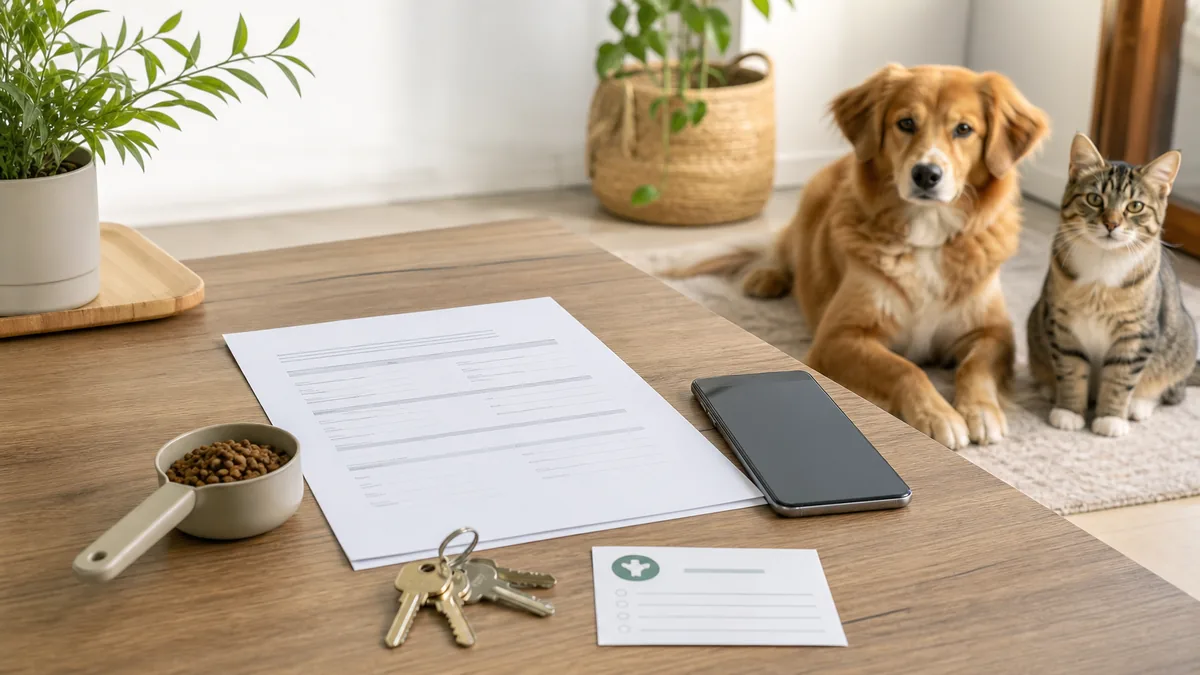
A sitter should not have to search a long document while a dog is waiting at the door, a cat has missed a meal, or a clinic is asking who can authorize care. Give the sitter one operational page for every visit, then attach conditional detail that is opened only when medication, behavior, access, an emergency, or the return handover requires it.
- Single-Page Operational Briefing: Consolidate exact gram-measured feeding amounts, medication dosages, walk schedules, and litter cleaning routines onto one laminated, highly visible daily reference page.
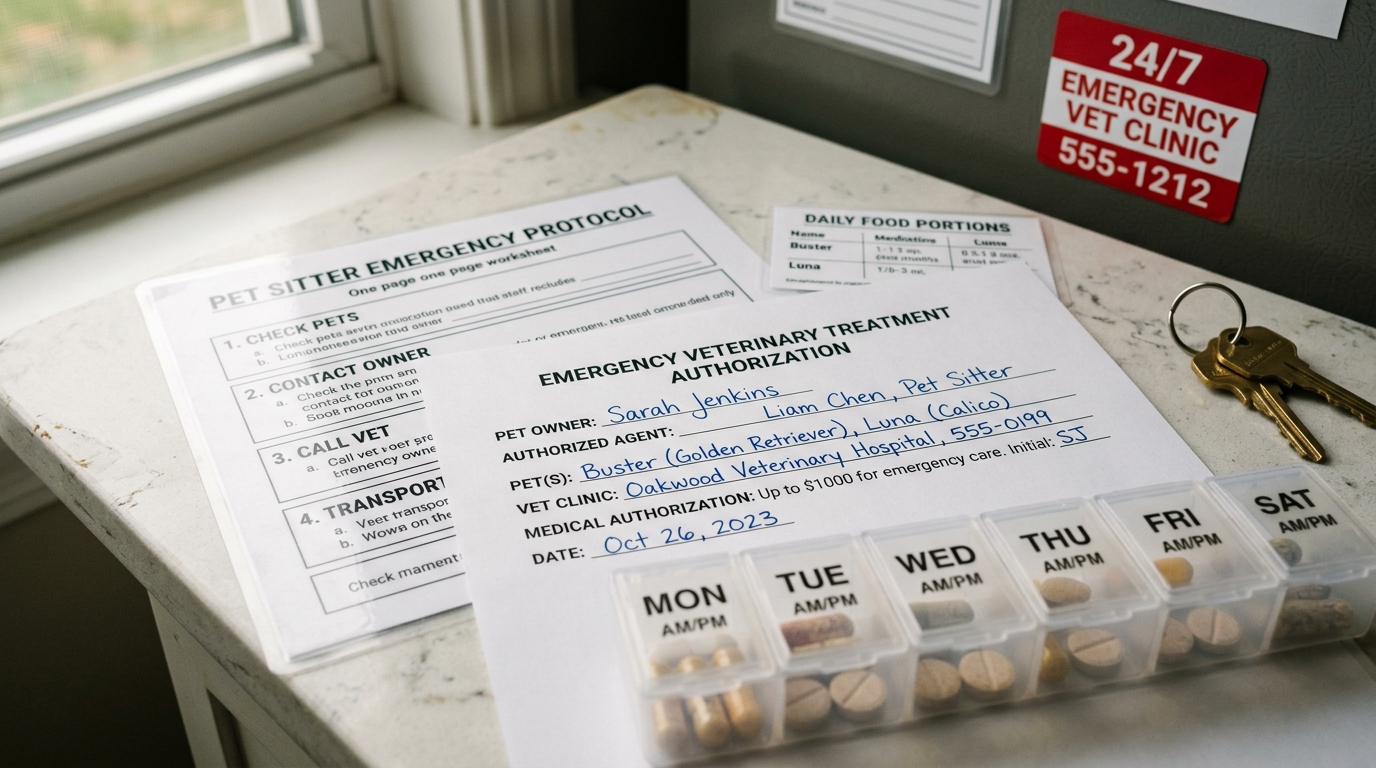
- Pre-Authorized Veterinary Emergency Protocol: Leave written medical authorization specifying spending limits, emergency contacts, primary veterinarian details, and 24-hour emergency hospital addresses.
- Safety Baselines & Flight-Risk Triggers: Clearly identify escape routes, door-dashing tendencies, fear triggers (thunder, vacuums, unfamiliar dogs), and individual hiding spots to prevent lost pet incidents.
Write observable instructions: amounts, locations, equipment, stop conditions, and named contacts. Replace “as usual” with what the sitter can actually see and do. Date the packet, rehearse it in the home, and leave the same current copy in print and in an agreed digital location.
The one-page core handover
Keep this page to what must be known on an ordinary visit. Use one row per animal where needs differ, and put the pet’s name and photograph at the top if animals could be confused.
| Core field | What to write |
|---|---|
| Identity | Name, species, description, microchip or registration location, usual hiding places, and current photograph. |
| Visit sequence | Arrival check, toilet or litter check, measured food, water, medication reference, movement or play, final head count, and lock-up. |
| Food | Exact product, measured amount, time window, preparation, bowl location, separation rules, and what counts as a refused meal. |
| Elimination | Dog toilet route and equipment or cat tray locations, expected output, cleaning supplies, and changes that trigger a call. |
| Containment | Which doors, gates, windows, rooms, leads, carriers, or barriers must be secured before another is opened. |
| Communication | Owner, backup, regular clinic, emergency clinic, preferred update time, and the first person to call for each type of problem. |
Add a prominent “not permitted” line: for example, no off-lead access, no dog greetings, no balcony, no visitors, no treats outside the listed container, or no handling of a particular body area. The sitter should be able to complete the final visit check by physically seeing every animal, checking water and elimination, securing the defined boundaries, and sending the agreed update.
Medication and treatment sheet
Create a separate sheet for each animal receiving medication. Copy the pharmacy or veterinary label exactly: medication name, strength, dose, route, time, whether it is given with food, storage, start and stop dates, and the prescribing clinic. Include a photograph of the container and note where supplies, oral syringes, gloves, sharps containers, or prescription food are stored.
Describe only the administration method the animal already accepts and that the prescribing clinic has approved. Ask the clinic to write the fallback if medication cannot be given by that method. Without a written fallback, the sitter stops and contacts the owner or clinic before another attempt or any change to dose, timing, or formulation.
Medication authority ends at the written owner and clinic instructions. The sheet should say who is called after a refused, dropped, vomited, late, or uncertain dose and what information to report; it should not ask the sitter to diagnose the event, repeat a dose, double the next dose, substitute a product, or change the route. Record the result of each attempt so the owner, backup, and clinic receive the same facts.
List the animal’s known treatment reactions and the clinic-written contact threshold. Demonstrate the approved method during the handover. If the sitter cannot give it without force, repeated failed attempts, or unsafe restraint, the instruction is to stop and contact the owner or clinic. Arrange another caregiver or a veterinary plan before travel when the ordinary method is not safe for this sitter and animal.
Behavior, handling, and conflict sheet
Describe behavior as a sequence rather than a label. “May freeze and back away when a hand reaches over his head; stop reaching and toss the lead-side treat away from the door” is usable. “Can be moody” is not. Record known triggers, early stress signals, safe distance, recovery signs, preferred rewards, and the action that ends the interaction.
| Situation | Prevention | If it starts |
|---|---|---|
| Door or gate rush | Secure the inner barrier and locate the animal before opening the outer door. | Close the safer boundary; do not grab at a collar near the exit. |
| Food or object guarding | Feed separately and keep people and animals away from bowls and chews. | Increase distance; do not test, scold, or take the item by force. |
| Fear of handling | Use the demonstrated approach and touch only where necessary. | Stop at freezing, avoidance, growling, swatting, or escalating tension. |
| Animal conflict | Maintain the listed doors, zones, feeding separation, and visual barriers. | Do not put hands between animals; use the pre-arranged separation plan and call. |
Include walk equipment, routes to avoid, dog or wildlife distances, cat hiding locations, and any history of escape, bite, scratch, chase, panic, or confinement distress. Unknown history belongs on the sheet too. It tells the sitter not to run an experiment.
Write one conflict line for each animal pairing, not one household label. For each pair, mark the normal zones, feeding order, shared doorway or window risks, early blocking or stalking signs, the barrier that restores separation, and which animal is counted first after a disruption. If animals who normally share space begin avoiding resources, guarding routes, or fighting, the sitter returns to the written separation layout and reports the change rather than testing another meeting.
Home access and containment sheet
Provide the address exactly as emergency services and the clinic should receive it, building name or unit, parking and entry instructions, alarm steps, key or code method, Wi-Fi only if needed, and the location of the electrical panel, water shutoff, fire extinguisher, carrier, leads, and cleaning supplies. Separate household access from financial or private information the sitter does not need.
Walk the sitter through the lock sequence. Mark gates that do not latch, doors that rebound, windows or screens that are not animal-proof, rooms that remain closed, delivery risks, and where an animal may hide before the sitter leaves. State what to do if a key fails, an alarm activates, a contractor arrives, severe weather begins, or the home becomes unsafe to occupy.
An access failure needs a timed call sequence before the booking starts. List the backup key or authorized contact, property manager or alarm contact where relevant, owner and backup order, and the threshold for reporting a missed welfare task. The sitter does not force a lock, climb a boundary, share a code with an unlisted person, or leave an exterior door unsecured. If access cannot be restored in time for essential care, the named owner or emergency contact activates the documented alternative.
Containment instructions must still work when the sitter is carrying food or managing more than one animal. If the sequence depends on two hands, two people, or temporary barriers, arrange that before the booking rather than leaving the sitter to invent a solution.
Emergency care authority and veterinary escalation
Ask the regular and emergency clinics what consent, contact, transport, and payment documentation they will accept for this booking, then use their form or record their instructions. Name the owner and backup, but describe a sitter’s spending or treatment role only to the extent the owner and clinic have documented it. This packet does not create legal authority or guarantee that a clinic will accept a payment arrangement.
Include insurance details where relevant, allergies, diagnoses, medications, vaccination and microchip records, mobility limitations, and local emergency contacts. If a clinic requires a deposit, card on file, insurer preauthorization, or direct owner consent, the owner should arrange it with that clinic before departure rather than leave the sitter to negotiate it.
Stage the records, medication reserve, carrier or lead, recent photographs, water, food, hygiene supplies, and containment equipment using the pet emergency kit guide. The sitter should know what can leave with the animal and what must remain at home.
Ask the named clinics to define which observations should bypass routine owner updates, and copy that wording into the attachment. For those clinic-defined situations, the sitter follows the documented call and transport sequence. The packet should never tell a sitter to delay a veterinary call while waiting for informal approval that the clinic has said is unnecessary.
The emergency handoff records who calls, who transports, and which authority applies. It also names the animal that must remain separated, the records and medication that travel, the person who secures the home, and where the sitter leaves an update if the owner is unreachable. The clinic decides assessment and treatment; the sitter follows the documented consent and payment boundaries and reports what was observed, given, transported, and handed over.
Handover rehearsal and return debrief
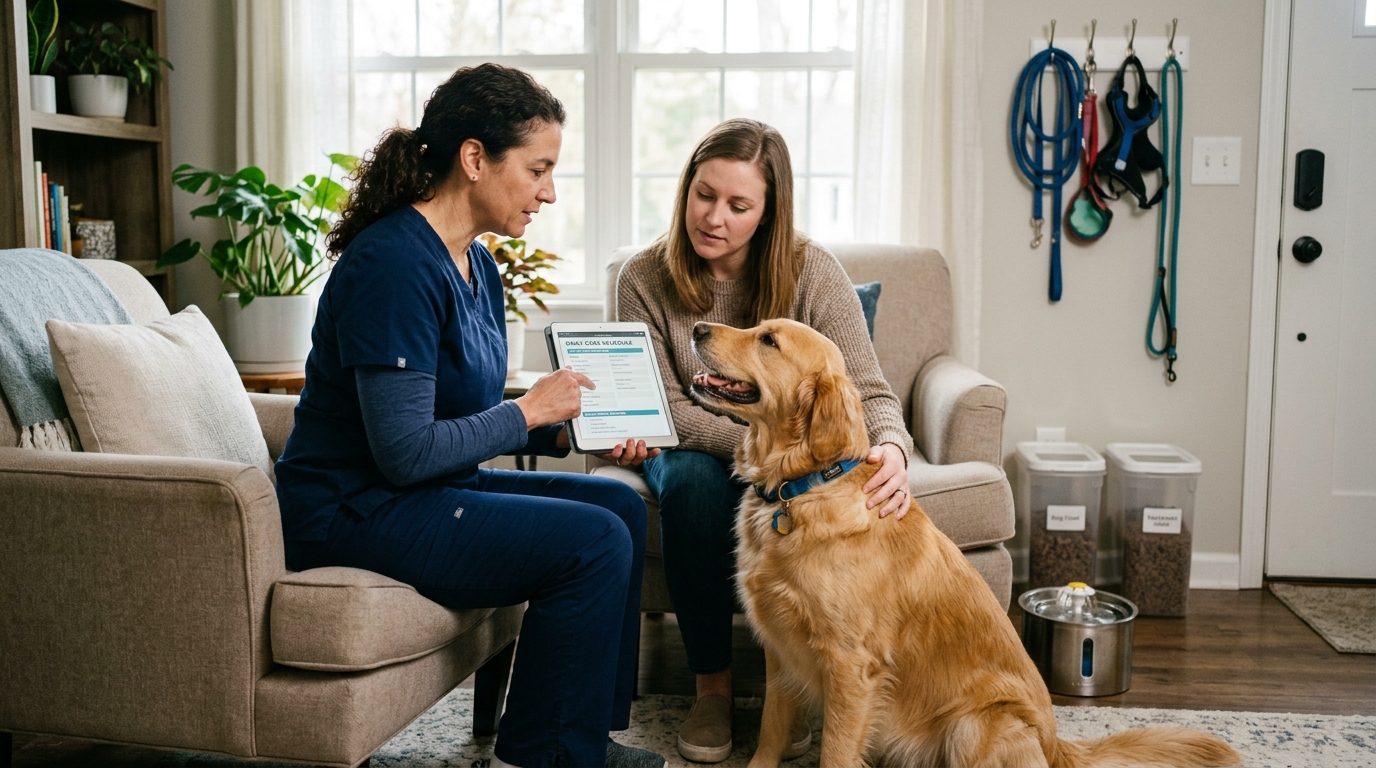
Complete one full visit together before departure. The sitter enters, locates each animal, measures a meal, follows the door sequence, finds medication and records, secures the home, and sends the planned update. Correct the sheet where the sitter hesitates; do not rely on a verbal explanation that is absent from the packet.
Rehearse one conditional branch as well: a refused medication, an animal not found at head count, or a failed key. The sitter should reach the correct attachment, contact, and stop condition without the owner coaching each step.
Agree on the update format: head count, food taken, water, urine and stool, medication result, movement or play, behavior change, home issue, and a photograph when safe. Define which changes require a message, phone call, clinic call, or immediate emergency action. If another walker, family member, cleaner, or neighbor may enter, name them and state how handoffs are confirmed.
Set a communication cadence with an overdue-update threshold and backup recipient. For example, the packet can require a short completion message after each visit, one fuller update in an agreed window, and a call to the backup when a required update remains unacknowledged for the written interval. The threshold is an operational handoff, not permission to postpone a clinic-defined emergency call.
Leave a return-debrief page with spaces for the final visit time, last meal and medication, elimination, supplies running low, home or access problems, incidents, and changes from baseline. On return, the owner reads it before resuming care. A missed dose, reduced appetite, damaged barrier, or conflict should not disappear into a casual text thread.
The return debrief must end in a named care decision: resume the documented routine when observations match baseline; continue separation and repair a failed barrier before access changes; contact the clinic about a medication, intake, elimination, injury, or behavior concern; or keep the emergency handoff active until the clinic or backup closes it. Record who owns the action and when it will be reviewed. The rehearsal is complete only when the written packet matches the visit, including the final lock, update, and exception handoff.
Sources
Sources reviewed July 13, 2026.
- PMID: 33769611: International veterinary canine dyskinesia task force ECVN consensus statement: Terminology and classification (J Vet Intern Med, 2021) (opens in new tab)
- PMID: 38351524: Defining sepsis in small animals (J Vet Emerg Crit Care (San Antonio), 2024) (opens in new tab)
- PMID: 38474142: Canine Mammary Tumors: Classification, Biomarkers, Traditional and Personalized Therapies (Int J Mol Sci, 2024) (opens in new tab)
- ASPCA: Pet sitter safety (opens in new tab)
Printable tools
Download the matching worksheet
Source transparency
Reference mix for this guide
Source labels describe the type of organization behind each reference; they are not a claim that any outside organization reviewed this article.
- International veterinary canine dyskinesia task force ECVN consensus statement: Terminology and classification (J Vet Intern Med, 2021) Government or public agency · pubmed.ncbi.nlm.nih.gov
- Defining sepsis in small animals (J Vet Emerg Crit Care (San Antonio), 2024) Government or public agency · pubmed.ncbi.nlm.nih.gov
- Canine Mammary Tumors: Classification, Biomarkers, Traditional and Personalized Therapies (Int J Mol Sci, 2024) Government or public agency · pubmed.ncbi.nlm.nih.gov
- ASPCA: Pet sitter safety Animal welfare nonprofit · aspca.org