
This guide is general education for pet owners. If your pet has urgent symptoms, possible poisoning, injury, breathing trouble, collapse, severe pain, or sudden decline, contact a licensed veterinarian or local emergency service.
Dosages must be calculated by a licensed veterinarian based on species, weight, and bloodwork. Never administer human medications or self-adjust prescription doses for pets.
Editorial standard
How this guide was prepared
A pet vaccination plan is not an arbitrary annual calendar or a one-size-fits-all checklist. Modern veterinary immunology designs immunization protocols around two distinct categories: non-negotiable “core” vaccines that protect against fatal, ubiquitous, or zoonotic pathogens, and targeted “lifestyle” vaccines calibrated to your pet’s geographic region, outdoor exposure, social habits, and boarding frequency. Tailoring this schedule protects your pet from life-threatening infectious disease while preventing unnecessary over-vaccination.
Clinical Quick Answer & Immediate Actions
Companion animal vaccination schedules are divided into universally recommended Core vaccines and exposure-dependent Lifestyle (Non-Core) vaccines based on clinical guidelines from the AAHA and AAFP. Core vaccines protect against fatal, highly contagious diseases with public health or high mortality risks (Rabies, DHPP for dogs, FVRCP for cats). Non-core vaccines (Leptospirosis, Lyme, Bordetella for dogs; FeLV for cats) are selected based on geographic vector density, boarding habits, and outdoor contact. Puppies and kittens require sequential boosters every 3 to 4 weeks until 16 weeks of age to overcome maternal antibody interference.
Whether you are navigating a puppy’s pediatric booster series, determining if your indoor cat truly needs vaccines, or assessing tick-borne disease risks before a woodland hiking trip, this clinical guide details evidence-based vaccine protocols endorsed by the American Animal Hospital Association (AAHA) and the American Association of Feline Practitioners (FelineVMA).
1. Core Vaccines: Universal Protection for Dogs and Cats
Core immunizations protect against pathogens that carry exceptionally high mortality rates, are easily transmitted via aerosol or fomites, or represent fatal zoonotic public health risks to human beings:
| Species | Core Vaccine | Target Pathogens | Clinical Schedule & Duration of Immunity |
|---|---|---|---|
| Canine | Rabies | Rabies virus (100% fatal zoonotic rhabdovirus). | Initial dose at 12–16 weeks of age; 1-year booster, then revaccinated every 3 years as mandated by local state law. |
| Canine | DHPP / DA2PP | Canine Distemper, Infectious Hepatitis (Adenovirus-1 & 2), Parvovirus, Parainfluenza. | Series every 3–4 weeks from 6–8 weeks until 16–20 weeks of age. Booster at 1 year, then revaccinated every 3 years. |
| Feline | Rabies | Rabies virus (transmitted via saliva/bites). | Initial dose at 12–16 weeks. Non-adjuvanted canarypox vector vaccines given annually; adjuvanted killed products every 1 to 3 years. |
| Feline | FVRCP | Feline Herpesvirus-1 (Rhinotracheitis), Feline Calicivirus, Feline Panleukopenia (distemper). | Series every 3–4 weeks from 6–8 weeks until 16–20 weeks of age. Booster at 1 year, then revaccinated every 3 years. |
| Feline | FeLV (Kittens) | Feline Leukemia Virus (retroviral oncogenesis & immunosuppression). | Core for all kittens under 1 year: 2 doses given 3–4 weeks apart. Reassessed as lifestyle-only after age one. |
The Biology of Puppy & Kitten Booster Series
New pet owners frequently ask why young animals require repeated shots every 3 to 4 weeks. When newborn puppies and kittens nurse during the first 24 to 72 hours of life, they absorb Maternally Derived Antibodies (MDA) through the mother’s colostrum. These circulating maternal antibodies provide temporary immunity but actively neutralize vaccines before the young animal’s own immune system can respond.
MDA levels decline at unpredictable rates between 6 and 16 weeks of age. Administering vaccinations every 3 to 4 weeks guarantees that as soon as maternal antibodies drop below the threshold of interference, a vaccine dose stimulates the puppy or kitten’s own naive B-lymphocytes to produce reliable, long-lasting memory cells. The final pediatric dose must be administered at or after 16 weeks of age to ensure lifelong immunocompetence.
2. Feline Safety: Injection-Site Sarcomas & Distal Limb Protocols
In cats, chronic subcutaneous inflammation can occasionally trigger a rare but highly aggressive malignant tumor called Feline Injection-Site Sarcoma (FISS), occurring in approximately 1 in 10,000 to 1 in 30,000 vaccinated felines. While the benefits of preventing fatal panleukopenia and rabies overwhelmingly outweigh this statistical risk, veterinary practitioners follow strict injection-site safety standards.
The AAFP Distal Limb Anatomical Guidelines
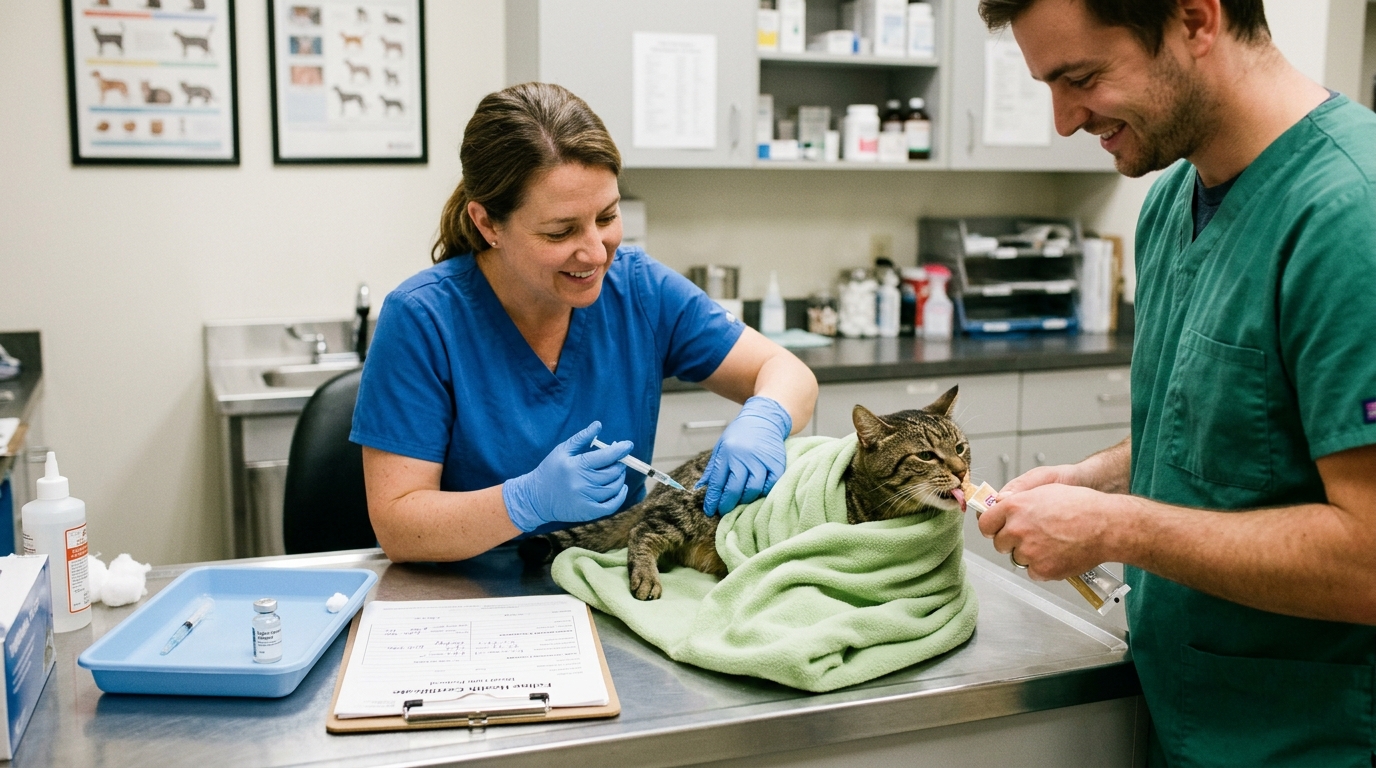
The American Association of Feline Practitioners (FelineVMA) established standardized anatomical injection sites to ensure patient safety. Vaccines should never be administered between the feline shoulder blades (interscapular space). Instead, injections are delivered as distally as possible on the limbs:
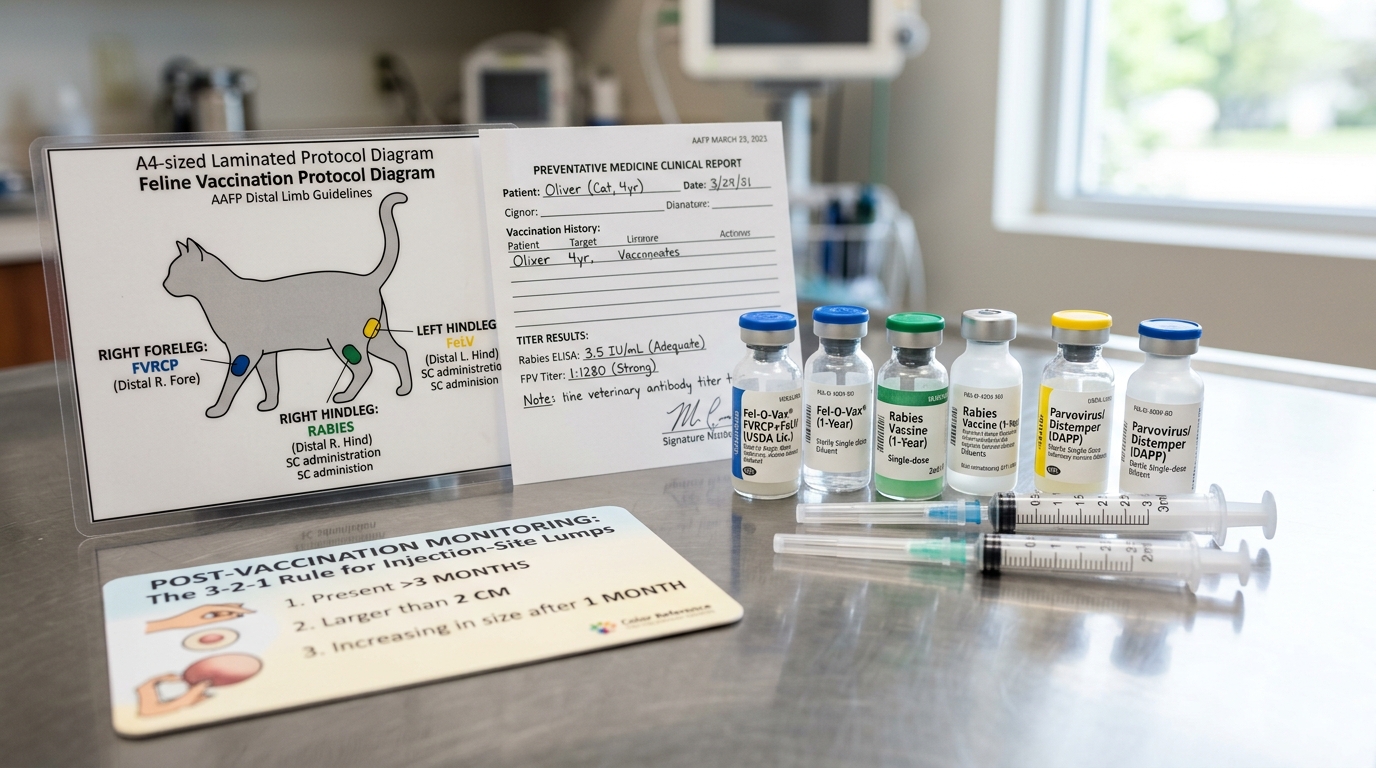
- FVRCP: Administered subcutaneously in the right forelimb below the elbow joint.
- Rabies: Administered subcutaneously in the right hindlimb below the stifle (knee) joint.
- Feline Leukemia (FeLV): Administered subcutaneously in the left hindlimb below the stifle joint.
- Distal Tail: An emerging, cat-friendly injection site shown to be well-tolerated and highly effective in recent clinical studies.
The 3-2-1 Monitoring Rule for Post-Vaccine Lumps
A small, non-painful subcutaneous lump frequently develops at the injection site as a normal inflammatory response to vaccine adjuvants. Pet owners should evaluate these lumps using the 3-2-1 Rule: contact your veterinarian for an incisional biopsy if the lump (1) persists for longer than 3 months after vaccination; (2) is larger than 2 centimeters in diameter; or (3) continues to increase in size 1 month after the injection.
3. Canine Lifestyle Vaccines: Evaluating Exposure Risk
Lifestyle vaccines are recommended based on specific environmental and behavioral exposure routes:
1. Leptospirosis: The Urban and Rural Threat
Leptospira is a spiral-shaped bacterium shed in the urine of wild rodents, raccoons, skunks, and deer. Dogs contract leptospirosis by drinking from puddles, ponds, or slow-moving streams, or by sniffing damp contaminated soil. Leptospirosis causes acute, life-threatening renal failure and severe hepatitis, and is directly transmissible to humans (zoonotic). Modern 4-serovar subunit vaccines are highly purified, have adverse reaction rates comparable to other vaccines, and are now considered an essential core-like vaccine in suburban and urban areas where wildlife and domestic rodents overlap.
2. Lyme Disease (Borrelia burgdorferi)
Transmitted by the bite of the blacklegged deer tick (Ixodes scapularis). Recommended for dogs living in or traveling to Lyme-endemic regions (Northeast, Mid-Atlantic, and Upper Midwest United States). The vaccine stimulates antibodies that neutralize the spirochete inside the tick’s gut as it feeds, preventing transmission of polyarthritis and fatal Lyme nephritis.
3. Bordetella & Canine Infectious Respiratory Disease Complex (CIRDC)
Commonly referred to as “kennel cough.” Crucial for social dogs that frequent boarding facilities, doggy daycare, grooming salons, agility competitions, or communal dog parks. Intranasal and oral formulations stimulate rapid local mucosal IgA immunity in the upper respiratory tract within 48 to 72 hours, providing superior protection against bacterial shedding compared to injectable formats.
4. Canine Influenza Virus (CIV H3N2 / H3N8)
Highly contagious respiratory viruses that spread rapidly through communal dog settings, causing high fevers, productive coughing, purulent nasal discharge, and secondary bacterial pneumonia. Bivalent vaccines provide protection against both circulating strains.
4. Antibody Titers: When Bloodwork Replaces Boosters
For adult dogs and cats with established vaccination histories, antibody titer testing (such as VacciCheck or TiterCHEK) measures circulating blood serum IgG antibody levels. A positive titer demonstrates that the animal possesses protective humoral immunity against specific viral pathogens—notably Canine Parvovirus, Canine Distemper, and Feline Panleukopenia—confirming that booster shots can be safely deferred for that year.
However, titer testing has clear clinical and legal boundaries: (1) titers cannot legally substitute for Rabies vaccination under municipal and state public health laws; and (2) titers cannot reliably assess protection against bacterial infections (such as Leptospirosis or Bordetella), which rely primarily on mucosal or cell-mediated immunity rather than circulating serum antibodies.
Veterinary Escalation Boundary: When to Seek Emergency Care
If your pet experiences facial swelling, hives, vomiting, respiratory distress, or sudden collapse following vaccination, contact an emergency veterinarian immediately for acute anaphylaxis treatment. While mild post-vaccination sleepiness or slight tenderness at the injection site is expected for 24 hours, acute allergic reactions typically develop within 15 to 60 minutes and require rapid administration of injectable antihistamines, epinephrine, and corticosteroids.
Clinical Practice Tool: Veterinary Visit Preparation Sheet
Prepare core and lifestyle vaccination questions for your clinician with our free printable Veterinary Visit Preparation Sheet. Download and print your copy of the Veterinary Visit Preparation Sheet, or explore all practical pet care guides in the NewsPet Resource Center.
Frequently Asked Questions
What core vaccinations are medically mandatory for all pet dogs and cats?
For dogs, core vaccines include Rabies and the combination DHPP (Distemper, Hepatitis, Parvovirus, Parainfluenza). For cats, core vaccines include Rabies and FVRCP (Feline Viral Rhinotracheitis, Calicivirus, Panleukopenia).
What lifestyle factors determine whether a pet needs non-core vaccines?
Exposure risks such as visits to boarding kennels, dog parks, wooded tick habitats, contact with standing wildlife water (Leptospirosis), or outdoor cat roaming determine the necessity of lifestyle vaccines.
Can antibody titer tests be used in place of routine vaccine boosters?
Yes, for certain viral agents like canine distemper and parvovirus, quantitative blood titers verify protective antibody levels. However, Rabies boosters are legally mandated by municipal public health statutes regardless of titer results.
Frequently Asked Questions
Which vaccines are legally required for dogs and cats?
Rabies vaccination is legally mandated across most jurisdictions in North America and Europe for both dogs and domestic cats due to public health biosecurity laws. Failure to maintain up-to-date rabies immunization can result in quarantine penalties if a bite incident occurs.
How often do adult pets need booster vaccinations?
Following the initial puppy/kitten series and 1-year booster, core vaccines (such as canine DAP/DHPP and feline FVRCP) are typically administered on an extended 3-year rotational schedule according to AAHA and AAFP guidelines. Non-core lifestyle vaccines (like Leptospirosis, Bordetella, and Lyme) require annual boosters for high-risk pets.
Are vaccine titers a substitute for regular pet boosters?
Vaccine antibody titer tests (such as VacciCheck or serum neutralization tests) can measure circulating antibody levels against canine distemper, parvovirus, and feline panleukopenia to confirm continuing immunity, allowing veterinarians to tailor booster timing safely.
Sources
Sources checked: September 8, 2026.
- AAHA: Canine Vaccination Guidelines and Lifestyle Calculator
- FelineVMA / AAHA: Feline Vaccination Guidelines and Distal Limb Protocol
- WSAVA: Global Guidelines for the Vaccination of Dogs and Cats
- CDC: Rabies Virus Prevention, Transmission, and State Compendium Laws
- Cornell Feline Health Center: Feline Vaccines and Injection-Site Sarcoma Protocols
Emergency Triage Matrix: Clinical Presentation & Required Response
| Triage Level | Clinical Signs & Presentation | Immediate Action Protocol |
|---|---|---|
| Tier 1: Immediate Emergency (0–2 Hours) | Acute post-vaccination anaphylaxis: facial swelling (angioedema), hives, persistent vomiting, pale gums, respiratory distress, or acute collapse within 1 hour of injection. | Immediate emergency hospital transport; emergency administration of intramuscular epinephrine, injectable dexamethasone, H1 antihistamines, and oxygen resuscitation. |
| Tier 2: Urgent Veterinary Care (Same-Day) | Persistent fever > 103.5°F lasting over 24 hours, profound lethargy, refusal to eat or drink for >24 hours, or large growing painful injection site swelling. | Urgent veterinary clinical examination; complete vital sign assessment, hydration check, and evaluation of local inflammatory versus hypersensitivity reaction. |
| Tier 3: Home Monitoring & Scheduled Care | Mild tiredness, slightly decreased energy for 12 to 24 hours, and slight localized soreness at the injection site in an otherwise alert, drinking pet. | Provide a warm, quiet resting area, monitor temperature and appetite, and avoid strenuous exercise or bathing for 48 hours. |
Rule S1 Boundaries & Immunization Safety Boundaries
Vaccine administration requires strict adherence to immunological protocols:
- NEVER stop puppy or kitten vaccinations after a single initial dose: Maternally derived antibodies neutralize vaccine antigens without activating adaptive memory cells; without sequential boosters through 16 weeks, young animals remain entirely vulnerable to fatal parvovirus and panleukopenia.
- NEVER vaccinate an animal exhibiting acute febrile illness or systemic immunosuppression: Vaccinating a compromised immune system blunts antibody response, risks exacerbating concurrent systemic disease, and precipitates severe systemic inflammatory reactions.
- NEVER administer human antihistamines or NSAIDs before vaccination without veterinary order: Human analgesics (ibuprofen, acetaminophen) are toxic; prophylactic antihistamines can mask early respiratory or cardiovascular signs of acute anaphylactic collapse.
- NEVER ignore the 3-2-1 rule for feline injection-site masses: Any feline injection lump persisting >3 months, larger than 2 cm, or growing 1 month post-vaccine requires incisional biopsy to rule out feline injection-site sarcoma (FISS).
Caregiver Immunization Preparation & Monitoring Checklist
- Review your pet’s lifestyle risk factors with your veterinarian (dog parks, boarding kennels, hunting, standing water, outdoor feline access).
- Ensure pediatric vaccines are spaced every 3 to 4 weeks (e.g., at 8, 12, and 16 weeks) to close maternal antibody vulnerability windows.
- Remain in the veterinary clinic waiting area or parking lot for 15 to 20 minutes post-vaccination to monitor for acute anaphylaxis.
- Request specific injection site documentation in medical records (distal limbs for felines per AAFP guidelines).
- Discuss serological antibody titer testing (e.g., for distemper and parvovirus) for adult dogs as a clinical alternative to automatic revaccination.
Related Clinical Guides & Tools
Peer-Reviewed Clinical References & Evidence Grounding
- PMID: 36336419: Ehrlichiosis and Anaplasmosis: An Update (Vet Clin North Am Small Anim Pract, 2022) (opens in new tab)
- PMID: 36006301: Canine Leishmaniasis: Update on Epidemiology, Diagnosis, Treatment, and Prevention (Vet Sci, 2022) (opens in new tab)
- PMID: 39480742: 2022 AAHA Canine Vaccination Guidelines (2024 Update) (J Am Anim Hosp Assoc, 2024) (opens in new tab)
- Cornell Feline Health Center — Veterinary Clinical & Diagnostic Resources (opens in new tab)
Printable tools
Download the matching worksheet
Source transparency
Reference mix for this guide
Source labels describe the type of organization behind each reference; they are not a claim that any outside organization reviewed this article.
- AAHA: Canine Vaccination Guidelines and Lifestyle Calculator Veterinary organization · aaha.org
- FelineVMA / AAHA: Feline Vaccination Guidelines and Distal Limb Protocol Veterinary organization · catvets.com
- WSAVA: Global Guidelines for the Vaccination of Dogs and Cats Veterinary organization · wsava.org
- CDC: Rabies Virus Prevention, Transmission, and State Compendium Laws Government or public agency · cdc.gov
- Cornell Feline Health Center: Feline Vaccines and Injection-Site Sarcoma Protocols Academic or extension · vet.cornell.edu
- Separation Anxiety in Dogs: What to Do First (Calm Reference source · newspet.net
- Cat Litter Box Problems: Causes & Solutions (V Reference source · newspet.net
- Foods Dogs & Cats Cannot Eat: Toxic List & Reference source · newspet.net