This guide is general education for pet owners. If your pet has urgent symptoms, possible poisoning, injury, breathing trouble, collapse, severe pain, or sudden decline, contact a licensed veterinarian or local emergency service.
Dosages must be calculated by a licensed veterinarian based on species, weight, and bloodwork. Never administer human medications or self-adjust prescription doses for pets.
Editorial standard
How this guide was prepared
A kitten’s first week is short enough that missed intake, unsafe access, or an overwhelming introduction can matter quickly. The goal is not to complete seven milestones. It is to establish a safe room and measurable care rhythm, then add play, handling, territory, and introductions only while the kitten remains warm, alert, eating, eliminating, resting, and recovering well.
Clinical Quick Answer & Immediate Actions
The initial seven days following the arrival of a kitten represent a physiologically vulnerable transition period where pediatric metabolic fragility requires vigilant oversight. Kittens under 12 weeks of age lack adult thermoregulatory efficiency and have minimal hepatic glycogen reserves; prolonged chilling (hypothermia below 99.0°F) or missing meals for longer than 4 to 6 hours can rapidly trigger fatal hypoglycemic collapse and ‘fading kitten syndrome’. Establishing a dedicated, kitten-proof sanctuary room (such as a warm bathroom or quiet spare bedroom) is clinically mandatory. The sanctuary space must feature a secure heat source (snuggle safe pad or heated pet bed wrapped in fleece), a shallow, low-entry litter box filled exclusively with non-clumping, paper-based litter (to prevent lethal gastrointestinal impaction from clumping clay ingestion), frequent high-calorie wet feedings, and complete elimination of mechanical hazards (recliner chairs, looped blind cords, toxic house plants, and tiny linear foreign bodies).
If a kitten shows signs of severe lethargy, hypothermia, or persistent vomiting, contact an emergency veterinarian immediately for urgent triage and fluid therapy.
Prepare before arrival: one room with observable essentials
Choose a quiet closable room without unsafe wall gaps, reclining furniture, open vents, unstable shelves, accessible cords, strings, medicines, cleaners, toxic plants, or small chewable objects. Check windows and screens; an insect screen is not automatically escape-proof. Block hiding voids you cannot safely reach, then provide reachable cover such as a carrier, box, or draped bed.
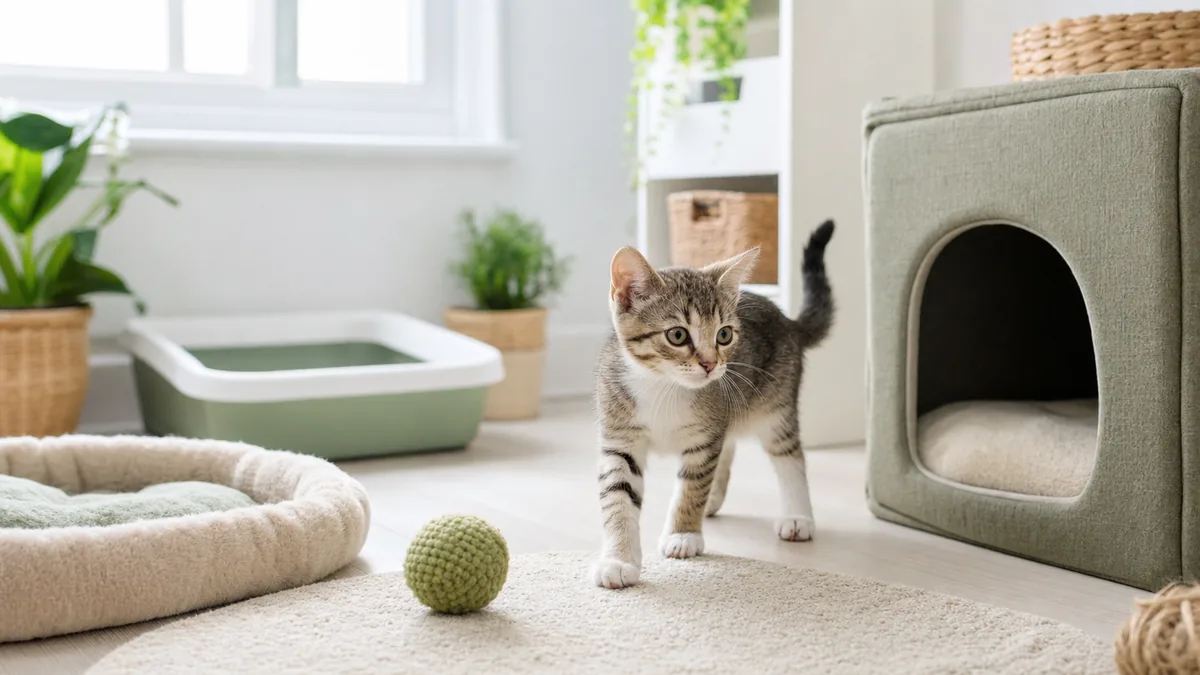
Set out the familiar food, shallow water, an appropriately sized litter tray with the known litter, soft bedding, a stable scratcher, and a few simple toys. Separate food and water from the tray where the room allows. Place the open carrier as part of the room, with bedding inside, rather than storing it until the veterinary visit.
Ask the previous caregiver for birth or estimated age, current weight if known, food product and portions, feeding frequency, litter type, vaccination and parasite records, microchip details, medication, illness exposure, and recent appetite and stool. Book the first veterinary review on the timeline the clinic recommends. Keep a transport plan ready before the kitten arrives.
Record the first observed intake and litter evidence instead of assuming the handover continued. Note the caregiver’s last known meal and elimination, then record what is offered, eaten, urinated, and passed as stool. Keep the original food and litter labels. If history is missing or the kitten is very young, small, unwell, or not fully weaned, ask the clinic when to report.
Days 1 and 2: protect intake, warmth, litter, and sleep
Bring the closed carrier into the prepared room, close the door, and let the kitten emerge without being tipped or pulled out. Keep the household quiet. Sit low, offer food and play gently if the kitten approaches, and allow retreat. A confident kitten may explore immediately; a cautious kitten may watch from cover. Neither response creates a deadline for more space.
| Care point | What to keep measurable | What changes the plan |
|---|---|---|
| Food | Product, offered amount, time, and amount eaten. | Repeated refusal, difficulty chewing or swallowing, vomiting, marked weakness, or a swollen painful belly. |
| Water | Fresh accessible water and whether the kitten is seen drinking. | Repeated vomiting or diarrhea, weakness, reduced responsiveness, or concern that the kitten cannot keep water down. |
| Litter | Urine and stool frequency, appearance, and tray access. | Straining, blood, persistent diarrhea, no observed urine, or inability to reach the tray. |
| Rest and temperature | Warm bedding, quiet sleep, normal waking, and comfortable movement. | Cold body, persistent crying, collapse, difficult breathing, pain, or inability to stand normally. |
Continue the known commercially prepared kitten food and feeding plan unless the veterinarian or responsible rescue directs a change. Do not add milk, supplements, raw food, or homemade replacements as a settling remedy. If the kitten is not fully weaned, ask the veterinary clinic or experienced rescue for an age- and health-specific feeding plan rather than applying the schedule for a weaned kitten.
Show the litter tray after waking and meals without repeatedly placing or holding the kitten in it. Scoop promptly and clean accidents without punishment. Protect long periods of sleep; constant handling and entertainment can make it harder to notice when a kitten is genuinely lethargic.
The overnight plan names who checks warmth, waking, food, and litter. Before the household sleeps, confirm the room temperature is comfortable, bedding is dry, water and the tray are reachable, hazards are removed, and the next known feeding or clinic instruction is understood. Use only heating equipment specifically considered safe for the setup and prevent direct contact or entrapment. On waking, record whether the kitten rouses normally and compare intake and elimination with the arrival note; persistent crying, unusual coldness, weakness, or poor responsiveness ends the settling agenda.
Days 3 and 4: add play and cooperative handling
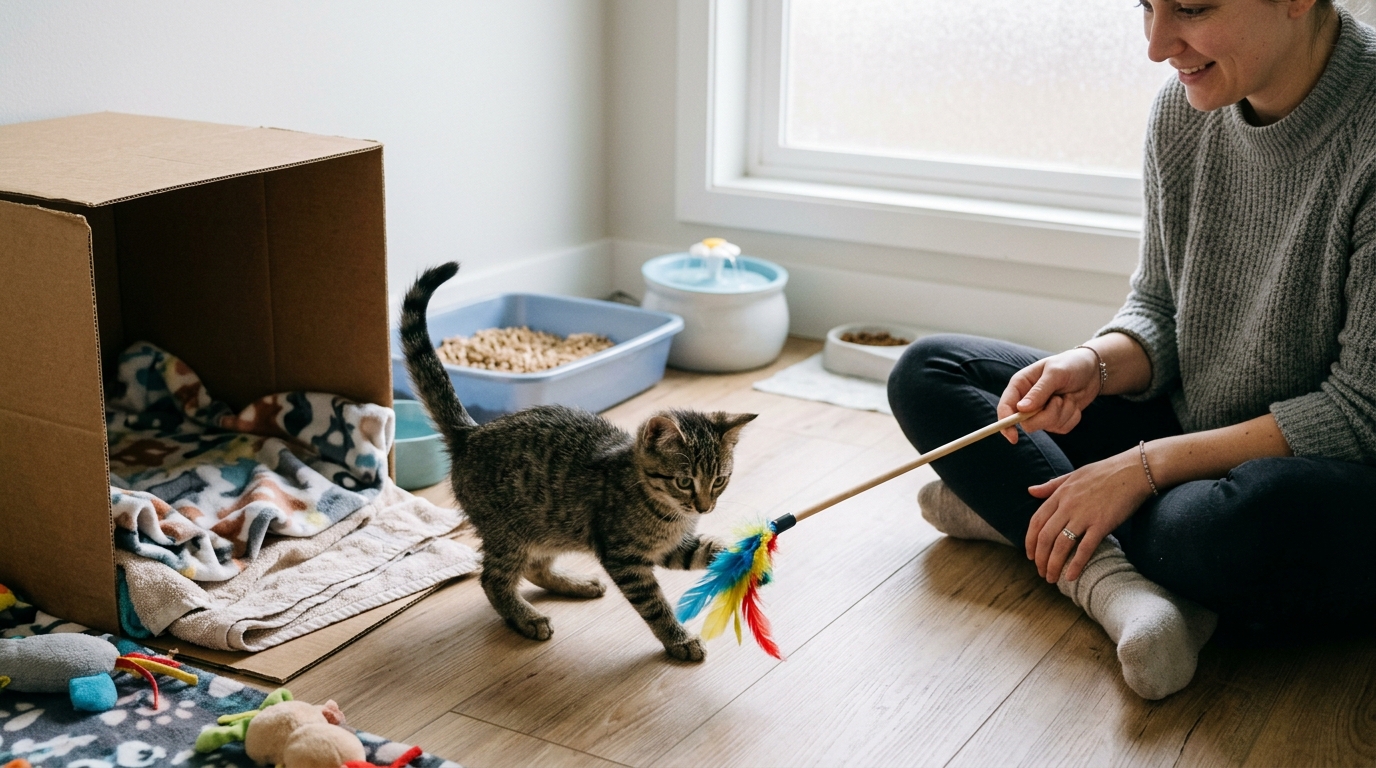
If intake and elimination are stable and the kitten is voluntarily engaging, introduce several short play sessions with wand or toss toys. Move the toy away like prey, allow catching, and finish with a small food opportunity when appropriate. Keep hands and feet out of the chase game so ordinary touch does not become a bite-and-grab target.
Begin handling as tiny consent-aware repetitions: touch a shoulder, pause, and offer a reward; briefly lift a lip, touch an ear flap, or hold a paw only while the kitten stays loose and returns. Stop at retreat, flattening, freezing, tail lashing, growling, or repeated biting. Necessary care may still require veterinary help, but forceful practice is not preparation.
Make everyday sounds gradual. Let the kitten hear a door, appliance, voices, and ordinary movement from a manageable distance rather than staging a noisy exposure event. Everyone should use the same rules for doors, lifting, play, food, and sleep. Children sit on the floor with direct adult supervision and allow the kitten to leave.
Continue carrier trust by placing treats or part of a meal near or inside it. If the kitten enters comfortably, briefly touch the door and reopen it. The purpose is to preserve an exit choice and build a usable transport skill, not to complete a confinement test by day four.
Days 5 to 7: decide whether the room can grow
Consider a short supervised look into one additional secure area only if the kitten is eating, using the tray, sleeping, moving comfortably, playing, and returning to the base room without frantic behavior. Inspect the new area at kitten height first. Check gaps behind appliances, stair rails, balconies, plants, strings, hot surfaces, washers and dryers, toilets, furniture mechanisms, and access to exterior doors.
Open one inspected room boundary while the base room stays available. Close exterior doors, remove resident animals, count the kitten before and after the trial, and keep the route back unobstructed. End the trial while the kitten can still return and settle. Do not add a visitor, new animal view, unfamiliar food, and another room in the same session, because a later change in eating, litter use, or sleep would have no clear cause.
Keep the original room intact while access expands. A kitten who hides continuously after expansion, misses meals, has accidents, becomes difficult to locate, or cannot settle needs less territory and another review of the setup. More space is not automatically more enrichment; a small room with usable hiding, climbing, scratching, play, food, water, litter, and social choice can support the first week well.
At the end of day seven, review the individual rather than checking off milestones. Confirm the veterinary appointment, identification, food supply, weight-monitoring advice, parasite and vaccination questions, carrier access, sleep protection, and the next safe area. If the new arrival is an adult cat rather than a kitten, switch to the distinct adult-cat trust and territory plan; kitten development should not be stretched into a 30-day template.
Introduce people and resident animals through barriers
Delay introductions until the kitten’s base routine and health are stable. New people enter quietly, sit rather than pursue, and allow approach and retreat. Avoid passing the kitten around. The kitten should retain a hiding place and an unobstructed route back to the safe room.
For a resident cat, begin with separate territories and scent exchange using bedding or cloths, then positive experiences on opposite sides of a closed door. Progress to controlled visual access only when both cats can eat, play, or disengage without escalating. Provide separate food, water, litter, resting, scratching, and high escape options; do not expect the adult cat to supervise or discipline the kitten safely.
For a dog, use a secure barrier and direct adult control. The kitten needs vertical and room-level escape routes the dog cannot access. Reward calm orientation and disengagement at a distance. End the session for stalking, fixation, lunging, barking that cannot settle, chase attempts, or a kitten that freezes or flees. Never leave the pair together because one calm meeting appeared successful.
Resident-animal progress requires a secure barrier and a kitten-only retreat. Test the barrier without the animals present, prevent paws or heads from reaching through unsafe gaps, and keep food, litter, sleep, and play available away from the viewing point. Advance only one sense at a time when possible, such as scent before sight. After any chase attempt, barrier failure, prolonged fixation, or blocked resource route, restore separate territories and reassess before another session.
When to contact a veterinarian during the first week
Age, size, known illness, and weaning status can change how urgently a kitten needs assessment. Contact the veterinary clinic for reduced intake, repeated vomiting or diarrhea, weakness, unusual coldness, pain, discharge accompanied by reduced appetite, coughing, abdominal swelling, abnormal movement, wounds, or a marked change from the kitten’s recorded baseline. Give the clinic the kitten’s age and weight if known and follow its triage advice.
Stop the settling plan and call the clinic when the recorded baseline changes. Do not wait for the next meal, overnight check, room trial, or introduction when a very young or small kitten has not eaten as expected, cannot stay warm, is difficult to wake, repeatedly vomits or has diarrhea, strains, produces no observed urine, or loses normal standing or movement. The clinic should set the response time from the kitten’s age, size, history, and current signs.
Seek urgent assessment for labored or open-mouth breathing, collapse, major trauma, uncontrolled bleeding, repeated seizure activity, suspected poisoning, inability to stand, straining without urine, or rapid deterioration. Do not delay care to complete the day’s settling step, wait for an introduction, or try an unprescribed product.
Use careful hygiene around litter and waste, supervise children, and wash hands after cleaning. If anyone in the household is pregnant, immunocompromised, very young, or otherwise at higher infection risk, ask human and veterinary healthcare professionals for advice relevant to the household rather than separating the kitten without a plan.
Clinical Practice Tool: New Pet First Week Checklist
Guide your new kitten through their vital first 7 days of territory exploration and gentle socialization with our printable New Pet First Week Checklist. Download and print your copy of the New Pet First Week Checklist, or explore all practical pet care guides in the NewsPet Resource Center.
Frequently Asked Questions
What temperature and environmental setup does a newly adopted kitten require?
Kittens under 8 weeks struggle with thermoregulation and require a draft-free warm room (75-80°F) equipped with low-sided litter boxes, soft nesting blankets, and accessible shallow food and water dishes.
How often should an 8 to 12 week old kitten be fed daily?
Young kittens have tiny stomachs and high metabolic demands; they should receive 3 to 4 portion-controlled meals of balanced kitten formula wet and dry food daily to maintain steady blood glucose levels.
When should a new kitten receive their initial veterinary examination and deworming?
Schedule an initial exam within 48 to 72 hours of bringing the kitten home. Kittens routinely require veterinary deworming for roundworms and hookworms and initiation of core FVRCP vaccines starting around 6 to 8 weeks.
Sources
Sources checked: September 8, 2026.
- AAFP and ISFM Feline Environmental Needs Guidelines
- CDC: Cats and healthy pets
- ASPCA: General cat care
- VCA Animal Hospitals: Feeding growing kittens
- VCA Animal Hospitals: Emergencies in cats
Emergency Triage Matrix: Clinical Presentation & Required Response
| Triage Level | Clinical Signs & Presentation | Immediate Action Protocol |
|---|---|---|
| Tier 1: Immediate Emergency (0–2 Hours) | Kitten is limp, unresponsive, or comatose; body temperature <98.5°F (cold paws and ears); watery foul-smelling diarrhea with vomiting; or severe respiratory gasping with open-mouth breathing (fading kitten crisis). | Immediate emergency veterinary transport; initiate active warming using warm fleece blankets, rub corn syrup or high-calorie glucose gel onto the oral mucous membranes, and provide immediate veterinary IV/IO fluid resuscitation. |
| Tier 2: Urgent Veterinary Care (Same-Day) | Kitten refuses food for >8 hours, exhibits crusted shut eyes or purulent nasal discharge (severe feline herpesvirus / calicivirus), heavy flea infestation with pale white gums (flea anemia), or strained urination. | Same-day veterinary evaluation; point-of-care blood glucose and hematocrit check, gentle nasal passage clearing, prescription pediatric antimicrobial ophthalmic ointment, and safe pediatric parasite decontaminations. |
| Tier 3: Home Monitoring & Scheduled Care | Kitten is energetic, purring, eating kitten formula/canned food enthusiastically, with normal urine and formed stool, but vocalizes softly or explores cautiously during initial night settling. | Provide consistent thermal warmth, maintain frequent small meals every 4 to 6 hours, offer gentle human socialization, and schedule routine pediatric wellness checkups within 3 to 5 days. |
Rule S1 Boundaries & Pediatric Feline Safety Rules
Pediatric kitten care demands strict observance of physiological boundaries:
- NEVER use clumping clay or silica litter for kittens under 10 weeks of age: Young kittens explore by mouthing environmental substrates; ingested sodium bentonite clumping clay expands massively in the gastrointestinal tract, causing fatal intestinal impaction.
- NEVER fast a young kitten or withhold food overnight: Pediatric felines have immature hepatic gluconeogenesis; fasting longer than 6 hours causes rapid, severe neuroglycopenia, seizures, and irreversible brain injury.
- NEVER apply adult over-the-counter flea spot-ons or medicated flea baths: Topical adult ectoparasiticides cause fatal organ toxicity in pediatric felines; manual flea combing with warm water and veterinary-approved pediatric nitenpyram is mandatory.
- NEVER operate mechanical recliner chairs or sofa beds without visual confirmation: Kittens instinctively seek dark, enclosed cavities inside recliner scissor mechanisms, leading to catastrophic crush trauma and death when furniture is moved.
Caregiver First-Week Kitten Sanctuary & Safety Protocol
- Set up a warm, quiet sanctuary room equipped with a cozy bed, heated fleece pad, and secure boundaries before bringing the kitten home.
- Deploy a shallow, low-lipped litter box filled with non-scented paper pellets or natural pine pellets rather than bentonite clay.
- Feed high-quality kitten canned food mixed with warm water or kitten milk replacer (KMR) 4 to 5 times daily on a predictable schedule.
- Kitten-proof the sanctuary room: tie up all dangling blind cords, cover electrical cables with conduit, and remove all toxic plants (especially lilies).
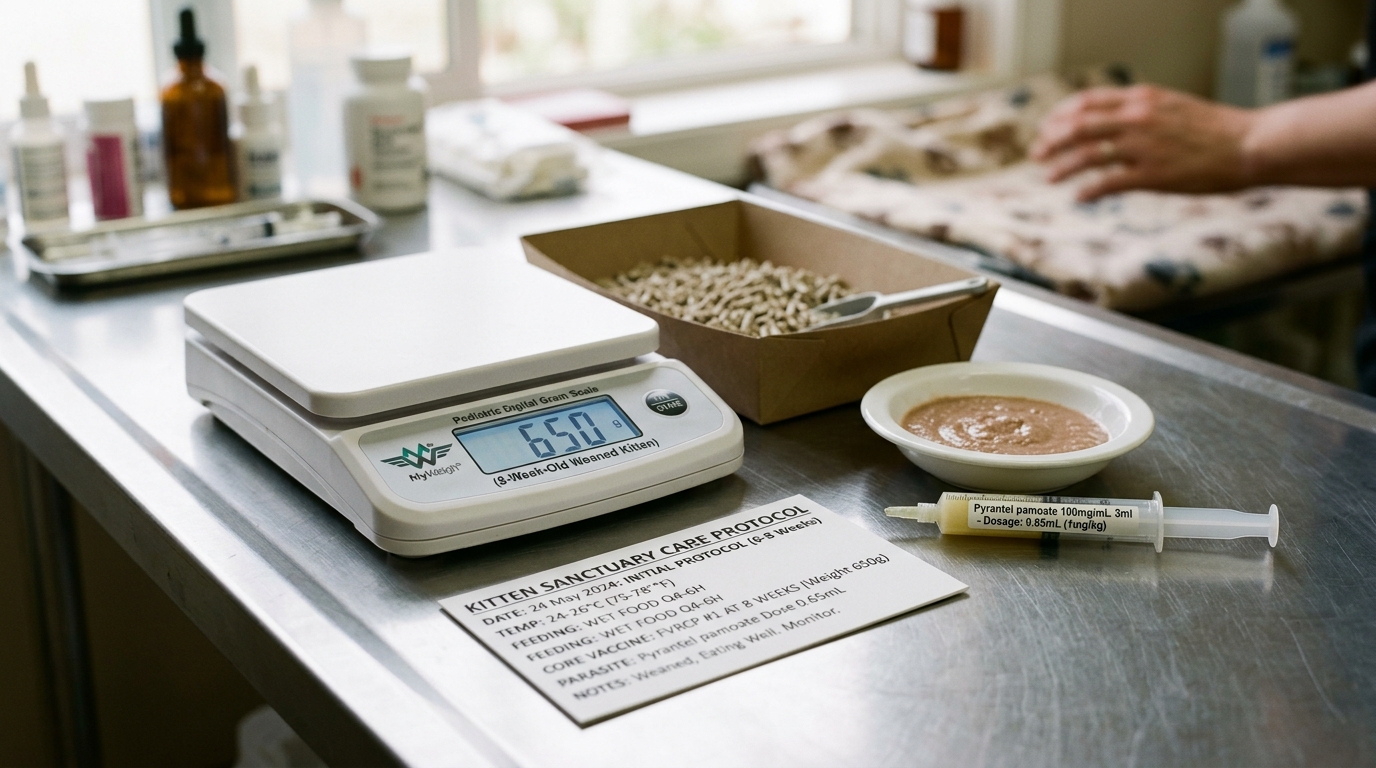
- Weigh the kitten daily at the same time using a digital kitchen scale graduated in grams; ensure consistent daily weight gain (typically 10–15 grams/day).
- Schedule a primary veterinary pediatric exam within the first 72 hours for initial deworming, fecal flotation, and overall baseline health clearance.
Related Clinical Guides & Tools
Peer-Reviewed Clinical References & Evidence Grounding
- PMID: 21413385: The Primary Visual Cortex (Veterinary Journal, 1995) (opens in new tab)
- PMID: 31474197: Preliminary analysis of post-adoption outcomes for kittens and adult cats rehomed through a New Zealand animal shelter (N Z Vet J, 2020) (opens in new tab)
- PMID: 1429133: Multiple cardiac anomalies in a cat (J Am Vet Med Assoc, 1992) (opens in new tab)
- Cornell Feline Health Center — Veterinary Clinical & Diagnostic Resources (opens in new tab)
Printable tools
Download the matching worksheet
Source transparency
Reference mix for this guide
Source labels describe the type of organization behind each reference; they are not a claim that any outside organization reviewed this article.
- AAFP and ISFM Feline Environmental Needs Guidelines Veterinary organization · catvets.com
- CDC: Cats and healthy pets Government or public agency · cdc.gov
- ASPCA: General cat care Animal welfare nonprofit · aspca.org
- VCA Animal Hospitals: Feeding growing kittens Reference source · vcahospitals.com
- VCA Animal Hospitals: Emergencies in cats Reference source · vcahospitals.com
- Indoor Cat Enrichment: Build a Home That Meets Nat Reference source · newspet.net
- Cat Litter Box Problems: Causes & Solutions (V Reference source · newspet.net
- Why Cats Scratch Furniture and How to Redirect It Reference source · newspet.net