Editorial standard
How this guide was prepared
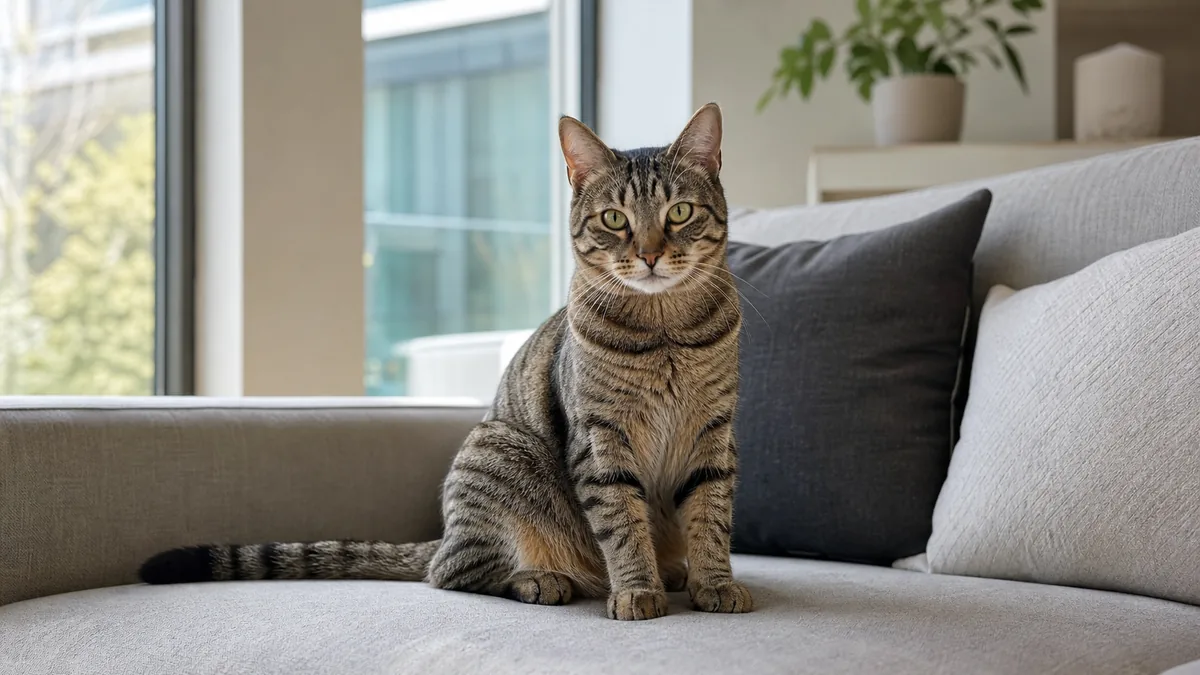
Decoding feline body language requires moving beyond simplistic, single-feature interpretations to observe the entire animal in its immediate environmental context. A cat’s physical posture does not operate like a static dictionary; an upright tail can express enthusiastic social greeting or intense territorial arousal, wide dilated pupils can reflect dim ambient illumination or acute sympathetic terror, and purring can signify profound contentment or severe physiological distress during terminal illness. The fundamental question for caregivers is never “what does an isolated ear movement mean?” but rather “what is the cat’s whole body communicating right now, and what human response preserves the animal’s sense of agency, security, and physical choice?”
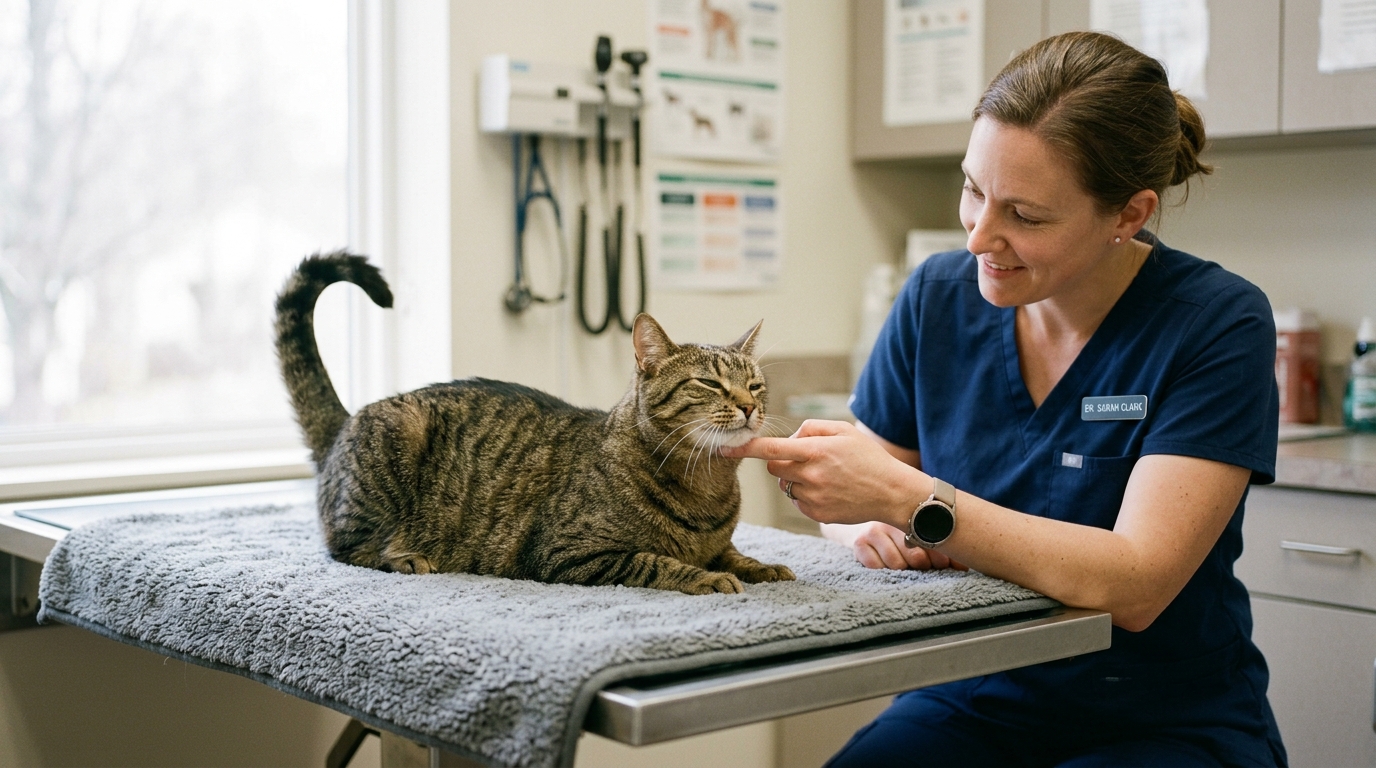
Clinical Quick Answer & Immediate Actions
Feline communication relies heavily on subtle body language cues combining tail carriage, ear positioning, pupil dilation, and whole-body muscle tension. Unlike dogs, a wagging or swishing tail in cats signals escalating emotional arousal, irritation, or conflict rather than happiness. Recognizing early warning signs—such as skin rippling, rapid ear rotation (‘airplane ears’), or sudden dilated pupils—allows caregivers to stop interaction before petting-induced aggression or defensive scratches occur.
Feline ethology combines evolutionary adaptations of a solitary ambush predator with those of a small prey species susceptible to larger carnivores. Because cats must constantly balance hunting opportunities with self-preservation, their visual signals are remarkably nuanced, rapid, and subtle. By evaluating dynamic postures across three integrated biological layers—the environmental setting, the simultaneous cluster of anatomical signals (tail, pinnae, pupils, vibrissae, and musculoskeletal tension), and deviations from an individual cat’s known behavioral baseline—caregivers can prevent defensive aggression, deepen cross-species trust, and identify early clinical markers of systemic disease.
Phase 1: Feline Tail Dialects: From Friendly Greetings to Defensive Warnings
The feline tail is an exquisite extension of the spinal column, consisting of 18 to 23 caudal vertebrae surrounded by specialized musculature. Tail mobility provides balance during high-speed athletic maneuvers and serves as one of the most expressive visual communication channels in mammalian ethology.
The Upright “Question Mark” Tail (Affiliative Greeting)
When a cat walks toward a human or another bonded feline with the tail held vertically erect, often with a gentle anterior hook or curve at the tip resembling a question mark, they are demonstrating classic affiliative behavior. This posture evolved as an amicable greeting signal between mothers and kittens, later adapted into social interactions between adult cats and trusted human companions. An upright tail exposes the anal glands and perineal region, communicating absolute transparency and an invitation to engage in peaceful olfactory and tactile greeting.
The Low, Tucked, or Wrapped Tail (Apprehension and Defensive Guarding)
A tail carried horizontally level with the spine or clamped down tightly against the perineum, often tucked between the rear legs, indicates spatial uncertainty, acute fear, or submissive evasion. When resting, tightly wrapping the tail around the perimeter of the body can serve a dual purpose: conserving metabolic body heat in cool environments or forming a physical shield around the vulnerable underbelly when the cat feels unsafe in their environment.
The Swishing, Lashing, and Thumping Tail (Rising Autonomic Arousal)
Unlike dogs, who wag their tails during broad ranges of social excitement and friendly arousal, a lashing feline tail is a definitive distance-increasing signal. Movement typically begins as microscopic twitches at the tail tip, indicating mild cognitive conflict or sensory processing. As autonomic arousal escalates, the motion transforms into rhythmic lateral swishing, culminating in forceful thumping against the floor or furniture cushions. A thumping tail warns that the cat’s neurological threshold has been breached; continued petting or crowding will trigger an instantaneous swat, bite, or defensive retreat.
The Piloerect “Bottlebrush” Tail (Sympathetic Adrenergic Surge)
Under sudden acute fright, surprise, or intense territorial confrontation, adrenaline stimulates the tiny arrector pili muscles surrounding each hair follicle along the tail and dorsal spine. The tail instantly puffs outward to two or three times its normal circumference, resembling a bottlebrush, often accompanied by an arched back and sideways walking gait. This involuntary autonomic response is designed to visually exaggerate the cat’s body size to deter potential predators or rival cats.
Phase 2: Ear Positions: Pinnae Mechanics and Auditory Radar
A cat’s outer ear (pinna) is controlled by 32 individual muscles, granting each ear the remarkable ability to rotate independently up to 180 degrees. While evolved primarily to pinpoint the ultrasonic rustling of rodents, ear positioning serves as an instantaneous barometer of emotional state.
- Erect and Forward-Facing: In a content, relaxed cat, the pinnae point forward and slightly outward, soft and mobile, tracking ambient domestic sounds without rigidity.
- Asymmetrical Ear Twitching: When one ear swivels backward while the other faces forward, the cat is processing conflicting sensory stimuli or experiencing mild irritation. Rapid, persistent fluttering of the ears indicates growing annoyance or sensory overload.
- Sideways “Airplane Ears” (Defensive Fear & Uncertainty): When the ears rotate horizontally outward and flatten down against the skull like the wings of an aircraft, the cat is experiencing acute fear and emotional distress. This posture protects the delicate auricular cartilage from lacerations during potential physical conflict while signaling that the cat feels cornered.
- Pinned Flat Backward Against the Nape: Ears plastered completely flat backward against the neck, completely hidden from frontal view, represent extreme defensive aggression. In this state, the cat is fully primed to launch physical strikes with claws and teeth if an encroaching human or animal steps within strike range.
Phase 3: Ocular Cues: Pupillary Dilation, Slow Blinks, and Direct Stares
Feline eyes possess elliptical pupils capable of expanding to absorb minimal photons in near-total darkness or constricting into razor-thin vertical slits under bright sunlight. Beyond optical light regulation, pupil aperture is directly tied to autonomic nervous system tone.
Pupillary Mydriasis (Dilated Pupils) vs. Miosis (Constricted Pupils)
When light levels are constant, sudden pupillary dilation (mydriasis)—where the black pupil expands to consume nearly the entire iris—signals acute sympathetic nervous system excitation. This dilation maximizes visual field capture and peripheral motion detection during predatory play, intense fear, acute pain, or defensive terror. Conversely, constricted slit pupils (miosis) in moderate light often accompany high assertive arousal, offensive territorial posturing, or intense competitive focus on a rival animal.
The Slow-Blink Phenomenon (Feline Social Trust)
Pioneering cognitive research conducted at the University of Sussex established that the feline “slow blink”—a series of slow, half-closed blinks where the eyes soften and momentarily close—functions as the feline equivalent of a genuine human smile. Because a solitary predator never closes its eyes in the presence of an active threat, closing the eyelids in the presence of another individual represents an explicit declaration of social safety and vulnerability. Pet owners can reciprocate by slow-blinking back, which has been shown experimentally to increase a cat’s willingness to approach and engage.
The Hard, Unblinking Stare
A prolonged, direct, unblinking visual lock directed toward another cat or a human is a dominant, distance-increasing challenge. In multi-cat households, subtle social bullying rarely involves physical brawling; instead, a dominant cat will quietly sit in a hallway or doorway, holding an unblinking gaze that effectively traps a more submissive cat away from litter boxes, food bowls, or favored resting platforms.
Phase 4: Facial Pheromone Bunting, Whiskers, and the 3-Second Consent Test
A cat’s face is a complex chemical broadcast station lined with specialized sebaceous scent glands located around the lips (perioral), chin (submandibular), cheeks (temporal), and base of the ears. When a cat rubs these facial regions against furniture, doorframes, or human limbs—a behavior known ethologically as bunting or allorubbing—they deposit calming feline facial pheromones (such as the F3 fraction), integrating the recipient into their safe olfactory territory.
The Three-Second Petting Consent Test
Petting-induced aggression is one of the most common behavioral complaints among cat owners. It occurs when a cat enjoys initial tactile contact, but continuous stroking rapidly overstimulates their tactile nervous system until they react with a sudden swat or bite. You can eliminate this conflict entirely by implementing the evidence-based Three-Second Consent Test:
- Present a Stationary Hand: Extend your hand toward the cat at their eye level, roughly two to three inches away, curling your fingers into a relaxed, motionless fist with knuckles forward.
- Wait for the Cat to Initiate: Do not reach forward to touch the cat. Allow the animal to bridge the gap voluntarily. If the cat leans forward, sniffs your knuckles, and rubs their cheek or chin against your hand (bunting), they have explicitly granted consent for interaction.
- Pet for Exactly Three Seconds: Stroke the cat gently only on preferred anatomical zones—specifically the cheeks, under the chin, or between the ears. Strictly avoid the sensitive abdomen, paws, and base of the tail.
- Remove Your Hand and Pause: After three seconds, lift your hand away completely and remain still. Observe what the cat does next:
- Consent Granted: If the cat nudges your hand, purrs, rubs against you again, or follows your hand, they are requesting continued interaction. You may pet for another three seconds and repeat the pause.
- Consent Revoked: If the cat looks away, grooms their shoulder, ripples their skin, twitches their tail tip, or remains motionless without re-engaging, contact has concluded. Respect their boundary and give them physical space.
Phase 5: The Feline Somatic Posture Matrix
This structured reference matrix correlates feline whole-body postures with emotional valence, autonomic states, and recommended human interventions.
| Emotional State | Ears & Facial Cues | Tail Configuration | Body Posture & Weight | Recommended Human Action |
|---|---|---|---|---|
| Relaxed & Content | Forward, soft pinnae; half-closed or slow-blinking eyes; relaxed whiskers | Upright with curved tip (“question mark”) or loose resting curve | Stretched out on side or loaf position with paws tucked loosely; fluid movement | Engage gently; offer 3-second consent test; share peaceful space |
| Playful & Predatory | Forward-facing ears; dilated pupils; whiskers thrust forward toward target | Low twitching tip; horizontal swish before pouncing | Hindquarters wiggling; low stalk; crouched with weight forward on toes | Direct energy to wand toys, kicker toys, or puzzle feeders; avoid bare hands |
| Mild Irritation / Overstimulation | Ears twitching backward; pupils slightly dilated; skin rippling on back | Rapidly swishing or thumping rhythmically against floor or cushion | Body tenses; head turns abruptly toward touching hand; feet braced | Stop petting immediately; withdraw hands; give cat space to decompress |
| Fearful & Defensive | “Airplane ears” rotated sideways; fully dilated black pupils; whiskers retracted | Tucked tightly between legs or wrapped firmly around paws | Crouched low to floor; tight compact ball; head lowered below shoulders | Do not approach or reach; open doors/escape routes; extinguish lights and noise |
| Territorial / Threat Posturing | Ears pinned back flat; narrow slit pupils or wide stare; lips pulled back hissing | Piloerect “bottlebrush” held low or in inverted “U” shape | Arched back; stiff-legged sideways crab walk; bristled fur along spine | Create physical visual barrier (cardboard/blanket); never attempt to grab or pick up |
| Physical Pain / Systemic Illness | Ears rotated downward/outward; squinted eyes; flattened whiskers; grimace | Held motionless, clamped low, or resting limp | Hunched meatloaf posture; head hanging low; reluctance to jump or groom | Seek immediate veterinary diagnostic evaluation; do not palpate sore areas |
Phase 6: Petting-Induced Overstimulation & Feline Hyperesthesia
Many cat owners inadvertently trigger aggressive reactions by petting cats along the caudal dorsum (the lower spine adjacent to the tail base). The sacral and tail-base regions possess a dense network of sensitive sensory nerve endings. Repetitive, heavy stroking across this area triggers a phenomenon known as tactile allodynia—where normally non-noxious touch becomes physiologically overwhelming or painful.
In cats suffering from Feline Hyperesthesia Syndrome (FHS), this sensitivity is amplified by an underlying neuromuscular or dermatological disorder. Signs include spontaneous rippling or rolling of the dorsal skin, frenzied self-directed grooming or biting at the flanks and tail, frantic vocalization, and sudden erratic darting across the home. If your cat demonstrates extreme skin sensitivity, consult a veterinarian to rule out flea allergy dermatitis, spinal osteoarthritis, or neurological hyperesthesia.
Phase 7: Medical Disguises: When Body Language Signals Pain or Systemic Illness
Because cats are solitary hunters in the wild, displaying overt weakness, limping, or vocalizing from chronic pain makes them vulnerable to predation and territorial eviction. Consequently, cats mask physical discomfort until pathological conditions are advanced.
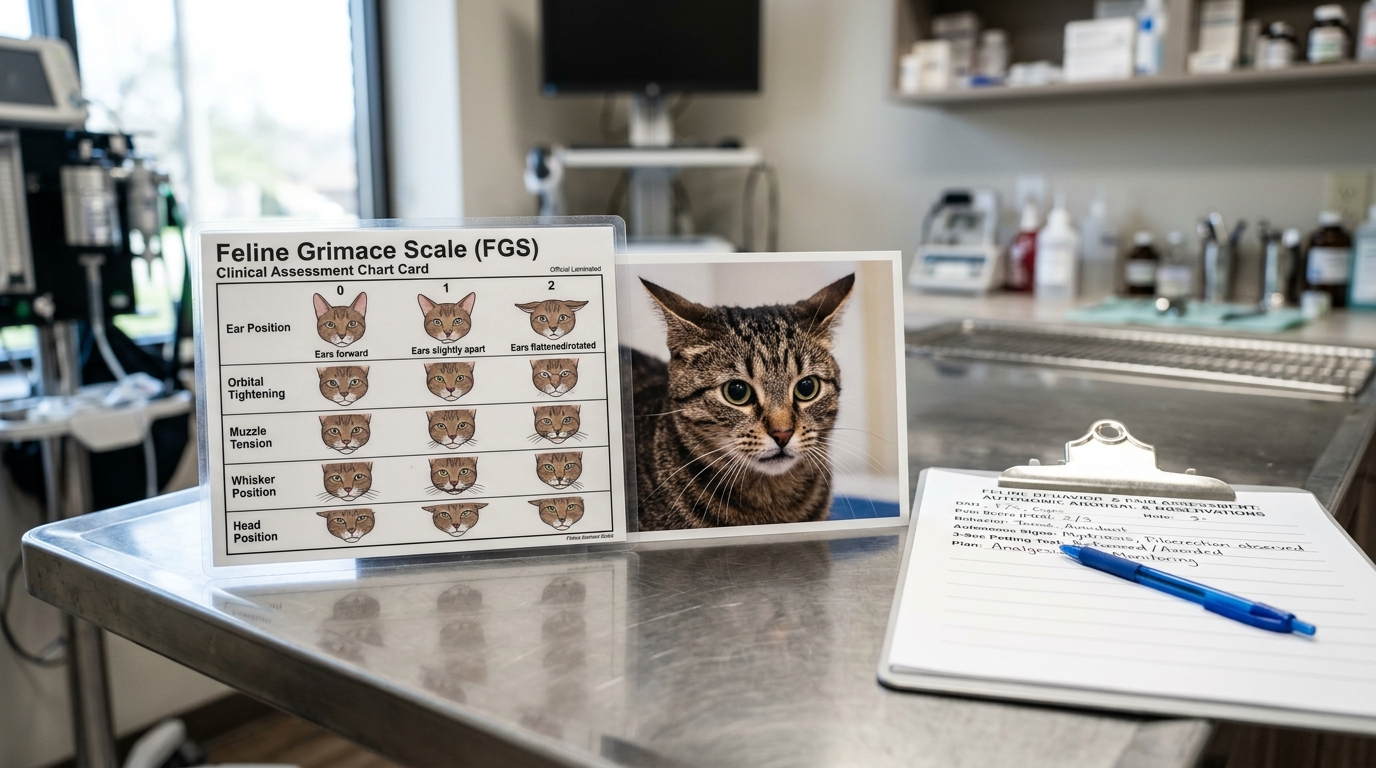
The Feline Grimace Scale (FGS)
Developed and validated by veterinary researchers at the University of Montreal, the Feline Grimace Scale evaluates acute and chronic pain through five facial action units (FAUs):
- Ear Position: Normal (ears facing forward, score 0), Moderate pain (ears pulled slightly apart, score 1), Severe pain (ears rotated outward and flattened, score 2).
- Orbital Tightening: Normal (eyes open and rounded, score 0), Moderate pain (partially closed or almond-shaped eyelids, score 1), Severe pain (eyes squinched shut tightly, score 2).
- Muzzle Tension: Normal (relaxed, round muzzle, score 0), Moderate pain (mild tension, score 1), Severe pain (elliptical, tense, pulled-back muzzle, score 2).
- Whisker Change: Normal (loose, curved downward whiskers, score 0), Moderate pain (slightly curved or straight whiskers, score 1), Severe pain (straight whiskers pointing forward and bristled, score 2).
- Head Position: Normal (head held above the shoulder line, score 0), Moderate pain (head aligned level with shoulders, score 1), Severe pain (head hanging low, chin tilted toward chest, score 2).
A cumulative FGS score of 4 or higher out of 10 indicates that the cat requires clinical analgesia. If your cat sits persistently in a hunched “meatloaf” posture with their head hanging low, stops grooming their coat, or suddenly avoids jumping onto favorite perches, schedule a detailed veterinary physical examination rather than dismissing the behavior as aging or moodiness.
Clinical Practice Tool: Cat Enrichment Rotation Calendar
Support positive feline welfare and lower arousal stress by coordinating daily play sessions with our printable Cat Enrichment Rotation Calendar. Download and print your copy of the Cat Enrichment Rotation Calendar, or explore all practical pet care guides in the NewsPet Resource Center.
Frequently Asked Questions
Why does my cat show me their belly and then bite when I touch it?
When a cat rolls onto their back exposing their abdomen, it is a demonstration of comfort, social trust, and thermoregulation—not an invitation for a belly rub. The feline abdomen houses vital organs, and touching it triggers an instinctive predatory defense reflex, prompting the cat to wrap their front paws and bite while kicking with their hind claws.
What does it mean when a cat’s tail is twitching only at the tip?
A twitching tail tip indicates rising emotional conflict, intense concentration, or mild irritation. If you are petting the cat and the tail tip begins to flick, it serves as an early warning that sensory overstimulation is building; pause your contact immediately to prevent a swat.
Why do cats’ ears turn into “airplane ears”?
Airplane ears occur when a cat rotates their pinnae sideways and flattens them against the skull. This posture signals fear, anxiety, or defensive aggression. It protects the vulnerable ears from physical damage during potential fights while preparing the cat to defend itself.
How can I tell the difference between cat play and real fighting?
Healthy play involves role reversals (chaser becomes chased), frequent pauses where both cats shake off and re-engage, soft body postures, and minimal vocalization. Real fighting features prolonged unblinking stares, intense screeching, hissing, yowling, flattened ears, piloerect fur, and severe avoidance where one cat hides for hours after the encounter.
Frequently Asked Questions
What does it mean when a cat wags or twitches its tail?
Unlike dogs, tail wagging or thumping in cats signals rising agitation, frustration, or predatory arousal. A slow tip twitch indicates focus, while a rapid, heavy tail thwack against the floor is a clear warning to cease physical interaction immediately.
Why do cats slow-blink at their owners?
A slow blink—often called a ‘cat kiss’—is a profound signal of trust and relaxation in feline communication. In cat body language, closing the eyes deliberately in someone’s presence confirms that the cat feels secure and non-threatened. Returning a slow blink strengthens your mutual bond.
What are subtle signs that a cat is stressed or anxious?
Subtle anxiety signs include flattened or ‘airplane’ ears turned outward, dilated pupils in bright light, tense whiskers pulled flat against the cheeks, excessive swallowing or lip-licking, a tucked tail wrapped tightly around the paws, and ripples along the back skin.
Sources
Sources checked: September 8, 2026
- American Association of Feline Practitioners (AAFP) & ISFM: Feline Environmental Needs Guidelines
- International Cat Care (iCatCare): Feline Handling, Interaction, and Consent Protocols
- Cats Protection: Understanding Cat Body Language and Facial Expressions
- University of Montreal: The Feline Grimace Scale for Pain Assessment
- Best Friends Animal Society: Decoding Feline Emotions and Communication
Emergency Triage Matrix: Clinical Presentation & Required Response
| Triage Level | Clinical Signs & Presentation | Immediate Action Protocol |
|---|---|---|
| Tier 1: Immediate Emergency (0–2 Hours) | Deep feline puncture bite penetrating human or animal skin, rapidly spreading erythema, systemic fever, or severe eye laceration from an aggressive cat interaction. | Immediate human emergency medical attention (Pasteurella multocida prophylaxis, thorough wound irrigation, oral augmentin); isolate the cat safely in a darkened room. |
| Tier 2: Urgent Veterinary Care (Same-Day) | Sudden uncharacteristic aggression when touched along the spine or hip, persistent ear flattening with head tilt, or painful vocalization during grooming. | Urgent veterinary clinical examination; orthopedic palpation, spinal radiographs to evaluate for arthritis/spondylosis, and otoscopic examination for deep otitis. |
| Tier 3: Home Monitoring & Scheduled Care | Cat exhibiting a relaxed upright tail with curved tip, slow blinking, soft ear posture, and gently rubbing cheeks against furniture or caregiver legs. | Maintain low-stress interaction, return slow blinks to reinforce social trust, and respect the cat’s natural bodily boundaries during grooming. |
Rule S1 Boundaries & Feline Interaction Protocols
Handling cats safely requires strict adherence to behavioral and physiological boundaries:
- NEVER continue stroking a cat whose tail is thumping or ears are rotating: Rhythmic tail lashing and backward-turned ears signal sensory overload; continuing to pet pushes the cat past their tolerance threshold, triggering acute petting-induced bites.
- NEVER touch an exposed cat belly without explicit trust testing: Rolling onto the back is an appeasement or defensive posture exposing all four clawed paws for fighting, not an invitation for vigorous belly rubs like a dog.
- NEVER stare unblinkingly into a frightened or aroused cat’s eyes: Direct sustained eye contact is a dominant predatory challenge in feline ethology; it escalates panic and precipitates lunging defensive attacks.
- NEVER pick up or cradle a cat displaying a puffed ‘bottle-brush’ tail: Piloerection accompanied by an arched back indicates autonomic sympathetic fight-or-flight crisis; touching the cat redirects catastrophic fear-aggression onto the handler.
Caregiver Feline Body Language Assessment Checklist
- Perform the ‘petting consent test’: extend your index finger at cat nose level; allow the cat to sniff and initiate contact by rubbing their cheek before you touch them.
- Limit petting strokes primarily to scent-gland rich facial regions (cheeks, chin, base of ears) rather than the sensitive flank or belly.
- Watch the tail: an upright tail with a curled question-mark tip indicates friendly social greeting; a horizontal twitching tip warns of growing overstimulation.
- Monitor ear orientation: forward ears reflect curiosity; ears turned flat against the head (‘airplane ears’) signal intense defensive terror and strike readiness.
- Practice slow blinking (narrowing eyes and gently closing lids) to communicate non-threatening peaceful intent.
Related Clinical Guides & Tools
Peer-Reviewed Clinical References & Evidence Grounding
- PMID: 24766700: Intercat aggression: restoring harmony in the home: a guide for practitioners (Vet Clin North Am Small Anim Pract, 2014) (opens in new tab)
- PMID: 33226285: Readability and content of online pet obesity information (J Am Vet Med Assoc, 2020) (opens in new tab)
- PMID: 29706094: Recognising and assessing feline emotions during the consultation: History, body language and behaviour (J Feline Med Surg, 2018) (opens in new tab)
- Cornell Feline Health Center — Veterinary Clinical & Diagnostic Resources (opens in new tab)
Printable tools
Download the matching worksheet
Source transparency
Reference mix for this guide
Source labels describe the type of organization behind each reference; they are not a claim that any outside organization reviewed this article.
- American Association of Feline Practitioners (AAFP) & ISFM: Feline Environmental Needs Guidelines Veterinary organization · catvets.com
- International Cat Care (iCatCare): Feline Handling, Interaction, and Consent Protocols Animal welfare nonprofit · icatcare.org
- Cats Protection: Understanding Cat Body Language and Facial Expressions Reference source · cats.org.uk
- University of Montreal: The Feline Grimace Scale for Pain Assessment Reference source · felinegrimacescale.com
- Best Friends Animal Society: Decoding Feline Emotions and Communication Reference source · bestfriends.org
- Indoor Cat Enrichment: Build a Home That Meets Nat Reference source · newspet.net
- Cat Litter Box Problems: Causes & Solutions (V Reference source · newspet.net
- Why Cats Scratch Furniture and How to Redirect It Reference source · newspet.net