Editorial standard
How this guide was prepared
In multi-cat households, feline territorial conflict rarely manifests as loud, dramatic physical brawling until social tension has reached an unmanageable breaking point. More frequently, territorial friction operates as an invisible, silent traffic crisis: one cat quietly positions itself in a central hallway, monitors the entryway to the litter room, claims the sole elevated vantage perch, or hovers menacingly near the kitchen bowls while a housemate eats. Over time, the subordinate or harassed cat alters its daily behavioral rhythms–delaying litter box visits, bolting down meals in terrified gulps, hiding beneath beds, taking elaborate detours behind furniture, or eliminating inappropriately on rugs and laundry piles to avoid entering contested territory.
Clinical Quick Answer & Immediate Actions
Domestic cats evolved as solitary hunters without complex social reconciliation mechanisms; living in multi-cat households requires structured environmental architecture. Feline conflict rarely begins with screeching fights; it typically starts as silent, passive intimidation, including doorway blocking, staring, and guarding resources. Preventing inter-cat aggression and stress cystitis requires distributing core resources (food, water, litter, rest, vertical perches) across separated micro-territories according to the N+1 rule.
Preventing and resolving inter-cat hostility requires transforming the home’s physical architecture rather than attempting to force artificial social bonding. Domestic cats retain the evolutionary neurobiology of their solitary wild ancestor, Felis lybica, meaning they possess minimal natural mechanisms for group conflict resolution. When resources are centralized or physical bottlenecks force unwanted proximity, chronic neuroendocrine stress spikes, precipitating feline idiopathic cystitis (FIC), gastrointestinal disorders, and persistent inter-cat aggression. By systematically auditing your home’s spatial layout, enforcing the biological N+1 resource distribution standard, and constructing continuous vertical escape routes, you replace territorial friction with sustainable, peaceful coexistence.
Phase 1: Understanding Feline Territoriality and Bottleneck Mechanics
Unlike canines, who evolved as pack animals with complex cooperative social hierarchies, domestic felines are facultatively social. While they can form close social bonds (allogrooming, sleeping intertwined) with preferred affiliates, they view unrelated cats as potential resource competitors. In a confined domestic indoor footprint, territory is not measured purely in square footage; it is defined by unobstructed travel corridors, sightline barriers, and access to core survival assets.
Territorial friction in domestic environments centers on structural choke points:
- Corridor and Doorway Bottlenecks: Narrow hallways, single staircases, and doorway thresholds allow a confident cat to control access to entire sections of the home simply by resting in the center of the walkway. The approaching cat is forced into an intimate, confrontational approach with zero evasive options.
- Resource Dead-Ends: Placing litter boxes, food bowls, or resting beds at the end of deep walk-in closets, beneath low bed frames, or behind laundry appliances creates high-risk sensory traps. A cat cornered in a dead-end cannot flee without charging past the aggressor, dramatically increasing fight-or-flight aggression.
- Persistent Visual Surveillance: Cats monitor each other across open floor plans. If an anxious cat cannot eat, drink, or eliminate without being visibly tracked by a housemate, their sympathetic nervous system remains chronically activated, suppressing immune function and driving behavioral displacement.
Phase 2: The Core Resource Allocation Formula (The N+1 Rule)
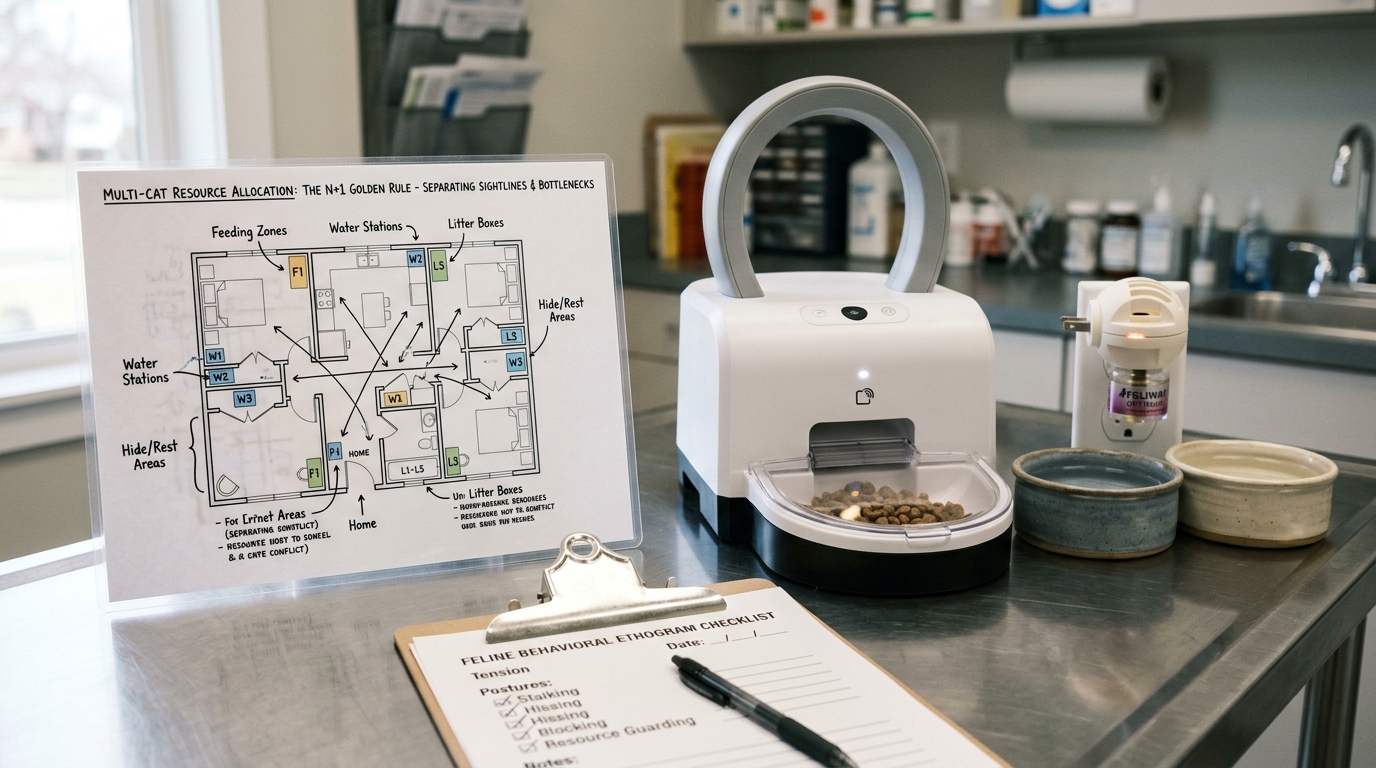
The gold standard of feline behavioral medicine, endorsed by the American Association of Feline Practitioners (AAFP) and the International Society of Feline Medicine (ISFM), is the N+1 Rule: provide one resource station for every cat residing in the household, plus one additional station, positioned in distinct physical locations.
Why Side-by-Side Resources Fail
A frequent error among pet owners is placing two or three food bowls side-by-side along the same kitchen baseboard, or placing two litter boxes side-by-side in a single utility room. In feline spatial perception, resources placed within the same visual sightline or room constitute a single station. One assertive cat can easily guard both bowls or both litter boxes simultaneously without taking a step, effectively disenfranchising other household cats.
Managing Mealtime Surveillance & Selective Feeders
Eating is an inherently vulnerable activity for a predator-prey species. Cats should never be forced to eat within ten feet of an unbonded housemate. Separate feeding stations into distinct rooms, around corner architectural barriers, or on elevated counter surfaces accessible only to the more agile cat.
In households where cats require distinct diets (e.g., a senior cat on renal support food vs. a young cat on high-protein diet), or where one cat bullies others away from bowls, invest in microchip-activated selective pet feeders. These automated feeders feature an RFID scanner arch that unlocks only when the programmed microchip of the designated cat is detected, sealing shut when an unauthorized cat approaches. This mechanically eliminates food theft, gulping behavior, and mealtime intimidation.
Phase 3: The Litter Station Architecture: Preventing Ambush and Periuria
Inappropriate elimination (periuria) in multi-cat households is overwhelmingly triggered by environmental territorial stress rather than spontaneous spite. When a cat experiences an ambush while using the litter box–or anticipates the threat of an ambush–they rapidly develop a negative conditioned association with the box itself, seeking alternative soft surfaces (carpets, bath mats, duvets) that provide open 360-degree sightlines.
Crucial Litter Box Architectural Guidelines
- Open-Top Design Over Hooded Boxes: While hooded, covered litter boxes appeal to human aesthetics by containing odor and scatter, they represent sensory traps for cats. A covered box traps noxious ammonia vapors and restricts the cat’s visual horizon to a single narrow door. An open-top, high-sided storage tote or low-entry open tray allows the cat to monitor the surrounding room in 360 degrees while eliminating.
- Sizing Dimensions: The box must measure at least 1.5 times the total length of the cat from the tip of the nose to the base of the tail. This allows full rotational maneuvering, digging, and post-elimination covering without touching soiled sides.
- Bilateral Escape Pathways: Never push a litter box into the far corner of a tight laundry closet or wedge it beside loud vibrating appliances like washing machines. Position boxes along open, flat wall expanses with clear escape clearance to both the left and right, ensuring a cat cannot be pinned inside by an approaching rival.
- Substrate Consistency: Fill boxes with 2 to 3 inches of fine-granule, unscented clumping clay litter. Scented deodorizers, crystal pearls, and pellet substrates can irritate sensitive feline paw pads and respiratory passages.
Phase 4: Vertical Territory and Feline Superhighways
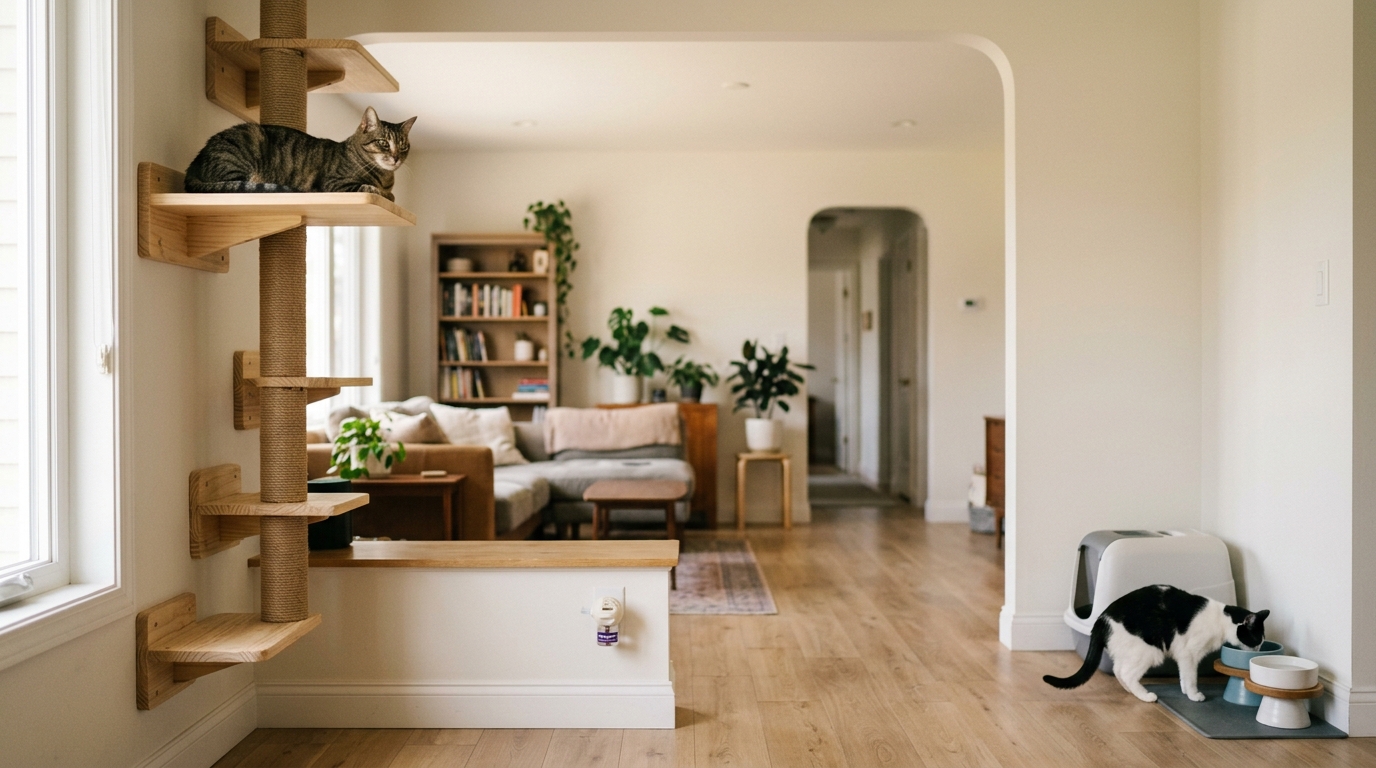
When physical floor space is constrained, vertical architecture expands usable territory exponentially. In feline social dynamics, height confers safety, emotional security, and visual command. Building a “cat superhighway”–a continuous network of elevated perches, wall shelves, and climbing ramps–allows cats to manage the room without touching the floor.
To design an effective vertical system, adhere to these engineering principles:
- Never Create Vertical Dead Ends: A single tall cat tree with only one way up and down is an ambush trap. If cat A climbs to the top platform and cat B sits on the middle tier, cat A is held hostage. Always ensure that elevated paths connect to furniture, secondary wall steps, or alternative descent ramps so an animal can exit via multiple routes.
- Multiple Vantage Perches at Equal Heights: If a household contains two cats who both seek elevated dominance, providing only one top-tier perch will spark daily physical disputes. Install multiple perches at comparable elevations on opposite walls so both cats can enjoy high vantage points simultaneously without sharing immediate airspace.
- Intermediate Steps for Senior and Arthritic Cats: Feline osteoarthritis affects over 90% of cats over 12 years of age. Ensure that vertical walkways feature shallow, carpeted steps or sisal ramps spaced no more than 8 to 10 inches apart, allowing aging felines to ascend without high-impact jumping that triggers joint pain.
Phase 5: Olfactory Environment & Pheromone Architecture
Cats inhabit a chemical sensory world where territorial ownership is communicated primarily through olfactory markers. Strategic pheromone distribution reduces systemic stress and re-establishes communal group scents.
Synthetic Pheromone Diffusers
- Feline Facial Fraction F3 (Feliway Classic): Mimics the soothing facial pheromones cats deposit during head bunting. Best utilized in individual refuge rooms, near entrances, and around litter stations to promote individual emotional security.
- Cat Appeasing Pheromone / CAP (Feliway Friends / MultiCat): Mimics the natural pheromone produced by mother cats in the intermammary groove during nursing. Clinically proven to reduce social tension, stare-downs, chasing, and physical conflict between cohabitating adult cats. Place diffusers in primary shared transit areas and active gathering rooms.
Scratching Post Infrastructure
Scratching serves two critical functions: mechanical claw conditioning and chemical scent marking. When a cat scratches, interdigital sebaceous glands on the bottom of their paw pads deposit semiochemicals that claim territory. Scratching posts should be sturdy, heavy-based, wrapped in natural un-oiled sisal rope or thick vertical carpeting, and tall enough (at least 32 to 36 inches) for the cat to achieve a full vertical stretch. Place scratchers along prominent territorial boundaries–such as doorways, near sleeping perches, and adjacent to outdoor-viewing windows–where territorial marking drives are highest.
Phase 6: Multi-Cat Conflict Triage and Safe Intervention Protocol
When tension escalates from passive staring into active physical combat, human intervention must be swift, decisive, and strictly hands-off. Reaching your bare hands or arms between fighting cats is the single most common cause of severe human bite injuries and pasteurella cellulitis infections requiring emergency hospitalization.
| Conflict Stage | Observed Behavioral Indicators | Immediate Human Action | Critical Mistakes to Avoid |
|---|---|---|---|
| Passive Monitoring | Prolonged unblinking stare; blocking hallways or doorways; slow creeping approach | Step between cats with a large cardboard panel to break visual sightline; call subordinate cat away with treats | Ignoring the stare; assuming silence means peaceful coexistence |
| Acoustic Warning | Low guttural growling; prolonged yowling/howling; hissing with bared incisors | Place a solid visual barrier between them; gently guide one cat into a separate room with a broom or cushion | Shouting, clapping loudly, or spraying water (intensifies autonomic arousal) |
| Physical Combat | Screeching brawling; flying fur; locked rolling fight with teeth and claws engaged | Drop a heavy blanket or towel over both cats, or slide a large board/cardboard between them; immediately close a door | Reaching bare hands into the fight; picking up an aroused fighting cat |
| Post-Fight Recovery | Piloerect fur; dilated pupils; rapid respiration; retreating to hiding spots | Isolate both cats in separate, fully-equipped rooms for 24 to 48 hours to allow cortisol levels to normalize | Forcing immediate re-introduction while adrenaline remains elevated |
Phase 7: The Multi-Cat Household Resource Audit Matrix
Use this step-by-step engineering checklist to audit your home’s spatial layout against feline behavioral requirements.
| Core Resource | The N+1 Minimum Formula | Optimal Placement Criteria | Common Architectural Failure Modes |
|---|---|---|---|
| Litter Stations | Number of cats + 1 box | Separate rooms, open walls, 360° visibility, quiet well-lit zones | Boxes side-by-side; placed in dark closets or beside noisy washers |
| Feeding Stations | Number of cats + 1 station | Distinct rooms or around corners; elevated for agile cats; microchip feeders | Bowls touching on same kitchen mat; feeding in high-traffic corridors |
| Water Stations | Number of cats + 1 fountain/bowl | Placed at least 5-10 feet away from food bowls; circulating stainless steel | Single water bowl placed directly beside food or adjacent to litter box |
| Vertical Perches | At least 2 elevated perches per cat | Window perches with outdoor views; high vantage perches on opposing walls | Single cat tree with one dead-end descent pole; zero climbing access |
| Scratching Posts | At least 1 vertical + 1 horizontal per cat | Entryways, hallway intersections, adjacent to preferred sleeping zones | Wobbly short scratchers tucked out of sight in unused back rooms |
| Hiding Refuges | Multiple private enclosed boxes/beds | Dual-exit boxes, elevated cubbies, under-furniture tunnels with two openings | Single-opening deep boxes where a cat can be trapped inside by a rival |
Phase 8: Medical Differentials: When Territorial Conflict Stems from Disease
A sudden shift in multi-cat harmony where previously compatible housemates begin fighting frequently signals an underlying medical pathology in one of the animals. Cats are masters at concealing somatic pain; irritability, reduced tolerance for proximity, and altered body odor often precede visible clinical signs by weeks.
Before assuming an inter-cat dispute is purely behavioral, schedule clinical evaluations to screen for:
- Feline Osteoarthritis: Chronic joint inflammation makes jumping painful and alters mobility. An arthritic cat feels physically vulnerable and may lash out defensively when another cat approaches too quickly.
- Feline Idiopathic Cystitis (FIC) & Urinary Tract Disease: Dysuria, hematuria, and painful bladder spasms increase irritability and territorial insecurity, frequently triggering litter-box avoidance and defensive aggression.
- Hyperthyroidism: Elevated circulating thyroxine (T4) levels in cats over 8 years of age causes ravenous hunger, hyper-irritability, nocturnal pacing, and aggressive resource guarding around food stations.
- Periodontal Disease & Feline Resorptive Lesions (TRLs): Severe oral nerve pain causes sudden swatting during grooming or when housemates approach during eating.
- Cognitive Dysfunction Syndrome (CDS): In geriatric cats (12+ years), neurodegenerative changes produce disorientation, altered social recognition, and sudden unprovoked territorial confusion.
When to Contact a Veterinarian or clinical specialist Behaviorist
Contact a veterinarian immediately if either cat exhibits bite wounds, abscesses, sudden vocalizing in the litter box, or acute behavioral withdrawal. You must seek veterinary medical evaluation promptly when inter-cat aggression emerges suddenly in previously bonded adult cats, as underlying systemic illness or chronic pain frequently drives defensive irritability. If medical causes are ruled out and physical conflict persists despite spatial redistribution, arrange a consultation with a clinical specialist veterinary behaviorist (DACVB) or certified feline behavior consultant (IAABC) for an individualized desensitization protocol.
Clinical Practice Tool: Multi-Cat Conflict Tracker
Identify territorial tension, staring standoffs, and resource guarding early by logging behavioral interactions on our printable Multi-Cat Conflict Tracker. Download and print your copy of the Multi-Cat Conflict Tracker, or explore all practical pet care guides in the NewsPet Resource Center.
Frequently Asked Questions
Can two cats share one litter box if they get along well?
No. Even closely bonded sibling cats should never be forced to share a single litter box. As cats age, health changes, subtle social tensions, or minor disruptions can turn a shared box into a conflict trigger, sparking house-soiling that is extremely difficult to reverse once established.
Why does my resident cat attack our new cat even through a closed door?
This occurs due to olfactory territorial intrusion. Cats rely heavily on pheromones to define their boundaries. Introducing an unfamiliar cat’s scent too rapidly without gradual scent-swapping and positive food associations triggers defensive anxiety. Back up the introduction protocol to scent swapping using clean towels paired with high-value treats.
How do I stop my dominant cat from blocking the hallway?
Hallway blocking is a traffic management problem. Break the hallway bottleneck by installing elevated cat shelves along the hallway wall, allowing the subordinate cat to bypass the blocking cat overhead. Alternatively, place furniture barriers that break direct visual sightlines.
Should I use a spray bottle to punish fighting cats?
No. Water spray bottles increase arousal, fear, and territorial anxiety without addressing the root cause of the conflict. The sprayed cat will associate the punishment with the presence of the other cat, intensifying their mutual hostility. Use solid physical barriers (cardboard or blankets) to interrupt disputes safely.
Sources
Sources checked: September 8, 2026
- American Association of Feline Practitioners (AAFP) & ISFM: Feline Environmental Needs Guidelines
- International Cat Care (iCatCare): Introducing Cats and Designing Multi-Cat Households
- ASPCA: Managing Aggression Between Cats in Your Household
- Cats Protection: Understanding Conflict in Multi-Cat Households
- Cornell Feline Health Center: Behavioral House-Soiling and Inter-Cat Stress
Emergency Triage Matrix: Clinical Presentation & Required Response
| Triage Level | Clinical Signs & Presentation | Immediate Action Protocol |
|---|---|---|
| Tier 1: Immediate Emergency (0–2 Hours) | Active violent inter-cat fight resulting in deep puncture wounds, severe ocular injury, bleeding lacerations, or complete catatonic terror with involuntary elimination. | Safely separate cats using a physical barrier (sheet, blanket, heavy cardboard); emergency veterinary care for bite wounds to prevent anaerobic abscesses; immediate territorial separation. |
| Tier 2: Urgent Veterinary Care (Same-Day) | Cat hiding continuously in closets, refusing food for >24 hours, or developing periuria (urinating outside the box) due to territorial ambush by another cat. | Urgent veterinary clinical examination; serum chemistry to rule out early hepatic lipidosis, urinalysis to rule out stress cystitis, and implementation of strict temporary room segregation. |
| Tier 3: Home Monitoring & Scheduled Care | Mild resource blocking (one cat sitting in a hallway causing another cat to hesitate), occasional hissing during close passing, with normal eating and litter box habits. | Duplicate core resources in separate rooms, expand vertical perches to create bypass routes, and diffuse synthetic appeasing pheromones throughout the home. |
Rule S1 Boundaries & Multi-Cat Safety Protocols
Multi-feline conflict management must observe strict safety boundaries:
- NEVER allow fighting cats to ‘work it out’ without intervention: Cats lack social peacemaking rituals; allowing fights to continue deepens territorial trauma, establishes permanent negative conditioned associations, and leads to lethal bite abscesses.
- NEVER use bare hands to separate fighting cats: Redirected aggression causes severe, deep human puncture wounds inoculating Pasteurella multocida into tendon sheaths, frequently requiring emergency surgical debridement.
- NEVER cluster all food bowls or litter boxes in a single communal room: Clustered resources allow a single dominant cat to control access to vital biological needs, causing subordinate cats to develop dehydration, starvation, or stress cystitis.
- NEVER reintroduce previously fighting cats without systematic desensitization: Rushing reintroductions without scent swapping and gradual visual barriers immediately reactivates fight-or-flight aggression, resetting behavioral rehabilitation to zero.
Caregiver Multi-Cat Environmental Audit Checklist
- Distribute food and water stations across separate rooms so cats can eat without visual contact or defensive tension.
- Implement the N+1 rule for litter boxes (e.g., 3 boxes for 2 cats) situated in open, accessible rooms with two clear exit routes.
- Install vertical pathways (cat trees, sturdy wall shelves, window perches) to allow cats to bypass ground-level hallway bottlenecks.
- Deploy synthetic feline facial appeasing pheromone diffusers (e.g., Feliway Friends / Optimum) in core congregating rooms.
- Provide daily individual one-on-one interactive play sessions behind closed doors for each cat to discharge predatory drive.
Related Clinical Guides & Tools
Peer-Reviewed Clinical References & Evidence Grounding
- PMID: 24923754: Feline parvovirus infection and associated diseases (Vet J, 2014) (opens in new tab)
- PMID: 19481039: Feline infectious peritonitis. ABCD guidelines on prevention and management (J Feline Med Surg, 2009) (opens in new tab)
- PMID: 40233794: Feline infectious peritonitis – a current overview (Tierarztl Prax Ausg K Kleintiere Heimtiere, 2025) (opens in new tab)
- aaha.org (opens in new tab)
Printable tools
Download the matching worksheet
Source transparency
Reference mix for this guide
Source labels describe the type of organization behind each reference; they are not a claim that any outside organization reviewed this article.
- American Association of Feline Practitioners (AAFP) & ISFM: Feline Environmental Needs Guidelines Veterinary organization · catvets.com
- International Cat Care (iCatCare): Introducing Cats and Designing Multi-Cat Households Animal welfare nonprofit · icatcare.org
- ASPCA: Managing Aggression Between Cats in Your Household Animal welfare nonprofit · aspca.org
- Cats Protection: Understanding Conflict in Multi-Cat Households Reference source · cats.org.uk
- Cornell Feline Health Center: Behavioral House-Soiling and Inter-Cat Stress Academic or extension · vet.cornell.edu
- Indoor Cat Enrichment: Build a Home That Meets Nat Reference source · newspet.net
- Cat Litter Box Problems: Causes & Solutions (V Reference source · newspet.net
- Why Cats Scratch Furniture and How to Redirect It Reference source · newspet.net