This guide is general education for pet owners. If your pet has urgent symptoms, possible poisoning, injury, breathing trouble, collapse, severe pain, or sudden decline, contact a licensed veterinarian or local emergency service.
Editorial standard
How this guide was prepared
This clinical guide establishes evidence-based respiratory monitoring and triage protocols under American College of Veterinary Emergency and Critical Care (ACVECC) standards. If a dog or cat exhibits open-mouth gasping, cyanotic blue gums, extended neck posture, or violent abdominal breathing, seek immediate emergency oxygen therapy.
- Measure Sleeping Respiratory Rate (SRR): Measure your pet’s breathing rate while in deep, non-dreaming sleep in a quiet, cool room; consistent resting rates should remain below 30 breaths per minute.
- Differentiate Dream Twitches from True Tachypnea: Distinguish normal REM sleep motor twitches (whimpering, paw paddling) from respiratory distress; true pathological tachypnea persists without interruption when the animal is gently aroused.
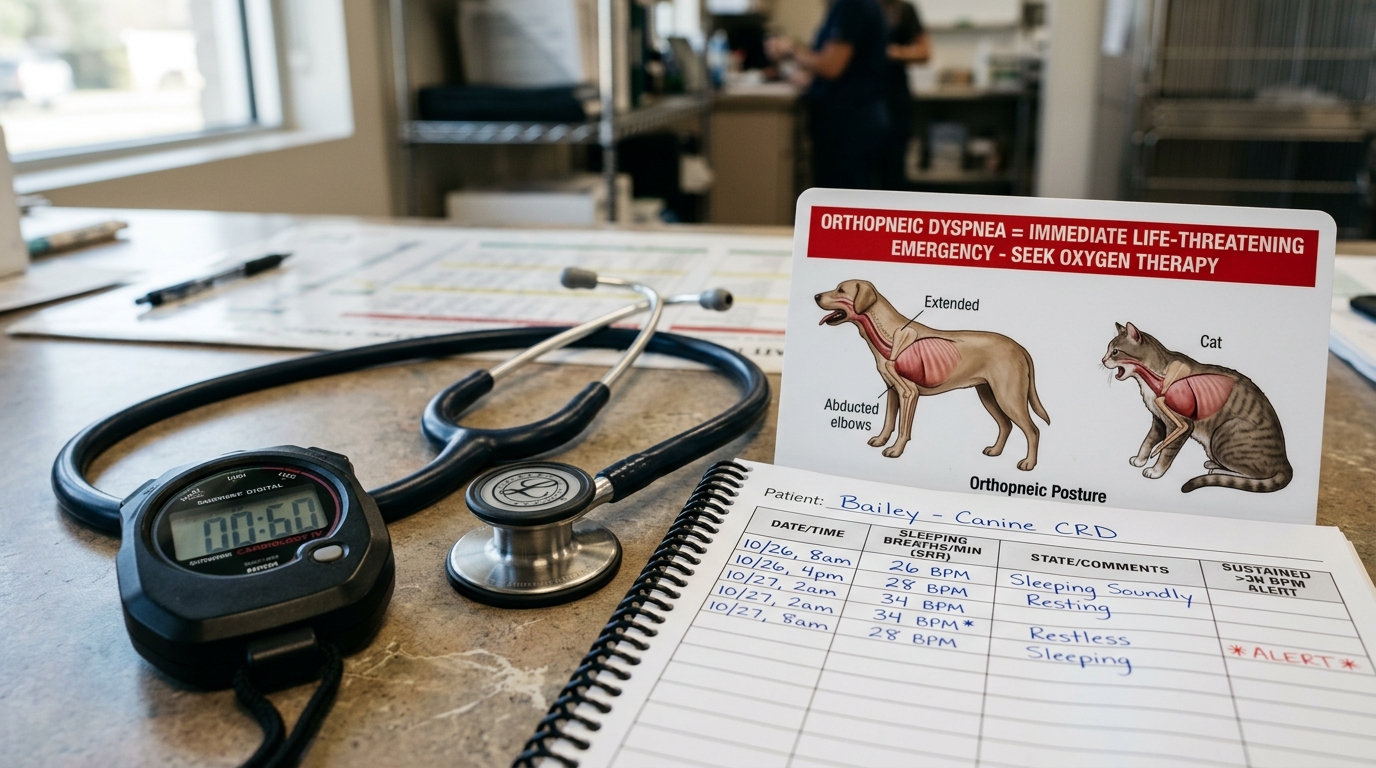
- Recognize Critical Orthopneic Posturing: A dog or cat standing with forelegs abducted (‘elbows out’), neck extended, and pronounced abdominal pumping requires immediate emergency veterinary oxygen therapy.
Identifying early cardiopulmonary distress represents one of the most vital life-saving skills a companion animal caregiver can master. Because dogs and cats possess strong evolutionary instincts to mask weakness, respiratory compromise frequently advances silently until physiological decompensation occurs. Implementing an objective home respiratory surveillance routine allows busy households to detect incipient congestive heart failure, asthma flare-ups, and airway obstruction long before acute asphyxiation strikes.
The Gold Standard Metric: Sleeping Respiratory Rate (SRR)
Veterinary cardiologists and critical care specialists consider the home Sleeping Respiratory Rate (SRR) the single most sensitive non-invasive indicator of left-sided congestive heart failure and pulmonary edema. Hospital measurements of breathing rate are frequently elevated by stress, panting, and clinic excitement, making home tracking indispensable:
- Measurement Protocol: Wait until your pet is in a quiet, temperature-neutral room and in a state of deep, undisturbed sleep (verify the pet is not dreaming, twitching paws, or purring).
- Counting Mechanism: One full breath cycle consists of one chest rise (inspiration) followed by one chest fall (expiration). Count the number of complete rises over 30 full seconds, then multiply by two to calculate breaths per minute (bpm).
- The Clinical Normal Baseline: Healthy sleeping canines and felines maintain an SRR strictly below 25 to 30 breaths per minute, often averaging between 16 and 24 bpm.
- The Threshold of Alarm: If the SRR consistently exceeds 30 breaths per minute across multiple sleep cycles, or suddenly climbs above 35 bpm, subclinical pulmonary fluid accumulation is likely underway.
Diagnostic Differential: Coughing, Snorting, and Dyspnea
Caregivers frequently confuse benign airway irritation with critical pulmonary emergencies. Differentiating distinct mechanical patterns aids clinical reporting:
| Respiratory Presentation | Physical Mechanics & Sound | Primary Clinical Differential |
|---|---|---|
| Reverse Sneezing | Rapid, forceful, rhythmic inspiratory snorting through the nose with head pulled back, lasting 30–60 seconds. | Benign nasopharyngeal spasm triggered by environmental dust, pollen, or mild post-nasal drip; harmless in dogs. |
| Tracheal Collapse Honk | Harsh, dry, paroxysmal “goose-honk” cough triggered by leash excitement, barking, or drinking water. | Progressive hypocellularity and weakening of hyaline cartilage rings in toy canine breeds (Yorkshire Terriers, Pomeranians). |
| Feline Asthma Attack | Crouched low to floor with neck extended forward, wheezing on expiration with abdominal heave. | Lower airway allergic bronchoconstriction and eosinophilic inflammation demanding inhalant bronchodilators. |

Clinical Signs of Orthopneic Posture: The Ultimate Red Flag
When animals experience critical hypoxemia, they adopt instinctual anatomical compensations known as orthopneic positioning to maximize thoracic volume and laminar airflow. A pet exhibiting orthopnea stands or sits with forelimbs widely abducted away from the ribcage, neck and head stretched forward in a straight line, and nostrils flared.
Domestic felines should never breathe with an open mouth under normal circumstances. Open-mouth breathing in a cat—unlike canine heat panting—is a red-line medical emergency indicating severe pleural effusion, heart failure, or diaphragmatic rupture. Never attempt home remedies or force sedatives into an animal displaying orthopneic distress.
Red-Flag Triage Matrix: Respiratory Emergency Actions
Use this objective triage matrix to guide immediate clinical escalation for breathing irregularities:
| Triage Tier | Clinical Presentation | Required Action Protocol |
|---|---|---|
| Immediate Emergency (0–2 Hours) | Open-mouth gasping in a feline, pale white or blue-grey mucous membranes, foam or blood at nostrils, orthopneic abducted-elbow posture, SRR over 45 bpm. | Transport immediately to the nearest 24-hour veterinary emergency ICU. Minimize handling stress, keep vehicle air conditioning on high, and notify the hospital in transit for an oxygen cage setup. |
| Urgent Assessment (12–24 Hours) | SRR consistently measured between 30 and 38 breaths per minute during undisturbed sleep, progressive wet productive cough, exercise intolerance during short walks. | Contact your primary veterinarian for same-day evaluation. Request thoracic radiographs and cardiac biomarker testing (NT-proBNP). |
| Routine Home Monitoring | Isolated episode of reverse sneezing resolving within 60 seconds, occasional clearing throat cough after vigorous play, normal resting SRR under 24 bpm. | Log episodes in your home tracking app. Maintain cool indoor humidity, avoid aerosol air fresheners, and review during routine annual wellness exams. |
Never administer human cough suppressants, antihistamines, or inhalers to companion animals without explicit veterinary prescription. Respiratory distress can stem from cardiac, pulmonary, toxicological, or trauma vectors that require professional thoracic imaging and blood gas analysis.
Caregiver Decision Tree: Respiratory Monitoring Dilemmas
Why is resting respiratory rate (RRR) evaluated exclusively during sleep rather than while awake?
Awake respiratory rates fluctuate dramatically in response to environmental stimuli, household foot traffic, emotional arousal, temperature shifts, and minor physical movements. Assessing the pet while in deep, quiet sleep eliminates these confounding variables, isolating true pulmonary mechanics. Counting sleeping chest rises across 30 seconds and multiplying by two provides the gold-standard metric for detecting subclinical pulmonary edema, occult pleural effusion, or progressive congestive heart failure well before overt dyspnea appears.
The clinical distinction between a respiratory cough and an attempt to vomit
A true respiratory cough typically presents as an outstretched neck, rhythmic thoracic contractions, and a dry terminal retch or “gag” that produces nothing or only a small amount of white, frothy saliva; caregivers often mistake this terminal retch for vomiting hairballs or food. Gastrointestinal vomiting, by contrast, involves forceful, visible abdominal heaving, audible borborygmi, repeated swallowing, and the active ejection of gastric contents or bile. Documenting whether abdominal contractions precede the ejection helps clinicians distinguish primary cardiopulmonary disease from gastrointestinal disorders.
Frequently Asked Questions
How and when should caregivers measure Sleeping Respiratory Rate (SRR)?
Measure SRR when your pet is in deep, calm sleep (not dreaming). Count one full breath (one rise and fall of the chest) for 30 seconds and multiply by 2. A normal rate is under 30 breaths per minute; sustained readings above 30 bpm warrant contacting your vet.
What is the clinical difference between reverse sneezing, hairballs, and true coughing?
Reverse sneezing consists of rapid, loud inspiratory snorts with an extended neck, often resolving in under a minute. Hairball retching involves rhythmic abdominal heaves ending in fluid or hair expulsion. True coughing presents as extended hacking or wheezing, often pointing to bronchial or cardiac disease.
What breathing signs indicate an immediate life-threatening emergency?
Open-mouth breathing in cats, pale or blue gums, intense abdominal effort while inhaling, flared nostrils, neck extended with elbows held out, or audible chest crackles indicate critical respiratory distress requiring immediate oxygen therapy.
Caregiver Respiratory Monitoring Checklist
- Log your pet’s sleeping respiratory rate over 3 consecutive days during calm sleep to establish an accurate baseline.
- Check gum and tongue color in natural lighting: healthy tissue is pink, while blue, grey, or pale white indicates hypoxia.
- Film short 15 to 30-second videos of any coughing, wheezing, or abnormal breathing episodes for the veterinary team.
- Eliminate indoor airborne irritants, including tobacco smoke, aerosol sprays, scented candles, incense, and dusty litters.
- Transport your pet to an emergency veterinary hospital immediately if you observe open-mouth breathing or gasping.
Sources
- ACVECC Guidelines for Emergency Respiratory Management. American College of Veterinary Emergency and Critical Care.
- AAHA Cardiopulmonary Guidelines. American Animal Hospital Association.
- Respiratory System Overview and Diagnosis. Merck Veterinary Manual.
Interactive Resting Respiratory Rate (RRR) Counter
Count your resting or sleeping pet's breaths per minute using our timed clinical tap tool. Resting respiratory rate below 30 breaths/min is the veterinary baseline for canine and feline home monitoring.
Printable tools
Download the matching worksheet
Source transparency
Reference mix for this guide
Source labels describe the type of organization behind each reference; they are not a claim that any outside organization reviewed this article.
- ACVECC Guidelines for Emergency Respiratory Management Reference source · acvecc.org
- AAHA Cardiopulmonary Guidelines Veterinary organization · aaha.org
- Respiratory System Overview and Diagnosis Reference source · merckvetmanual.com