Editorial standard
How this guide was prepared
A harness is secure only when its measurements, shape, adjustment range, and movement all suit the individual dog. A size label can start the search, but it cannot show whether a strap crosses the throat, rubs behind the elbow, restricts the shoulder, loosens in reverse, or shifts when the dog turns.
Clinical Quick Answer & Immediate Actions
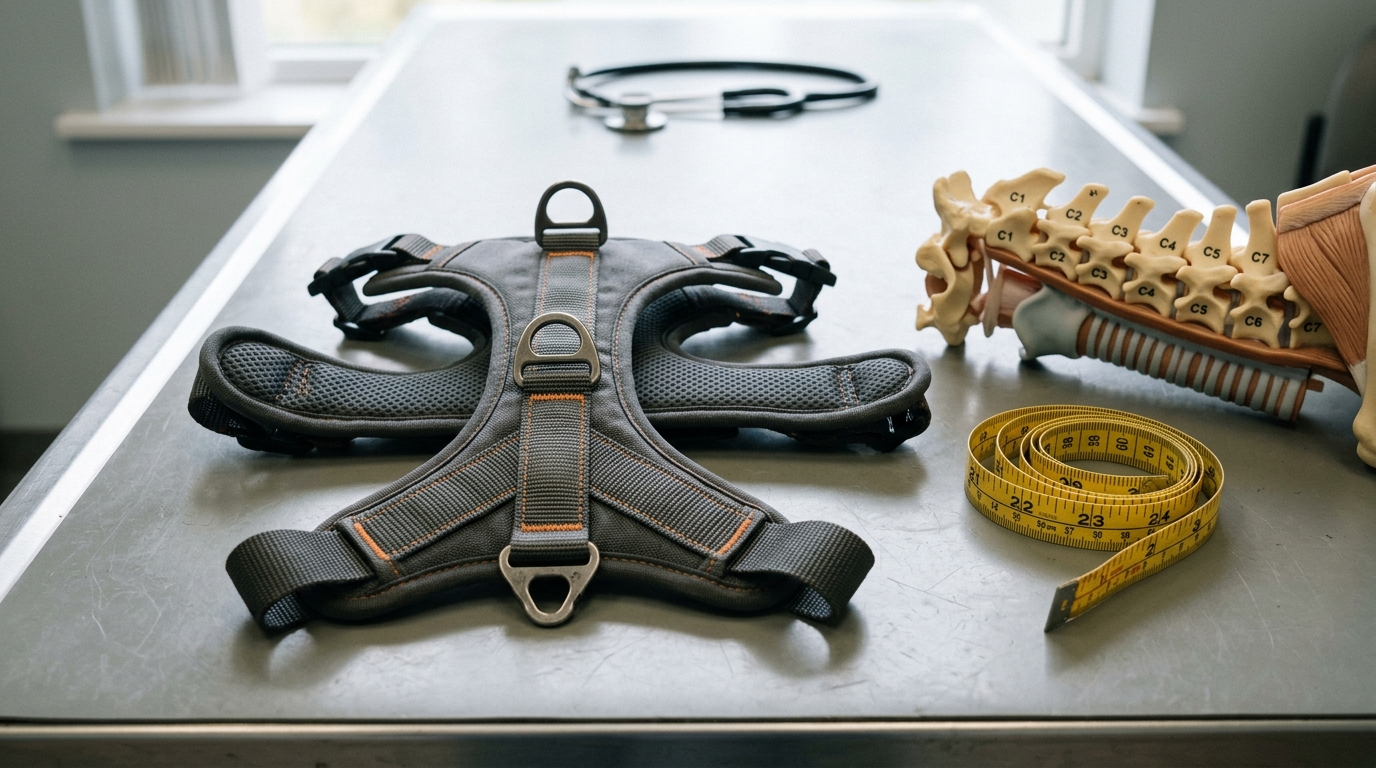
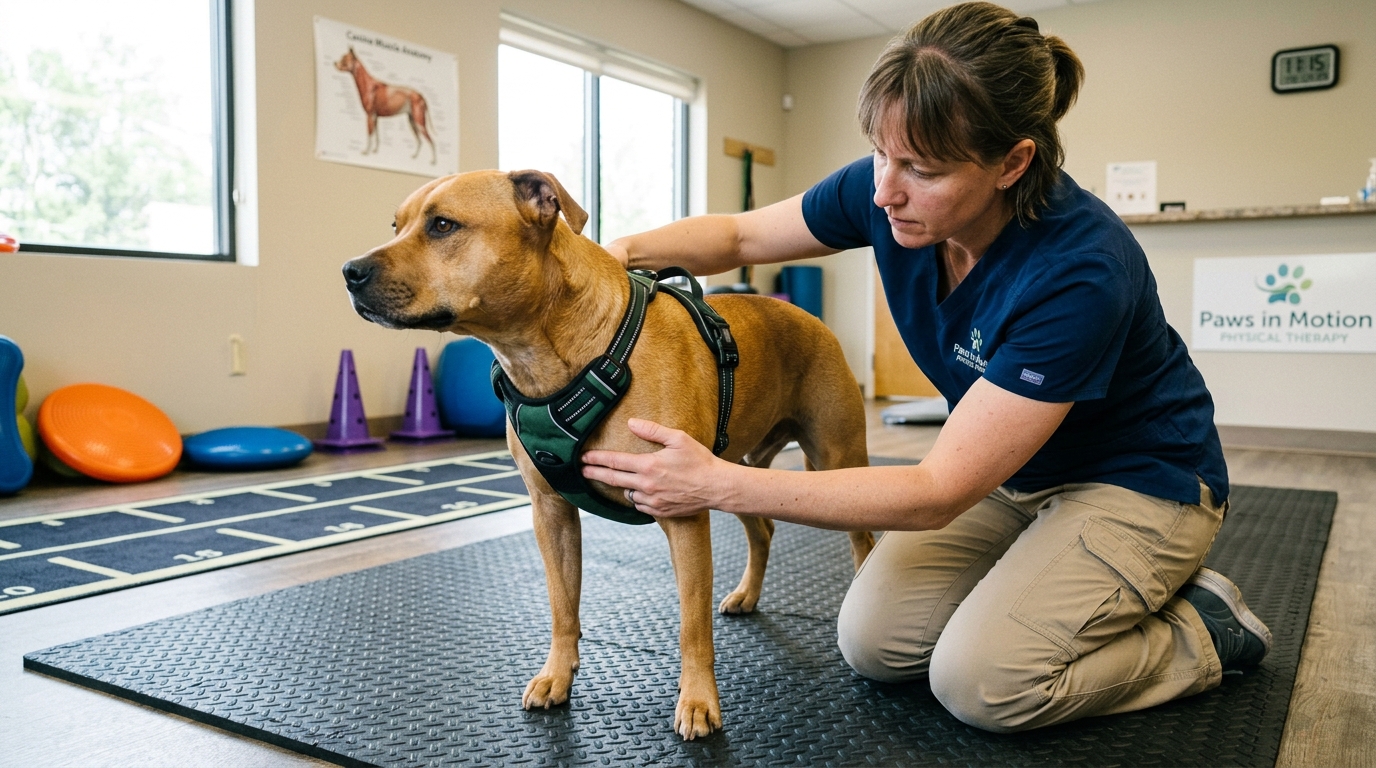
Selecting canine walking equipment is a fundamental orthopedic and respiratory health decision rather than a simple accessory choice. Standard neck collars focus tension directly over the canine cervical spine, thyroid gland, and delicate hyoid-tracheal apparatus; repeated pulling on a collar elevates intraocular pressure (dangerous for glaucoma-susceptible breeds) and induces severe tracheal ring compression and chronic laryngeal neuropathy. When transitioning to a harness, biomechanical architecture is critical: restrictive horizontal-strap harnesses (Norwegian or T-strap designs) lie directly across the supraspinatus and infraspinatus tendons and the scapulohumeral (shoulder) joint, mechanically altering front-limb stride length, inhibiting scapular rotation, and contributing to chronic shoulder bursitis. In contrast, ergonomic Y-shaped (or V-shaped) front-and-back clip harnesses cross over the rigid manubrium of the sternum, leaving the shoulders entirely uninhibited and distributing tensile forces across the ribcage.
Choose for the job, fit at six points, observe the dog moving, and test escape resistance in a controlled place. Recheck whenever the dog’s body, coat, health, or equipment changes.
Measure the body the harness must control
Use the maker’s chart for the exact model. Measure the chest or girth at the location shown, usually around the widest part of the ribcage behind the front legs. Also record lower-neck circumference, chest width, body weight if the chart uses it, and the distance behind the elbows so you can judge where straps will sit.
Measure with the coat in its normal condition and keep the tape level and close without compressing tissue. Dogs near a size boundary need the actual adjustment range, not a guess that the larger or smaller label will be safer. Deep-chested, narrow-necked, long-bodied, growing, recently groomed, or changing-weight dogs may fall outside the shape assumed by a standard chart.
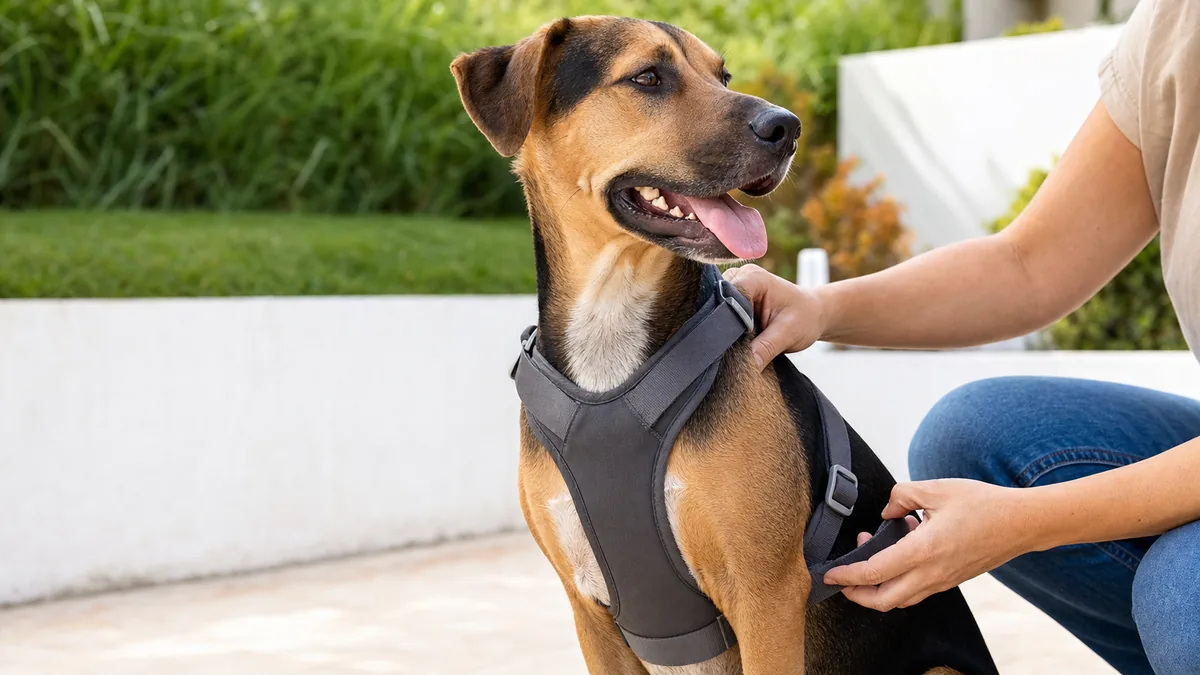
Body proportions can make the same labeled design sit differently, so use the manufacturer’s chart and fitting instructions for the exact model. Observe where panels and straps actually land, whether the available adjustment keeps hardware away from joints, and whether coat hides rotation or pinched hair. Let the dog’s standing fit and ordinary gait decide whether the shape remains centered and clear. If the fit cannot be interpreted confidently, use a knowledgeable fitting service or veterinary guidance rather than assigning a design by breed or appearance.
Bring the measurements when comparing products and confirm return or fitting terms where available. Do not size up simply to create room; excess space can increase shifting and escape risk.
Match the design to its purpose
For ordinary walking, look for a design that distributes load across the chest and torso without sitting on the throat or blocking normal shoulder movement. Entry style matters: a dog who dislikes equipment passing over the head may tolerate a neck-opening or step-in design differently, but convenience does not outweigh secure closure and fit.
Attachment points change handling, not training by themselves. A back attachment may suit relaxed walking; a front attachment may change utilize but can also pull a poorly fitted harness sideways. Multiple adjustment points can improve shape fit, while extra straps add more places to twist, rub, or be fastened incorrectly.
The harness selection ends at equipment. Teaching the dog how to walk with a loose lead is a separate process; use the loose-leash walking guide for reward placement, difficulty, and response to tension.
Complete a six-point fit inspection
| Fit point | What to inspect | Reason to adjust or reject |
|---|---|---|
| 1. Throat and lower neck | Straps remain below the throat and do not press on the windpipe when the lead changes angle. | Coughing, gagging, strap migration, or pressure across the front of the neck. |
| 2. Shoulder front | The dog can extend the forelimb without a rigid band cutting across the shoulder. | Shortened stride, strap crossing the joint, or frame digging during reach. |
| 3. Armpits and elbows | There is clearance behind the front legs through standing and movement. | Rubbing, pinched hair, redness, or the elbow striking a strap. |
| 4. Ribcage | The girth strap sits on the ribs, stays level, and cannot slide over the narrow waist. | Rotation, twisting, compression, or the rear edge reaching soft abdomen. |
| 5. Spine and chest piece | Panels lie centered and flat without buckles or hardware pressing into the body. | Persistent sideways shift, folded webbing, or concentrated pressure. |
| 6. Closures and adjustment tails | Every buckle is fully engaged, adjusters hold, and loose ends are secured. | Cracks, weak clicks, slipping adjusters, chewed webbing, or dangling loops. |
A finger rule is only a rough check because strap width, coat, body shape, and location differ. The stronger test is whether the harness remains secure without compressing breathing or changing movement.
Movement checks and when to contact a veterinarian
In a quiet secure area, observe walking, turning both ways, sitting, lying down, stepping over a low change in surface, and gently taking lead tension from different angles. The harness should stay centered; straps should remain clear of joints; breathing and stride should remain normal.
Inspect chafing by location and timing. Look beneath strap edges, buckles, adjustment hardware, the sternum panel, and behind both elbows immediately after use and again after the coat settles. Damp webbing, sand, trapped hair, clothing underneath, and repeated sideways pull can create friction even when the static fit seems reasonable. Compare left and right contact points because asymmetric rotation can expose one side first. Record which movement caused shifting, clean and dry the equipment as instructed, and change the shape or use pattern rather than padding over persistent pressure.
Check skin and coat after several minutes. Stop for coughing, gagging, chafing, hair pulling, freezing, repeated scratching at the harness, shortened stride, reluctance to move, or a sudden behavior change. Refit or choose another shape instead of tightening every strap.
Stop using the harness and contact a veterinarian if coughing, gagging, a breathing change, weakness, pain, skin injury, or movement difficulty continues after the harness is removed, appears when no harness is being worn, or begins suddenly. Do not keep refitting equipment to investigate a possible medical problem.
Check escape risk without provoking the dog
Follow the fitting and security instructions for the specific harness. In a quiet enclosed space, observe what happens when the relaxed dog naturally turns, backs up, lowers the head, or changes direction on a slack lead, and use only any model-specific checks the manufacturer describes. Watch whether panels fold, straps migrate, an opening visibly widens, or an adjuster slips; if so, stop and refit or choose another design. Check every buckle and adjuster by hand while the harness is off the dog. Never pull backward, lift by the harness, tighten the lead to provoke struggling, stage a startle, or invent another stress test, because forced resistance creates risk without proving real-world security. This ordinary-movement observation can reveal an obvious path toward an opening, but it cannot prove security during panic, a snag, equipment failure, or handling error, so inspect the lead, clips, attachment rings, and harness condition as the same walking system.
Reject or modify the fit if an elbow can pass through, the neck opening travels over the head, the girth strap slides behind the ribs, or the dog can rotate inside the frame. Dogs who reverse suddenly, have a narrow head, or are newly adopted may need an escape-resistant design and a temporary backup connection while fit is assessed.
Set recheck triggers rather than a calendar alone
- Recheck after growth, weight gain or loss, coat trimming, seasonal coat change, pregnancy, illness, surgery, or reduced mobility.
- Recheck after washing, disassembly, lending the harness, changing clothing underneath, or moving an adjuster.
- Inspect before each use for chewed webbing, cracked buckles, corrosion, stretched seams, slipping hardware, and identification caught in straps.
- Repeat the movement and escape checks when any fit point changes.
For a growing dog, keep dated girth, lower-neck, weight, and strap-position notes rather than relying on the remaining adjustment tail. Recheck after a growth spurt and whenever the rear strap moves closer to the elbows or waist. For adults, repeat measurements after a noticeable weight or muscle change, a coat clip, new clothing, surgery, or reduced activity. A harness can remain within its labeled size while no longer matching the body shape that made it stable.
Puppies and dogs in active body change need more frequent measurement. Replace equipment when adjustment can no longer maintain all six fit points or when damage affects the load path.
Keep walking equipment and transport restraint separate
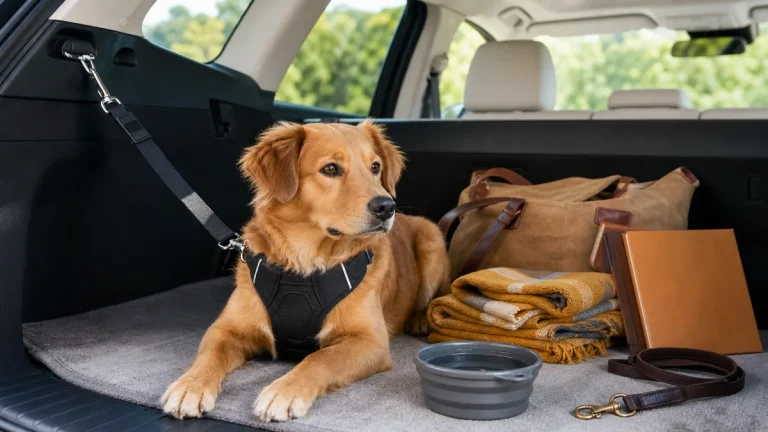
An ordinary walking harness is not crash protection unless the specific restraint system has applicable evidence for its attachment method, dog size, vehicle position, and test standard. Keep one separate transport record with the restraint model and version, supported dog-size range, approved attachment points, vehicle position, instructions, evidence or test standard, and inspection date. A seat-belt loop, sturdy-looking chest panel, or ordinary walking attachment is not proof of crash performance. Do not route a seat belt through a walking harness, clip into an unverified ring, or infer protection from thickness. If one product claims both walking and vehicle purposes, verify each purpose independently. This guide records fit, gait, chafing, escape openings, and lead attachment for ordinary walking; it does not choose, fit, or validate a vehicle restraint. Record any visible post-trip damage against the transport system, not the walking-fit notes.
Clinical Practice Tool: Dog First 90 Days: A Calm Owner Roadmap
Ensure proper gear habituation, leash mechanics, and equipment security with our Dog First 90 Days Roadmap. Download and print your copy of the Dog First 90 Days: A Calm Owner Roadmap, or explore all practical pet care guides in the NewsPet Resource Center.
Frequently Asked Questions
Why is a Y-shaped harness preferred over a neck collar or restrictive chest strap?
A Y-front harness distributes pull forces across the sturdy sternum and ribcage without impinging on delicate shoulder joint motion, protecting the trachea from collapse in prone breeds like Pomeranians and Yorkies.
How should caregivers test the fit of a dog harness at home?
Apply the two-finger rule: you should be able to slide two fingers comfortably between the harness straps and the dog’s body at all points while ensuring the harness cannot slip over the head during backing up.
Can walking a leash-reactive dog on a traditional neck collar cause eye damage?
Yes. Sudden severe neck pressure from pulling on a flat collar sharply spikes intraocular pressure, potentially accelerating glaucoma progression and aggravating corneal pathology in predisposed dogs.
Sources
Sources checked: September 8, 2026.
- RSPCA: Walking Your Dog
- VCA Animal Hospitals: Collar and Harness Options for Dogs
- AAHA: 2019 Canine Life Stage Guidelines
- AVSAB: Humane Dog Training Position Statement
- ASPCA: Dog Walking and Restraint Safety
Emergency Triage Matrix: Clinical Presentation & Required Response
| Triage Level | Clinical Signs & Presentation | Immediate Action Protocol |
|---|---|---|
| Tier 1: Immediate Emergency (0–2 Hours) | Dog collapses, exhibits cyanotic purple gums/tongue, or acute severe respiratory asphyxiation during or immediately after pulling on walking gear; or dog escapes harness into active vehicular traffic. | Immediate emergency veterinary transport; initiate emergency oxygenation, evaluate for acute tracheal trauma or cervical disc herniation, and provide emergency stabilization. |
| Tier 2: Urgent Veterinary Care (Same-Day) | Dog develops severe axillary (armpit) skin ulceration, open friction sores, abnormal gait / front-limb lameness, or a persistent honking cough developing after walks. | Same-day veterinary evaluation; thoracic and cervical radiographs to assess tracheal lumen diameter and shoulder joint integrity, accompanied by wound management and analgesic therapy. |
| Tier 3: Home Monitoring & Scheduled Care | Dog is physically comfortable, sound, and energetic, but the harness twists during walks, fits too loosely, or the dog hesitates slightly when the harness is slipped over their head. | Perform the two-finger fit test, adjust straps for balanced symmetry, desensitize with positive treat reinforcement, or upgrade to a step-in or buckled-neck Y-shaped ergonomic harness. |
Rule S1 Boundaries & Canine Biomechanical Rules
Canine walking gear requires adherence to strict anatomical and orthopedic rules:
- NEVER use neck collars as the primary attachment point for dogs prone to pulling: Tensile pulling forces on neck collars compress the tracheal cartilage, trigger acute coughing fits, spike intraocular pressure, and cause permanent cervical intervertebral disc herniation.
- NEVER select restrictive horizontal chest-band (T-shaped/Norwegian) harnesses for active dogs: Horizontal chest straps sit directly across the shoulder joint, restricting scapular range of motion, reducing stride extension by up to 20%, and inducing chronic orthopedic joint inflammation.
- NEVER use punitive choke chains, prong collars, or electronic shock collars: Aversive walking tools induce severe tissue trauma, tracheal bruising, esophageal injury, and sharp increases in fear-based defensive aggression.
- NEVER leave a harness on an unsupervised dog indoors or in a crate: Harness straps catch on crate wire bars, furniture corners, or jaw teeth during chewing, creating life-threatening strangulation and panic entrapment risks.
Caregiver Biomechanical Harness Sizing & Safety Checklist
- Select an ergonomic Y-shaped harness that crosses over the hard bony sternum (breastbone), keeping the throat and shoulder blades completely free.
- Measure your dog’s ribcage circumference at the widest point (2 to 3 finger-widths behind the elbows) and lower neck base using a flexible tailor’s tape.
- Execute the ‘Two-Finger Fit Test’: ensure you can slip two flat fingers snugly between the harness webbing and your dog’s body at all contact points.
- Verify axillary clearance: ensure the girth strap sits far enough behind the front legs to prevent painful chafing against the sensitive armpit skin.
- Utilize a dual-clip harness (front chest clip and back clip); attach to the front clip to safely redirect pulling without torquing the spinal column.
- Inspect all webbing, buckles, and metal D-rings weekly for signs of fraying, stress micro-cracks, or plastic fatigue.
Related Clinical Guides & Tools
Peer-Reviewed Clinical References & Evidence Grounding
- NCBI PubMed (PMID: 33769611) — International veterinary canine dyskinesia task force ECVN consensus statement: Terminology and classification (J Vet Intern Med, 2021) (opens in new tab) (Peer-reviewed veterinary clinical study indexed in NCBI PubMed (J Vet Intern Med, 2021).)
- NCBI PubMed (PMID: 38351524) — Defining sepsis in small animals (J Vet Emerg Crit Care (San Antonio), 2024) (opens in new tab) (Peer-reviewed veterinary clinical study indexed in NCBI PubMed (J Vet Emerg Crit Care (San Antonio), 2024).)
- NCBI PubMed (PMID: 38474142) — Canine Mammary Tumors: Classification, Biomarkers, Traditional and Personalized Therapies (Int J Mol Sci, 2024) (opens in new tab) (Peer-reviewed veterinary clinical study indexed in NCBI PubMed (Int J Mol Sci, 2024).)
- Cornell Riney Canine Health Center: Biomechanical Fit and Safe Harness Selection for Dogs (opens in new tab) (Verified clinical reference retrieved via Antigravity Ground-Truth Search (vet.cornell.edu).)
Printable tools
Download the matching worksheet
Source transparency
Reference mix for this guide
Source labels describe the type of organization behind each reference; they are not a claim that any outside organization reviewed this article.
- RSPCA: Walking Your Dog Reference source · rspca.org.uk
- VCA Animal Hospitals: Collar and Harness Options for Dogs Reference source · vcahospitals.com
- AAHA: 2019 Canine Life Stage Guidelines Veterinary organization · aaha.org
- AVSAB: Humane Dog Training Position Statement Veterinary organization · avsab.org
- ASPCA: Dog Walking and Restraint Safety Animal welfare nonprofit · aspca.org
- Puppy Socialization Without Overwhelm: A Vet-Safe Reference source · newspet.net
- Dog Body Language Chart: 9 Stress Signs Before a B Reference source · newspet.net
- Reward-Based Dog Training: Force-Free Steps & Reference source · newspet.net