Editorial standard
How this guide was prepared
Useful enrichment is not the activity that looks most impressive. It is the activity that meets the need the dog has now and leaves the dog able to recover. A restless dog may need a chance to sniff or move; a dog already racing from window to window may need less intensity, more distance from stimulation, and an undisturbed place to settle.
- Olfactory Engagement Over High-Arousal Fetch: Sniff-driven activities (scent games, cardboard foraging boxes, and outdoor sniffaris) lower canine heart rate and provide superior mental decompression compared to repetitive ball throwing.
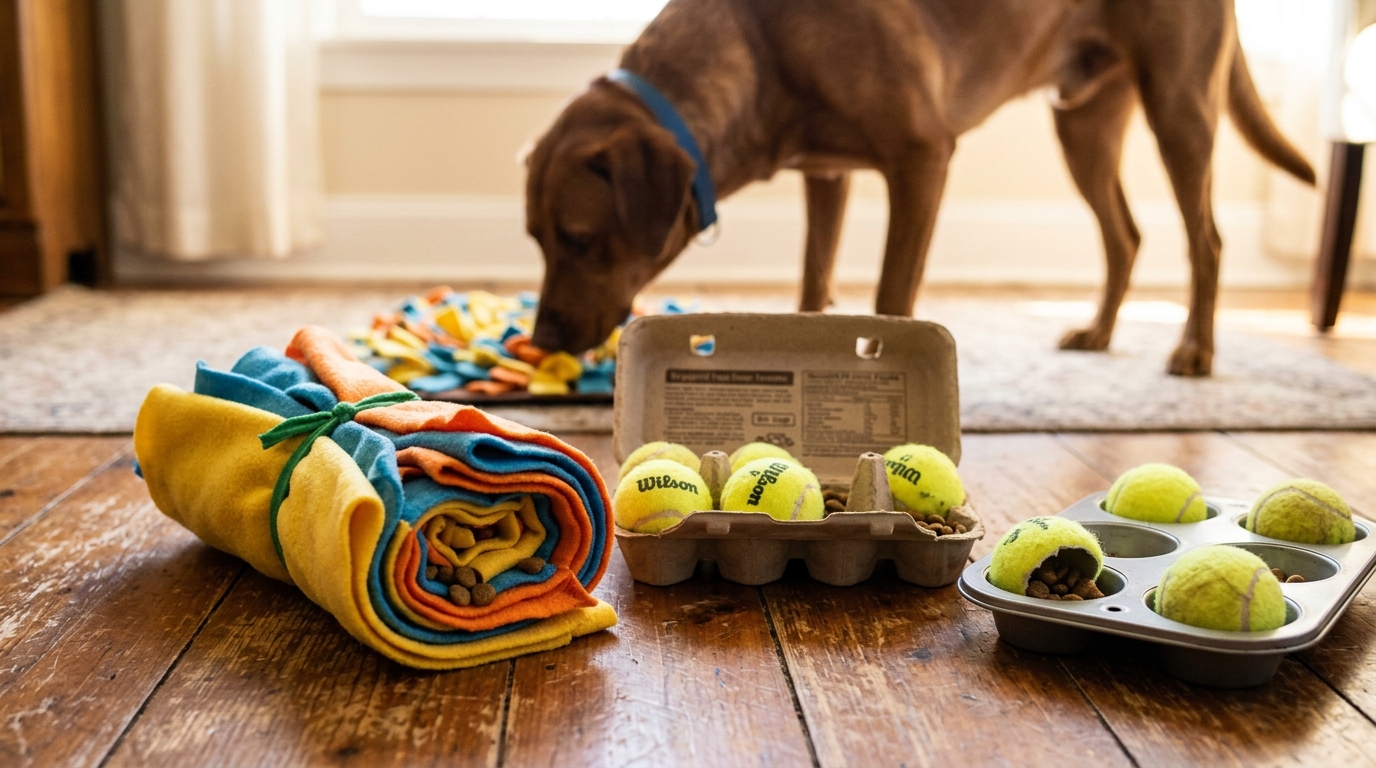
- DIY Scatter Feeding & Lick Mats: Scattering daily kibble in safe backyard grass, rolling food into damp towels, or freezing pet-safe broth onto silicone mats taps into natural scavenging instincts without purchasing costly commercial puzzles.
- Outcome Assessment via Post-Activity Rest: True enrichment results in calm, contented resting and restorative sleep; if an activity triggers frantic overarousal, whining, or destructive agitation, reduce task difficulty.
Start with one question: what should be different afterward? If the answer is calmer breathing, less searching for trouble, easier rest, or a satisfied meal, choose an activity that can plausibly produce that result. More excitement is not automatically more enrichment.
Choose by need and current arousal
| What you notice | Try first | Make it easier when |
|---|---|---|
| Scanning for smells, rushing through the walk | A slow sniffing section or an easy indoor food search | The setting is busy enough that the dog cannot investigate and disengage |
| Finishes meals instantly, then keeps searching | Scatter part of the measured meal or place it in several easy locations | Food competition, gulping, or frantic searching appears |
| Enjoys learning but loses interest quickly | One short problem with an obvious first success | The dog paws, barks, bites the object, or walks away |
| Has physical energy and can move comfortably | Choice-led walking, gentle play, or movement between simple stations | Movement becomes slippery, repetitive, painful, or over-arousing |
| Seeks company but dislikes being crowded | Parallel time, a consent-based game, or choosing a resting place nearby | The dog turns away, freezes, leaves, or cannot protect its rest |
| Looks tired but cannot switch off | Reduce noise and visual triggers; offer water, a familiar resting area, and quiet | Panting, pacing, pain signs, or a sudden change suggests a health problem |
The same activity can land differently on different days. A cardboard search may be absorbing for a dog who noses gently and unsafe for a dog who swallows pieces. A chase game may suit a rested dog outdoors but add fuel to an already hectic evening. Adjust the choice, not just the duration.
Stimulation adds information or challenge: a new search area, a moving toy, a problem to solve, or a training task. Decompression reduces pressure and lets the dog control pace, distance, and attention. A sniff walk can do either job. A quiet familiar verge with room to pause may support decompression; the same activity beside traffic, crowds, and repeated dog encounters may add stimulation.
Choose the category before setting up the activity. When the dog has spent the day monitoring windows, visitors, travel, or close encounters, begin by lowering input rather than presenting a harder puzzle. When the dog is rested, physically comfortable, and seeking engagement, a small new problem may be appropriate. The dog’s response decides which label fits.
Sniffing and foraging: let the nose set the pace
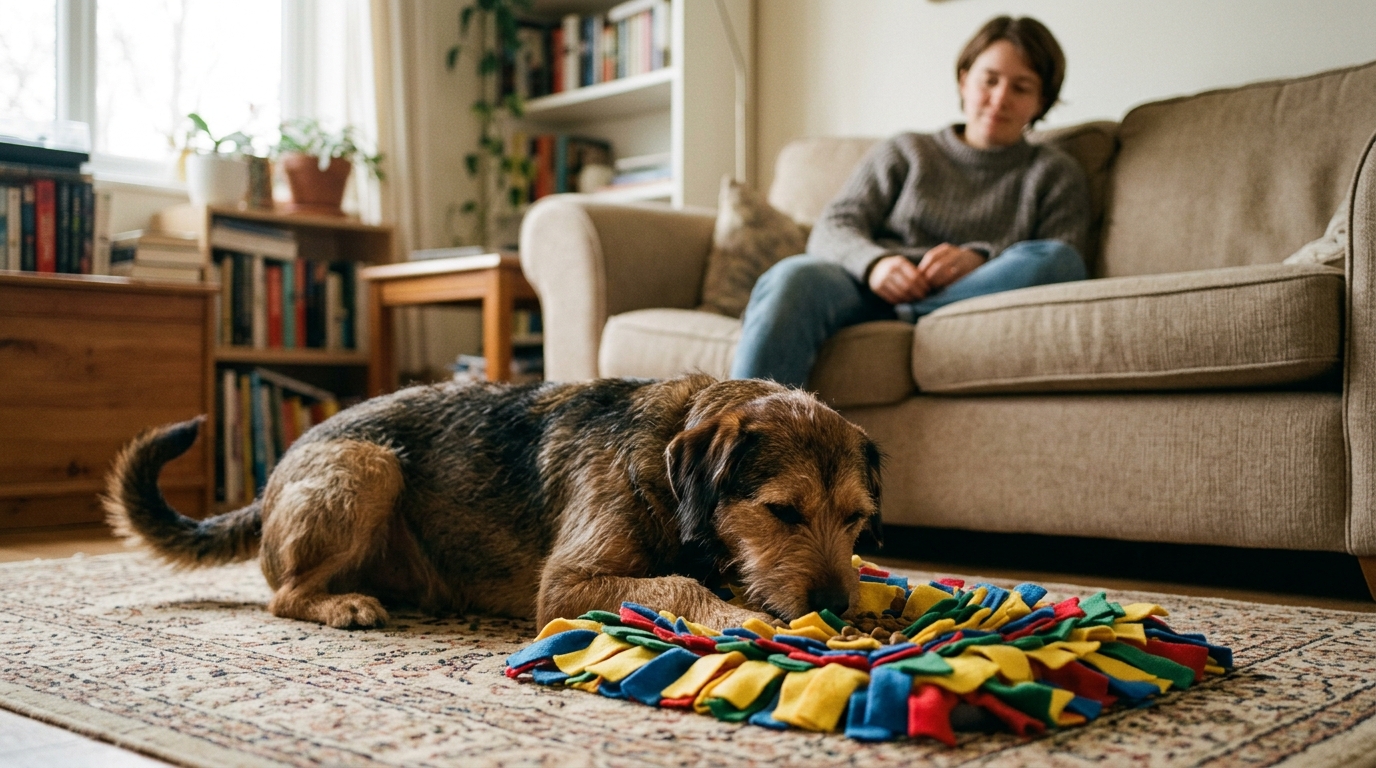
On a safe walk, designate a section where distance is not the goal. Let the dog investigate grass, posts, or quiet edges without being hurried. In a home with little outdoor access, hide a few pieces of the dog’s normal food in visible places, then gradually use chair legs, a washable mat, or the edge of a towel. Beginners should win quickly.
Foraging should not quietly add a second ration. Measure food first, especially for a dog on a weight plan or prescription diet. Separate animals during searches; even dogs that share ordinary space peacefully may feel pressure when food is scattered.
Problem solving and movement: add difficulty one variable at a time
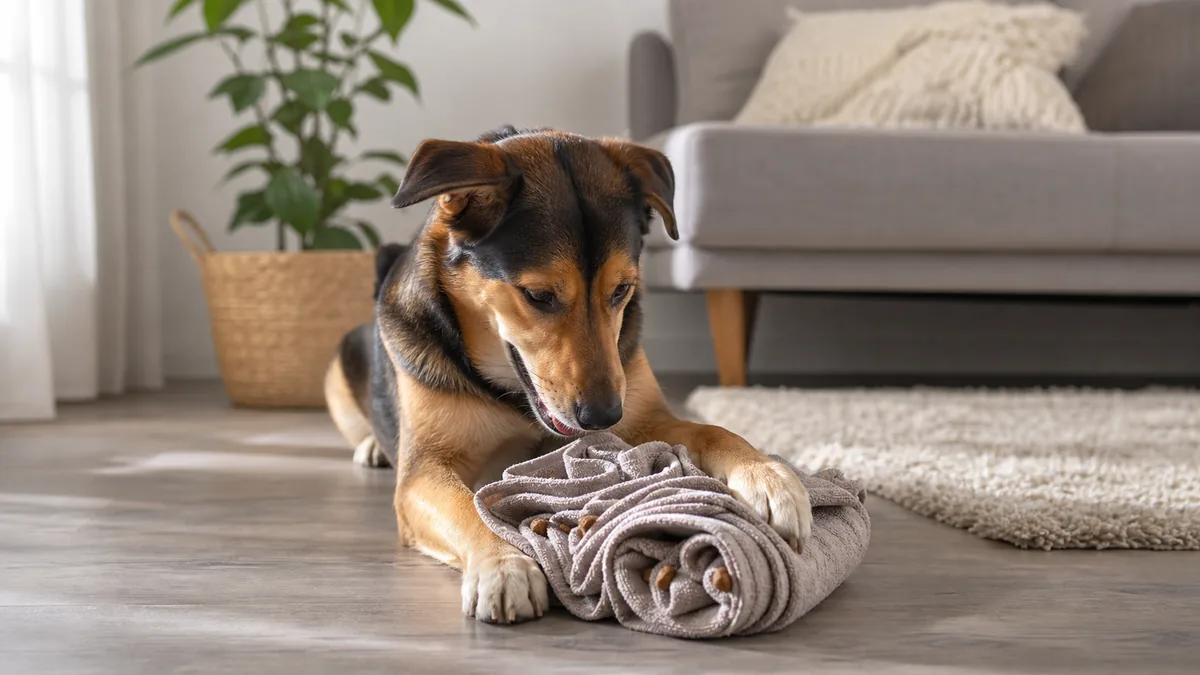
A loosely rolled towel, a muffin tin with easy covers, or plain cardboard without tape or staples can create a simple problem for a dog who does not eat the material. Supervision means being close enough to interrupt swallowing, remove damaged pieces, and end the activity before frustration takes over. If fabric or cardboard goes into the mouth, use an object-free search instead.
Problem solving can also happen without a puzzle. Ask for a hand target at two locations, walk around a chair, step onto a stable mat, or find one visible food piece. Change only one feature at a time: distance, concealment, number of choices, or background distraction. Repeating a failed hard version does not teach persistence; it rehearses frustration.
Movement enrichment should fit the dog’s body and footing. Gentle route choices, sniff walks, tug with clear pauses, or moving between rooms may be useful. Fast turns, jumping, stairs, and slippery floors change the risk for puppies, older dogs, and dogs with pain or mobility limits.
Social choice and settling belong in the plan
Enrichment can be shared without demanding contact. A dog may choose to follow a person during a household task, rest near the family, engage in a brief reward-based game, or move to a quieter bed. Both available rest places should be acceptable; choice is not meaningful if children, visitors, or other pets repeatedly interrupt one of them.
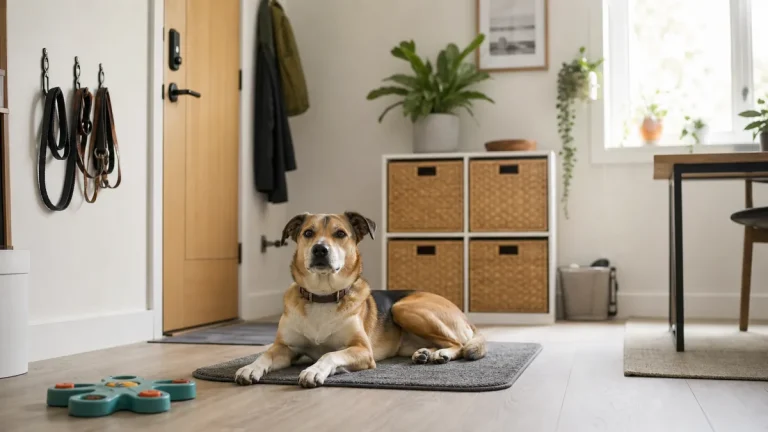
Settling is not an obedience performance. After an active activity, lower the lights or household traffic, close the view that triggers barking, and protect a familiar resting area. A dog that sleeps normally after a short search may have gained more than a dog kept busy for an hour.
Fit the activity to the household
- Small or shared homes: use quiet searches, short sniff outings, and defined rest zones rather than repeated indoor chase.
- Multi-dog homes: separate food work and high-value chews; do not use enrichment to test sharing.
- Children present: an adult controls food games and protects the dog from interruption during chewing or rest.
- Destructive chewing: skip improvised containers and use floor searches, walking choices, or brief training.
- Limited time: turn part of a meal, a toilet trip, or a route choice into the activity instead of adding a separate event.
Stop if the activity produces hard staring, guarding, frantic biting, repeated barking, swallowing, escape attempts, or an inability to settle afterward. Make the next attempt simpler, choose another need category, or seek qualified help when the pattern creates risk.
Three household decisions that change the chooser
The dog becomes louder after every game. Review the whole sequence, not just the activity. Window watching, a fast walk, visitors, tug, and a difficult food puzzle can stack into one long arousal period. Replace the next exciting event with a predictable sniff search in a quiet room, then protect an actual rest block. If the dog still cannot settle, more tasks are unlikely to solve that evening.
The dog destroys every homemade puzzle. Destruction may be part of play for some dogs, but swallowing turns a cheap activity into a medical risk. Remove fabric, tubes, boxes, and small covers. Use food placed on a clear floor, several bowls positioned around one room, scent on a walk, or simple cue-and-release games. The enrichment goal survives even when the object does not.
The household cannot supervise a long session. Choose activities embedded in care: allow a few minutes of sniffing during a toilet trip, divide breakfast among safe visible locations, invite the dog to choose between two resting spots, or practice three hand targets before opening a door. Short does not mean trivial when the activity fits a real need.
Supervision is a risk assessment
Before using household material, ask what the dog does when excited. A dog who mouths gently under direct observation presents a different risk from one who consumes socks, guards found objects, or shreds and gulps. Consider the material, piece size, coatings, previous ingestion, other animals, children, and whether a person can intervene without conflict. When the answers are uncertain, choose an object-free activity.
Food changes the household calculation. Close doors or use secure separation before setting up searches for several dogs. Pick up leftovers before reuniting them. A dog who guards space, bowls, or discovered food needs an individualized safety plan; scattering food around shared territory can make the problem harder.
Judge the recovery, then change one thing
Review the last four activities by effect rather than novelty. Note the need each activity was meant to meet, whether the dog joined voluntarily, what ended the session, and how long ordinary movement, drinking, and rest took to return. A rotation made entirely of fast movement, food competition, or difficult manipulation is repetitive in demand even when every object looks different.
Compare what happened before, during, and after. Loose movement, an easy return to the household rhythm, and voluntary rest support repeating the same level. Frantic searching, repeated demands, guarding, disrupted sleep, gastrointestinal upset, or arousal that spreads into barking and grabbing means the next attempt should be quieter, shorter, or from a different need category.
Change one variable at a time: duration, difficulty, movement, competition, setting, or the activity category itself. Keep one familiar success in the rotation and remove a setup that repeatedly produces guarding or frustration. When the dog appears sore, unusually tired, or unlike the normal baseline, pause progression while health is considered.
When enrichment is not the answer
A sudden change in pacing, sleep, appetite, house-soiling, touch tolerance, mobility, or ability to settle deserves veterinary advice. Enrichment can support ordinary wellbeing, but it cannot identify pain, gastrointestinal discomfort, cognitive change, or a behavior disorder.
For a clearer learning loop, continue with reward-based dog training without fear. If floor space, noise, and shared access shape every choice, use the small-apartment care planner.
Sources
Sources checked: July 13, 2026.
- PMID: 38885492: 2024 AAHA Fluid Therapy Guidelines for Dogs and Cats (J Am Anim Hosp Assoc, 2024) (opens in new tab)
- PMID: 30847984: ACVIM consensus statement on the treatment of immune-mediated hemolytic anemia in dogs (J Vet Intern Med, 2019) (opens in new tab)
- PMID: 37167252: 2023 AAHA Selected Endocrinopathies of Dogs and Cats Guidelines (J Am Anim Hosp Assoc, 2023) (opens in new tab)
- ASPCA: Canine DIY Enrichment (opens in new tab)
Printable tools
Download the matching worksheet
Source transparency
Reference mix for this guide
Source labels describe the type of organization behind each reference; they are not a claim that any outside organization reviewed this article.
- 2024 AAHA Fluid Therapy Guidelines for Dogs and Cats (J Am Anim Hosp Assoc, 2024) Government or public agency · pubmed.ncbi.nlm.nih.gov
- ACVIM consensus statement on the treatment of immune-mediated hemolytic anemia in dogs (J Vet Intern Med, 2019) Government or public agency · pubmed.ncbi.nlm.nih.gov
- 2023 AAHA Selected Endocrinopathies of Dogs and Cats Guidelines (J Am Anim Hosp Assoc, 2023) Government or public agency · pubmed.ncbi.nlm.nih.gov
- ASPCA: Canine DIY Enrichment Animal welfare nonprofit · aspca.org