Editorial standard
How this guide was prepared
A dog bed is a fit decision before it is a material or style decision. The useful size is the space the dog can actually sleep on; the useful support is the support the dog will choose; and the useful cover is one the household can remove, wash, dry, and put back before the bed is needed again.
- Sleeping Posture Matching: Canines that curl or nest require bolstered, circular doughnut beds with supportive rims; side sleepers and sprawlers need flat, generous rectangular mattresses.
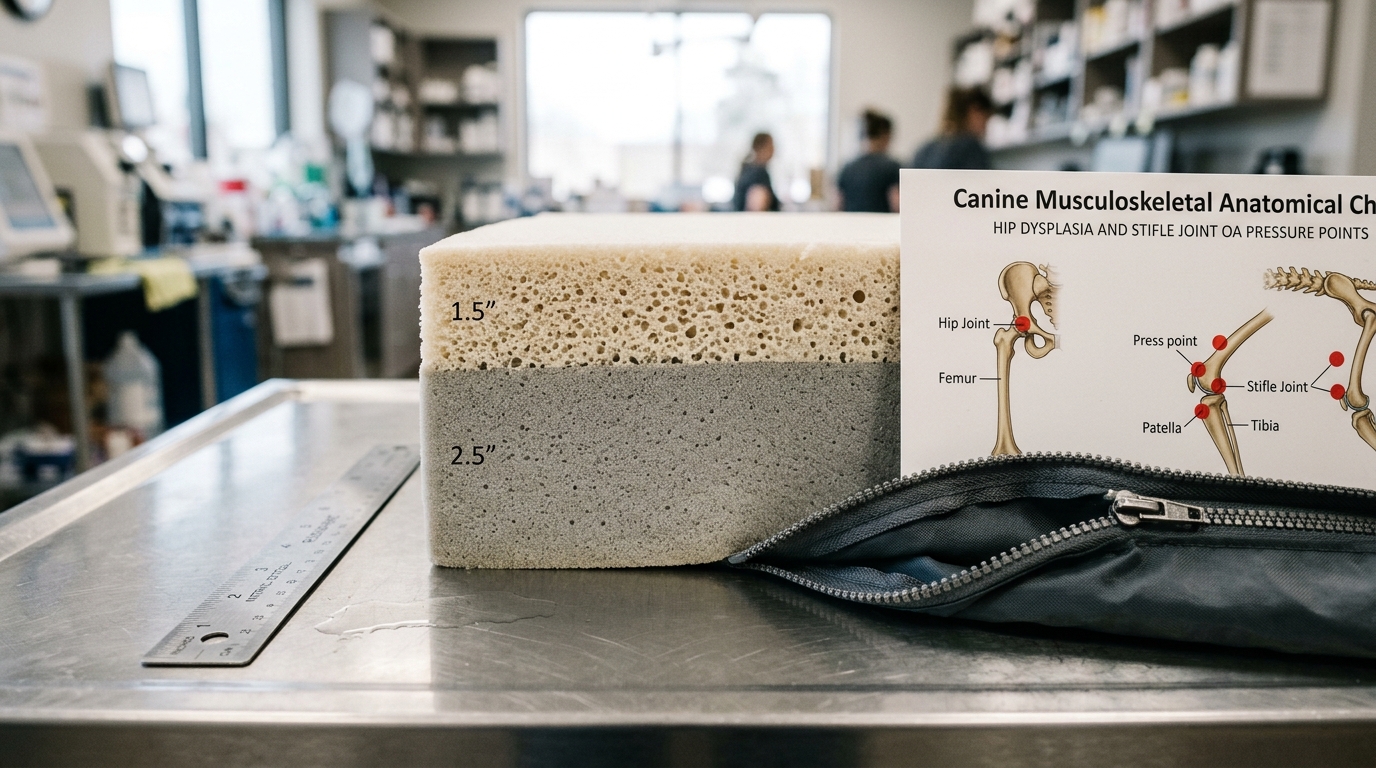
- High-Density Orthopedic Memory Foam: Senior canines, giant breeds, and pets with osteoarthritis require 4 to 5 inches of true high-density orthopedic foam to prevent joint bottoming-out and alleviate pressure sores.
- Sanitation & Internal Moisture Barriers: Select beds with heavy-duty, machine-washable removable outer covers equipped with internal waterproof zippered liners to shield memory foam cores from urine, dander, and bacterial growth.
Follow one path: measure the dog in real sleep positions, choose a construction that fits support and cleaning needs, test it in the intended location, then set replacement rules. Age, chewing, temperature, and mobility can change the answer without making any single product universally best.
Measure the sleeping dog and the usable surface
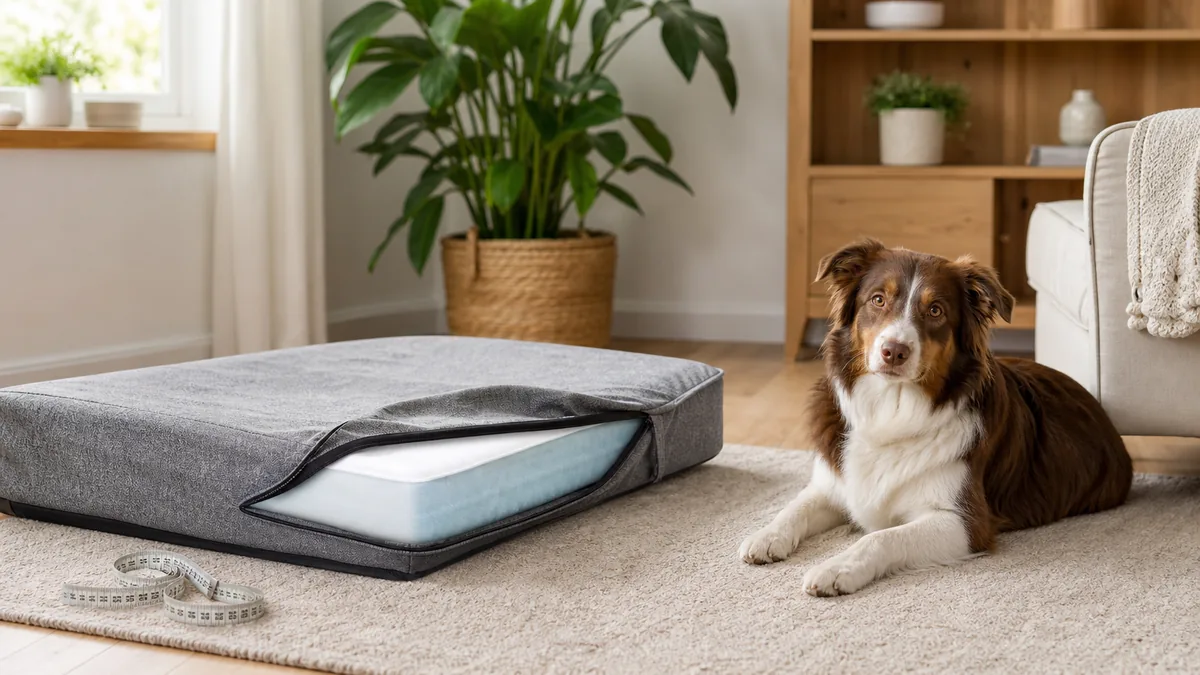
Measure from nose to the base of the tail while the dog lies stretched on the side, then measure the widest comfortable position. Add room for the paws, head, and a change of position. Compare those measurements with the flat inner sleeping surface, not the manufacturer’s outside dimensions, raised rim, or size label.
Work through the dimensions with the actual bed diagram. For example, a dog whose stretched measurement from nose to the base of the tail is 78 centimeters and whose widest curled posture is 52 centimeters across needs both figures to fit inside the flat sleep area. Take each measurement on a flat surface without pulling the dog into a pose, and repeat it if the dog moves before the tape can be read. If a 95-centimeter product includes 12-centimeter bolsters at each end, its usable length may be much less than the label suggests. Repeat the comparison for the doorway or rim height so adequate surface area does not hide a difficult entry.
Record how the dog sleeps over several days. A dog that curls against a wall may value a low bolster, while a dog that sprawls, sleeps belly-down, or changes sides needs open area. A dog that regularly puts the head on a firm edge may prefer a supported boundary, but a high continuous rim can reduce usable space and make entry harder.
Also measure the route to the bed. The dog needs room to approach, turn, step in, and rise without hitting furniture. If the dog is growing, estimate near-term adult dimensions rather than buying a tight fit that will be replaced immediately.
Match support and washable layers to the household
Support should hold the dog’s body without creating a steep, unstable edge. Very soft fill may bunch or leave heavy areas against the floor; very firm or tall foam may be difficult to step onto. Compare thickness after compression, edge stability, and whether the dog can change position normally. Terms such as orthopedic are not a treatment guarantee and do not replace assessment of pain or mobility change.
Posture and mobility can pull the choice in different directions. A curled sleeper may use a boundary for contact, yet a dog that braces to rise may need an open side and firm edge that does not roll under the paws. A sprawler needs uninterrupted area, while a dog that changes position often may reject deep hollows that restrict turning. Observe these tradeoffs; do not infer support needs from age, breed, or a foam label alone.
Think in washable layers. A practical bed has a removable outer cover, a protected inner cushion, and a non-slip base or separate mat. Check whether zips and fasteners are guarded from chewing, whether the insert can be cleaned after urine or vomit, and whether the cover fits the household’s washer and drying conditions. A spare cover can matter more than a decorative extra when drying takes a full day.
Trace common cleaning failures before purchase. A removable cover can still fail if the zip opening is too narrow for the insert, the care label prohibits the household’s available wash cycle, or thick seams remain damp after the surface feels dry. A waterproof liner can trap liquid at a zip or puncture, and loose fill can clump when only one section is washed. Time one realistic remove-wash-dry-reassemble cycle and identify where the dog rests while every affected layer is unavailable.
| Need | Construction question | Reason to reject or modify |
|---|---|---|
| Warm sleeper or hot climate | Can air move around the dog and can heavy layers be removed? | The bed traps heat or sits in direct sun or beside a heater. |
| Older or less mobile dog | Is entry low and stable, with grip before and after the bed? | The dog must climb a tall rim or step onto a sliding cover. |
| Frequent mud or accidents | Can every affected layer be removed, washed, and dried? | Moisture reaches sealed fill that cannot be cleaned. |
| Chewer or digger | Are seams, zips, loose trim, and exposed fill hard to reach? | Damage exposes material that can be swallowed. |
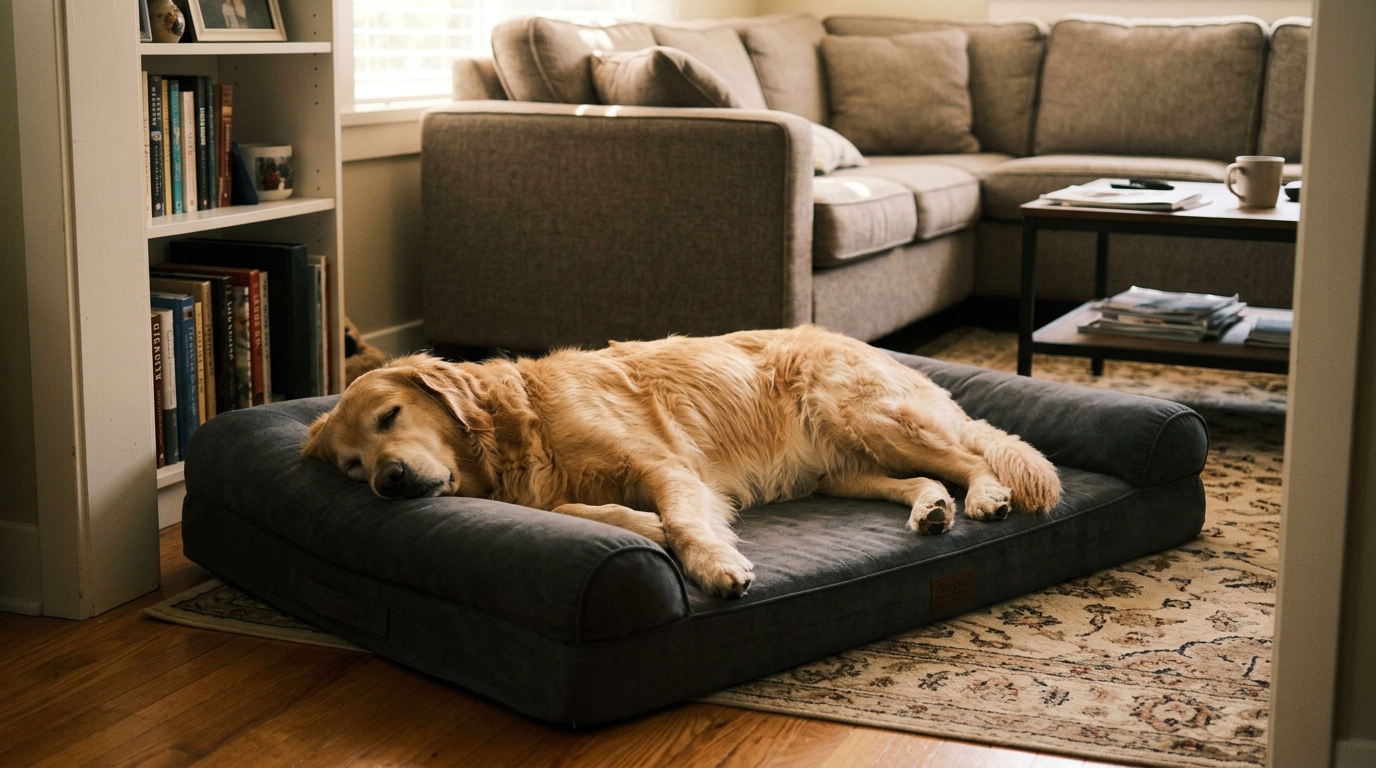
Choose placement as part of the bed
A correctly sized bed can fail in the wrong room. Put it beyond the main footpath and door swing, away from persistent drafts, direct heat, harsh sun, loud appliances, and places where children or other animals repeatedly interrupt rest. Many dogs prefer to remain near household activity without lying in its center.
Check the entire movement path for grip. A non-slip base is not enough if the dog has to stand up onto smooth tile. Extend a stable mat around the approach and exit, especially for long-bodied, older, recovering, or hesitant dogs.
Test placement constraints with the bed’s full footprint, not an empty-room estimate. Open nearby doors, pull out drawers and chairs, walk the night-time route, and check whether a person carrying laundry or food narrows the exit. In a multi-pet home, make sure another animal cannot block the only approach. If the usable location forces the bed beside heat, stairs, or persistent traffic, choose a different footprint rather than folding or wedging the bed.
If the bed is one part of a larger resting area, use the pet nook room-and-animal fit planner to test traffic, temperature, escape routes, cleaning, and multi-pet pressure. Do not wedge the bed so tightly into furniture that the dog must back out or cannot stretch.
Run a short trial and watch movement
Keep the receipt and trial terms where available, but test more than whether the dog lies down once. Over several normal rest periods, observe voluntary use, settling time, position changes, sleep duration, panting, getting up, and the condition of the coat and skin at contact points. Record the time and conditions, which posture appears, how often the dog leaves for another surface, and whether rising looks different after a long rest. Compare similar periods on the established rest surface so heat, noise, or household activity is not mistaken for a bed preference. The trial is useful when this one observation record identifies a fit, temperature, movement, or location problem, not when it merely records that the dog touched the bed.
If the dog avoids it, change one variable: location, cover texture, temperature, rim position, or nearby traffic. If the dog uses it but repeatedly moves to the floor, the bed may be too warm or restrictive. If the cover slides, the edge collapses, or the dog hesitates at entry, correct the movement problem rather than adding treats to persuade the dog onto it.
Chewing changes the trial. Supervise early use, remove the bed if seams open or fill is accessible, and provide an appropriate alternative resting surface. A bed is not safe merely because its material is marketed as tough.
Replace for loss of function, not fashion
Set replacement thresholds when the bed is new. Replace or repair it when support stays compressed, the base slides, seams or fasteners fail, filling becomes accessible, odors or contamination cannot be removed, the dog no longer fits, or the cover cannot be secured. Wash according to the material instructions and inspect hidden layers before putting the bed back.
Judge replacement by the failed function. A flattened sleeping hollow is a support failure; a cover that will not stay closed is a containment failure; moisture in an unreachable layer is a hygiene failure; a sliding base is a movement failure. Repair only when the original function can be restored securely and cleaned as intended.
Re-measure after growth, major weight change, surgery, injury, or a change in mobility. Sudden reluctance to lie down, difficulty rising, limping, vocalizing, restlessness, or a new preference for hard or unusual surfaces warrants veterinary advice; buying a softer bed should not be used to explain away pain.
The final choice is the bed that gives the individual dog enough usable space, stable support, a manageable entry, and a cleaning cycle the household can sustain in the location where the dog actually rests. Confirm those functions after the longest normal rest period.
Sources
Sources checked: July 13, 2026.
- PMID: 38885492: 2024 AAHA Fluid Therapy Guidelines for Dogs and Cats (J Am Anim Hosp Assoc, 2024) (opens in new tab)
- PMID: 30847984: ACVIM consensus statement on the treatment of immune-mediated hemolytic anemia in dogs (J Vet Intern Med, 2019) (opens in new tab)
- PMID: 37167252: 2023 AAHA Selected Endocrinopathies of Dogs and Cats Guidelines (J Am Anim Hosp Assoc, 2023) (opens in new tab)
- RSPCA Australia: Providing an optimal life for your companion animal (opens in new tab)
Printable tool
Download the matching worksheet
Source transparency
Reference mix for this guide
Source labels describe the type of organization behind each reference; they are not a claim that any outside organization reviewed this article.
- 2024 AAHA Fluid Therapy Guidelines for Dogs and Cats (J Am Anim Hosp Assoc, 2024) Government or public agency · pubmed.ncbi.nlm.nih.gov
- ACVIM consensus statement on the treatment of immune-mediated hemolytic anemia in dogs (J Vet Intern Med, 2019) Government or public agency · pubmed.ncbi.nlm.nih.gov
- 2023 AAHA Selected Endocrinopathies of Dogs and Cats Guidelines (J Am Anim Hosp Assoc, 2023) Government or public agency · pubmed.ncbi.nlm.nih.gov
- RSPCA Australia: Providing an optimal life for your companion animal Animal welfare nonprofit · rspca.org.au