
This guide is general education for pet owners. If your pet has urgent symptoms, possible poisoning, injury, breathing trouble, collapse, severe pain, or sudden decline, contact a licensed veterinarian or local emergency service.
Dosages must be calculated by a licensed veterinarian based on species, weight, and bloodwork. Never administer human medications or self-adjust prescription doses for pets.
Editorial standard
How this guide was prepared
This clinical guide outlines parasite prevention principles based on Companion Animal Parasite Council (CAPC) and AAHA standards. If your dog exhibits acute tremors, stumbling, persistent vomiting, or seizures after receiving a preventive medication, contact a veterinary emergency hospital immediately.
- Non-Seasonal Year-Round Prevention: Parasites do not follow a calendar; indoor heating and hardy vector species allow fleas, ticks, and microfilarial mosquitoes to survive during winter, making uninterrupted 12-month prophylaxis essential.
- Mandatory Pre-Treatment Heartworm Testing: Always conduct a veterinary blood antigen and microfilaria test before initiating or resuming canine heartworm preventives to avoid catastrophic microfilarial shock reactions.
- Cross-Species Formulation Safety: Select preventives carefully in multi-species homes: never apply canine pyrethroid/permethrin topicals in households with cats, as permethrin is neurotoxic and acutely fatal to felines.
Adopting a rescue or shelter dog introduces immediate medical uncertainty regarding parasite exposure and preventative history. Shelters frequently treat shelter-intake populations with broad dewormers such as pyrantel pamoate or ponazuril, yet long-term continuous prevention against heartworms, fleas, and ticks is rarely documented consistently. For new pet parents, initiating parasite protection requires evaluating diagnostic test windows and drug safety parameters rather than guessing with over-the-counter formulations.

Verify Documentation and Diagnostic History
Prior to administering any preventive medication, assemble all medical transfer records from the shelter, rescue organization, or foster caregiver. Look specifically for verified clinical documentation rather than informal discharge notes:
- Heartworm Antigen and Microfilaria Test Date: Note whether a commercial point-of-care ELISA or lateral flow test (such as an IDEXX SNAP 4Dx Plus or Heska Solo Step) was performed, along with the specific result.
- Fecal Centrifugation and Flotation Results: Check whether a centrifugal flotation test was run to detect nematode eggs (hookworms, roundworms, whipworms) and protozoal cysts (Giardia, Coccidia), noting any prescribed clearance medications.
- Product Brand Name and Active Ingredient: Identify the specific preventative administered, distinguishing between oral chewables, topical spot-ons, or long-acting injectables.
- Exact Administration Timestamp and Weight Tier: Record the date given and verify that the package weight bracket matches your dog’s actual measured weight on veterinary scales.
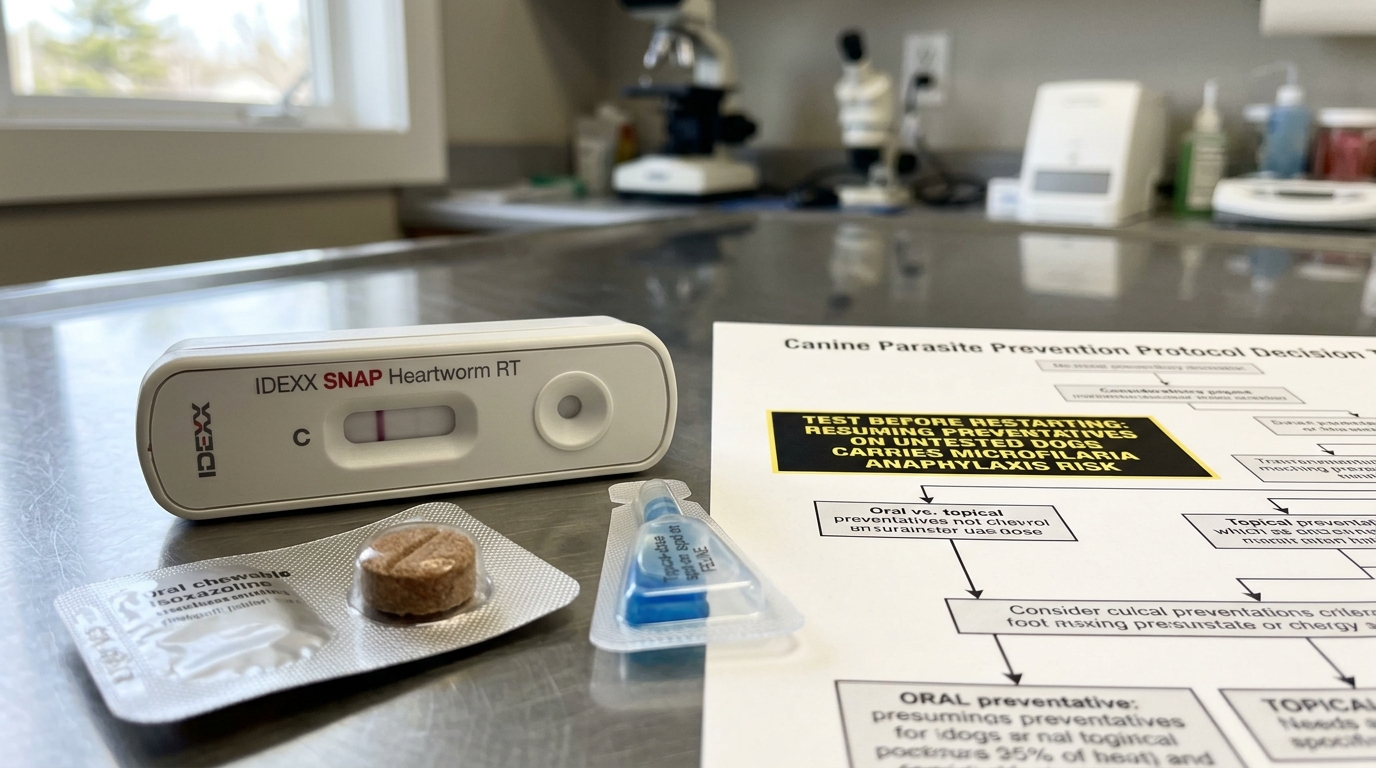
The Biological Window and Heartworm Testing Imperative
The Companion Animal Parasite Council (CAPC) and the American Heartworm Society (AHS) emphasize that heartworm prevention must never be initiated blindly in a dog with an unknown or interrupted medical history. Understanding the parasite’s life cycle is critical for safe decision-making:
| Parasite Biological Stage | Diagnostic Detection Window | Preventive Drug Mechanism & Risk Boundary |
|---|---|---|
| L3 / L4 Larvae (Transmitted by mosquitoes) | Undetectable via blood tests; larvae migrate through subcutaneous tissues for 50–70 days. | Macrocyclic lactones (ivermectin, milbemycin oxime, moxidectin) eliminate L3 and L4 tissue larvae, preventing molt to adult stages. |
| Young Adult Heartworms (Migrate to pulmonary arteries) | Undetectable via antigen tests until females reach sexual maturity at approximately 5–6 months post-bite. | Standard preventive doses do not reliably eliminate adult worms; initiating prevention without testing can mask emerging infection. |
| Circulating Microfilariae (First-stage offspring in bloodstream) | Detected via modified Knott’s test or blood smear examination in patent infections. | Administering macrocyclic lactones to microfilaremic dogs can trigger rapid, massive larval die-off, causing circulatory shock and fatal anaphylactoid reactions. |
Because heartworm antigen tests only detect an antigen glycoprotein secreted by mature adult female heartworms, an adopted dog infected 3 months prior will test negative. A veterinary baseline re-test at 6 months post-adoption is essential to capture delayed antigen seroconversion.
Pharmacological Classes and Safety Boundaries
Modern veterinary preventatives combine distinct pharmacological classes to provide broad-spectrum endoparasite and ectoparasite protection. Understanding how these drug classes function ensures safe home administration:
- Isoxazolines (Afoxolaner, Fluralaner, Sarolaner, Lotilaner): Systemic oral or topical insecticides that target flea and tick GABA and glutamate receptors. The FDA has issued clinical guidance noting that while safe for the majority of canines, isoxazolines may lower seizure thresholds. Dogs with a diagnosed history of epilepsy, tremors, or ataxia require careful veterinary neurological screening before use.
- Macrocyclic Lactones (Moxidectin, Milbemycin Oxime, Ivermectin): Preventative anthelmintics targeting heartworm larvae, hookworms, and roundworms. Certain herding breeds (Collies, Australian Shepherds, Whippets) carry the MDR1 (ABCB1) gene mutation, causing neurotoxicity at high deworming doses, though standard monthly heartworm preventative doses remain clinically safe.
- Strict Rule Against Splitting Chewables: Never split a large-dog chewable tablet between two smaller dogs to save costs. Active pharmaceutical ingredients are not distributed uniformly throughout extruded soft chews, risking severe under-dosing in one dog and toxic overdosing in the other.
- Feline Permethrin Toxicity Warning: Many canine topical spot-on preventatives contain high concentrations of permethrin. Permethrin is acutely neurotoxic and potentially fatal to domestic cats. Never apply canine topical spot-on products to cats, and keep treated dogs physically separated from household cats until the application site is completely dry (24–48 hours).
Red-Flag Triage Matrix: Parasite Prevention Adverse Events
Monitor your dog closely during the first 24 hours following any new preventative administration using this clinical triage matrix:
| Triage Level | Clinical Manifestations | Required Action Protocol |
|---|---|---|
| Immediate Emergency (0–2 Hours) | Generalized muscle tremors, ataxia (uncoordinated, drunken gait), acute seizures, facial angioedema (hives and swelling), persistent projectile vomiting, pale or blue gums, sudden collapse. | Transport immediately to the nearest veterinary emergency critical care facility. Bring the preventative packaging with active ingredient details for toxicology evaluation. |
| Urgent Assessment (12–24 Hours) | Marked lethargy lasting beyond 24 hours, refusal of all food and water, severe diarrhea or hematochezia (fresh blood in stool), intense localized pruritus or hair loss at a topical application site. | Contact your primary care veterinarian for same-day evaluation. Topical products should be bathed off immediately using mild liquid dish soap (e.g., Dawn) to halt systemic absorption. |
| Routine Home Monitoring | Transient single-episode soft stool, slight decrease in appetite for one meal that resolves within 12 hours, mild sleepiness. | Ensure constant access to fresh water, maintain a bland diet temporarily if recommended by your vet, and document the observation in your permanent medical binder. |
Parasite prevention products must be selected and prescribed by a licensed veterinarian based on your dog’s verified body weight, medical history, regional vector risks, and diagnostic test results. Never use expired products or divide medications across multi-pet households.
Frequently Asked Questions
Why must dogs undergo heartworm antigen testing before starting or restarting preventives?
Administering certain heartworm preventives to an animal with circulating microfilariae can trigger a rapid die-off that leads to severe, potentially fatal anaphylactic shock. Testing confirms negative status and protects therapeutic safety.
Are oral parasite chewables better than topical spot-on medications?
Both options provide strong protection when administered consistently. Oral isoxazoline chews cannot be washed off by bathing or swimming and prevent exposure to children and other pets, while topical options are ideal for pets with food allergies or history of seizures.
Do strictly indoor cats require routine flea and heartworm prevention?
Yes. Heartworms are transmitted by mosquitoes that easily enter homes through windows or doors, and fleas frequently hitchhike indoors on clothing or other animals. Because feline heartworm disease has no approved medical cure, continuous prevention is critical.
Caregiver Parasite Prevention Action Checklist
- Set a recurring monthly reminder on your calendar or phone to ensure timely administration without gaps.
- Confirm an up-to-date negative heartworm test before initiating or renewing microfilarial medications.
- Part the coat down to the skin between the shoulder blades when applying topical liquids to prevent oral grooming.
- Inspect paws, ears, and groin with a fine flea comb after outings in tall grass, dog parks, or wooded trails.
- Never apply permethrin-based canine treatments to cats; permethrin induces fatal neurotoxicity in felines.
Sources
- CAPC Canine Parasite Control Guidelines. Companion Animal Parasite Council.
- Current Canine Guidelines for the Prevention, Diagnosis, and Management of Heartworm (Dirofilaria immitis) Infection in Dogs. American Heartworm Society.
- FDA Fact Sheet for Pet Owners and Veterinarians About Potential Adverse Events Associated with Isoxazoline Flea and Tick Products. U.S. Food and Drug Administration.
Printable tools
Download the matching worksheet
Source transparency
Reference mix for this guide
Source labels describe the type of organization behind each reference; they are not a claim that any outside organization reviewed this article.
- CAPC Canine Parasite Control Guidelines Reference source · capcvet.org
- Current Canine Guidelines for the Prevention, Diagnosis, and Management of Heartworm (Dirofilaria immitis) Infection in Dogs Reference source · heartwormsociety.org
- FDA Fact Sheet for Pet Owners and Veterinarians About Potential Adverse Events Associated with Isoxazoline Flea and Tick Products Government or public agency · fda.gov

