
This guide is general education for pet owners. If your pet has urgent symptoms, possible poisoning, injury, breathing trouble, collapse, severe pain, or sudden decline, contact a licensed veterinarian or local emergency service.
Dosages must be calculated by a licensed veterinarian based on species, weight, and bloodwork. Never administer human medications or self-adjust prescription doses for pets.
Editorial standard
How this guide was prepared
Fostering rescue companion animals requires objective, structured clinical observation. Foster pets arrive from shelter facilities experiencing significant neuroendocrine stress, transition anxiety, and altered physiological routines. In shelter medicine, communicating with rescue medical coordinators and shelter veterinarians demands clear, factual records rather than emotional generalizations. A foster caregiver who can document precise timelines, caloric intake measurements, stool scoring, and behavioral decompression milestones provides rescue coordinators with actionable clinical data, ensuring prompt medical intervention while avoiding unnecessary shelter hospital readmissions.
- Log Daily Quantitative Vital Statistics: Record exact caloric consumption, water intake, daily body weights for pediatric fosters, and fecal consistency using the standard 1-to-7 Bristol-scale metric.
- Distinguish Shelter Decompression from Sickness: Mild shyness and temporary anorexia are expected during initial decompression; persistent vomiting, liquid diarrhea, or fever requires prompt medical reporting.
- Follow Shelter Pre-Authorization Chains: Always notify the rescue organization’s medical coordinator and obtain treatment authorization before seeking outside emergency clinical services.
This foster clinical tracking protocol conforms to shelter medicine standards established by the Association of Shelter Veterinarians (ASV). Home timeline tracking supports shelter medical decisions and must never delay urgent emergency intervention. If your foster animal exhibits profuse bloody diarrhea, continuous vomiting, hypothermia (<99.0°F), severe respiratory distress, or sudden unresponsiveness, transport the animal immediately to the approved emergency partner hospital.
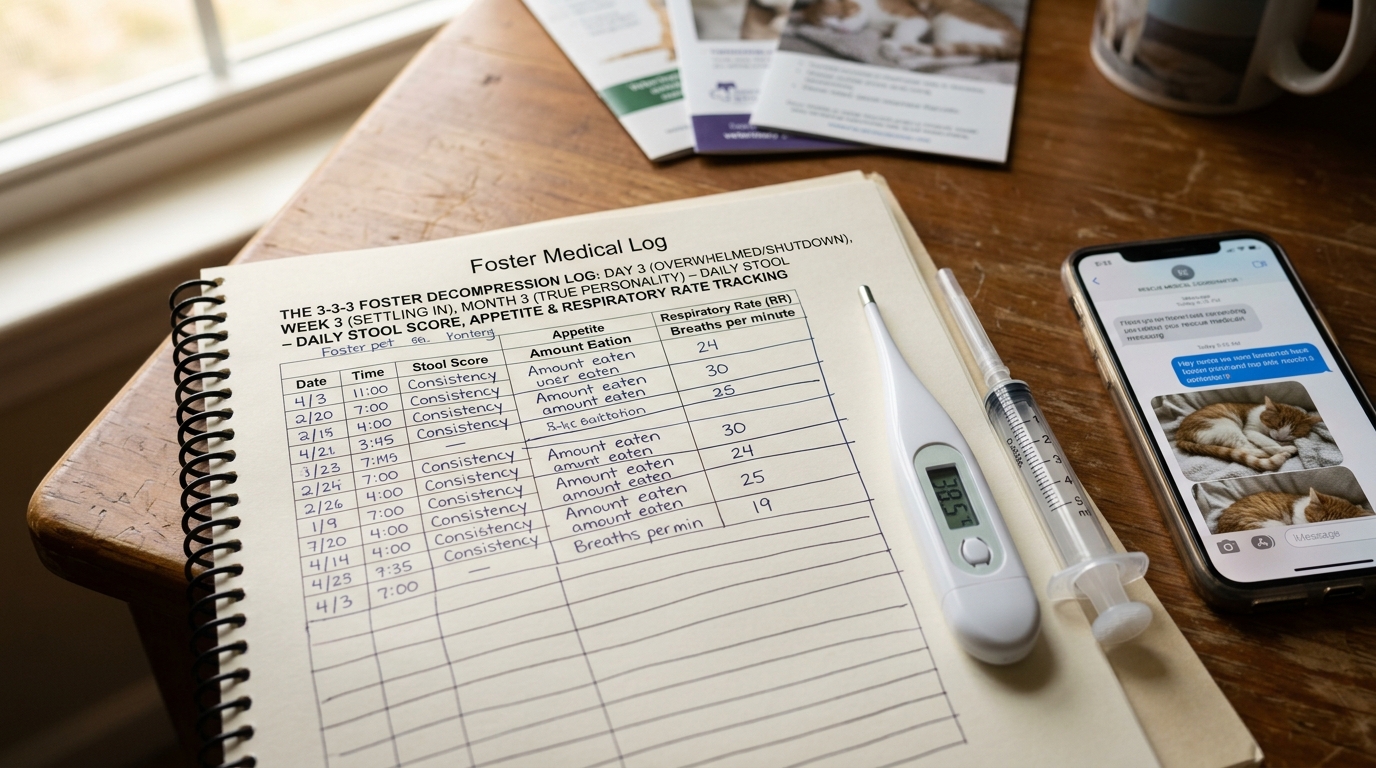

The 3-3-3 Decompression Rule in Rescue Medicine
Veterinary behaviorists and shelter specialists utilize the 3-3-3 timeline framework to distinguish normal behavioral decompression from physiological pathology:
- First 3 Days (Decompression & Shock): The animal feels overwhelmed, shut down, or hyper-vigilant. Appetite may be temporarily diminished, water consumption variable, and elimination hesitant. Mild stress colitis (soft stool without blood) frequently occurs due to dietary shifts and transport stress.
- First 3 Weeks (Settling & Routine): The foster animal begins learning household expectations and feeling secure. True behavioral baselines emerge, and appetite stabilizes. Persistent vomiting, progressive diarrhea, or chronic coughing during this phase indicates underlying infectious disease rather than stress.
- First 3 Months (Integration & Security): The animal establishes full trust, bonding with caregivers and displaying true personality traits. Physical recovery from chronic shelter ailments (such as mange, malnutrition, or respiratory infections) reaches completion.
Structuring the Daily Foster Medical Log
Maintain an objective daily health record to share with your rescue medical team:
| Clinical Monitoring Metric | Standardized Documentation Technique | Objective Clinical Benchmark |
|---|---|---|
| Food & Water Intake | Weigh food bowls before feeding and record percentage eaten; track water bowl refill volumes. | Total food refusal exceeding 24 hours in felines risks acute hepatic lipidosis; prompt intervention required. |
| Standardized Fecal Scoring | Grade every bowel movement using a 1 to 7 fecal scoring scale (1 = hard dry pellets, 7 = watery liquid). | Scores of 6 or 7 lasting >24 hours require diagnostic fecal flotation and rescue veterinary notification. |
| Resting Respiratory Rate (RRR) | Count sleeping chest rises across 30 seconds while the animal is quietly resting; multiply by 2. | Normal rate remains strictly below 30 breaths per minute; counts >35 bpm indicate lower respiratory disease. |
| Integument & Coat Inspection | Check skin folds, inner ears, and paws daily for circular alopecia, redness, or dark discharge. | Catches early dermatophytosis (ringworm) or secondary bacterial pyoderma before widespread household spread. |
Effective Medical Communication with Rescue Coordinators
When reporting health updates to rescue medical teams, present organized, factual bullet points:
- Lead with Demographics and Duration: State the animal’s rescue ID, name, intake date, and exact symptom duration: “Foster Cat Bella (ID #4521), day 4 of foster, developed soft stool 18 hours ago.”
- Quantify Vital Signs and Output: Provide specific counts rather than generalizations. Report: “She passed grade 6 stool three times today, consumed 100% of her canned food, and her resting respiratory rate is 22 breaths per minute.”
- Attach Focused Digital Photographs: Include clear photos of abnormal stool, vomitus, or skin lesions taken under bright lighting. Visual evidence enables shelter veterinarians to triage severity and prescribe targeted treatments without delay.
Red-Flag Triage Matrix: Foster Animal Medical Escalation
Consult this clinical triage hierarchy to determine appropriate medical escalation for foster pets:
| Triage Tier | Clinical Presentation | Required Action Protocol |
|---|---|---|
| Immediate Emergency (0–2 Hours) | Hemorrhagic diarrhea with foul odor, repeated violent vomiting, profound hypothermia (<99.0°F), open-mouth breathing, or extreme lethargy with gray oral mucosa. | Contact the rescue emergency coordinator and transport immediately to the designated veterinary hospital. Suspected parvovirus or panleukopenia requires immediate barrier nursing and emergency fluid therapy. |
| Urgent Assessment (12–24 Hours) | Persistent watery diarrhea without blood, mild conjunctival discharge with sneezing, refusal to eat exceeding 24 hours, or expanding circular hair loss patches. | Notify the shelter medical team during clinic hours. Maintain strict room isolation and prepare stool or skin cytology samples for veterinary evaluation. |
| Routine Foster Monitoring | Mild soft stool on day one following shelter food transition, slight initial shyness resting in the crate, or mild transient ocular crusting. | Maintain the structured quarantine timeline. Feed consistent shelter-provided food, ensure fresh water, and log daily appetite and stool scores. |
Never administer leftover human medications, aspirin, acetaminophen, or unprescribed antibiotics to foster animals. Human analgesics induce fatal organ destruction, while unapproved antibiotic administration obscures diagnostic testing and fosters dangerous antimicrobial resistance.
Caregiver Decision Tree: Foster Clinical Observation Dilemmas
Foster caregivers distinguish between transition stress diarrhea and viral enteritis
Mild stress colitis resulting from shelter transport and dietary shifts typically produces soft, pudding-like stool (fecal score 5) in an animal that remains bright, alert, playful, and hungry, with normal pink mucosal color and stable hydration. By contrast, infectious viral enteritis (such as parvovirus or panleukopenia) rapidly escalates to profuse, foul-smelling liquid diarrhea containing frank blood or sloughed mucosal tissue (fecal score 7), accompanied by intractable vomiting, profound depression, hypothermia, and refusal to drink. Severe symptoms warrant immediate emergency hospital transport.
Why should foster parents measure resting respiratory rates (RRR) during quiet sleep?
Shelter environments expose companion animals to high viral and bacterial respiratory pathogen loads (such as Bordetella, canine influenza, or feline calicivirus). Measuring resting respiratory rate while the animal is quietly sleeping—counting chest rises for 30 seconds and multiplying by two—provides the most reliable, non-invasive indicator of subclinical lower respiratory tract compromise or bronchopneumonia. An RRR consistently exceeding 30 to 35 breaths per minute alerts caregivers to seek prompt veterinary thoracic auscultation and chest radiography.
Frequently Asked Questions
What specific clinical information should be recorded in a pet symptom log?
Note exact dates, times, duration of episodes, descriptions of vomit or stool, behavioral posture, changes in water and food consumption, and brief smartphone video clips of coughing, limping, or tremors.
When does an observed symptom require immediate emergency veterinary evaluation?
Symptoms such as pale or blue gums, extreme lethargy, continuous unassisted vomiting, respiratory distress, abdominal distension, or inability to urinate require immediate emergency care rather than ongoing home logging.
How does maintaining an objective symptom journal assist the veterinary clinical team?
A detailed chronological timeline removes guesswork, identifies disease progression patterns, correlates signs with environmental triggers, and helps veterinarians select targeted diagnostic tests without unnecessary expense.
Caregiver Symptom Documentation Checklist
- Record exact times, duration, and frequency of every vomiting, coughing, or abnormal episode.
- Capture 15 to 30-second videos of unusual gaits, breathing patterns, or tremors to show the clinician.
- Grade stool consistency using the 1 to 7 fecal chart and note any presence of fresh blood or dark melena.
- Track water bowl intake and percentage of normal meal portions consumed across each 24-hour cycle.
- Bring your written or digital log directly to the veterinary examination to assist clinical diagnosis.
Sources
- ASV Guidelines for Standards of Care in Animal Shelters: Health Monitoring. Association of Shelter Veterinarians.
- AAHA Canine and Feline Life Stage Guidelines. American Animal Hospital Association.
- Merck Veterinary Manual: Principles of Shelter Medicine. Merck Sharp & Dohme Corp.
Source transparency
Reference mix for this guide
Source labels classify the institutional category of the references cited above.