This guide is general education for pet owners. If your pet has urgent symptoms, possible poisoning, injury, breathing trouble, collapse, severe pain, or sudden decline, contact a licensed veterinarian or local emergency service.
Dosages must be calculated by a licensed veterinarian based on species, weight, and bloodwork. Never administer human medications or self-adjust prescription doses for pets.
Editorial standard
How this guide was prepared
This clinical guide outlines parasite prevention and toxicological safety in multi-pet households based on Companion Animal Parasite Council (CAPC) guidelines. If a cat experiences contact with a canine permethrin topical product or exhibits twitching, tremors, or seizures, seek immediate emergency veterinary medical care.
- Simultaneous Household Treatment: Treat 100% of cohabitating dogs and cats concurrently; treating only the symptomatic pet leaves untreated housemates as perpetual environmental reservoirs for fleas and intestinal worms.
- Strict Feline Permethrin Safety Warning: Never apply canine-specific topical spot-on treatments in homes with cats, and keep treated dogs separated until application sites are completely dry (minimum 12–24 hours).
- Eliminate Environmental Flea Biomass: Adult fleas on pets represent merely 5% of the total infestation; wash all pet bedding weekly in hot water (> 60°C) and vacuum carpets daily to eliminate developing pupae and larvae.
Managing parasite prevention across multiple companion animals presents complex pharmacological challenges for pet parents. When dogs and cats cohabitate, sharing living spaces, sleeping cushions, and social grooming routines creates direct pathways for cross-species toxicosis and persistent re-infestation. Establishing a robust prevention plan requires evaluating individual species metabolic pathways, preventing accidental chew sharing, and systematically treating the shared environmental parasite reservoir.
The Critical Cross-Species Hazard: Feline Permethrin Toxicosis
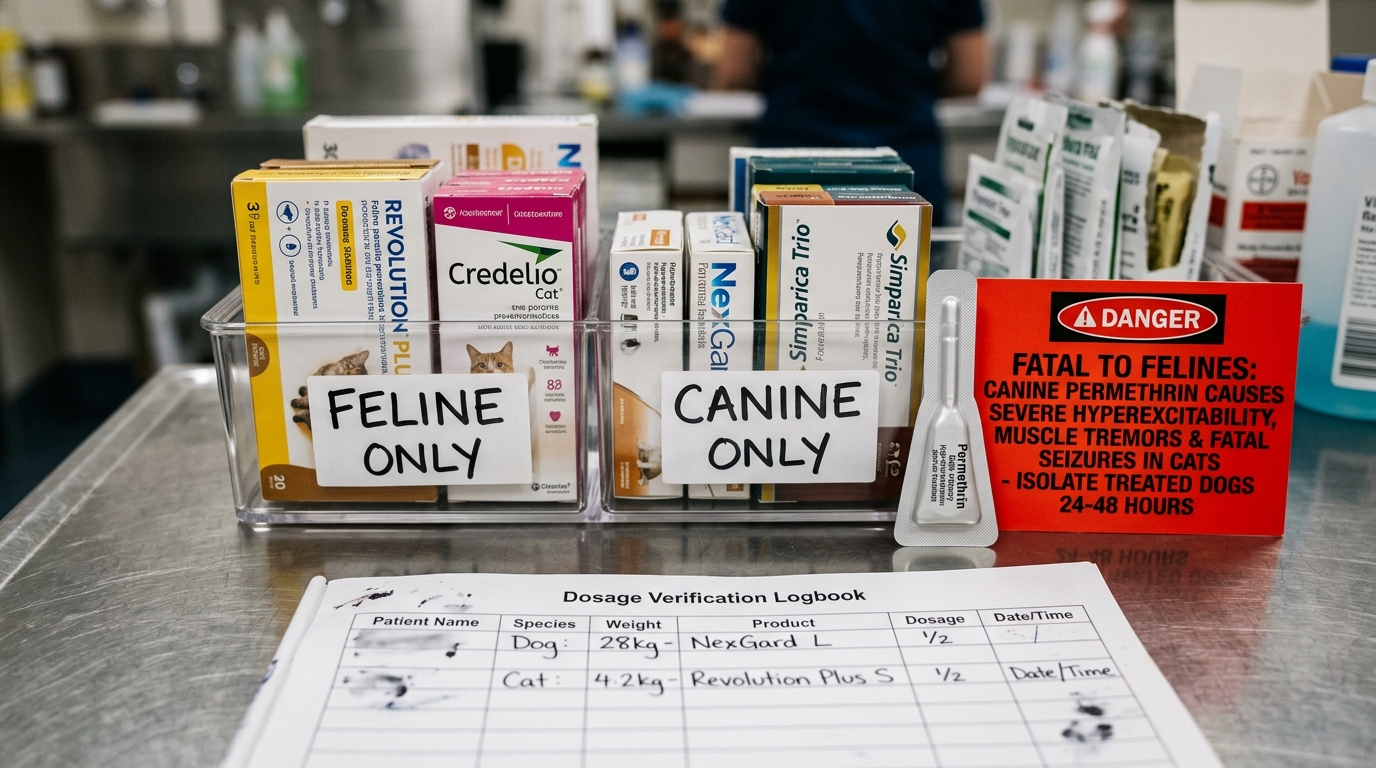
The most dangerous parasite prevention error in mixed-species homes is feline exposure to canine synthetic pyrethroid spot-on products, particularly concentrated permethrin. Domestic cats possess an evolutionary deficiency in hepatic glucuronidation, specifically lacking sufficient activity of the UGT1A6 enzyme isoform. While canine hepatocytes rapidly metabolize and clear permethrin without tissue accumulation, feline livers cannot conjugate these compounds, resulting in severe systemic toxicity and neuroexcitation.
Secondary grooming exposure represents a major vector for poisonings. Felines do not require direct application to suffer life-threatening toxicity. Grooming the coat of a dog treated with a permethrin spot-on within 24 to 48 hours of application, or resting beside a damp application site, delivers a toxic transdermal and oral dose. Initial symptoms emerge within hours, beginning with ear twitching, facial tremors, and generalized muscle fasciculations, rapidly advancing to whole-body convulsions, severe hyperthermia, and respiratory depression.
To safeguard felines in homes with dogs, families must enforce a mandatory 48-hour physical isolation protocol whenever canine topical pyrethroids are applied. The treated dog should remain physically separated until the oily spot-on carrier has completely dried and absorbed. Alternatively, many veterinary teams recommend prescribing systemic oral isoxazolines (such as sarolaner, fluralaner, or afoxolaner) for canine residents, entirely eliminating the risk of topical toxic transfer to feline housemates.
Medication Segregation: Preventing Weight-Bracket and Ingestion Errors
In multi-dog households with varying body weights, unmonitored medication administration creates dangerous dosing errors. Active pharmaceutical ingredients in flavored soft chews are not uniformly distributed throughout the confection matrix. Dividing a chew formulated for a large canine between smaller companions leads to severe under-dosing in one animal and acute toxicity in the other. Families must purchase species- and weight-specific packages for every animal.
Resource guarding and theft during administration present another frequent household hazard. A dominant dog may snatch a smaller companion’s chew, or a curious pup might swallow medication dropped onto the floor. Caregivers should administer oral preventatives to each animal behind closed doors in separate rooms, observing the pet until the tablet is completely swallowed before reuniting the animals. Avoid hiding medicated chews in shared feeding bowls or treat puzzle toys where competing pets interact.

The Environmental Reservoir: Treating the Entire Household
A frequent mistake in multi-pet homes is treating only the animal showing active scratching or live fleas. In veterinary entomology, visible adult fleas residing on companion animal coats represent merely 5% of the total flea biomass. The remaining 95% of the population exists within home carpets, upholstery, hardwood floor crevices, and pet bedding in the form of eggs (50%), larvae (35%), and pupae (10%).
When one pet in a multi-animal home remains untreated, that individual acts as a living incubator, sustaining the environmental parasite cycle. Effective flea eradication requires continuous, simultaneous preventive coverage for every dog, cat, and rabbit in the household for a minimum of 90 consecutive days. This extended duration guarantees that newly emerging adult fleas from resilient pupal cocoons are eliminated before depositing new viable eggs into the living space.
Veterinary Consultation Framework: Formulating a Unified Multi-Pet Plan
Preparing for a veterinary visit with multiple pets demands organized diagnostic and lifestyle tracking. Clinicians evaluate individual exposure profiles, travel histories, and regional disease prevalences before approving a household protocol. Prior to your appointment, gather documented body weights, current prevention records, and specific lifestyle details for each pet, including outdoor trail access, daycare attendance, and hunting behavior.
During the consultation, discuss screening tests such as annual heartworm antigen testing and microfilariae checks for dogs, alongside comprehensive fecal flotation for all household residents. Multi-pet environments foster easy cross-contamination of intestinal parasites like Giardia and roundworms through shared water stations and litter boxes. Establishing consistent diagnostic baselines ensures that selected pharmaceuticals target the specific parasitic risks present in your unique domestic ecosystem.
Red-Flag Triage Matrix: Multi-Pet Parasite Emergencies
Use this objective triage matrix to identify when multi-pet parasite exposure requires emergency veterinary intervention:
| Triage Level | Clinical Manifestations | Required Action Protocol |
|---|---|---|
| Immediate Emergency (0–2 Hours) | Cat showing ear twitching, muscle tremors, seizures, or hypersalivation after exposure to dog flea treatment; small animal ingesting high-milligram chew formulated for large pet; acute facial swelling or collapse after medication ingestion. | Transport immediately to the nearest veterinary emergency critical care hospital. Bring medication packaging for exact dosage assessment. For feline topical contact, wash the affected skin gently with lukewarm water and mild liquid dish detergent during emergency preparation to limit transdermal absorption. |
| Urgent Assessment (12–24 Hours) | Persistent vomiting or bloody stools following oral preventative, severe localized skin erythema and alopecia at topical application site, heavy flea infestation causing pale gums indicative of flea-induced anemia. | Contact your primary veterinarian for same-day evaluation. Rinse off topical products if skin irritation worsens, and request complete blood counts to evaluate red blood cell volumes in young or debilitated pets. |
| Routine Home Monitoring | Single transient soft stool, brief salivation from bitter tablet taste, or finding a single dead tick firmly attached to pet fur after woodland walk. | Launder all pet bedding in hot water exceeding 140°F (60°C), vacuum carpets and baseboards thoroughly daily, and maintain strict adherence to veterinary-approved monthly administration schedules. |
Parasite prevention medications must be selected under direct veterinary supervision based on certified weights, medical histories, and multi-species cohabitation dynamics. Under no circumstances should canine flea products be applied to felines, and never cut or divide chewable tablets between household pets.
Frequently Asked Questions
Why must dogs undergo heartworm antigen testing before starting or restarting preventives?
Administering certain heartworm preventives to an animal with circulating microfilariae can trigger a rapid die-off that leads to severe, potentially fatal anaphylactic shock. Testing confirms negative status and protects therapeutic safety.
Are oral parasite chewables better than topical spot-on medications?
Both options provide strong protection when administered consistently. Oral isoxazoline chews cannot be washed off by bathing or swimming and prevent exposure to children and other pets, while topical options are ideal for pets with food allergies or history of seizures.
Do strictly indoor cats require routine flea and heartworm prevention?
Yes. Heartworms are transmitted by mosquitoes that easily enter homes through windows or doors, and fleas frequently hitchhike indoors on clothing or other animals. Because feline heartworm disease has no approved medical cure, continuous prevention is critical.
Caregiver Parasite Prevention Action Checklist
- Set a recurring monthly reminder on your calendar or phone to ensure timely administration without gaps.
- Confirm an up-to-date negative heartworm test before initiating or renewing microfilarial medications.
- Part the coat down to the skin between the shoulder blades when applying topical liquids to prevent oral grooming.
- Inspect paws, ears, and groin with a fine flea comb after outings in tall grass, dog parks, or wooded trails.
- Never apply permethrin-based canine treatments to cats; permethrin induces fatal neurotoxicity in felines.
Sources
- CAPC Guidelines: Comprehensive Multi-Pet Parasite Control. Companion Animal Parasite Council.
- Permethrin Toxicosis in Cats: Pathogenesis, Clinical Signs, and Emergency Management. Today’s Veterinary Practice.
- Pyrethroid Toxicity in Animals Overview. Merck Veterinary Manual.
Printable tools
Download the matching worksheet
Source transparency
Reference mix for this guide
Source labels describe the type of organization behind each reference; they are not a claim that any outside organization reviewed this article.
- CAPC Guidelines: Comprehensive Multi-Pet Parasite Control Reference source · capcvet.org
- Permethrin Toxicosis in Cats: Pathogenesis, Clinical Signs, and Emergency Management Reference source · todaysveterinarypractice.com
- Pyrethroid Toxicity in Animals Overview Reference source · merckvetmanual.com