Editorial standard
How this guide was prepared
Apartment suitability is not a body-size contest. A small dog who startles at corridor noise and cannot rest may struggle more than a larger dog whose toileting, movement, and sleep needs fit the household. The practical test is whether the home and schedule can deliver five things reliably: elimination access, varied movement, decompression, noise management, and undisturbed rest.
- Routine Consistency Over Square Footage: Thriving in small apartment spaces depends on structured physical exercise, sensory sniff walks, and predictable indoor rest cycles rather than home floor area.
- Predictable Toileting & Decompression Outings: Maintain rigid 4- to 6-hour outdoor bio-break schedules; combine elimination walks with dedicated sniffari time to satisfy investigative drives and avoid indoor marking.
- Hallway Noise Desensitization & White Noise: Mitigate acoustic reactivity to elevator chimes, corridor footsteps, and slamming doors through sound machines, visual window screening, and positive counter-conditioning.
Measure the plan by the dog’s day, not the floor plan. Where can the dog toilet when the lift is slow? Which route allows sniffing instead of constant close passes? Can the dog sleep while deliveries, children, or neighbors move outside the door?
Elimination access sets the schedule
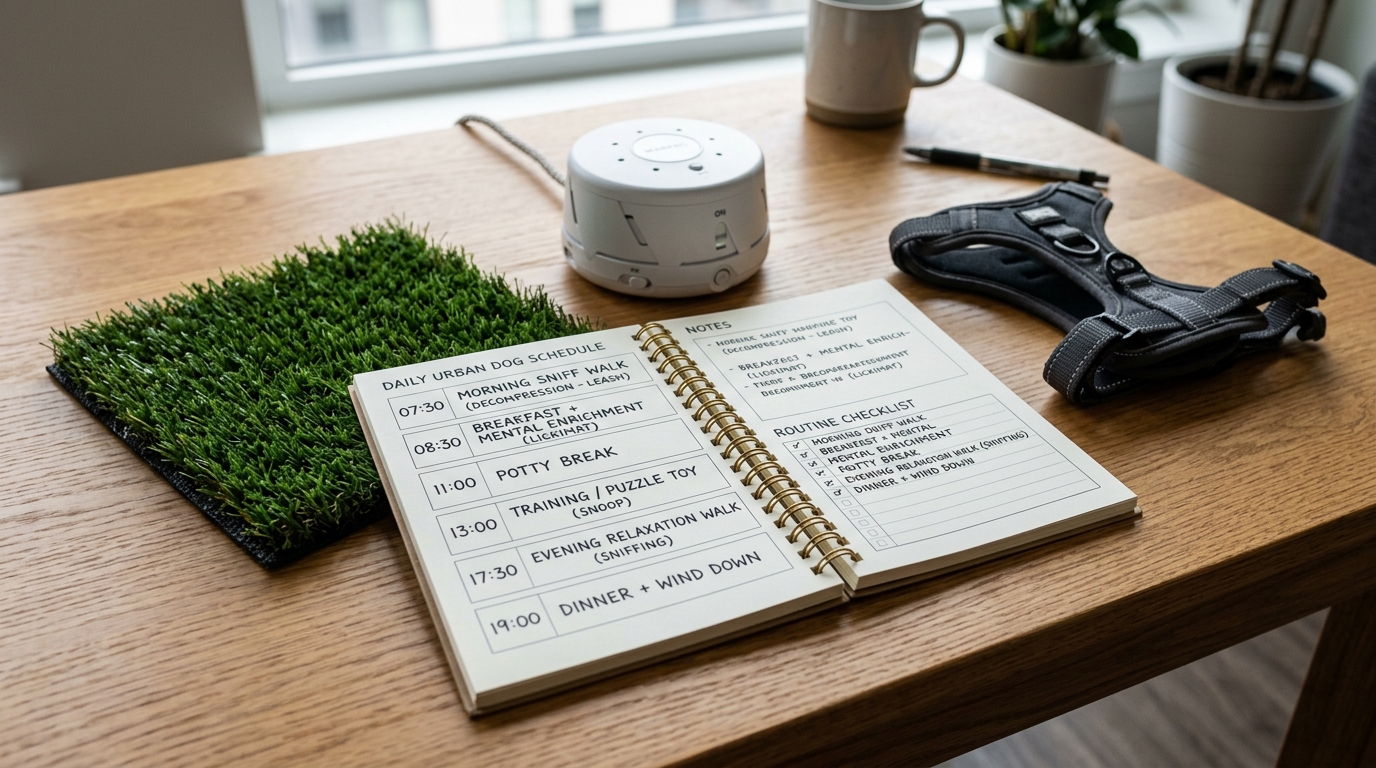
Map the trip from resting area to toilet location. Puppies, older dogs, dogs with gastrointestinal or urinary problems, and newly adopted dogs may need more frequent access than the household expects. Build extra time for stairs, lifts, secure equipment, weather, and a dog who freezes in a busy lobby.
Reward success at the intended location and clean accidents without punishment. Indoor toilet systems are a household choice, not a shortcut that suits every dog; placement, hygiene, surface preference, and later transition outdoors all matter. A sudden increase in accidents or straining belongs with a veterinarian, not a stricter training rule.
Movement and decompression do different jobs
Physical movement supports health, but a hurried pavement march does not replace opportunities to investigate. Combine purposeful outings with slower sections where the dog can sniff safely. The right amount depends on age, health, temperature, footing, fear, and recovery, not a universal distance target.
Indoors, use food searches, brief reward-based training, gentle play, or movement between stable stations. Avoid making a small room into a high-speed obstacle course. If an activity leaves the dog barking, skidding, grabbing, or unable to settle, lower the intensity.
Noise management begins before barking
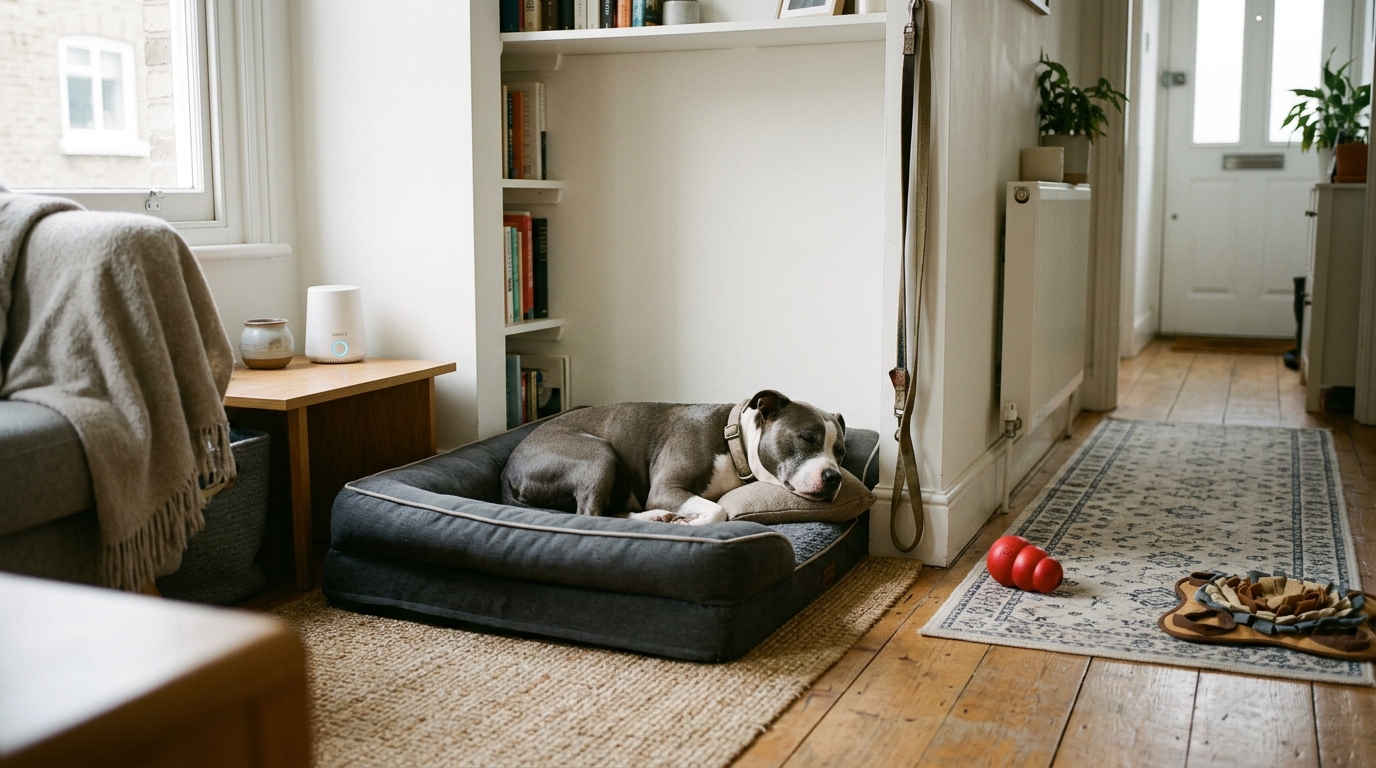
Map predictable triggers before choosing a training response: lift doors, footsteps, deliveries, dogs in shared areas, balcony activity, the corridor view, and active play beside a party wall. Move rest and play away from the noisiest boundary, soften sound where practical, block a triggering view, schedule vigorous indoor games outside quiet hours, and give delivery workers instructions that reduce knocking or lingering.
Prepare the dog before a known trigger rather than punishing sound afterward. A simple search, comfortable station, or greater distance from the entrance can reduce rehearsal while the dog is still able to orient to the handler. For corridor encounters, check the route and choose quieter times instead of forcing repeated close passes.
Use neighbor reports as timing evidence, not a verdict on whether the dog is generally quiet. Ask for the start time, approximate duration, and recurring context, then compare that with deliveries, lift traffic, departures, window activity, and the dog’s recovery. Change one predictable setup and review the next occurrence; arguments and delayed punishment cannot identify which variable mattered.
Track the quiet behavior that follows as well as the bark. A dog that gives one alert and returns to rest presents a different planning problem from one that patrols the boundary for twenty minutes. Record recovery, room position, and whether the trigger remained visible or audible so the next change addresses the sustained pattern rather than sound alone.
Rest needs protected territory
A bed placed in the center of family traffic is not a true rest option. Offer at least one location where the dog is not stepped over, hugged, moved for furniture access, or watched by another pet. In one-room homes, a visual screen, furniture arrangement, or household rule can create a meaningful boundary.
Sleep disruption can look like excess energy. Before adding more exercise, ask whether the dog can complete long, relaxed rest periods and recover after outings. Children and visitors need a simple rule: a dog in the protected place is left alone.
Two routines for different constraints
| Routine point | Household away for a work block | Home-based household with limited mobility |
|---|---|---|
| Morning | Toilet trip, unhurried sniff section, measured breakfast search, then quiet rest before departure | Prompt toilet access, short accessible route or courtyard sniff, breakfast delivered in several easy locations |
| Middle of day | Arrange a reliable toilet and movement break appropriate to the dog; avoid assuming every adult can wait the same duration | Alternate brief toilet outings with two-minute training or scent tasks; preserve a long rest block |
| Busy building period | Rest area away from the entrance, visual barrier if needed, predictable background sound | Schedule calm food work before deliveries or corridor traffic, then reduce stimulation |
| Evening | Decompression walk before high-energy play; finish with quiet household time | One longer supported outing if feasible, or several shorter routes with choice and recovery |
| Before bed | Final toilet access and a low-traffic sleep location | Final toilet access timed to medication, mobility, or sleep needs |
These are patterns, not prescriptions. A dog who cannot cope with the work-block routine may need a walker, sitter, daycare chosen with care, a different schedule, or a different housing plan. A person with limited mobility may use help from another caregiver while still providing rich sniffing and choice.
Shared-building fit and individual suitability
- Use secure, well-fitted equipment before opening the apartment door.
- Give other dogs space in lifts and narrow corridors instead of staging greetings.
- Keep waste, food, and enrichment materials hygienic and out of common routes.
- Plan for heat, balcony safety, open windows, and door escape risks.
- Tell walkers or sitters the same toilet route, equipment, trigger, and rest rules.
For low-cost indoor options, choose from enrichment activities organized by need and arousal. If the shared exit or street is where the routine breaks down, use the loose-leash troubleshooting guide.
Suitability is not a size or breed shortcut
Body size changes space and transport logistics, but it does not predict barking, fear of strangers, tolerance of shared corridors, exercise needs, ability to be alone, or recovery after stimulation. Before choosing or keeping a dog in an apartment, ask about the actual animal’s history, health, toileting pattern, sound sensitivity, movement needs, and comfort around close encounters.
A quieter adult with moderate movement needs may fit a small home better than a highly vigilant small dog. Conversely, a large dog with pain, heat intolerance, or no safe lift access may face practical barriers despite a calm temperament. Avoid breed promises and plan for the dog in front of you.
Alone time and building access can decide feasibility
A secure apartment does not make a dog comfortable alone. Use a camera for ordinary short absences and watch for pacing, vocalizing, drooling, exit destruction, or inability to settle. Do not assume neighbors will provide the first reliable warning; some dogs suffer quietly. Separation-related distress needs its own assessment, not extra exercise before departure or confinement as a cure.
Treat building access as a household feasibility exercise, not a universal rule about square footage. Two equally sized homes can create different daily demands when one has a quiet direct exit and backup care while the other requires a crowded lift, slippery stairs, or a long exposed toilet route. Record how long the route takes, whether the dog recovers comfortably after stairs, and which parts fail during heat, cold, heavy traffic, or mobility change.
Run through one lift outage, one severe-weather day, and one caregiver delay. Decide whether the dog can use stairs safely, who can assist if not, where an acceptable toilet break can occur, and how a walker or sitter enters without relying on the resident answering a phone. Keep current keys, building permissions, equipment notes, and emergency contacts where the backup person can use them.
These are planning prompts for the individual household, not fixed welfare thresholds supplied by a building type. The evidence is whether toileting, movement, rest, care access, and recovery remain workable on ordinary and disrupted days. If the plan only works under perfect timing, the constraint needs redesign before another activity is added.
Separate daily capacity from emergency capacity. A dog may manage two flights once yet struggle when every toilet trip requires them, and a sitter may hold a key yet be unable to follow the usual route with that dog. Review frequency, recovery, handling skill, and backup access together before calling the contingency usable.
Review outcomes that matter to dog and neighbors
Look for reliable toileting, normal appetite and sleep, the ability to recover from corridor events, relaxed use of the rest zone, and barking that is manageable without intimidation. Keep a brief log only for a problem window: what triggered it, what distance or barrier helped, and how long recovery took. Change the environment when the same failure repeats.
If the dog spends most of the day suppressing reactions, waiting too long for toileting, or recovering from necessary building traffic, the care plan needs structural change. More intense evening exercise cannot repay a day of unmet needs.
Reconsider the plan when welfare is shrinking
Seek veterinary advice for pain, breathing change, exercise intolerance, sleep disruption, sudden house-soiling, appetite change, or a marked behavior shift. Qualified reward-based behavior help is appropriate when barking, fear, escape attempts, guarding, or conflict persists despite reducing difficulty.
The apartment question is not whether a dog can be made tired enough to stay quiet. It is whether ordinary needs can be met predictably without chronic distress for the dog or household.
Sources
Sources checked: July 13, 2026.
- RSPCA Australia: Providing an optimal life for your companion animal (opens in new tab)
- ASPCA: Canine DIY Enrichment (opens in new tab)
- Ohio State Indoor Pet Initiative: Environmental Enrichment for Dogs (opens in new tab)
- AVSAB: Humane Dog Training Position Statement (opens in new tab)
Printable tools
Download the matching worksheet
Source transparency
Reference mix for this guide
Source labels describe the type of organization behind each reference; they are not a claim that any outside organization reviewed this article.
- RSPCA Australia: Providing an optimal life for your companion animal Animal welfare nonprofit · rspca.org.au
- ASPCA: Canine DIY Enrichment Animal welfare nonprofit · aspca.org
- Ohio State Indoor Pet Initiative: Environmental Enrichment for Dogs Academic or extension · indoorpet.osu.edu
- AVSAB: Humane Dog Training Position Statement Veterinary organization · avsab.org