Editorial standard
How this guide was prepared
A useful dog budget is not a universal monthly price. It is a local cash-flow plan built around the dog you have or may bring home, the services your household will genuinely need, and the bills that arrive less often than the food order. Start with categories, collect current local figures, and keep the date beside every quote.
- Baseline Monthly Care ($100–$250): Routine monthly operating costs include species-appropriate nutrition, parasite prevention (flea/tick/heartworm), waste supplies, basic grooming, and minor replacements, varying primarily by body weight.
- Dedicated Emergency Medical Reserves: Maintain a dedicated emergency savings reserve ($1,500–$3,000) or secure comprehensive accident-and-illness pet insurance to absorb unexpected veterinary surgical or medical costs.
- Bimodal Lifecycle Expense Peaks: Veterinary expenditures are highest during the pediatric phase (spay/neuter, microchipping, vaccine series) and senior geriatric years (bi-annual diagnostics, prescription diets, arthritis management).
Build the first version before adoption or before a major change such as a move, a new work schedule, or senior care. Then test whether the plan still protects food, housing, routine care, and urgent veterinary access when an ordinary month stops being ordinary.
Separate the five kinds of dog spending
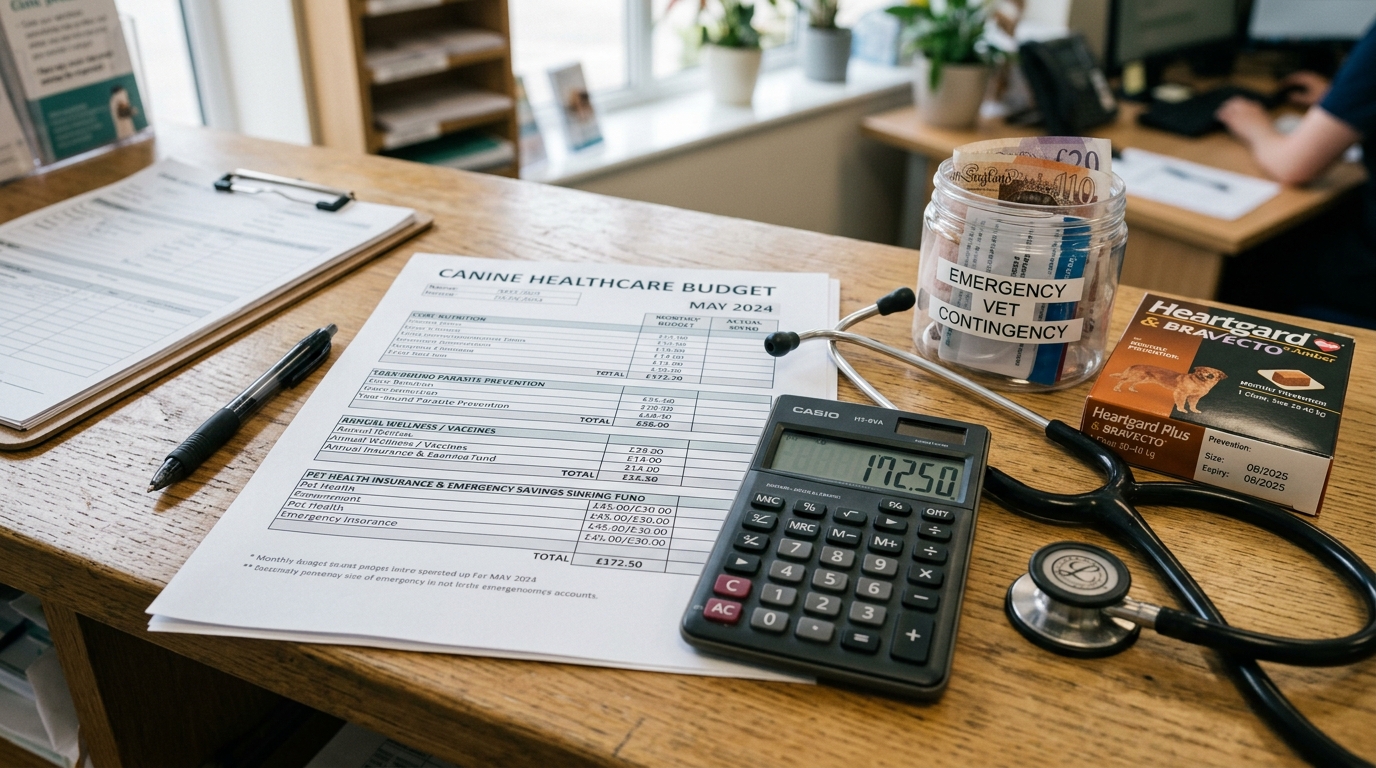
| Budget bucket | What belongs in it | How to plan it |
|---|---|---|
| Recurring | Complete food, waste supplies, routine medication, parasite prevention where locally advised, and frequently replaced chews or cleaning items. | Use the dog’s actual consumption and the delivered local price, then review after weight, diet, or supplier changes. |
| Annualized | Routine veterinary examinations, vaccinations where advised, licensing, grooming cycles, training refreshers, and planned boarding. | Add the expected yearly total and set aside one-twelfth each month in a separate pot. |
| Startup | Adoption or purchase costs, first records review, identification, gates, bed, bowls, lead, harness, crate if appropriate, and safe transport. | Keep this one-time total outside the ordinary monthly headline so the first year is not made to look artificially cheap. |
| Emergency | Urgent consultation, diagnostics, treatment, transport, deposits, and the portion not covered by any insurance arrangement. | Choose a reserve target and a way to access funds promptly; do not assume reimbursement removes the need to pay first. |
| Location-dependent | Pet rent or deposits, registration, walkers, day care, boarding, grooming, transport, and local veterinary fees. | Collect quotes for the actual address and schedule rather than importing a national or overseas average. |
Do not blur these buckets simply to produce a lower monthly figure. Startup spending is real but not recurring; annual bills are predictable even when they are not monthly; emergency capacity is different from routine savings.
Price the dog rather than an average dog
Body size changes food volume, bed and crate size, medication quantities, and sometimes boarding or transport charges. Life stage changes the pattern: puppies can bring clustered training, vaccination, chewing-replacement, and supervision costs, while older dogs may need more frequent monitoring, dental care, mobility support, or ongoing treatment.
Put body size and life stage on separate worksheet rows so one change does not disappear inside a broad estimate. For food, record the current daily amount and pack yield. For equipment, note which items must fit the adult body. For a puppy, add short-horizon remeasurement and replacement points; for an adult, use current condition and activity; for a senior dog, leave space for locally quoted monitoring, mobility, and handling support without assuming that every older dog will need the same services.
Coat and handling needs matter too. A short coat that can be maintained safely at home has a different service pattern from a coat that mats without regular professional grooming. A dog who can remain comfortably alone for the household’s normal work period creates a different support budget from one who needs a walker, day care, or a gradual behavior plan.
Separate paid support by cause and duration. A predictable workday walker is a recurring line; a sitter during two planned trips is annualized; temporary help after an owner injury is a stress-test scenario. Quote the visit length, frequency, transport, medication handling, cancellation terms, and any assessment fee that apply locally. This prevents a single optimistic pet-care allowance from hiding the service the household would actually purchase.
Housing and climate can move costs without changing the dog. Rental rules, secure fencing, hot-weather transport, cold-weather drying, seasonal parasites, and distance to veterinary services all belong in the local estimate. Ask clinics what a routine visit includes, compare food by daily feeding amount, and obtain service quotes that include fees and taxes.
Turn irregular care into a monthly transfer
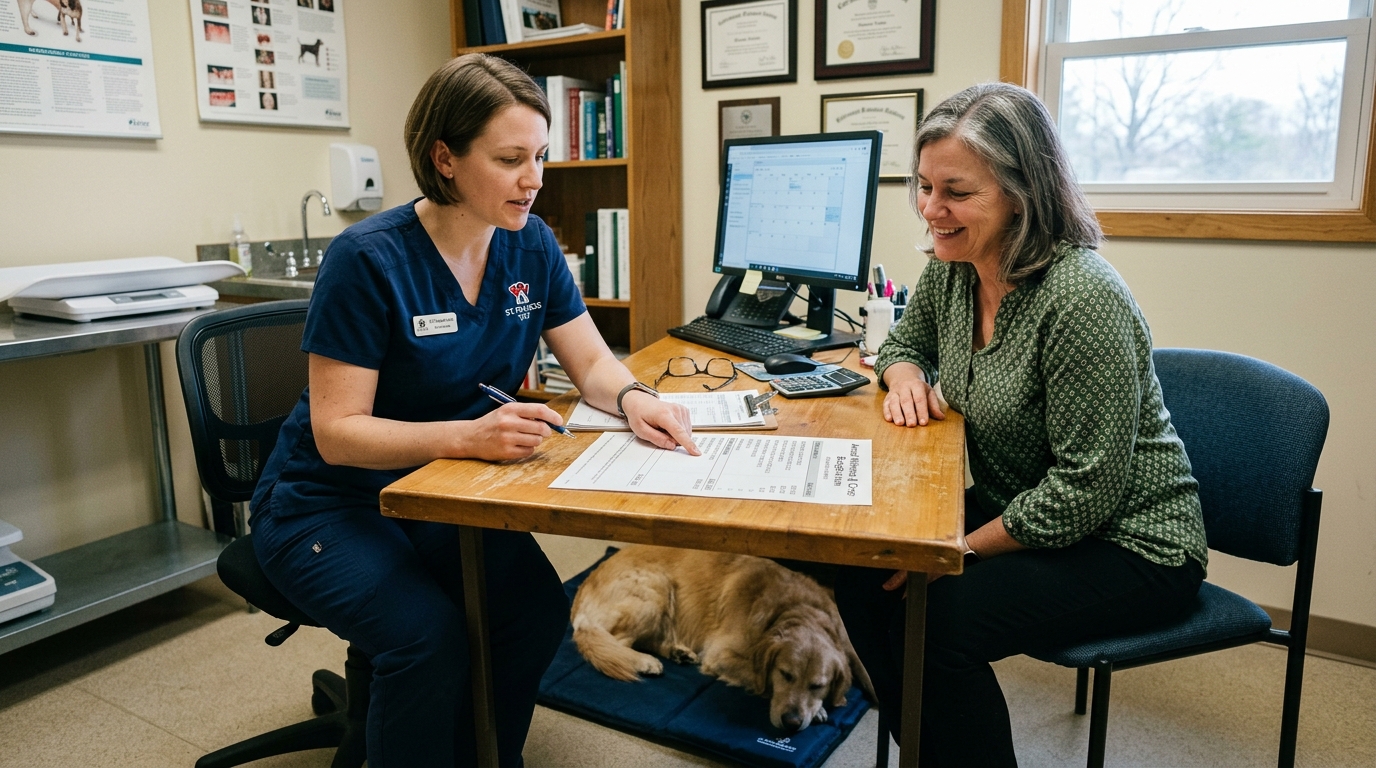
List every expected non-monthly bill over the next year: routine examinations, preventive care advised for local risk, dental assessment, grooming, registration, planned training, and known travel care. Record the likely month, add the local estimates, and divide the total across the months remaining before each bill. A single generic annual total can hide the fact that several charges arrive together.
Keep replacement equipment in this schedule. Harnesses, leads, beds, gates, identification tags, and bowls do not last forever, but they also do not need an arbitrary monthly shopping allowance. Inspect them, estimate a replacement window, and fund the item before wear becomes a safety problem.
Smooth each irregular bill from its due date backward. If registration is due sooner than grooming, or travel care and a routine appointment fall in the same month, calculate separate transfers based on the months remaining rather than dividing every estimate by twelve. Keep the money in labeled pots or worksheet columns. When a quote changes, adjust that line only; do not raid the urgent-care reserve to make a predictable bill appear affordable.
Review the transfer whenever the dog’s weight, health, coat, medication, household schedule, or address changes. The model is meant to be renewed, not treated as a one-time adoption worksheet.
Stress test one: paid support becomes necessary
Imagine that the household loses its usual care arrangement for several weeks. A work change may require a walker or day care; illness may require boarding or help with exercise; a family trip may need a sitter, transport, or a different facility because the dog needs medication or cannot share group space.
Price one realistic version locally. Then ask which ordinary spending can pause without reducing essential care, how quickly a trusted provider can be found, and whether the annualized-care pot can absorb the disruption. This test is especially important when the normal plan depends on one person always being available.
Run more than the cheapest version. Test a short weekday gap, several consecutive days, and a period when the dog needs one-to-one handling, medication, or transport. Record provider availability as well as price: a service that cannot accept the dog on the required schedule does not solve the planning problem. The output is a dated fallback showing who can help, what notice they require, what the first payment would be, and which budget line funds it. Keep each provider’s backup-contact, key-handover, and medication-record requirements beside the quoted first payment.
Stress test two: urgent care creates a cash-flow shock
Now model an urgent veterinary visit that happens before the emergency reserve is fully built. Include transport, an examination, possible diagnostics, a deposit, follow-up, medication, and the amount the household must pay while any claim is being assessed. Do not guess the diagnosis or use one dramatic procedure price; the purpose is to test access to funds and decision-making under time pressure.
Decide who can authorize care, where records are stored, which payment options the clinic actually offers, and what minimum reserve remains available after the first bill. If insurance is part of the plan, treat the premium, deductible or excess, excluded care, owner payment, and reimbursement delay as budget inputs. Compare the policy wording separately from this care budget; this article does not provide coverage or policy-selection advice.
Test timing in stages: funds needed to reach the clinic, funds requested before diagnostics or treatment, the amount still available for follow-up, and the delay before any eligible reimbursement. Then repeat the exercise with the urgent event arriving in the same month as a routine bill. This does not estimate a medical outcome; it shows whether the household has an accessible first-payment route without cancelling food, medication, housing, or another essential obligation.
Protect essentials when the local total changes
If quotes make the plan unaffordable, revise the adoption timing, housing assumption, service schedule, or savings period before cutting food suitability, safe shelter, identification, necessary medication, or veterinary assessment. Compare durable basics by fit and lifespan, measure food accurately, plan travel early, and ask shelters or clinics what is included rather than assuming a low sticker price is a saving.
If the budget fails because work, housing, or travel arrangements changed, price the missing support directly: a temporary walker, boarding place, pet-friendly housing cost, transport option, or grooming appointment. Confirm when those services require payment and protect a separate urgent-care reserve rather than letting one disruption consume every available fund. If immediate veterinary care is needed and accessible cash is short, tell the clinic that cash flow is the constraint; do not delay contact while reorganizing optional spending.
Keep the working sheet reader-owned and auditable. For every line, write the item or service, the dog-specific quantity or frequency, the dated local price, the next due date, the monthly transfer, and the event that triggers a review. Mark uncertain entries instead of filling them with national averages. A second column can show the paid-support and urgent-care tests, making it clear which costs belong to ordinary months and which require additional accessible cash. Keep a quote source and contact date beside each variable line so the next review begins with evidence rather than memory.
Recheck the complete budget at least annually and after any major life change. The useful output is not a perfect number; it is a dated plan showing what is funded, what depends on local quotes, and what the household will do when a stress test becomes real.
Sources
Sources checked: July 13, 2026.
- PMID: 31387390: Effectiveness of a Dog-Assisted Therapy Program to Enhance Quality of Life in Institutionalized Dementia Patients (Clin Nurs Res, 2021) (opens in new tab)
- PMID: 29121815: Preclinical Animal Models for Temporomandibular Joint Tissue Engineering (Tissue Eng Part B Rev, 2018) (opens in new tab)
- PMID: 37606523: Optimising rabies vaccination of dogs in India (Epidemiol Infect, 2023) (opens in new tab)
- PDSA: The cost of owning a dog (opens in new tab)
Printable tool
Download the matching worksheet
Source transparency
Reference mix for this guide
Source labels describe the type of organization behind each reference; they are not a claim that any outside organization reviewed this article.
- Effectiveness of a Dog-Assisted Therapy Program to Enhance Quality of Life in Institutionalized Dementia Patients (Clin Nurs Res, 2021) Government or public agency · pubmed.ncbi.nlm.nih.gov
- Preclinical Animal Models for Temporomandibular Joint Tissue Engineering (Tissue Eng Part B Rev, 2018) Government or public agency · pubmed.ncbi.nlm.nih.gov
- Optimising rabies vaccination of dogs in India (Epidemiol Infect, 2023) Government or public agency · pubmed.ncbi.nlm.nih.gov
- PDSA: The cost of owning a dog Reference source · pdsa.org.uk