This guide is general education for pet owners. If your pet has urgent symptoms, possible poisoning, injury, breathing trouble, collapse, severe pain, or sudden decline, contact a licensed veterinarian or local emergency service.
Dosages must be calculated by a licensed veterinarian based on species, weight, and bloodwork. Never administer human medications or self-adjust prescription doses for pets.
Editorial standard
How this guide was prepared
Hypoadrenocorticism, commonly known as Addison’s disease, is famously dubbed “The Great Pretender” in veterinary medicine due to its uncanny ability to masquerade as severe chronic gastroenteritis, acute kidney failure, pancreatitis, or primary neuromuscular collapse. In dogs, primary hypoadrenocorticism is typically an immune-mediated disorder that results in the progressive destruction of all three zones of the adrenal cortex (zona glomerulosa, zona fasciculata, and zona reticularis). This leads to a severe, concurrent deficiency of both glucocorticoids (cortisol) and mineralocorticoids (aldosterone). While many affected dogs experience an insidious, waxing-and-waning history of lethargy, mild vomiting, trembling, and unexplained anorexia, any acute physiological stress can tip the animal into a sudden, catastrophic decompensation known as an Addisonian crisis. Characterized by profound hypovolemic shock, vascular collapse, severe hyponatremia, and cardiotoxic hyperkalemia, an Addisonian crisis is a true medical emergency that will prove rapidly fatal without swift, targeted clinical intervention.
Quick Answer: Identifying and Responding to an Addisonian Crisis
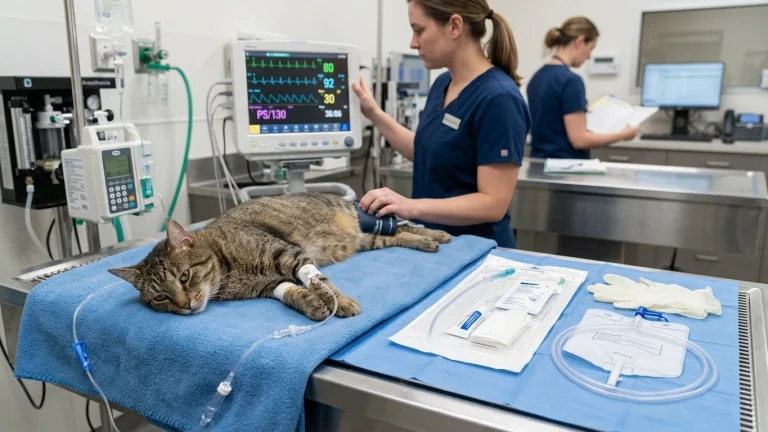
If your dog suddenly collapses into extreme weakness, displays weak “thready” pulses, hypothermia, pale gums, and an abnormally slow heart rate (bradycardia) despite being in obvious shock, suspect an acute Addisonian crisis. This occurs because the absence of aldosterone impairs the kidneys’ ability to retain sodium and excrete potassium. The resulting hyperkalemia acts as a cardiac toxin, slowing the heart rate down while blood pressure collapses. Transport your dog immediately to an emergency hospital. Emergency treatment involves aggressive intravenous fluid resuscitation with 0.9% sodium chloride to flush out potassium and restore blood pressure, ECG monitoring, and an emergency ACTH stimulation test followed by intravenous glucocorticoid and mineralocorticoid replacement.
Pathophysiology: Why Mineralocorticoid Deficiency Causes Collapse
Understanding the severe clinical signs of an Addisonian crisis requires examining the twin hormones produced by the adrenal cortex:
1. Aldosterone Deficiency (Mineralocorticoid Loss): Aldosterone acts directly on the distal convoluted tubules and collecting ducts of the kidneys to stimulate sodium reabsorption in exchange for potassium and hydrogen ion excretion. Without aldosterone, the kidneys waste massive amounts of sodium and water into the urine while retaining lethal quantities of potassium. This produces a progressive triad of severe hyponatremia (low blood sodium), hypochloremia, and hyperkalemia (high blood potassium). The loss of vascular volume causes dramatic hypovolemia, severe hypotension, and prerenal azotemia (elevated BUN and creatinine mimicking acute renal failure).
2. Cortisol Deficiency (Glucocorticoid Loss): Cortisol is essential for maintaining vascular tone, intestinal mucosal integrity, hepatic gluconeogenesis, and cellular response to stress. Cortisol-deficient dogs suffer from hypoglycemia, profound muscle weakness, gastrointestinal mucosal sloughing with melena (black tarry stool), and an inability to mount a physiological response to everyday physiological stressors.
3. The Paradox of Hyperkalemic Bradycardia: In ordinary hypovolemic shock (such as bleeding or severe dehydration), the body compensates with tachycardia (rapid heart rate >140–180 bpm). In an Addisonian crisis, however, severe hyperkalemia raises the resting membrane potential of myocardial cells, impairing cardiac conduction. This produces progressive ECG abnormalities: tall “tented” T waves, loss of P waves (atrial standstill), widening of the QRS complex, and an inappropriately slow heart rate (bradycardia, often <60 bpm in large dogs). A collapsed dog with a slow heart rate is the clinical signature of hyperkalemic crisis.
Clinical Emergency Triage Matrix
| Triage Tier | Clinical Presentation | Required Action |
|---|---|---|
| Tier 1: Hypovolemic Shock & Hyperkalemic Crisis (0-1h) | Acute recumbency, unable to stand or lift head; severe bradycardia (<60–70 bpm) despite profound shock; undetectable or weak “thready” femoral pulses; hypothermia (<37.5°C / <99.5°F); cold extremities; gray or pale tacky mucous membranes; stupor or impending coma. | Transport immediately to an emergency veterinary ICU. Keep the dog warm with blankets during travel. Call ahead so the critical care team can set up emergency ECG telemetry, point-of-care electrolyte analyzers, and rapid 0.9% saline infusion lines. Avoid any home medications. |
| Tier 2: Waxing-Waning Gastrointestinal Collapse (1-4h) | Recurrent episodes of severe vomiting, diarrhea with melena (black tarry stool), muscle tremors, severe weakness following stress (boarding, grooming, thunderstorms); bloodwork reveals elevated kidney enzymes (BUN/creatinine) with normal phosphorus. | Proceed directly to an emergency veterinary facility for an emergency electrolyte panel, venous blood gas, and baseline cortisol / ACTH stimulation testing. Early intervention prevents progression into fatal arrhythmias. |
| Tier 3: Unexplained Chronic Lethargy & Anorexia (4-12h) | Intermittent episodes of pickiness, mild trembling, lethargy that improves temporarily after simple fluid therapy but relapses weeks later; no bradycardia or collapse. | Schedule a comprehensive veterinary diagnostic workup. Request a complete blood count (noting absence of a stress leukogram in a stressed dog), chemistry profile with sodium-to-potassium ratio, and basal cortisol screening. |
Dangerous Home Pitfalls: What NOT to Do (Rule S1)
- NEVER administer home prednisone or dexamethasone before diagnostic testing: Even a tiny dose of human or veterinary prednisone cross-reacts with cortisol laboratory assays. This completely invalidates the ACTH stimulation test, leaving the dog without a definitive diagnosis and complicating lifelong therapy. (If a dog is actively dying in the clinic, veterinarians use dexamethasone sodium phosphate, which does not cross-react with cortisol testing, but this must only be administered by medical professionals).
- NEVER offer potassium-containing fluids, broths, or electrolyte drinks: Giving electrolyte beverages designed for humans (such as sports drinks or coconut water) floods the body with potassium, triggering immediate fatal ventricular fibrillation or cardiac arrest.
- NEVER abruptly discontinue lifelong Addison’s medications: Once diagnosed, replacement therapies (DOCP injections or daily fludrocortisone, plus physiologic prednisone) are required for the animal’s entire lifespan. Stopping medications abruptly precipitates a fatal Addisonian crisis within 24 to 72 hours.
- NEVER ignore the need for “stress-dose” adjustments: During anticipated stressful events (travel, boarding, dental procedures, illness), Addisonian dogs cannot produce natural cortisol. Pet parents must consult their veterinarian in advance to temporarily increase oral prednisone doses to prevent an acute crisis.
Diagnostic Standards: The Na:K Ratio & ACTH Stimulation Test
When an emergency patient arrives in collapse, point-of-care venous blood gas and electrolyte testing provide the fastest diagnostic clue. In healthy dogs, the ratio of serum sodium to serum potassium (Na:K ratio) is typically between 28:1 and 35:1. In an Addisonian crisis, the combination of hyponatremia and hyperkalemia causes the Na:K ratio to plunge below 27:1 (and frequently below 20:1).
While an abnormal Na:K ratio is highly suggestive of hypoadrenocorticism, other conditions can occasionally produce pseudo-Addisonian electrolyte changes (such as severe trichuriasis whipworm infection, acute renal failure, or cavitary effusions). Therefore, the ACTH Stimulation Test remains the undisputed gold standard for definitive diagnosis:
- A baseline blood sample is drawn to measure pre-stimulation serum cortisol.
- Synthetic adrenocorticotropic hormone (cosyntropin / Cortrosyn) is administered intravenously.
- A post-stimulation blood sample is collected exactly one hour later.
- In a healthy dog, cortisol increases dramatically (typically >6–10 μg/dL). In an Addisonian dog, both the pre- and post-stimulation cortisol levels remain flat and undetectable (<1.0–2.0 μg/dL), confirming complete adrenocortical failure.
Emergency Stabilization in the Veterinary ICU
Treatment of an Addisonian crisis follows an aggressive, structured resuscitation protocol aimed at correcting hypovolemia, mitigating hyperkalemic cardiotoxicity, and replacing deficient hormones:
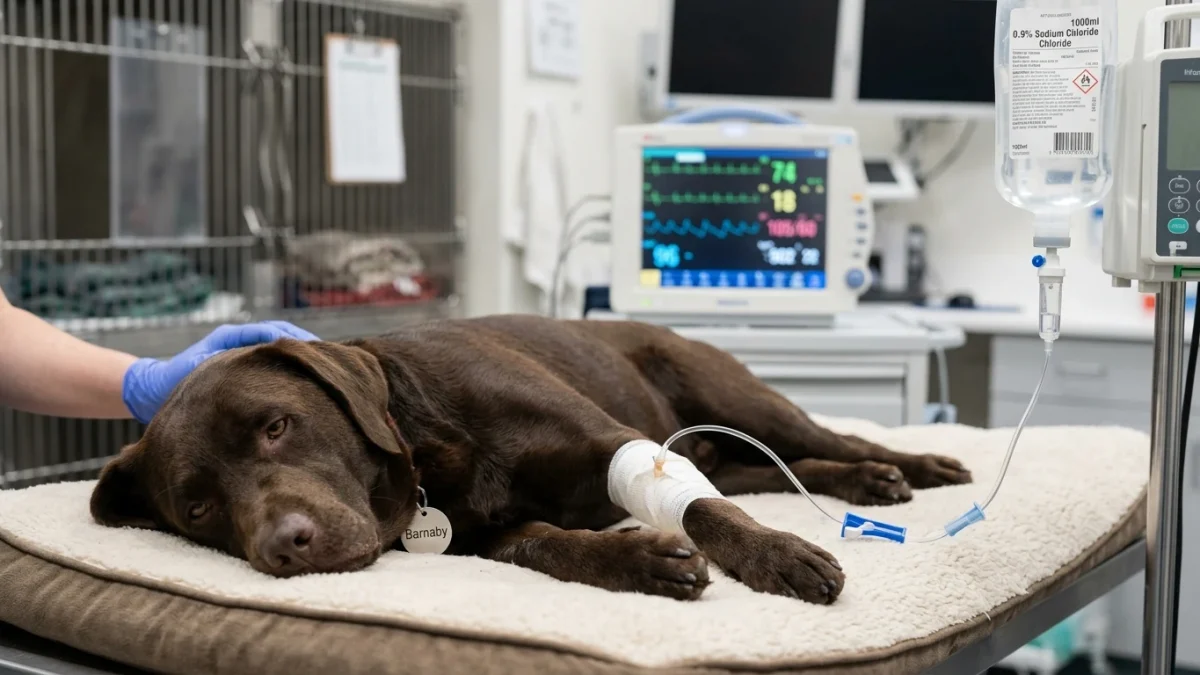
1. Intravenous Fluid Resuscitation: The cornerstone of emergency therapy is rapid IV fluid expansion using 0.9% Sodium Chloride (normal saline). Normal saline contains no potassium and has a high sodium concentration (154 mEq/L), which restores circulating blood volume, dilutes serum potassium, and maximizes renal perfusion to promote urinary potassium excretion.
2. Immediate Cardioprotection: If severe hyperkalemic arrhythmias (absent P waves, severe bradycardia) are visible on the ECG, the veterinarian immediately administers 10% Calcium Gluconate IV under continuous cardiac monitoring. Calcium does not lower blood potassium levels; instead, it immediately normalizes cardiac cell membrane excitability, shielding the heart against fatal arrhythmias within minutes.
3. Shifting Potassium Intracellularly: In refractory hyperkalemia, regular insulin combined with dextrose is administered IV. Insulin drives potassium out of the vascular space and into the cells, while concurrent dextrose infusion prevents hypoglycemia.
4. Long-Term Mineralocorticoid & Glucocorticoid Therapy: Once stabilized and the ACTH test is completed, the patient begins long-term replacement: injectable Desoxycorticosterone Pivalate (DOCP / Zycortal, given subcutaneously every 25–30 days) or oral fludrocortisone, paired with daily physiologic oral prednisone.
Frequently Asked Questions
What is the life expectancy of a dog diagnosed with Addison’s disease?
With prompt emergency stabilization and compliant, lifelong hormone replacement therapy, the prognosis for a dog with Addison’s disease is excellent. Treated Addisonian dogs have a completely normal life expectancy and can enjoy active, happy, and vigorous lives with no permanent dietary or exercise restrictions.
Why is Addison’s disease called “The Great Pretender”?
Because its early clinical symptoms—mild intermittent vomiting, loose stool, lethargy, shivering, and reduced appetite—closely mimic common gastrointestinal ailments or food allergies. Furthermore, bloodwork typically shows elevated kidney values (BUN and creatinine) caused by dehydration, leading many clinicians to initially misdiagnose the dog with acute kidney failure.
What should an owner do if an Addisonian dog experiences a stressful event?
Owners of diagnosed Addisonian dogs should consult their veterinarian about a “stress-dose” protocol. Under medical direction, the oral prednisone dose is typically doubled or tripled for 1 to 2 days prior to and during planned stressful occurrences (such as veterinary visits, grooming sessions, kennel boarding, or family travel) to compensate for the dog’s inability to naturally produce cortisol.
Scientific Sources and Literature
- Klein SC, Peterson ME. “Canine hypoadrenocorticism: part I and II. Pathophysiology, clinical presentation, and emergency management of acute crisis.” Canadian Veterinary Journal. PMID: 27790757
- Adler JA, et al. “Abnormalities of serum electrolyte concentrations in dogs with hypoadrenocorticism: evaluation of sodium-to-potassium ratios in 118 cases.” Journal of Veterinary Internal Medicine. PMID: 25156058
- Sieber-Ruckstuhl NS, et al. “Evaluation of desoxycorticosterone pivalate (DOCP) and fludrocortisone for the treatment of primary hypoadrenocorticism in dogs.” Journal of Small Animal Practice. PMID: 31754766
Caregiver Emergency Addisonian Crisis Action Checklist
- Assess vital state: note whether your dog is collapsed, shivering, or abnormally weak.
- Check heart rate: observe if the pulse or heartbeat is unusually slow (bradycardia) despite the dog being in shock.
- Do not administer leftover oral steroids (prednisone/dexamethasone) before arriving at the clinic.
- Do not offer high-potassium broths, electrolyte beverages, or human sports drinks.
- Keep your dog comfortably warm with blankets; avoid direct electric heating pads to prevent burns and vasodilation.
- Proceed directly to an emergency veterinary intensive care facility capable of point-of-care electrolyte and ACTH testing.
- Inform the triage nurse immediately if your dog has a known history of Addison’s disease or unexplained waxing-waning illness.
Source transparency
Reference mix for this guide
Source labels describe the type of organization behind each reference; they are not a claim that any outside organization reviewed this article.
- Dog Sudden Collapse & Pale Gums Triage Reference source · newspet.net
- Dog Shaking & Lethargic Differential Triage Reference source · newspet.net
- Dog Vomiting: Home Monitoring vs Emergency Red Flags Reference source · newspet.net
- Dog Diabetic Ketoacidosis (DKA) Emergency Triage Reference source · newspet.net
- PMID: 27790757 Government or public agency · pubmed.ncbi.nlm.nih.gov
- PMID: 25156058 Government or public agency · pubmed.ncbi.nlm.nih.gov
- PMID: 31754766 Government or public agency · pubmed.ncbi.nlm.nih.gov