
Health and Safety Boundary
Jump to Emergency Red Flags ↓
This guide is general education for pet owners. If your pet has urgent symptoms, possible poisoning, injury, breathing trouble, collapse, severe pain, or sudden decline, contact a licensed veterinarian or local emergency service.
Veterinary Medication & Dosage Boundary
Dosages must be calculated by a licensed veterinarian based on species, weight, and bloodwork. Never administer human medications or self-adjust prescription doses for pets.
Editorial standard
How this guide was prepared
Edited for decisions
NewsPet guides are structured around practical owner choices, tradeoffs, and safety boundaries.
Source policy
Sources are listed when a guide relies on outside references.
Veterinary boundary
This article does not diagnose or prescribe; urgent symptoms need veterinary care.
Corrections
Readers can flag unclear, outdated, or inaccurate information through our contact page.
Keppra (Levetiracetam) for Pets: Non-Hepatic Seizure Triage
Clinical Classification & Indications
- Drug Class: Pyrrolidine Antiepileptic Drug
- Approved Uses: Monotherapy or add-on therapy for refractory canine and feline epilepsy, cluster seizures, and pre-emptive pulse therapy following traumatic brain injury.
Mechanism of Action (Pharmacodynamics)
Selectively binds to presynaptic vesicle protein 2A (SV2A), modulating exocytotic release of neurotransmitters across synaptic junctions and dampening hyper-synchronous epileptiform bursts.
Adverse Reactions & Side Effect Profile
Common / Expected Side Effects
Mild transient sedation, slight ataxia, behavioral changes, mild inappetence. Virtually free of direct organ toxicity.
Emergency Red Flag Reactions
Breakthrough cluster seizures (more than 1 seizure in a 24-hour window) or prolonged status epilepticus (>5 minutes) requiring emergency rectal/nasal midazolam.

Clinical Contraindications & Interactions
- Do Not Use In: Known hypersensitivity to levetiracetam. Requires dosage reduction in animals with advanced renal failure as it is eliminated almost exclusively via urine.
Strict Rule S1 Veterinary Prescription Directive
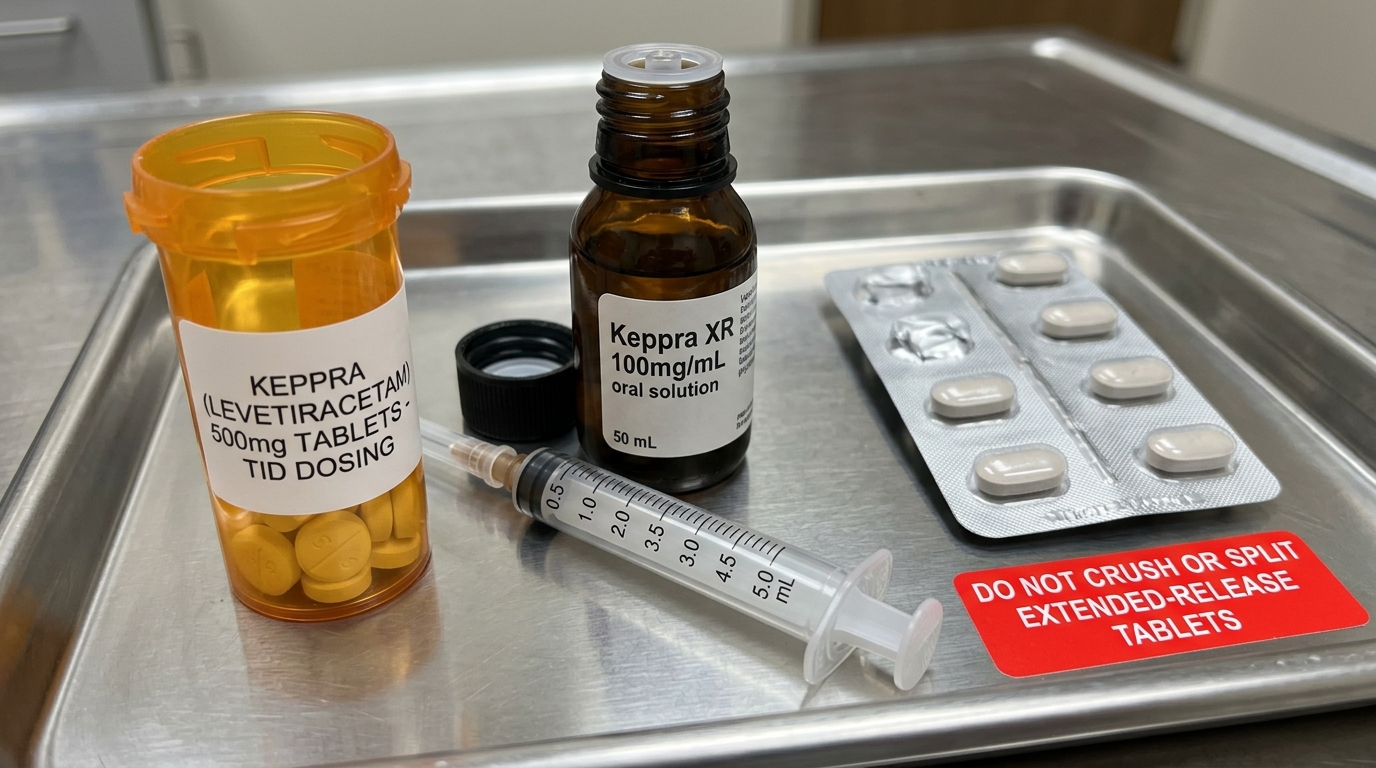
VETERINARY DIRECTIVE: Strict dosing schedule adherence is vital: standard Keppra MUST be administered precisely every 8 hours (TID), whereas Keppra Extended-Release (XR) is dosed every 12 hours (BID). Never crush or split Keppra XR tablets as this destroys the slow-release matrix. Never administer human pharmaceutical products or adjust dosages without direct examination and bloodwork by a licensed Doctor of Veterinary Medicine (DVM).
Printable tools