This guide is general education for pet owners. If your pet has urgent symptoms, possible poisoning, injury, breathing trouble, collapse, severe pain, or sudden decline, contact a licensed veterinarian or local emergency service.
Dosages must be calculated by a licensed veterinarian based on species, weight, and bloodwork. Never administer human medications or self-adjust prescription doses for pets.
Editorial standard
How this guide was prepared
Feline aortic thromboembolism (FATE), widely known as a “saddle thrombus,” is one of the most agonizing, terrifying, and time-critical medical emergencies encountered in feline practice. The catastrophe occurs when a blood clot formed within an enlarged left atrium dislodges into systemic arterial circulation and travels down the descending aorta until it reaches the aortic trifurcation—the anatomical junction where the main aorta branches into the left and right external iliac arteries supplying the hind limbs. Like a saddle straddling a horse, the embolus wedges tightly across this narrow bifurcation, completely severing arterial blood supply to both pelvic limbs. Within seconds, the cat experiences excruciating ischemic muscle pain, loss of motor nerve conduction, and sudden, flaccid or rigid hind limb paralysis.
Quick Answer: Identifying a Feline Saddle Thrombus Emergency
If your cat suddenly loses the use of its rear legs, drags its hindquarters, cries out in uncharacteristic screaming agony, or pants with open-mouth distress, suspect an aortic thromboembolism. Check the rear paws immediately: in a saddle thrombus, the hind paw pads feel noticeably ice-cold compared to the front paws, and the nail beds appear pale or cyanotic bluish-purple. This condition is an immediate red-tier emergency requiring rapid hospital transport. Immediate veterinary intervention focuses on potent opioid pain relief, supplemental oxygen therapy, cardiovascular stabilization, and intensive antithrombotic management.
The “5 Ps” of Feline Aortic Thromboembolism
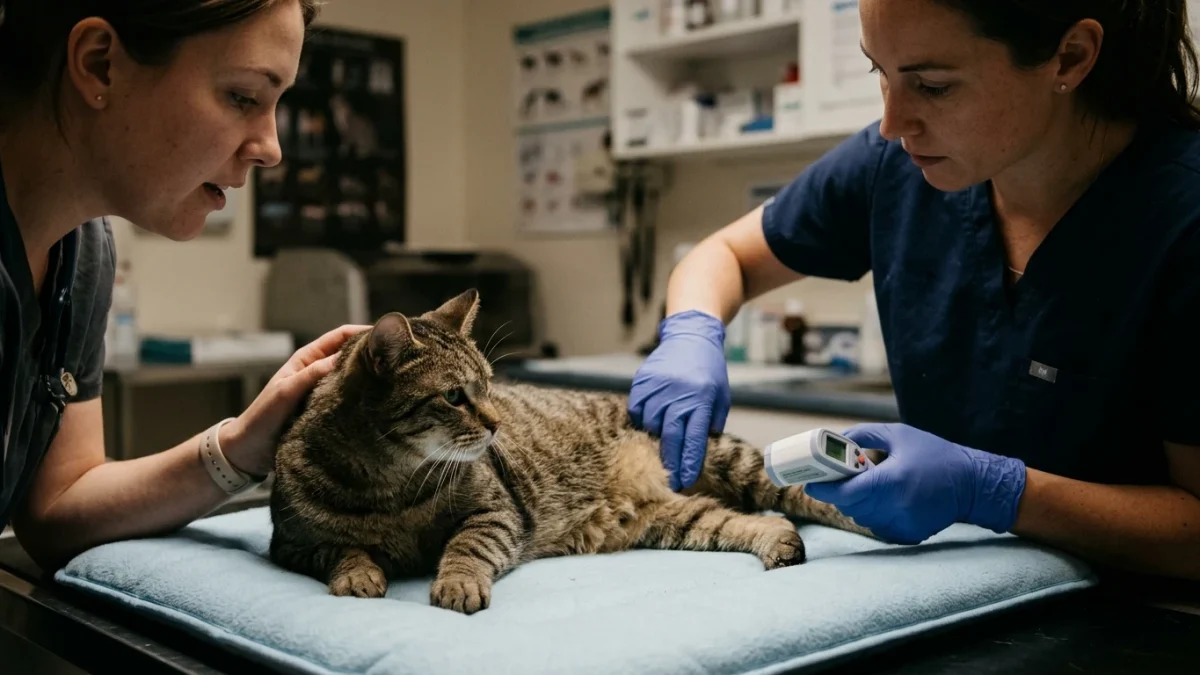
Veterinary emergency clinicians identify feline saddle thrombus through five pathognomonic clinical signs, traditionally taught as the “5 Ps”:
1. Pain: Ischemic neuromyopathy—the sudden deprivation of oxygen and glucose to major peripheral nerves and muscle groups—causes intense, unendurable pain. Affected cats vocalize frantically with loud howling, yowling, or screaming, often hissing and biting defensively if touched near the hindquarters.
2. Paresis or Paralysis: Complete loss of voluntary motor function occurs in both hind limbs (or occasionally in a single limb if the clot lodges unilaterally). The cat cannot stand or walk, dragging its rear limbs behind its body like dead weight. The gastrocnemius (calf) muscles become hard, swollen, and wooden to the touch within hours.
3. Pulselessness: Palpation of the femoral arteries along the medial aspect of the inner thighs reveals an absolute absence of arterial pulses. In contrast, the front limb pulses and carotid pulses remain palpable and strong.
4. Pallor: The footpads and nail beds of the affected rear legs appear blanched porcelain white or cyanotic grayish-purple, reflecting zero microvascular capillary perfusion.
5. Poikilothermia: Because warm arterial blood cannot reach the extremities, the hind paws become distinctly hypothermic (ice-cold) when compared directly to the warm front paws.
Clinical Emergency Triage Matrix
| Triage Tier | Clinical Presentation | Required Action |
|---|---|---|
| Tier 1: Immediate Critical Emergency (0-1h) | Acute onset of rear limb paralysis with loud vocal agony; cold rear paws with bluish-purple nail beds; absent femoral pulses; concurrent tachypnea (>40 breaths/min), open-mouth panting, or frothy oral discharge (congestive heart failure). | Call the emergency hospital immediately so the trauma team can prepare an oxygen cage and injectable opioid analgesics. Transport cat in a padded carrier without disturbing the hind limbs. Immediate IV access, electrocardiogram, and cardiac stabilization required. |
| Tier 2: Urgent Cardiovascular Evaluation (1-3h) | Cat showing unilateral hind limb knuckling, weakness, or stumbling; one paw feels colder than the others; weak femoral pulse detectable; cat restless and licking rear leg compulsively. | Proceed directly to an emergency veterinary clinic. Partial or unilateral thromboembolisms can rapidly progress to bilateral complete occlusions as platelet aggregation expands the clot. |
| Tier 3: Same-Day Veterinary Appointment (3-6h) | Gradual onset of hind limb stiffness over weeks or months; paws remain warm with normal pink footpads and strong femoral pulses; cat is not vocalizing in acute distress. | Keep cat rested indoors. Schedule an outpatient appointment with your regular veterinarian for orthopedic and neurological evaluation to differentiate degenerative joint disease from disc disease. |
Dangerous Home Pitfalls: What NOT to Do (Rule S1)
- NEVER apply direct heating pads or hot water bottles to paralyzed paws: It is instinctive for worried caregivers to try to warm ice-cold rear paws. However, ischemic tissues possess zero capillary blood flow to dissipate thermal energy. Applying electric pads, hot packs, or hair dryers causes third-degree thermal necrosis and massive skin sloughing.
- NEVER administer human painkillers, aspirin, or acetaminophen: Paracetamol/acetaminophen is lethal to cats even at microscopic doses, destroying feline red blood cells through oxidative Heinz body formation and acute hepatic necrosis. Aspirin administered without veterinary supervision causes fatal gastric hemorrhage.
- NEVER perform aggressive deep-tissue massage on the legs: Rubbing or kneading paralyzed hind limbs may dislodge micro-emboli and suddenly wash accumulated lactic acid and hyperkalemic cellular breakdown products back into systemic circulation, provoking fatal ventricular fibrillation.
- NEVER assume the cat suffered a broken bone or hip dislocation: Over 70 percent of cat owners initially assume their cat was hit by a car or sustained a spinal fracture. Wasting time waiting for a mobile orthopedic vet delays critical cardiac stabilization and opioid pain management.
Underlying Etiology: Hypertrophic Cardiomyopathy (HCM)
In over 90 percent of feline aortic thromboembolism cases, the underlying primary pathology is advanced heart disease—predominantly hypertrophic cardiomyopathy (HCM). In HCM, the muscular walls of the left ventricle thicken abnormally, restricting diastolic filling and leading to marked elevation of left ventricular filling pressures. Consequently, blood backs up into the left atrium, causing the atrial chamber to dilate and stretch.
As the left atrium enlarges, normal laminar blood flow is disrupted, generating turbulent flow and blood stasis in the left auricle. This blood stasis activates platelets and the feline coagulation cascade (Virchow’s triad). A gelatinous thrombus forms within the heart chamber. At any moment, a fragment of this cardiac clot can break free, pass through the mitral valve and aortic valve, and travel down the aorta until it impacts the aortic bifurcation, instantly halting distal circulation.
Frequently Asked Questions
What is the immediate veterinary treatment upon hospital arrival?
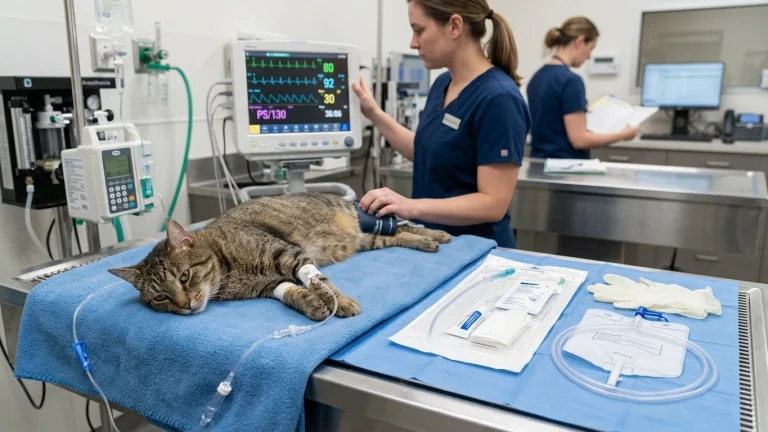
The immediate priority upon hospital arrival is aggressive pain control using pure mu-agonist injectable opioids (such as hydromorphone, methadone, or fentanyl), combined with supplemental oxygen therapy in a stress-free oxygen cage. If concurrent pulmonary edema or congestive heart failure is present, injectable diuretics (furosemide) are administered. Once stabilized, the cat receives anticoagulant therapy (such as low-molecular-weight heparin or clopidogrel) to prevent clot expansion.
Can cats recover from a saddle thrombus?
Yes, some cats do recover motor function in their hind limbs over a period of 2 to 6 weeks as collateral blood vessels (such as the lumbar and deep circumflex iliac arteries) dilate and restore circulation. However, the overall prognosis remains guarded, with acute hospital discharge rates ranging between 30 and 40 percent. Long-term survival depends heavily on the severity of the underlying heart disease and the risk of recurrent thromboembolic events.
What is reperfusion injury and why is it dangerous?
Reperfusion injury occurs when blood flow is suddenly restored to severely ischemic muscle tissue. During ischemia, oxygen-deprived cells break down, releasing massive amounts of potassium, lactic acid, and reactive oxygen species into extracellular fluid. When blood vessels reopen, this toxic wash enters the central circulation, causing severe hyperkalemia (dangerously high potassium levels) and systemic metabolic acidosis, which can trigger sudden, fatal cardiac arrest.
Scientific Sources and Literature
- Hogan DF, et al. “Secondary prevention of cardiogenic arterial thromboembolism in the cat: The FAT CAT study.” Journal of Veterinary Cardiology. PMID: 26031448
- Borgeat K, et al. “Arterial thromboembolism in 250 cats in general practice: 2004-2012.” Journal of Veterinary Internal Medicine. PMID: 29749117
- Fuentes VL, et al. “ACVIM consensus statement guidelines for the classification, diagnosis, and management of cardiomyopathies in cats.” Journal of Veterinary Internal Medicine. PMID: 32677180
Caregiver Emergency Saddle Thrombus Action Checklist
- Check the 5 Ps immediately: assess pain level, hind limb paralysis, cold footpad temperature, pale/blue nail beds, and absent inner thigh pulses.
- Never apply heating pads, electric blankets, or hot water bottles to the cold paws; avoid severe burns on ischemic skin.
- Never administer human pain medications like acetaminophen, ibuprofen, or aspirin.
- Minimize stress and physical handling: place the cat gently into a secure, dark, towel-lined carrier.
- Do not aggressively rub or massage the paralyzed legs to avoid dislodging micro-clots or provoking reperfusion shock.
- Proceed directly to a 24-hour veterinary emergency facility equipped with an oxygen cage and continuous intensive monitoring.
Source transparency
Reference mix for this guide
Source labels describe the type of organization behind each reference; they are not a claim that any outside organization reviewed this article.
- Cat Open-Mouth Breathing & Respiratory Distress Reference source · newspet.net
- Cat Chronic Kidney Disease & Uremic Crisis Reference source · newspet.net
- Cat Anorexia & Hepatic Lipidosis Timeline Reference source · newspet.net
- Cat High-Rise Syndrome & Blunt Trauma Emergency Reference source · newspet.net
- PMID: 26031448 Government or public agency · pubmed.ncbi.nlm.nih.gov
- PMID: 29749117 Government or public agency · pubmed.ncbi.nlm.nih.gov
- PMID: 32677180 Government or public agency · pubmed.ncbi.nlm.nih.gov