This guide is general education for pet owners. If your pet has urgent symptoms, possible poisoning, injury, breathing trouble, collapse, severe pain, or sudden decline, contact a licensed veterinarian or local emergency service.
Dosages must be calculated by a licensed veterinarian based on species, weight, and bloodwork. Never administer human medications or self-adjust prescription doses for pets.
Editorial standard
How this guide was prepared
A feline fall from any elevated structure constitutes an immediate medical crisis, even if the animal appears completely uninjured upon initial inspection, as severe internal bleeding and respiratory failure frequently manifest hours after the initial impact.
Quick Answer: My Cat Fell from a Window
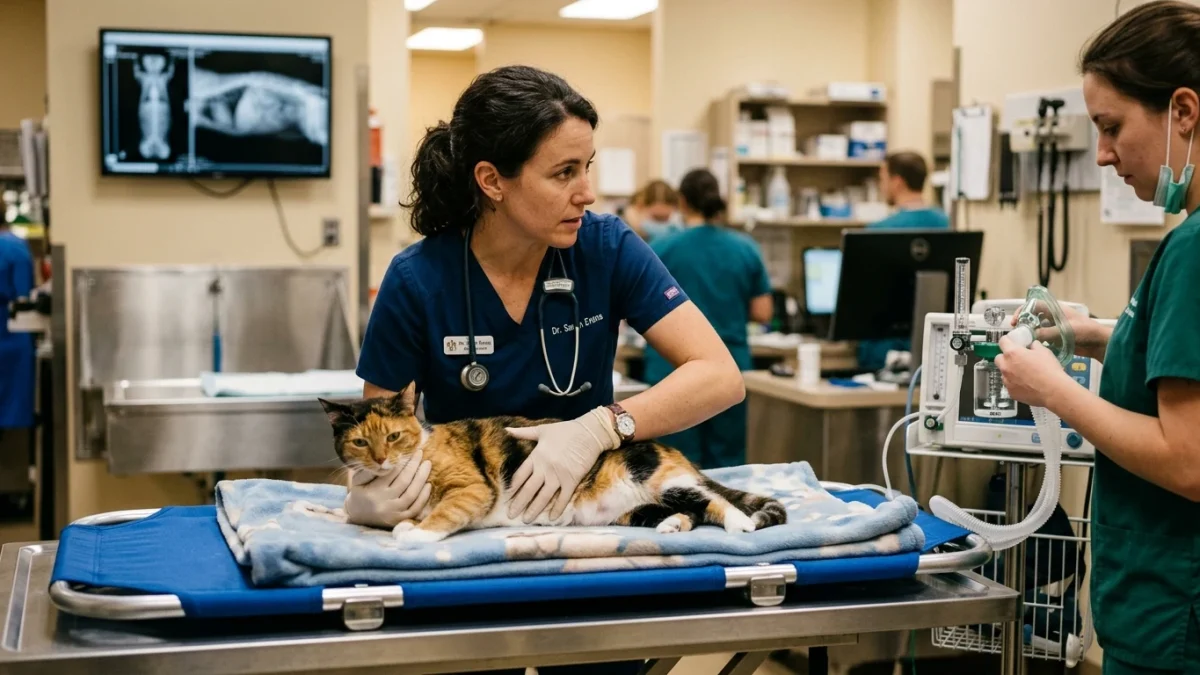
Assume every fall from a window, balcony, or tall structure requires emergency veterinary evaluation. Do not wait for symptoms to develop. Gather the animal securely in a rigid carrier without compressing the thorax, minimize handling, and proceed directly to a veterinary emergency center. Delayed recognition of internal hemorrhage, lung bruising, or diaphragmatic rupture drastically reduces survival probabilities.
The Physics of Feline Falls: Terminal Velocity and the Righting Reflex
Veterinary traumatology describes a specific clinical entity known as “high-rise syndrome.” This syndrome involves a predictable pattern of injuries sustained by cats falling from higher than a two-story elevation. The biomechanics of a feline fall explain the unique and sometimes counterintuitive injury patterns observed in these patients.
The feline vestibular system and remarkable spinal flexibility enable an innate “righting reflex.” During a free fall, a cat will rapidly orient its body to land feet first. However, the dynamics of the fall change dramatically as the distance increases. Initially, the cat accelerates. If the fall is short (e.g., from a second-story window), the cat may complete the righting reflex but impact the ground with significant vertical velocity, often resulting in severe limb fractures, particularly of the forelimbs.
Conversely, falls from greater heights (typically above the fifth story) introduce a critical aerodynamic factor: terminal velocity. As the cat reaches maximum falling speed (approximately sixty miles per hour), vestibular stimulation ceases to indicate acceleration. Consequently, the cat stops rigidifying its limbs in preparation for impact and instead assumes a splayed, horizontal posture—akin to a parachute. The spread-eagle posture distributes the impact force over a larger surface area upon landing.
The resulting aerodynamic shift creates a paradoxical survival pattern documented in veterinary literature. Cats falling from mid-level heights (two to four stories) often sustain more severe localized injuries (like complex fractures) than those falling from greater heights. The higher-altitude falls, while dispersing force, preferentially translate impact energy into the thoracic cavity and facial structures, leading to pulmonary contusions, pneumothorax, and mandibular trauma rather than long bone fractures.
The Hidden Injury Pattern: What You Cannot See
The deceptive nature of high-rise syndrome lies in the prevalence of occult internal injuries. A cat may survive the initial impact, rise, and attempt to ambulate or hide, leading a caregiver to falsely conclude the animal escaped serious harm. Such an assumption is highly dangerous. The sheer force of impact invariably generates systemic shock and potentially lethal internal disruption that may take hours to fully manifest clinically.
Thoracic Trauma: The Primary Threat to Life
The most common and critical consequence of high-rise syndrome is thoracic trauma. Impact forces propagate through the chest cavity, leading to multiple life-threatening conditions.
- Pneumothorax: Blunt force trauma can rupture alveolar spaces or lacerate lung tissue, causing air to leak into the pleural space surrounding the lungs. Trapped air in the pleural space prevents lung expansion. The cat will exhibit a progressively increasing respiratory rate (tachypnea) and visible effort. You can monitor this using our Resting Respiratory Rate tool, but in trauma scenarios, any abnormal breathing requires immediate intervention.
- Pulmonary Contusions: Severe bruising of the lung tissue impairs oxygen exchange. Contusions can progressively worsen over the first twelve to twenty-four hours post-trauma, causing delayed respiratory failure.
- Diaphragmatic Hernia: The massive, abrupt increase in abdominal pressure upon impact can rupture the diaphragm, the muscular partition separating the chest from the abdomen. The rupture allows abdominal organs (liver, stomach, intestines) to herniate into the chest cavity, severely compromising cardiac and respiratory function. Diaphragmatic hernia is universally fatal without surgical correction.
Craniofacial and Orthopedic Trauma
Impact with the ground frequently involves the head and limbs. Common visible and palpable injuries include:
- Mandibular Symphyseal Separation: The force transmitted through the jaw often splits the lower jaw exactly at the midline (the symphysis). You may observe bleeding from the mouth, abnormal alignment of the lower canine teeth, or an inability to close the mouth completely.
- Palatal Fractures: A longitudinal split in the hard palate (the roof of the mouth) is common, often presenting as epistaxis (nosebleed) or oral hemorrhage.
- Appendicular Fractures: While long bone fractures (femur, tibia, radius) are common in shorter falls, they must be stabilized professionally to prevent further soft tissue damage and blood loss.
Abdominal Visceral Rupture
The abdominal organs are highly susceptible to blunt trauma deceleration forces.
- Bladder or Urethral Rupture: If a cat falls with a full bladder, the impact can cause it to burst, leaking highly irritating urine into the abdominal cavity (uroabdomen). Uroabdomen leads to rapid chemical peritonitis, electrolyte derangements, and shock.
- Splenic or Hepatic Laceration: The spleen and liver can sustain lacerations, causing insidious, slow internal hemorrhage (hemoabdomen). The cat may gradually become pale, weak, and cold over several hours as blood volume depletes.
Clinical Emergency Triage Matrix
The following matrix outlines the clinical presentation of high-rise syndrome and dictates the appropriate level of intervention.
| Triage Tier | Clinical Presentation | Action Required |
|---|---|---|
| Tier 1: Immediate Emergency (0-2 hours) | Unconsciousness, active bleeding from mouth or nose, open mouth breathing, cyanosis (blue gums), extreme lethargy, inability to stand, visible bone protrusion, severe abdominal distention. | Immediate, rapid transport to the nearest veterinary emergency facility. Do not delay. |
| Tier 2: Same-Day Urgent (Within 12 hours) | Cat is walking but hiding, refusing food (see anorexia guide), exhibiting a mild limp, rapid resting respiratory rate (above 30 breaths per minute), vocalizing when touched. | Transport to a veterinary clinic within hours. Occult injuries are likely present. |
| Tier 3: Home Monitoring | Not applicable for high-rise syndrome. Even asymptomatic cats require professional evaluation. | Veterinary examination is mandatory to rule out masked internal trauma. |
Safe Emergency Transport Following a Fall
Improper handling during transport can exacerbate spinal injuries, worsen pneumothorax, or convert a closed fracture into an open, contaminated wound. The goal is rapid, safe, and minimal manipulation.
- Minimize Handling: Approach the cat calmly. Avoid manipulating the limbs or spine. If the cat is aggressive due to pain, use a thick towel or blanket to gently but firmly wrap the animal.
- Provide Rigid Support: Use a flat, rigid surface (like a piece of plywood or a stiff cardboard box) to slide under the cat if spinal trauma is suspected. Do not carry the cat draped over your arms.
- Avoid Thoracic Compression: Never squeeze or apply pressure to the chest cavity, as this can fatally exacerbate pneumothorax or pulmonary contusions.
- Use a Secure Carrier: Transfer the cat into a sturdy carrier. If the cat cannot walk, gently slide them into the carrier while on the rigid support, or use the towel as a makeshift sling to lower them in.
- Maintain Warmth: Cats in shock rapidly lose body heat. Cover the cat lightly with a blanket or towel during transport, but ensure their face remains uncovered so you can monitor breathing.
Dangerous Home Pitfalls: What NOT to Do (Rule S1)
Inappropriate home interventions severely compromise patient outcomes in high-rise trauma cases.
- NEVER assume a walking cat is uninjured. The masking of profound shock and internal hemorrhage is a defining characteristic of feline high-rise syndrome.
- NEVER splint fractures at home. Improper application of bandages or splints to broken limbs causes severe vascular compromise, tissue necrosis, and intense pain. Professional orthopedic stabilization is required.
- NEVER administer human or over-the-counter pain medications. Acetaminophen, ibuprofen, and other common human analgesics are highly toxic to felines and can induce fatal organ failure.
- NEVER force-feed or administer oral medications. If a cat has sustained a palatal fracture, mandibular symphyseal separation, or head trauma, forcing fluids or food can lead to aspiration pneumonia.
- NEVER delay veterinary care beyond 2 hours. Waiting to see if the cat “recovers” allows progressive shock and respiratory compromise to advance past the point of reversibility.
Sources
- High-Rise Syndrome in Cats: 119 Cases. Journal of the American Veterinary Medical Association (1987). PubMed.
- Feline High-Rise Syndrome: 332 Cases. Journal of Veterinary Emergency and Critical Care (2004). PubMed.
- Thoracic Trauma in Cats: A Review of 112 Cases. Journal of Veterinary Internal Medicine (2011). PubMed.
Caregiver Safety Checklist
- Ensure your own safety when retrieving the cat from potentially hazardous outdoor areas.
- Use heavy gloves or a thick blanket if the injured animal is panicked or aggressive.
- Do not administer any medications or food before veterinary assessment.
- Drive safely to the emergency hospital; a traffic accident will further jeopardize the animal’s survival.
Source transparency
Reference mix for this guide
Source labels describe the type of organization behind each reference; they are not a claim that any outside organization reviewed this article.