This guide is general education for pet owners. If your pet has urgent symptoms, possible poisoning, injury, breathing trouble, collapse, severe pain, or sudden decline, contact a licensed veterinarian or local emergency service.
Editorial standard
How this guide was prepared
In homes with multiple domestic cats, litter box harmony is the single most critical barometer of feline mental well-being and physical health. When litter box arrangements fail to satisfy natural feline behavioral instincts, subtle social tensions quickly degenerate into overt territorial disputes, hallway ambushes, and widespread inappropriate elimination across carpets, laundry baskets, and furniture. Even more concerning from a clinical perspective, chronic territorial stress is the leading environmental trigger for Feline Idiopathic Cystitis (FIC)—a painful neuroendocrine bladder inflammation that can cause fatal urethral blockages in male cats.
Clinical Quick Answer & Immediate Actions
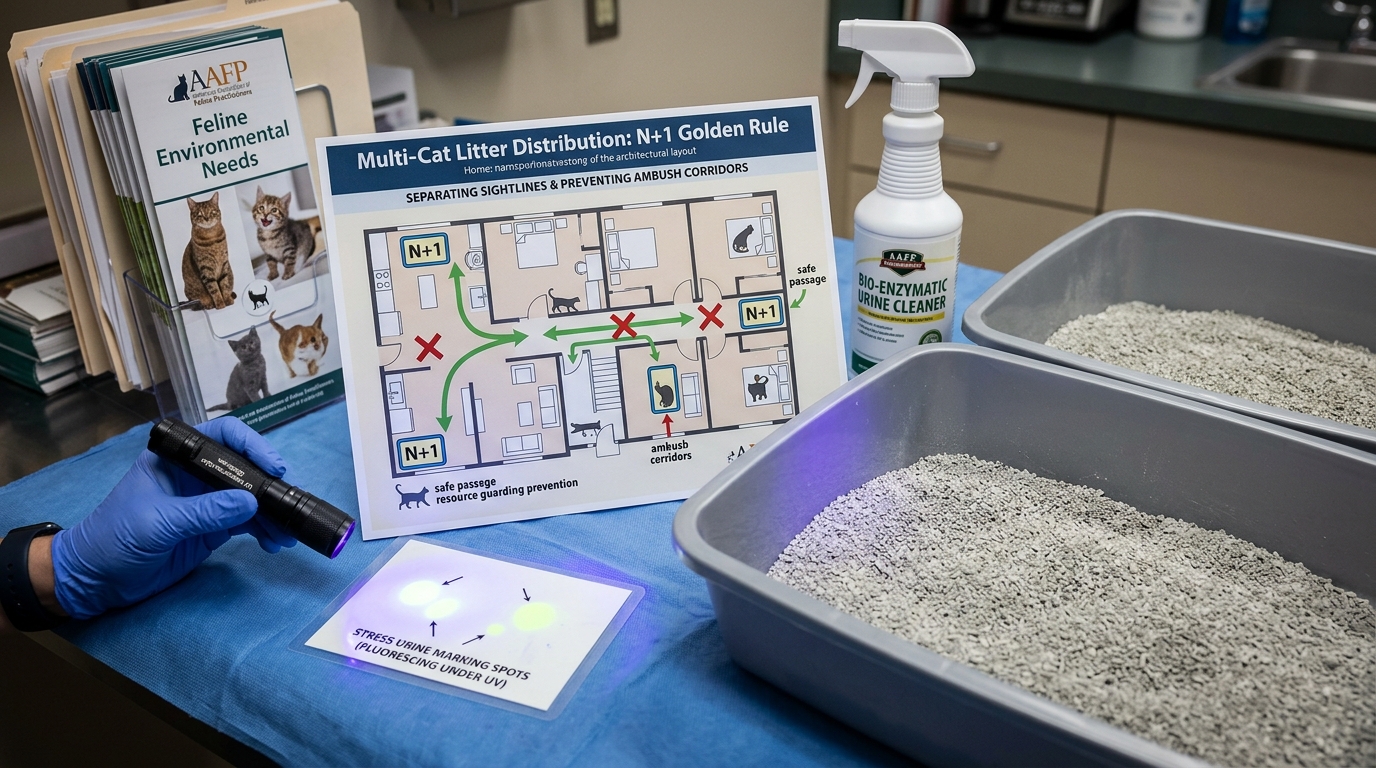
In multi-cat households, litter box layout is a primary health determinant directly linked to the development of stress-induced feline idiopathic cystitis (FIC) and life-threatening urethral obstruction. Subordinate cats ambushed or stalked while eliminating develop acute box aversion, holding urine until painful bladder inflammation develops. Preventing elimination battles requires deploying N+1 large, uncovered boxes across separate visual territories with unobstructed escape routes.
Cats are solitary hunters by evolutionary design, requiring uncontested access to vital survival resources including food, clean water, elevated resting perches, and safe toileting zones. Approaching multi-cat litter management with structured behavioral architecture eliminates social competition, restores household cleanliness, and safeguards feline urinary health.
The 5 Pillars of Multi-Cat Litter Box Architecture
Veterinary feline behaviorists emphasize five core environmental requirements to prevent elimination disputes:
- 1. Strict Adherence to the N+1 Formula: If you have two cats, you need a minimum of three litter boxes. If you care for three cats, you need four boxes. This ensures that even if one box is soiled or occupied, an anxious or subordinate cat always has immediate, unimpeded access to an alternative private toileting facility.
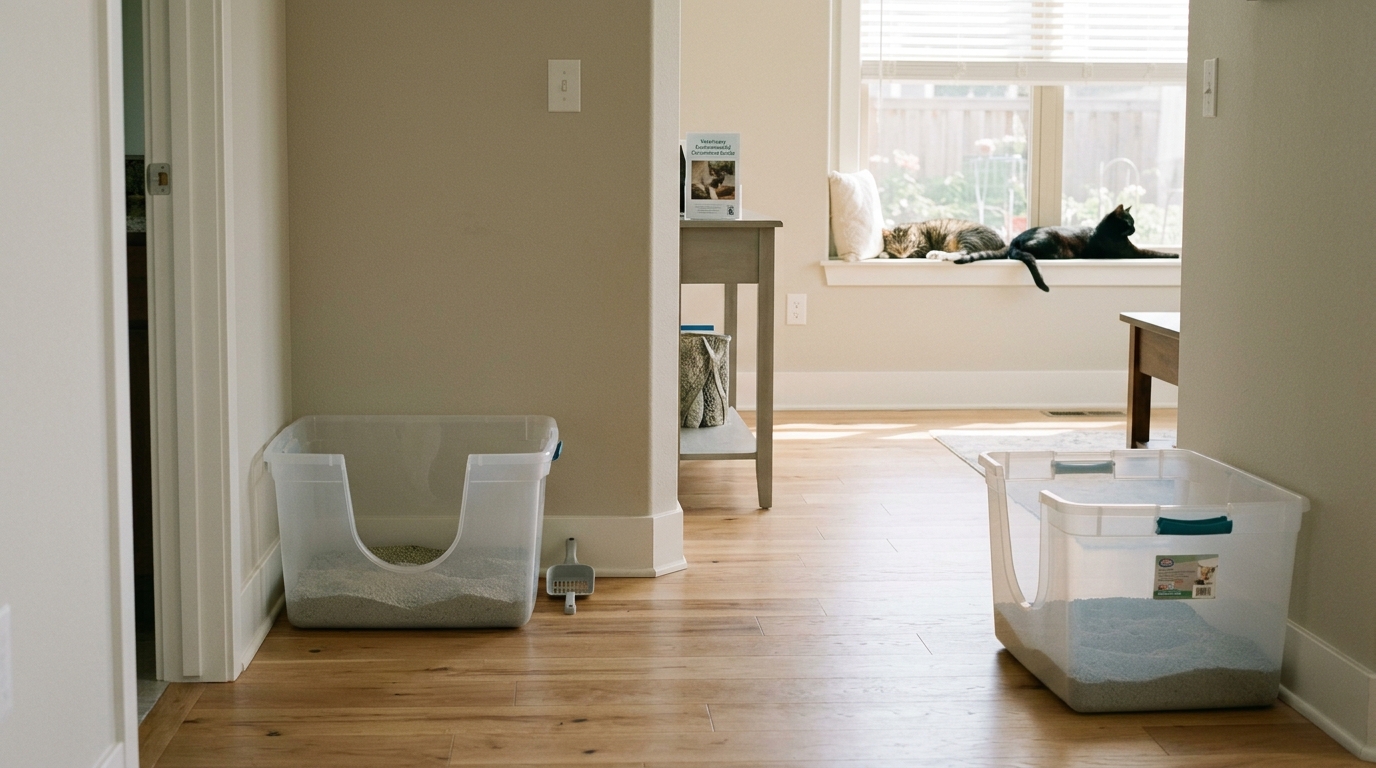
- 2. Spatial Distribution Over Proximity: Placing three litter boxes next to each other in a basement corner violates feline territorial rules. A single confident cat resting in the doorway can easily ambush, block, and intimidate other cats attempting to enter. Distribute boxes across different rooms, floors, and living zones.
- 3. Uncovered Boxes with 360-Degree Sightlines: Enclosed or covered “hooded” litter boxes trap caustic ammonia odors and create a dangerous visual blind spot where an eliminating cat cannot see approaching rivals. Felines feel most vulnerable while posturing to eliminate; wide open boxes with low clear sides allow immediate escape routes in all directions.
- 4. Substrate Selection: The Clay Gold Standard: Controlled feline preference studies consistently show that over eighty percent of domestic cats overwhelmingly prefer soft, unscented, fine-grained clumping clay that mimics natural outdoor sandy loam. Avoid strongly perfumed crystal litters, cedar chips, or noisy pellets that hurt sensitive paw pads.
- 5. Rigorous Sanitation Habits: Scoop all litter boxes twice daily to remove feces and urine clumps. Empty the litter completely, wash boxes with warm soapy water (never bleach or ammonia!), and refill with fresh substrate every two to three weeks. Download our printable Daily Pet Care Routine Tracker to log maintenance.
Recognizing Subtle Litter Box Ambushing & Bullying
Inter-cat aggression in feline households is rarely loud or physical; it is almost always silent, psychological, and posture-based:
| Subtle Ambush Tactic | Cat Behavioural Manifestation | Targeted Environmental Solution |
|---|---|---|
| Doorway & Hallway Blocking | Dominant cat loafs or grooms casually in narrow corridor leading to litter room | Move one litter box out into a wide, open living room with two clear exit pathways. |
| Stairway Surveillance | Sitting at the top of basement stairs, staring intently as subordinate cat climbs | Ensure at least one litter box is located on every inhabited floor of the home. |
| Immediate Post-Box Chasing | Waiting outside box and pouncing on victim as soon as it steps out of the litter | Switch to giant uncovered storage totes so victim can see ambushers and leap out in any direction. |
| Box Odor Over-Marking | Rushing into the box immediately after another cat finishes to bury and re-mark it | Increase total box count and deploy synthetic feline pheromone diffusers (Feliway Friends). |
The Dangerous Link Between Litter Stress & FLUTD
Chronic psychosocial stress directly stimulates the feline sympathetic nervous system, releasing excessive neurokinins and substance P into the bladder lumen. This causes profound vasodilation, submucosal edema, and hemorrhage—the clinical syndrome known as Feline Idiopathic Cystitis (FIC). Learn how to recognize acute urinary blockage signs in our feline urinary health and FLUTD emergency guide.
When to Contact a Veterinarian Immediately
Never assume house-soiling is purely behavioral without a complete veterinary urinalysis. If your cat strains in the litter box without producing urine, cries out in pain, visits the box every few minutes, grooms its genitals obsessively, or passes dark pink or blood-tinged urine, seek immediate emergency veterinary hospital care. In male cats, these symptoms indicate a life-threatening urethral blockage that can cause fatal hyperkalemia and acute bladder rupture within twenty-four to forty-eight hours.
Clinical Practice Tool: Multi-Cat Conflict Tracker
Eliminate litter station guarding and territorial friction early using our printable Multi-Cat Conflict Tracker. Download and print your copy of the Multi-Cat Conflict Tracker, or explore all practical pet care guides in the NewsPet Resource Center.
Frequently Asked Questions
How does litter box competition trigger feline stress cystitis (FIC)?
When litter boxes are grouped together or insufficient in number, dominant cats can block access, causing subordinate cats to hold their urine. Bladder wall inflammation ensues from chronic urinary retention and elevated cortisol.
What is the optimal spatial distribution of litter boxes in a multi-level home?
Place at least one litter box on every level of the home in quiet, low-traffic areas with clear escape routes, avoiding noisy laundry rooms or confined closets where cats can be ambushed.
How does increasing water stations prevent recurrent stress cystitis in multi-cat homes?
Multiple widely separated water bowls and fountains encourage frequent drinking throughout the day, producing dilute urine that prevents chemical irritation of the bladder lining (urothelium).
Emergency Triage Matrix: Clinical Presentation & Required Response
| Triage Level | Clinical Signs & Presentation | Immediate Action Protocol |
|---|---|---|
| Tier 1: Immediate Emergency (0–2 Hours) | Male cat making repeated frantic trips to the litter box with zero urine output, crying in pain, grooming genitals obsessively, or vomiting (acute urethral blockage). | Immediate emergency veterinary transport; emergency urethral desobstruction, relief of hyperkalemic cardiac pressure, and inpatient intravenous fluid diuresis. |
| Tier 2: Urgent Veterinary Care (Same-Day) | Pink-tinged or bloody urine in the litter box, small frequent urine drops on carpets, or intense hissing/screeching around litter box corridors. | Same-day veterinary consultation; complete urinalysis to diagnose cystitis vs. crystals, prescription multimodal analgesia, and territorial separation. |
| Tier 3: Home Monitoring & Scheduled Care | One cat hesitating at the laundry room threshold while another cat lounges nearby, with both cats still producing normal urine volumes daily. | Relocate litter boxes out of blind hallway traps into open multi-exit living zones, add additional litter boxes, and scoop all boxes twice daily. |
Rule S1 Boundaries & Multi-Cat Elimination Rules
Protecting feline urinary and psychological health requires strict environmental standards:
- NEVER place litter boxes in dead-end closets or narrow laundry alcoves: Dead ends create inescapable ambush zones where aggressive cats trap eliminating cats, causing severe psychological trauma and immediate periuria.
- NEVER line up multiple litter boxes side-by-side along a single wall: Cats perceive adjacent boxes as a single large territory; a dominant cat can guard the entire row simultaneously, blocking all other cats.
- NEVER install loud automated self-cleaning boxes without gradual adaptation: A sudden mechanical motor cycling while a skittish cat approaches causes terrifying acoustic fright, resulting in permanent refusal of all litter facilities.
- NEVER wait overnight when a cat strains to urinate without producing urine: Urethral obstruction is fatal within 24 to 48 hours due to potassium-induced cardiac arrest; immediate emergency desobstruction is non-negotiable.
Caregiver Multi-Cat Litter Setup Action Checklist
- Calculate your exact box requirement using the N+1 formula: number of cats plus one (e.g., 4 boxes for 3 cats; 3 boxes for 2 cats).
- Place boxes on different floor levels and in distinct rooms out of sight of each other to prevent territorial monopolization.
- Ensure every box location offers at least two distinct exit pathways so an eliminating cat cannot be cornered.
- Select oversized, uncovered, clear or low-sided storage containers (at least 30 x 20 inches) to provide 360-degree situational awareness.
- Maintain 2 to 3 inches of fine-grained unscented clumping clay litter and scoop every box twice daily without fail.
Related Clinical Guides & Tools
Peer-Reviewed Clinical References & Evidence Grounding
- PMID: 36745090: Hair cortisol levels in cats with and without behavioural problems (J Feline Med Surg, 2023) (opens in new tab)
- PMID: 40482058: Feline management practices and resource provision in the UK: A questionnaire-based study of 565 caregivers (Vet Rec, 2025) (opens in new tab)
- PMID: 28216119: Does previous use affect litter box appeal in multi-cat households? (Behav Processes, 2017) (opens in new tab)
- Cornell Feline Health Center — Veterinary Clinical & Diagnostic Resources (opens in new tab)
Source transparency
Reference mix for this guide
Source labels classify the institutional category of the references cited above.