
Health and Safety Boundary
Jump to Emergency Red Flags ↓
This guide is general education for pet owners. If your pet has urgent symptoms, possible poisoning, injury, breathing trouble, collapse, severe pain, or sudden decline, contact a licensed veterinarian or local emergency service.
Veterinary Medication & Dosage Boundary
Dosages must be calculated by a licensed veterinarian based on species, weight, and bloodwork. Never administer human medications or self-adjust prescription doses for pets.
Editorial standard
How this guide was prepared
Edited for decisions
NewsPet guides are structured around practical owner choices, tradeoffs, and safety boundaries.
Source policy
Sources are listed when a guide relies on outside references.
Veterinary boundary
This article does not diagnose or prescribe; urgent symptoms need veterinary care.
Corrections
Readers can flag unclear, outdated, or inaccurate information through our contact page.
Omeprazole & Famotidine: Acid Reducers & Gastric Triage
Clinical Classification & Indications
- Drug Class: Proton Pump Inhibitor (PPI) vs H2-Receptor Antagonist
- Approved Uses: Treatment and prevention of gastric and duodenal ulcers, esophagitis, severe acid reflux, and mucosal support during NSAID toxicity or uremic gastritis.
Mechanism of Action (Pharmacodynamics)
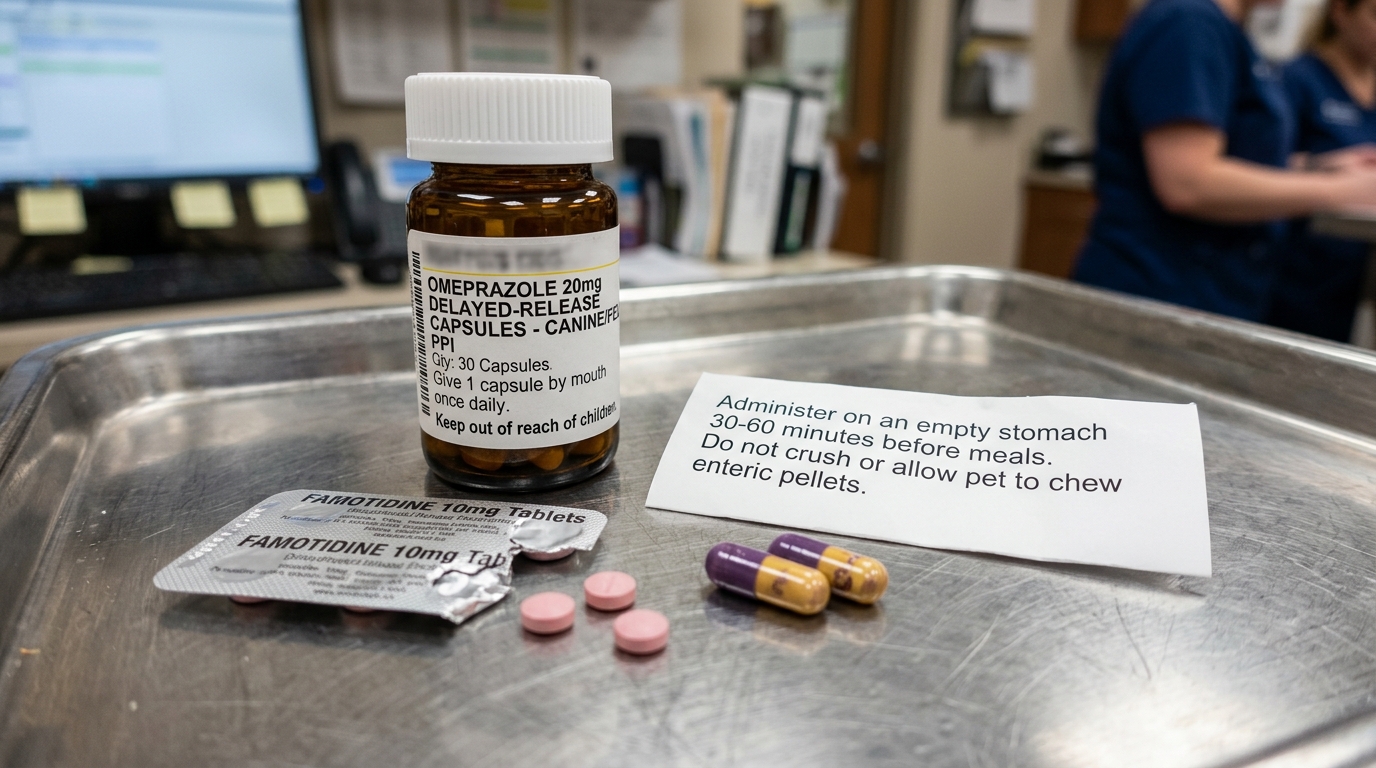
Omeprazole irreversibly binds to the H+/K+ ATPase pump (proton pump) in parietal cells, completely shutting down final acid secretion. Famotidine competitively inhibits histamine H2 receptors on parietal cells.
Adverse Reactions & Side Effect Profile
Common / Expected Side Effects
Mild loose stools, flatulence, inappetence. Long-term chronic acid suppression causes altered gut microbiome, reduced calcium absorption, and rebound acid hypersecretion upon sudden cessation.
Emergency Red Flag Reactions
Hematemesis (vomiting frank blood), severe abdominal cramping, black melenic feces, pale mucous membranes indicating bleeding gastric ulcers.

Clinical Contraindications & Interactions
- Do Not Use In: Known hypersensitivity. May alter the absorption of medications requiring an acidic gastric environment (e.g., ketoconazole, iron supplements).
Strict Rule S1 Veterinary Prescription Directive
VETERINARY DIRECTIVE: Clinical studies prove Omeprazole is vastly superior to Famotidine for raising gastric pH. Famotidine exhibits rapid tachyphylaxis (tolerance develops within 48-72 hours, rendering it largely ineffective). Never use antacids indefinitely without an endoscopic or clinical diagnosis. Never administer human pharmaceutical products or adjust dosages without direct examination and bloodwork by a licensed Doctor of Veterinary Medicine (DVM).
Printable tools