This guide is general education for pet owners. If your pet has urgent symptoms, possible poisoning, injury, breathing trouble, collapse, severe pain, or sudden decline, contact a licensed veterinarian or local emergency service.
Editorial standard
How this guide was prepared
Urethral obstruction in felines—colloquially known in emergency medicine as a “blocked cat”—represents the most frequent, rapidly fatal urological crisis encountered in small animal practice. Occurring almost exclusively in male cats due to their anatomical narrow, elongated, and tapering penile urethra, this condition is triggered by the mechanical impaction of urethral plugs (composed of a proteinaceous matrix mixed with struvite or calcium oxalate crystals), uroliths (bladder stones), or severe functional urethral muscle spasms secondary to feline idiopathic cystitis (FIC). When the urethra is completely occluded, urine cannot exit the body. The urinary bladder rapidly balloons under immense intraluminal pressure, becoming hard, turgid, and ischemic. Within 24 to 48 hours of complete blockage, kidneys can no longer filter waste products, culminating in profound post-renal azotemia, severe metabolic acidosis, and fatal cardiotoxic hyperkalemia. As blood potassium levels surge, cardiac electrical conduction is crippled, causing severe bradycardia, malignant arrhythmias, and sudden cardiac arrest. Immediate emergency stabilization, cardioprotective therapy, and retrograde urethral catheter unblocking are required to save the cat’s life.
Quick Answer: Identifying and Acting on a Blocked Male Cat
If your male cat repeatedly visits the litter box, strains with an arched back while producing zero urine (or only a few bloody drops), cries or yowls in pain, obsessively licks his genital area, or vomits and collapses, assume he is suffering from a urethral obstruction. Do not wait overnight or attempt home remedies. Transport your cat immediately to a 24-hour veterinary emergency center. Emergency teams place an immediate intravenous catheter, evaluate heart rhythm on an ECG, administer intravenous calcium gluconate if hyperkalemic bradycardia is present to protect the heart, and gently relieve the obstruction under sedation using sterile urethral hydropropulsion and an indwelling urinary catheter.
Pathophysiology: The Lethal Cascade of Urinary Blockage
The biological consequences of complete urinary tract occlusion develop rapidly and sequentially across multiple organ systems:
1. Intraluminal Backpressure and Bladder Ischemia: Within 12 hours of occlusion, hydrostatic backpressure transmits upward through the ureters into the renal pelves. The bladder wall becomes stretched to its anatomical limit, resembling a hard, tense peach or tennis ball. Capillary blood flow inside the bladder wall is choked off, leading to mucosal sloughing, transmural hemorrhage, and necrosis.
2. Post-Renal Azotemia and Uremic Encephalopathy: As backpressure halts glomerular filtration, blood urea nitrogen (BUN), serum creatinine, and phosphorus skyrocket. Toxic uremic compounds cross the blood-brain barrier, triggering persistent nausea, intractable vomiting, hypothermia, profound lethargy, and uremic coma.
3. Hyperkalemic Cardiotoxicity (The True Cause of Death): Potassium is primarily excreted by the kidneys. In an obstructed cat, potassium accumulates rapidly in the bloodstream. Elevated extracellular potassium lowers the resting membrane potential of myocardial cells, causing sequential, characteristic electrocardiographic abnormalities: tall tented T waves, loss of P waves (atrial standstill), widening of the QRS complex, and severe, paradoxical bradycardia (<100–120 bpm in a cat). Untreated hyperkalemia results in fatal ventricular fibrillation or asystole.
Clinical Emergency Triage Matrix
| Triage Tier | Clinical Presentation | Required Action |
|---|---|---|
| Tier 1: Cardiovascular Collapse & Hyperkalemic Crisis (0-1h) | Profound collapse, recumbent and stuporous; severe bradycardia (<100 bpm); hypothermia (<36.5°C / <97.7°F); gray or pale tacky gums; bladder is palpated as a hard, painful, rigid rock; known inability to urinate for >24 hours. | Transport immediately to an emergency hospital. Alert the ICU team en route so they can immediately prepare intravenous calcium gluconate for cardiac protection, regular insulin with dextrose, continuous ECG telemetry, and emergency unblocking equipment. |
| Tier 2: Active Straining & Vocalization (1-4h) | Cat is alert but in severe distress; repeatedly postures in litter box with loud vocalization (yowling); obsessively licks penis, which appears purple or inflamed; only produces tiny red drops or nothing; bladder is large and firm. | Proceed directly to an emergency veterinary clinic. Early unblocking within this window prevents progression into severe hyperkalemic arrhythmias, minimizing bladder wall devitalization and reducing hospital stay. |
| Tier 3: Partial Obstruction or Early Dysuria (4-12h) | Frequent visits to the litter box with productive urination (voiding small puddles); mild hematuria (pink-tinged urine); cat is energetic and eating; bladder is soft and small upon gentle examination. | Schedule an urgent same-day veterinary consultation for urinalysis, urine culture, and abdominal radiographs to rule out non-obstructive idiopathic cystitis or bladder stones before complete urethral blockage occurs. |
Dangerous Home Pitfalls: What NOT to Do (Rule S1)
- NEVER forcefully squeeze or palpate the bladder: Applying manual pressure to a tight, overdistended bladder wall can instantly rupture the organ, causing catastrophic uroabdomen, peritonitis, and rapid death. Manual expression must never be attempted on an obstructed patient.
- NEVER mistake urinary straining for constipation: Caregivers often see their cat squatting, straining, and crying in the litter box and assume they are constipated, administering pumpkin, milk, or laxatives. Cats rarely suffer fatal acute constipation, whereas urethral obstruction is fatal within 24 to 48 hours. When a male cat strains, it is a urinary emergency until proven otherwise.
- NEVER delay care overnight hoping the blockage clears: Obstruction does not resolve spontaneously. Potassium levels rise relentlessly each hour, and cats that are lively in the evening are frequently found in cardiac arrest or comatose by morning.
- NEVER attempt to insert needles, straws, or home catheters: The feline penile urethra is tiny (less than 1 mm in diameter) and easily lacerated, torn, or permanently strictured by non-veterinary manipulation.
Emergency Stabilization: Cardioprotection First, Unblocking Second
A fatal pitfall in emergency medicine is rushing an unstable, severely hyperkalemic cat directly into general anesthesia for catheterization. Anesthetizing a cat with a potassium-crippled heart almost invariably causes anesthetic arrest. Experienced clinicians follow a strict stabilization protocol:
1. Immediate ECG and Point-of-Care Bloodwork: An emergency lead-II rhythm strip is obtained within minutes of arrival, accompanied by point-of-care venous blood gas and electrolyte testing to quantify potassium, pH, and creatinine.
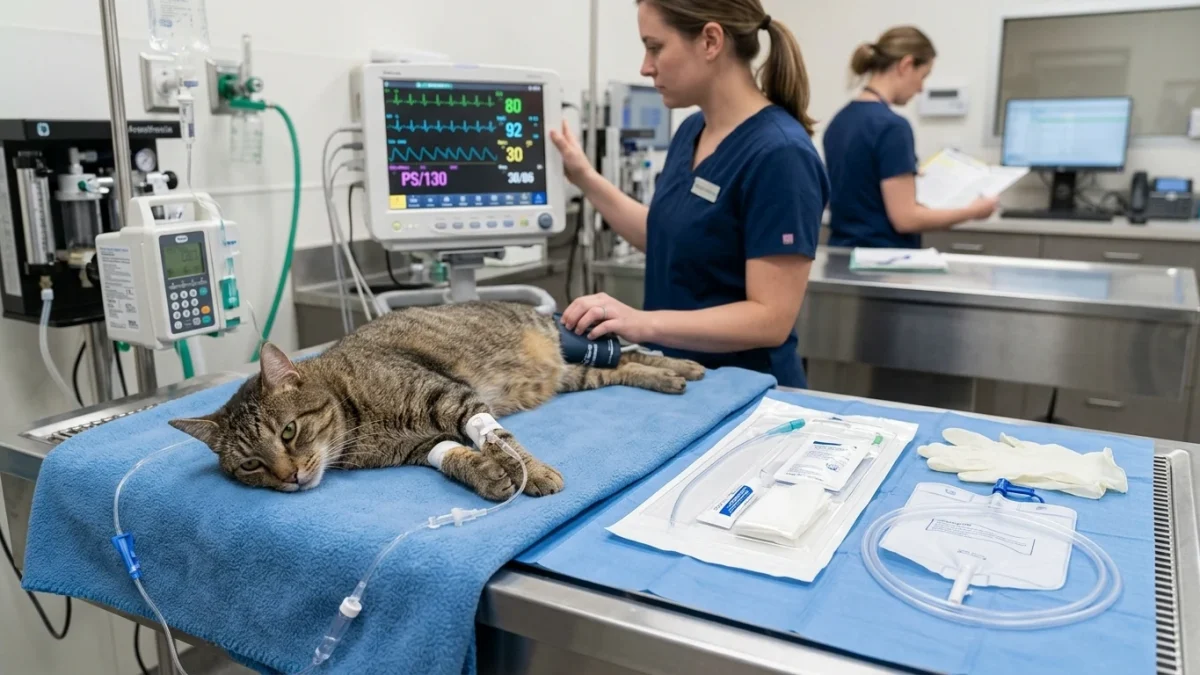
2. Immediate Cardioprotection with Calcium Gluconate: If severe hyperkalemia or bradycardia is identified, the veterinarian immediately administers 10% Calcium Gluconate intravenously under continuous ECG monitoring. Calcium antagonizes the cardiotoxic effects of potassium on the myocardium, restoring normal membrane thresholds and stabilizing the heart within minutes without altering blood potassium concentrations.
3. Shifting Potassium Intracellularly: Regular insulin combined with intravenous dextrose is administered to drive potassium out of the vascular space and into the cells, alongside balanced IV crystalloids.
4. Decompressive Cystocentesis: Under gentle sterile technique, an ultra-fine needle attached to an extension set and syringe is inserted into the distended bladder to aspirate urine, instantly relieving backpressure on the kidneys and making subsequent catheterization significantly easier.
Hospital Catheterization and Post-Obstructive Diuresis (POD)
Once cardiovascular stability is secured, the cat is lightly sedated for gentle retrograde urethral unblocking:
1. Sterile Hydropropulsion: The veterinarian exteriorizes the penis, passes a sterile open-ended tomcat catheter, and pulses sterile saline or sterile flush solution to hydropropulse the obstructing crystal plug retrograde back into the bladder lumen without tearing the delicate urethra.
2. Indwelling Closed Urinary System: A flexible, non-irritating indwelling urinary catheter (such as a 3.5 French Slippery Sam catheter) is advanced and sutured in place, connected to a closed sterile collection bag. This keeps the urethra open, allows the severely inflamed bladder wall to rest and heal, and enables precise hourly measurement of urine production.
3. Managing Post-Obstructive Diuresis (POD): Following the release of high backpressure, many cats enter a phase of massive, life-threatening urine overproduction called Post-Obstructive Diuresis (POD), excreting huge volumes of dilute urine each hour. If intravenous fluid therapy is not carefully matched to this urine output, the cat rapidly experiences fatal dehydration and severe hypokalemia. Intensive ICU fluid management is maintained until diuresis resolves.
Frequently Asked Questions
Why are male cats so much more prone to getting blocked than female cats?
Female cats have a short, wide, and highly elastic urethra that easily expands to pass small bladder stones, mucous, and crystal sediment in the urine. Male cats, by contrast, possess a long, narrow, and rigid urethra that tapers down to an extremely fine opening at the tip of the penis, creating an anatomical bottleneck where inflammatory plugs and tiny stones easily lodge.
How long does a cat need to stay in the hospital after being unblocked?
Most obstructed cats require 48 to 72 hours of intensive care hospitalization. The urinary catheter is typically maintained for 24 to 48 hours until gross hematuria clears, post-obstructive diuresis subsides, and blood kidney values (BUN and creatinine) normalize. Once the catheter is removed, the cat must be observed in the clinic for another 12 to 24 hours to confirm they can void voluntary, normal urine streams before discharge.
Can urethral obstruction happen again in the future?
Yes. Recurrence rates for feline urethral obstruction range between 15% and 35%, most commonly within the first few months following the initial episode. Long-term prevention requires transitioning to a 100% moisture-rich wet or therapeutic prescription urinary diet (to dissolve struvite crystals and reduce specific gravity), environmental enrichment to eliminate stress-induced idiopathic cystitis, and multiple clean water fountains. For cats with multiple, refractory blockages, a surgical procedure called a Perineal Urethrostomy (PU) can be performed to permanently widen the urethral opening into a female-like conformation.
Scientific Sources and Literature
- Cooper ES. “Controversies in the management of feline urethral obstruction: emergency stabilization, catheter selection, and monitoring.” Journal of Veterinary Emergency and Critical Care. PMID: 29959650
- Francis BJ, et al. “Post-obstructive diuresis in male cats following relief of urethral obstruction: incidence, risk factors, and fluid management.” Journal of the American Animal Hospital Association. PMID: 28414440
- Gerber B, et al. “Evaluation of risk factors, recurrence rates, and long-term survival in cats with obstructive feline lower urinary tract disease.” Journal of Feline Medicine and Surgery. PMID: 31215164
Caregiver Emergency Blocked Cat Action Checklist
- Monitor litter box behavior: note if your male cat visits repeatedly, strains with zero urine, or yowls in pain.
- NEVER manually squeeze, press, or palpate the cat’s belly; prevent fatal bladder rupture.
- NEVER assume straining is constipation; assume it is a lethal urethral blockage until proven otherwise by a vet.
- Inspect the penis gently: note if the tip appears purple, swollen, or covered in bloody discharge.
- Keep the cat calm and warm in a secure, padded carrier during car transport.
- Proceed immediately to a 24-hour veterinary emergency center capable of ECG monitoring and emergency unblocking.
Source transparency
Reference mix for this guide
Source labels describe the type of organization behind each reference; they are not a claim that any outside organization reviewed this article.
- Cat Straining in Litter Box: Constipation vs FLUTD Triage Reference source · newspet.net
- Dog Blood in Urine (Hematuria) Triage Protocol Reference source · newspet.net
- Cat Chronic Kidney Disease (CKD) Uremic Crisis Protocol Reference source · newspet.net
- Dog Sudden Collapse & Pale Gums Triage Reference source · newspet.net
- PMID: 29959650 Government or public agency · pubmed.ncbi.nlm.nih.gov
- PMID: 28414440 Government or public agency · pubmed.ncbi.nlm.nih.gov
- PMID: 31215164 Government or public agency · pubmed.ncbi.nlm.nih.gov