This guide is general education for pet owners. If your pet has urgent symptoms, possible poisoning, injury, breathing trouble, collapse, severe pain, or sudden decline, contact a licensed veterinarian or local emergency service.
Editorial standard
How this guide was prepared
Linear foreign bodies represent the single most insidious and mechanically destructive form of gastrointestinal obstruction encountered in feline and canine medicine. Unlike discrete, rounded objects (such as balls, stones, or coins) that cause localized, simple luminal blockages, linear foreign objects—including sewing thread (frequently with a needle still attached), yarn, ribbons, dental floss, tinsel, butcher’s twine, and carpet fibers—pose a catastrophic physical threat to the gastrointestinal tract. In cats, curious play or oral grooming behavior leads to the proximal end of a thread anchoring securely under the base of the tongue (the lingual frenulum); in dogs, linear objects typically anchor at the muscular gastric pylorus. As normal peristaltic contractions attempt to propel the free distal end downward through the small intestine, the anchored line pulls taut. Instead of passing smoothly, the delicate intestinal loops bunch together tightly like an accordion (intestinal plication). Under persistent peristaltic tension, the taut string acts like a cheese wire, sawing through the mesenteric border of the intestine, inflicting multiple perforations, spilling contaminated enteric flora into the sterile abdomen, and precipitating fatal septic peritonitis.
Quick Answer: Immediate Protocol for Swallowed String or Thread
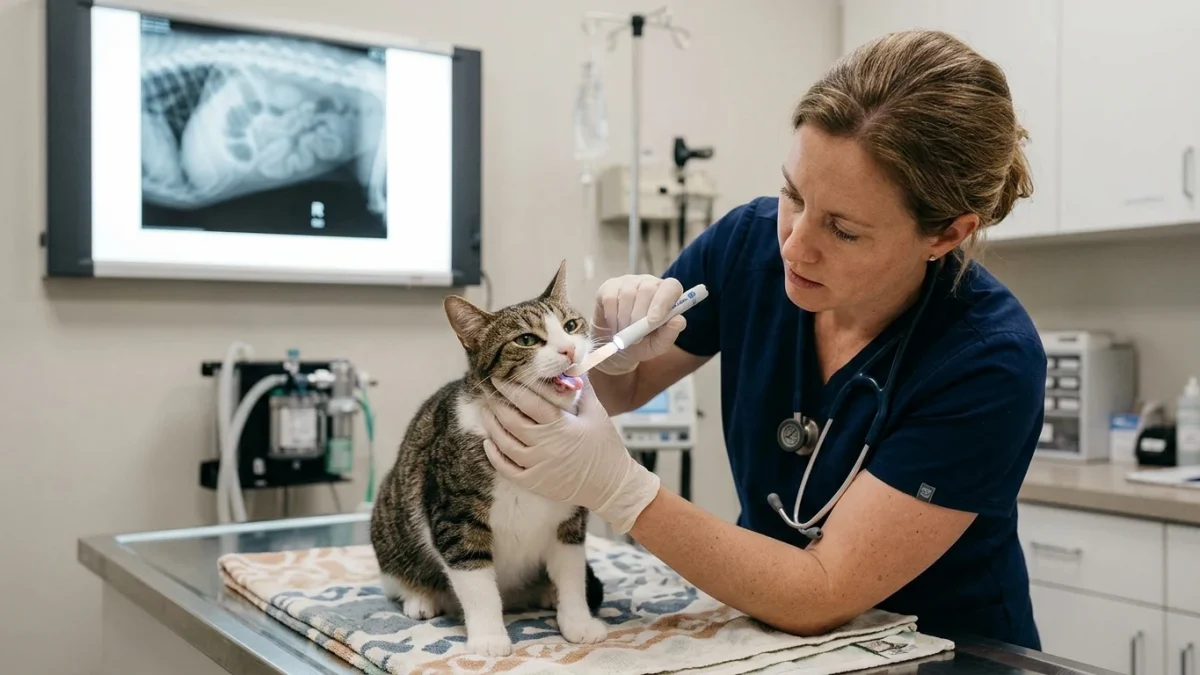
If you see a thread hanging from your pet’s mouth or anus, or if your cat or dog played with sewing materials and began vomiting relentlessly, act immediately. Do not pull the string under any circumstances. If the string is hanging from the mouth or anus, you may use blunt scissors to snip the exterior excess leaving a small visible tail, but never apply traction. Transport your pet immediately to an emergency hospital. Emergency clinicians perform a careful oral exam under the tongue and obtain abdominal radiographs or ultrasound to assess for intestinal plication. Surgical intervention via multiple small enterotomies or gentle endoscopic extraction is required before the bowel undergoes full-thickness mesenteric perforation.
Pathophysiology: The “Cheese-Wire” Effect and Accordion Plication
Understanding the lethal physics of a linear foreign body requires examining how peristalsis interacts with an anchored tension line:
1. Proximal Anchor Points: In felines, backward-pointing filiform papillae on the tongue make it virtually impossible for a cat to spit out a thread once it begins licking it. The thread loops around the base of the tongue (lingual frenulum), anchoring firmly. In dogs, heavier items like cloth towels, rope toys, or pantyhose bunch into a dense knot that becomes wedged in the pylorus, while the trailing strands extend into the duodenum.
2. Accordion Plication: The small intestine attempts to push the trailing end forward via normal peristalsis. Because the front end cannot move, the intestine crawls upward along the string, pleating into tight, bunched folds reminiscent of an accordion or a gathered curtain on a rod.
3. Mesenteric Border Sawing and Perforation: The blood supply to the intestine enters along the mesenteric border. When the string tightens along the inner curve of the pleated loops, the friction of rhythmic gut contractions saws through the intestinal wall. The resulting perforations occur along the mesenteric side, where leakage is difficult for the body to wall off, resulting in rapid polymicrobial septic peritonitis and shock.
Clinical Emergency Triage Matrix
| Triage Tier | Clinical Presentation | Required Action |
|---|---|---|
| Tier 1: Perforated Abdomen or Distal Strangulation (0-1h) | Visible string anchored under the tongue; high fever or subnormal body temperature (<37.5°C / <99.5°F); rigid, board-like abdomen with extreme pain (“prayer position”); persistent projectile vomiting; gray or brick-red mucous membranes; profound lethargy. | Transport immediately to an emergency veterinary hospital. Do not pull the thread. Alert the surgical team en route so they can initiate intravenous fluid resuscitation, multimodal analgesia, broad-spectrum IV antimicrobials, and prepare an operating suite for emergency exploratory celiotomy. |
| Tier 2: Witnessed Ingestion & Early Plication (1-4h) | Witnessed ingestion of sewing thread, dental floss, or yarn within past 4 hours; recurrent retching, gagging, or inability to keep water down; string visible protruding from mouth or anus without signs of peritonitis. | Proceed directly to an emergency clinic. Urgent examination under the tongue (often requiring light sedation) allows potential early release of the lingual anchor or endoscopic extraction before severe intestinal plication develops. |
| Tier 3: Suspected Unwitnessed Ingestion (4-12h) | Vague gastrointestinal signs: decreased appetite, intermittent vomiting of clear fluid or bile, mild dehydration; pet played with a sewing basket or gift wrapping ribbon earlier in the day. | Schedule an urgent same-day veterinary consultation. Perform a thorough physical examination, oral inspection under the tongue, and abdominal survey imaging to rule out occult linear foreign bodies. |
Dangerous Home Pitfalls: What NOT to Do (Rule S1)
- NEVER pull on a string visible at the mouth or anus: This is the cardinal rule of linear foreign body management. Traction on a visible string tightens the internal knots and causes the taut thread to slice through the bowel wall like a hot wire through butter, converting a clean obstruction into multiple septic bowel tears.
- NEVER induce vomiting at home using hydrogen peroxide or salt: Forcing violent gastric contractions against an anchored linear object increases shearing forces, tearing the esophagus and pyloric sphincter. Salt administration causes lethal brain swelling.
- NEVER administer laxatives, mineral oil, or hairball pastes: Lubricants cannot overcome mechanical plication. Giving oils increases intraluminal pressure and dramatically elevates the risk of fatal aspiration during vomiting.
- NEVER assume that because a cat is still defecating, there is no obstruction: In the early stages of a linear foreign body, the distal colon can continue to evacuate pre-existing feces, giving caregivers a false impression that the gastrointestinal tract is completely clear.
Diagnostic Standards: Identifying the Subtle Plication Pattern
Diagnosing a linear foreign body requires careful clinical acumen because thin strings, monofilament fishing lines, and sewing threads are completely radiolucent on standard X-rays unless a metallic sewing needle or fishhook is attached.
However, emergency clinicians identify secondary radiographic and ultrasonographic hallmarks:
- Pleated Bowel Contours: Survey abdominal radiographs demonstrate small intestinal loops bunched tightly into the central or cranial abdomen, displaying an unnatural, undulating “pleated” silhouette.
- Tapered Gas Bubbles: Unlike the rounded, distended gas patterns of simple foreign bodies, linear obstructions trap small pockets of gas between tight folds, creating distinctive tapered, crescent-shaped, or triangular gas bubbles.
- High-Resolution Ultrasound: Ultrasonography reveals a bright, hyperechoic central linear interface traversing through bunched, corrugated bowel loops, accompanied by hyperactive peristalsis in non-perforated segments and localized free peritoneal fluid if micro-leakage has begun.
Surgical Management: The Multiple Enterotomy Technique
Once the patient is cardiovascularly stabilized with intravenous crystalloids and analgesics, emergency exploratory laparotomy is performed. If the thread is anchored under the tongue, the oral loop is carefully severed first to release proximal tension.
The surgeon inspects the entire length of the gastrointestinal tract from the stomach to the ileocecal valve. To extract the linear object without causing further damage, surgeons employ the multiple enterotomy technique:
1. Segmental Release: Rather than attempting to pull a long string through a single large incision, the surgeon makes several small (1 to 2 cm) incisions (enterotomies) along the antimesenteric border of the affected bowel loops, dividing the string into short segments and extracting them in sections.
2. Bowel Viability Assessment: The surgeon closely inspects the mesenteric border for perforations. If localized areas exhibit full-thickness necrosis, irreversible ischemia, or multiple tears, an enterectomy (resection and anastomosis) is performed to remove the compromised intestinal segment.
3. Thorough Peritoneal Lavage: If perforation occurred, the abdomen is lavaged with copious volumes of warm sterile saline to eliminate enteric contamination and reduce the risk of post-operative abscessation.
Frequently Asked Questions
What should I do if a string is hanging out of my cat’s rectum?
Do not pull it under any circumstances. Pulling on a thread emerging from the anus can saw through the colon, rectum, or small intestine. Use a pair of clean, blunt-tipped scissors to carefully snip the excess thread leaving approximately one inch exposed outside the body, and transport your cat immediately to an emergency veterinary clinic for abdominal imaging.
Can a cat pass a small piece of string without surgery?
Very short pieces of thin thread (a few inches in length) that are not knotted, not attached to needles, and not anchored under the tongue can occasionally pass through the gastrointestinal tract and appear in the stool. However, this is unpredictable. If the pet exhibits any vomiting, decreased appetite, or abdominal guarding, immediate veterinary intervention is required.
What happens if a swallowed sewing thread has a needle attached?
A swallowed needle increases the urgency of intervention. While needles are radiopaque and easily located on X-rays, the sharp point can puncture the esophagus, stomach wall, or aorta, while the trailing thread causes intestinal plication. If the needle remains in the stomach, immediate emergency endoscopy can often retrieve it safely before it migrates into the intestines.
Scientific Sources and Literature
- Hobday MM, et al. “Linear foreign bodies in dogs and cats: a review of clinical presentation, surgical management, and outcomes in 143 cases.” Journal of the American Animal Hospital Association. PMID: 24785461
- Boysen SR, et al. “Ultrasonographic diagnosis of linear foreign bodies in cats: sensitivity, specificity, and pattern recognition.” Veterinary Radiology & Ultrasound. PMID: 20497298
- Bebchuk TN. “Feline gastrointestinal linear foreign bodies: surgical techniques and risk factors for intestinal resection.” Veterinary Clinics of North America: Small Animal Practice. PMID: 31215162
Caregiver Emergency Linear Foreign Body Action Checklist
- NEVER pull on any thread, yarn, or string hanging from your pet’s mouth or anus.
- Snip any long exterior dangling ends with blunt scissors, leaving a short visible tail without pulling.
- NEVER induce vomiting at home using hydrogen peroxide, salt, or home remedies.
- Inspect the pet’s oral cavity gently if safe to do so, checking under the tongue with a penlight.
- Withhold all solid foods and liquids to keep the stomach empty for emergency surgery.
- Transport the pet immediately to a 24-hour veterinary surgical hospital equipped with ultrasound and radiography.
Source transparency
Reference mix for this guide
Source labels describe the type of organization behind each reference; they are not a claim that any outside organization reviewed this article.
- Dog Septic Peritonitis & Acute Abdomen Triage Reference source · newspet.net
- Dog Vomiting: Home Monitoring vs Emergency Red Flags Reference source · newspet.net
- Cat Hairball Blockage vs Intestinal Foreign Body Reference source · newspet.net
- Dog Swallowed Chicken Bone & Sharp Object Guide Reference source · newspet.net
- PMID: 24785461 Government or public agency · pubmed.ncbi.nlm.nih.gov
- PMID: 20497298 Government or public agency · pubmed.ncbi.nlm.nih.gov
- PMID: 31215162 Government or public agency · pubmed.ncbi.nlm.nih.gov