This guide is general education for pet owners. If your pet has urgent symptoms, possible poisoning, injury, breathing trouble, collapse, severe pain, or sudden decline, contact a licensed veterinarian or local emergency service.
Dosages must be calculated by a licensed veterinarian based on species, weight, and bloodwork. Never administer human medications or self-adjust prescription doses for pets.
Quick Answer
When a dog hacks loudly and gags white foam, owners often suspect a foreign bone lodged in the throat. In most cases, this reflects infectious kennel cough (loud honking triggered by excitement) or early congestive heart failure (soft moist coughing when resting or sleeping). If breathing exceeds 30 breaths per minute during sleep or gums appear pale, seek immediate emergency care.
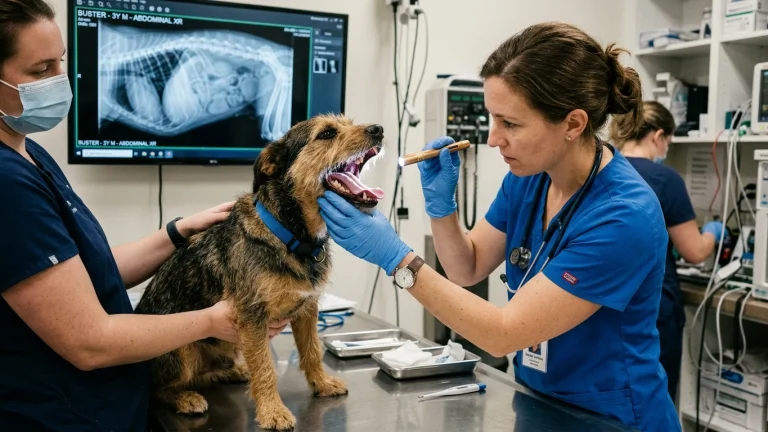
Few canine symptoms produce greater immediate panic than a sudden, violent coughing fit that culminates in an audible gag or retch. Caregivers routinely rush into emergency clinics convinced their dog has swallowed a stick, toy fragment, or chicken bone that is choking them in the pharynx. In clinical practice, true foreign body choking is characterized by silent, frantic pawing at the mouth and acute asphyxiation. When an alert dog repeatedly hacks and retches up a small puddle of white, frothy foam, the etiology is almost always inflammatory or hemodynamic: either acute infectious tracheobronchitis (kennel cough) or cardiogenic pulmonary edema stemming from congestive heart failure (CHF).
Editorial standard
How this guide was prepared
The Clinical Divergence: Kennel Cough versus Heart Failure
Distinguishing upper airway infectious disease from degenerative cardiovascular failure requires evaluating acoustic character, posture, and timing:
- Canine Infectious Respiratory Disease Complex (CIRDC / Kennel Cough): Caused by viral and bacterial pathogens including Bordetella bronchiseptica, canine parainfluenza virus, and canine adenovirus-2. The classic presentation is a loud, harsh, dry, paroxysmal cough that sounds strikingly like a honking goose. Because the tracheal mucosa is acutely inflamed, coughing is instantly triggered by excitement, drinking cold water, or gentle pressure on the trachea (such as pulling on a neck collar). At the end of the spasm, the dog gags and expels clear or foamy white mucus. The dog typically retains normal energy and a ravenous appetite.
- Congestive Heart Failure (CHF) & Mitral Valve Disease: In older small-to-medium breeds (Cavalier King Charles Spaniels, Poodles, Dachshunds, Chihuahuas), progressive myxomatous mitral valve disease (MMVD) causes blood to regurgitate backward into the left atrium. As the left atrium dilates massively, it physically compresses the adjacent left mainstem bronchus, triggering mechanical coughing. As left-sided pressures back up into the pulmonary vasculature, fluid leaks into alveolar spaces (pulmonary edema). Unlike kennel cough, cardiac coughing is soft, moist, and low-pitched, occurring predominantly at night or when the dog lies down to rest. It is accompanied by exercise fatigue and accelerated resting breathing.
- Dynamic Tracheal Collapse: Common in middle-aged toy breeds (Yorkies, Pomeranians, Pugs). The cartilaginous rings supporting the windpipe weaken, causing the trachea to flatten dynamically during inhalation or exhalation, producing a persistent honking cough without infectious exposure.
Clinical Cardiopulmonary Triage Matrix
Use this clinical matrix to determine the required level of veterinary urgency based on objective physical indicators:
| Triage Tier | Clinical Signs & Physical Presentation | Mandatory Action |
|---|---|---|
| Tier 1: Immediate Emergency (0–2 Hours) | Coughing accompanied by pink or blood-tinged frothy oral fluid; sleeping respiratory rate exceeding 35 to 40 breaths per minute; pale, blue, or purple gums (cyanosis); orthopneic posture (sitting upright with neck extended, refusing to lie down); sudden weakness, syncope (fainting after a coughing fit), or collapse. | Transport immediately to the nearest 24/7 emergency veterinary hospital. Handle the dog calmly to prevent adrenaline surges that exacerbate pulmonary edema. Call en route so the ICU team can prepare an oxygen cage, intravenous furosemide, and vasodilators. |
| Tier 2: Same-Day Veterinary Evaluation (12–24 Hours) | Loud, persistent honking cough occurring multiple times per hour; coughing that keeps the dog and family awake overnight; known history of a heart murmur that has newly developed a soft hacking cough; progressive exercise intolerance during routine walks; moderate lethargy or mild fever. | Schedule a same-day veterinary clinical examination. The veterinarian will perform thoracic auscultation, measure the vertebral heart size (VHS) on chest radiographs, and evaluate whether cardiac medications or airway treatments are required. |
| Tier 3: Structured Home Care & Monitoring (24–48 Hours) | Mild, occasional dry honking cough following known boarding or dog park contact; dog remains bright, alert, playful, and eager to eat; normal pink, moist gums; resting respiratory rate strictly under 30 breaths per minute while sleeping; zero breathing distress when resting. | Implement home tracheal rest: discontinue neck collars, transition completely to a chest harness, run a warm bathroom steam session for 15 minutes twice daily, and monitor sleeping breathing rates. If coughing worsens after 48 hours, advance to Tier 2 care. |
The Vital Home Screening Test: Sleeping Respiratory Rate (SRR)
For any coughing dog—particularly seniors or breeds predisposed to heart disease—monitoring Sleeping Respiratory Rate (SRR) is the single most accurate early warning system for pulmonary edema:
When your dog is sound asleep in a cool, quiet room, observe their ribcage. One expansion and relaxation cycle counts as one breath. Count the total breaths over 30 seconds and multiply by two to determine breaths per minute.
Clinical Benchmark: In a healthy canine, the normal sleeping respiratory rate is strictly below 30 breaths per minute (typically 15 to 25 bpm). If your dog’s sleeping breathing rate consistently exceeds 30 bpm, or climbs above 35 to 40 bpm, cardiogenic fluid is accumulating in the lungs even if daytime coughing appears mild. You can record, time, and track your dog’s exact breathing counts with our interactive Resting Respiratory Rate 30-Second Tap Timer.
Dangerous Home Pitfalls: What NOT to Do (Rule S1)
Caregivers attempting to relieve canine coughing frequently commit dangerous medical mistakes:
- Never administer human over-the-counter cough or cold syrups: Human cough medications often contain acetaminophen (toxic to canine liver cells), pseudoephedrine or phenylephrine (which trigger severe hypertensive crises and fatal tachyarrhythmias), or artificial sweeteners like xylitol. Furthermore, suppressing a productive cough in a dog with pneumonia or pulmonary edema prevents the clearance of inflammatory exudate.
- Never walk a coughing dog on a neck collar: Any mechanical leash tension against the ventral neck exerts direct force on inflamed tracheal rings, triggering intense bronchospasms and accelerating permanent tracheal cartilage collapse. Switch immediately to a wide, padded step-in chest harness.
- Do not assume antibiotics are required for all kennel cough: The majority of uncomplicated kennel cough cases are viral (parainfluenza, adenovirus) and resolve with supportive care and tracheal rest. Indiscriminate antibiotic administration promotes resistant bacterial pathogens.
- Do not expose coughing dogs to cold, dry air or secondhand smoke: Cold ambient air dries out the mucociliary escalator, impairing the natural clearance of respiratory debris. Keep the home well-humidified and completely free of tobacco smoke, incense, and aerosol cleaning sprays.
Sources
- ACVIM Consensus Guidelines for the Diagnosis and Treatment of Myxomatous Mitral Valve Disease in Dogs. Journal of Veterinary Internal Medicine. Checked September 21, 2026.
- Canine Infectious Respiratory Disease: New Insights into an Old Problem. Veterinary Clinics of North America: Small Animal Practice / PubMed. Checked September 21, 2026.
- Home Monitoring of Sleeping and Resting Respiratory Rates in Dogs with Subclinical Heart Disease and Heart Failure. American Journal of Veterinary Research / PubMed. Checked September 21, 2026.
Caregiver Safety Checklist
- A harsh honking cough ending in a retch usually indicates kennel cough or tracheal collapse rather than a choked bone.
- Measure sleeping respiratory rate; a rate consistently exceeding 30 breaths per minute signals cardiac pulmonary edema.
- Never attach leashes to a neck collar on a coughing dog; switch immediately to a padded chest harness to protect the trachea.
- Never give human cough syrups containing acetaminophen or pseudoephedrine; human cold medicines cause fatal poisoning in dogs.
Interactive Resting Respiratory Rate (RRR) Counter
Count your resting or sleeping pet's breaths per minute using our timed clinical tap tool. Resting respiratory rate below 30 breaths/min is the veterinary baseline for canine and feline home monitoring.
Source transparency
Reference mix for this guide
Source labels describe the type of organization behind each reference; they are not a claim that any outside organization reviewed this article.
- ACVIM Consensus Guidelines for the Diagnosis and Treatment of Myxomatous Mitral Valve Disease in Dogs Government or public agency · pubmed.ncbi.nlm.nih.gov
- Canine Infectious Respiratory Disease: New Insights into an Old Problem Government or public agency · pubmed.ncbi.nlm.nih.gov
- Home Monitoring of Sleeping and Resting Respiratory Rates in Dogs with Subclinical Heart Disease and Heart Failure Government or public agency · pubmed.ncbi.nlm.nih.gov