Editorial standard
How this guide was prepared
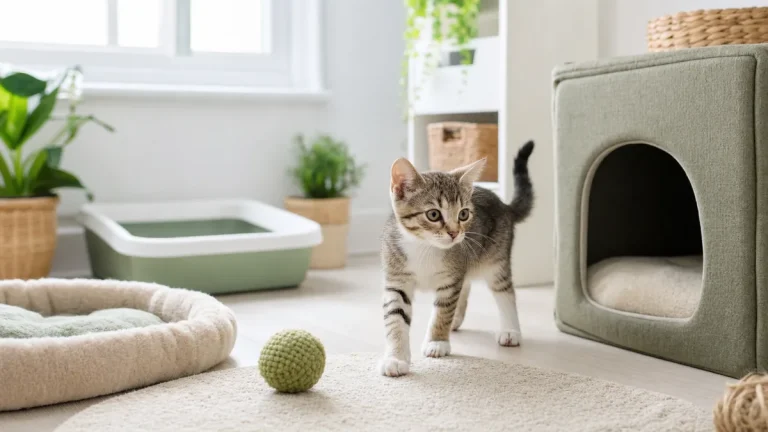
An enriched home is not the one with the most cat products. It is the one that lets a cat travel, hunt, scratch, hide, observe, eat, and choose company without every need depending on a person being available. Map those functions before buying anything.
Clinical Quick Answer & Immediate Actions
Keeping companion felines strictly indoors dramatically reduces risks of vehicular trauma, infectious epidemics, and predatory violence, but imposes significant neurobehavioral constraints. Without deliberate environmental enrichment, indoor cats experience chronic sensory deprivation and boredom, directly driving neuroendocrine stress disorders such as Feline Idiopathic Cystitis (FIC), psychogenic alopecia (compulsive overgrooming), inter-cat aggression, and obesity. Meeting feline environmental needs requires structuring daily routines around the biological ‘Predatory Motor Sequence’: stare, stalk, chase, pounce, catch, bite, and kill. Interactive wand sessions must conclude by allowing the feline to physically capture and ‘kill’ a tangible, tactile toy, immediately followed by a high-protein meal to simulate the natural hunting cycle. Furthermore, vertical territory (cat trees, elevated catwalks) and sensory enrichment (puzzle foraging feeders, safe cat grass, and novel olfactory scents like silvervine) provide vital territorial agency.
If an indoor cat stops jumping, hides continuously, or ceases grooming, contact a veterinarian immediately to rule out arthritis and hidden feline pain.
Map the home by function
| Function | Evidence it works | Useful adjustment |
|---|---|---|
| Vertical routes | The cat can move up, across, and down without being carried or trapped | Connect stable furniture or perches and provide more than one landing where possible |
| Hunting sequence | Play includes watching, stalking, chasing, catching, then disengaging | Move a wand toy like prey, allow catches, and finish before frustration or exhaustion |
| Scratching | A stable option matches the cat’s preferred angle, surface, and waking route | Place the alternative beside the chosen site rather than across the room |
| Hiding | The cat can rest concealed and leave by choice | Add a box, covered bed, or screened perch that people do not reach into |
| Observation | The cat watches without being exposed to heat, falls, or inescapable outside-cat triggers | Secure the window and add distance or screening when watching becomes tense |
| Food use | Measured food produces searching or problem solving without conflict | Start with visible pieces and separate cats who may compete |
| Social choice | The cat can approach, remain nearby, or leave without being followed | Create several resting locations and pause touch to check re-engagement |
Routes and refuge make the home usable
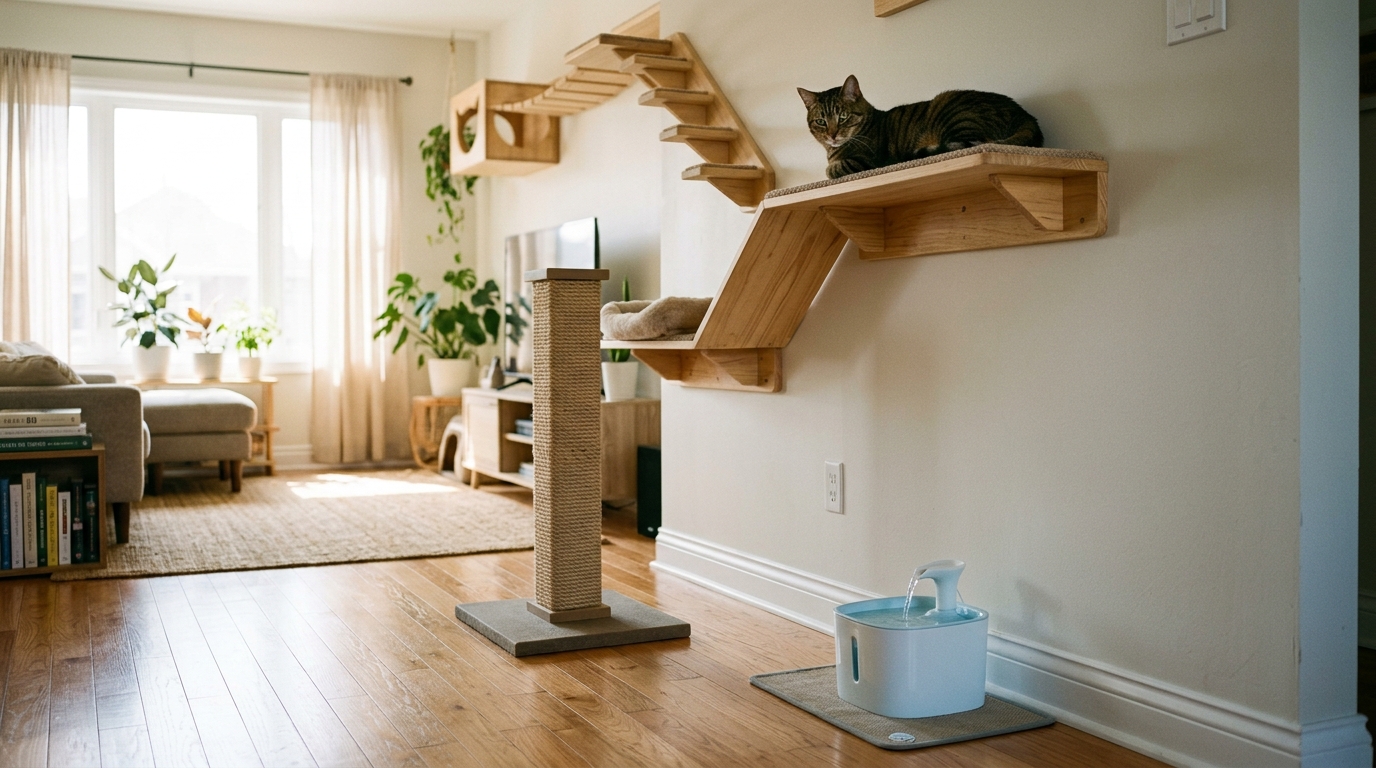
Height is most valuable when it forms a route. Connect a low step, a stable middle landing, and a higher observation point. Check load, wobble, sharp edges, window security, heat sources, and the cat’s ability to descend. Older cats and cats with limited mobility may need shorter gaps, wider surfaces, ramps, or lower destinations rather than losing vertical choice altogether.
Hiding has a different function. Provide locations where the cat can be concealed without becoming unreachable in an emergency. Do not pull the cat out for visitors or routine affection. If one hide has a single entrance in a multi-cat home, another cat may control it; separate routes matter more than a perfect-looking bed.
Hunting, food, and scratching need an ending
Interactive play works best as a sequence. Let the cat watch, stalk, chase, and catch. Abruptly waving a toy at the face or ending every chase without capture can create frustration. Keep string and wand components stored after supervised play, and choose speed and jumping that fit the cat’s health.
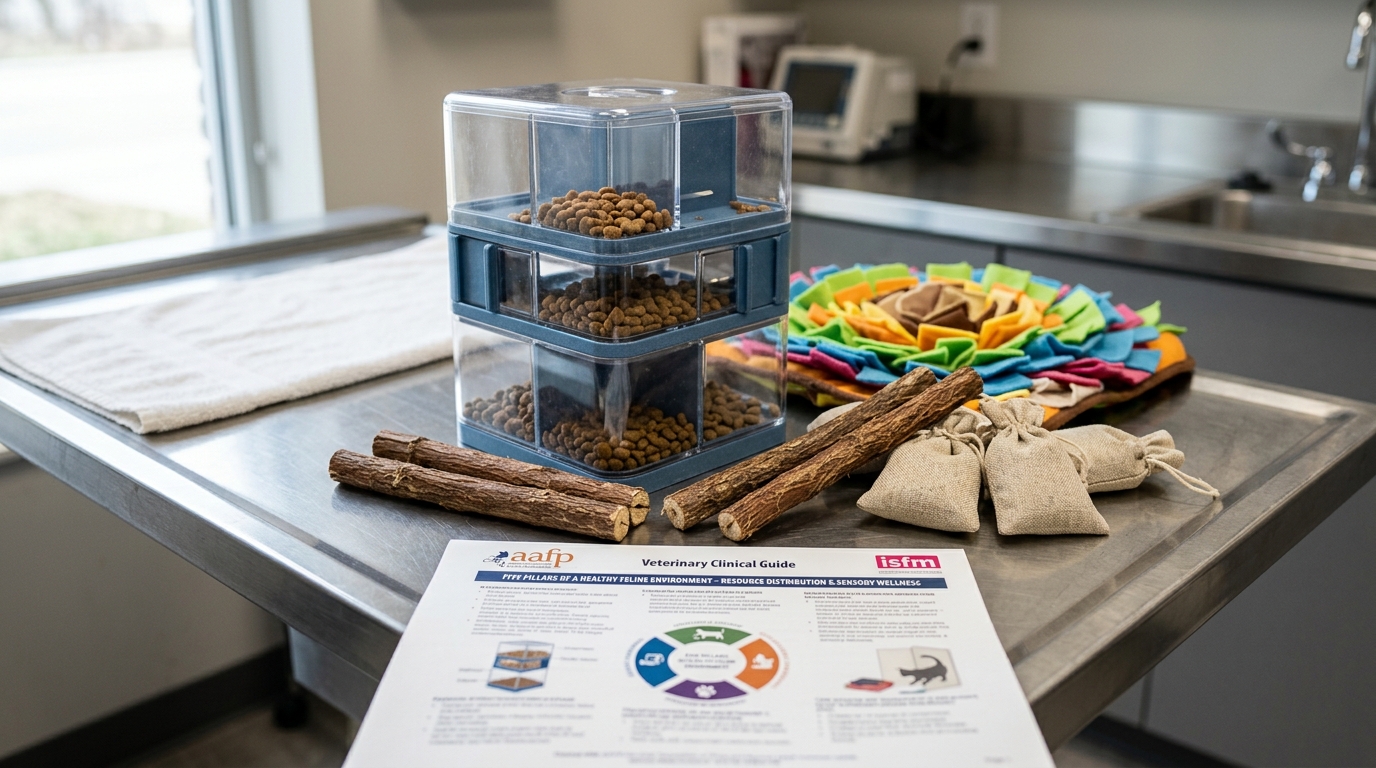
Food can extend the sequence through scattering or an easy puzzle. Use part of the measured ration, introduce one device while supervised, and simplify if the cat bites unsafe material or gives up. In homes with several cats, provide separated food opportunities rather than one competitive puzzle.
Scratching is both physical and communicative. Match the surface, horizontal or vertical orientation, height, and stability already selected by the cat. The furniture-redirection guide provides the location diagnosis and relocation sequence when one site is the problem.
Build the daily sequence from stable anchors and predictable care points rather than offering novelty all day. A morning sequence might include a short stalking-and-catch game, part of breakfast in an easy search, grooming or social contact only if invited, then an undisturbed rest period. Later, open a safe observation choice or rotate one box. In the evening, another brief hunt-catch-food sequence can finish before the household quiets.
The order matters more than adding activities. Intense play immediately after a window confrontation may extend arousal, while a familiar hide and reduced view may be the useful next choice. Protect sleep between active periods. A cat repeatedly awakened to demonstrate a new object has less control even when the object is marketed as enrichment.
Observation and sensory variety should remain controllable
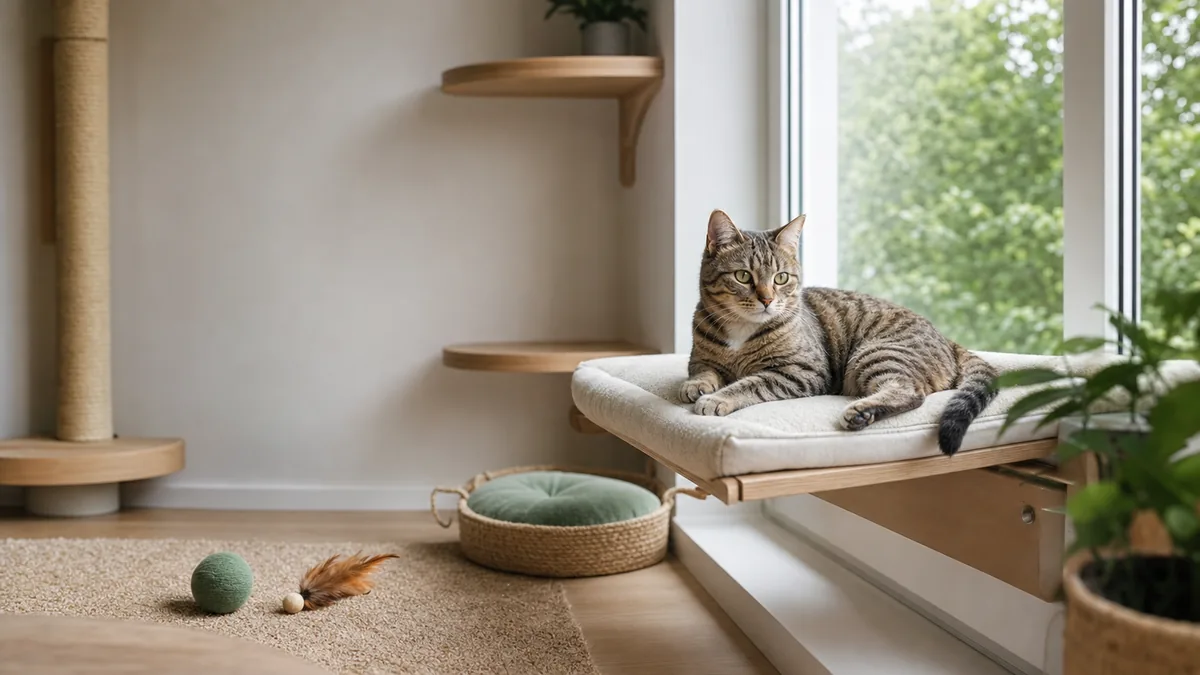
A window perch can offer light, movement, and scent, but it can also expose a cat to outdoor cats without an escape route. Watch the body: relaxed repositioning and ordinary rest differ from prolonged staring, tail lashing, redirected swatting, or patrolling. Add a second route, screen the lower view, or close access during predictable triggers.
Rotate a few safe experiences instead of changing the whole territory. Cardboard boxes, paper without handles, a moved perch, a safe scent from outdoors, or a different play route can be enough. Essential litter, water, feeding, hiding, and sleeping locations should remain predictable.
Keep sensory choices reversible. Let the cat leave a window, retreat from a sound, ignore a scent, or choose the familiar box instead of the new one. Avoid concentrated fragrances and do not apply scents to the cat or essential resources. Control matters because an experience the cat cannot escape is exposure, not enrichment.
Social choice includes choosing solitude
Some cats seek frequent contact; others prefer parallel presence. Offer brief touch and pause. A cat who rubs, re-approaches, or stays loose may invite more. Turning away, skin twitching, tail movement, freezing, or leaving ends the interaction. Food should not lure a cat into handling it cannot decline.
In a multi-cat home, enrichment does not treat conflict. If one cat blocks routes, stares, chases, ambushes, or causes another to hide, use the resource-distribution and conflict-log guide rather than adding a single shared activity.
Run a room-by-room access check
Start with the rooms the cat already uses. Mark entry and exit routes, height changes, hiding options, scratching sites, food and water, litter access, and where people or animals can interrupt. Then inspect the avoided rooms. The missing feature may be a safe crossing, non-slip landing, or second exit rather than lack of entertainment.
Door schedules matter. A valued perch that becomes inaccessible every night or a water station behind a frequently closed door is not reliable. Essential functions need dependable access or a true alternative.
Distribute opportunity by cat and ability. In a multi-cat home, duplicate functions in locations that cannot be watched from one station. One cat may use a high route while another needs a low, wide landing; both still need independent access to food work, scratching, hiding, observation, and people. Do not make the older or less agile cat cross the younger cat’s play area to reach every valued resource.
Adapt the map for age and mobility
Kittens and young adult cats are not the only cats who benefit from play and choice. For older cats, shorten jumps, add intermediate steps, use warm supportive rest areas, and place resources so stairs are not mandatory. Keep the goal–height, observation, scratching, hiding–while changing the physical route.
For cats with visual or sensory change, preserve furniture layout and predictable resource placement. Novelty that is enjoyable for one cat can disorient another. Veterinary advice should guide changes for arthritis, weight, dental disease, or chronic conditions.
Food enrichment should not create nutritional drift
Measure the daily ration before dividing it between meals, searches, training, and puzzles. Account for treats and household members who feed separately. A cat who needs a therapeutic diet should use only foods approved by the veterinarian.
Begin with easy access so the cat learns the food is available. Increase manipulation gradually. If the cat stops eating, loses weight, vomits, or guards the device, return to ordinary feeding and investigate rather than treating difficulty as beneficial work.
Low-cost changes can carry high value
A cleared shelf with safe access, a cardboard box with two exits, a chair moved to create a landing, a towel over part of a carrier, or measured food placed in several visible spots may solve a real function. Check handles, tape, staples, plastic, unstable stacks, cords, toxic plants, and small pieces before offering household materials.
Rotate only what is optional. Removing every familiar box and toy at once can erase scent and predictability. Keep favored resources while presenting one new choice.
Evaluate use without forcing demonstration
Give the cat time to investigate when the room is quiet. Do not place the cat on a shelf, carry it into a hide, or move paws on a scratcher. Look for voluntary use across several days and at different times. A resource may be valuable as an available option even if use is brief.
If nothing changes, revisit placement and access before buying another object. The function map turns “my cat is bored” into a narrower question that the home can answer.
Voluntary approach, repeated use, relaxed departure, and normal behavior afterward provide stronger evidence than placing the cat on or inside a resource once. Compare use across quiet and busy periods, and distinguish a brief useful option from avoidance that follows a blocked route or inaccessible setup.
When low activity may be medical
A new loss of play, jumping, grooming, appetite, litter-box use, or social tolerance needs veterinary attention. Pain, illness, obesity, and sensory or cognitive changes can alter how a cat uses the home. Adaptations can improve access, but enrichment should not be used to explain away a sudden decline.
After mapping the seven functions, change the weakest one first and watch whether the cat gains choice. A home that supports ordinary behavior consistently is more useful than a room full of rarely used novelty.
Clinical Practice Tool: Cat Enrichment Rotation Calendar
Prevent feline habituation and stimulate natural predatory instincts by downloading our printable Cat Enrichment Rotation Calendar. Download and print your copy of the Cat Enrichment Rotation Calendar, or explore all practical pet care guides in the NewsPet Resource Center.
Frequently Asked Questions
What essential environmental resources does an indoor cat require to avoid stress?
Indoor cats require five core environmental pillars: safe resting sanctuaries, multiple separated food and water stations, clean private litter boxes, vertical territory with scratching surfaces, and opportunities for simulated predatory play.
How does vertical territory reduce conflict in multi-pet households?
Cats manage territorial hierarchy through vertical elevation. Cat trees, wall shelves, and elevated window perches allow felines to survey surroundings, maintain visual distance from dogs, and avoid feeling cornered in floor hallways.
What type of play best satisfies a cat’s instinctual predatory drive?
Use interactive wand toys that simulate flight and evasion patterns of rodents or insects. End the play sequence by allowing the cat to capture the lure, followed immediately by a protein-rich meal to complete the natural predatory sequence.
Frequently Asked Questions
How do I keep an indoor cat mentally stimulated and active?
Incorporate the predatory cycle: play, hunt, eat, groom, sleep. Use wand toys mimicking birds or mice for two 10-15 minute interactive sessions daily, provide window perches overlooking bird feeders, rotate toys weekly, and ditch open bowls for foraging puzzle feeders.
How many scratching posts does an indoor cat need?
Provide at least one sturdy scratching post per cat, plus one extra, distributed across main living areas and sleeping spots. Posts should be tall enough for the cat to extend their spine fully (at least 32 inches) and made of natural sisal or corrugated cardboard.
Do puzzle feeders really prevent indoor cat boredom and obesity?
Yes, veterinary behavior studies show that foraging toys slow food ingestion, promote physical movement, prevent post-meal regurgitation, and satisfy natural feline foraging drives, reducing behavioral stress and obesity.
Sources
Sources checked: September 8, 2026.
- AAFP and ISFM: Environmental Needs Guidelines
- ASPCA: Feline DIY Enrichment
- Ohio State Indoor Pet Initiative: Feline Environmental Enrichment
- International Cat Care: Environmental Enrichment for Indoor Cats
- Cornell Feline Health Center: Feline Behavior and Enrichment
Emergency Triage Matrix: Clinical Presentation & Required Response
| Triage Level | Clinical Signs & Presentation | Immediate Action Protocol |
|---|---|---|
| Tier 1: Immediate Emergency (0–2 Hours) | Male cat straining in the litter box with zero urine output, crying in pain, or vomiting with a distended abdomen (stress-induced urethral obstruction); or cat ingested string, thread, or wand toy ribbon (linear foreign body emergency). | Immediate emergency veterinary transport; complete urethral blockage requires immediate de-obstruction under anesthesia; linear foreign bodies require urgent abdominal radiography and emergency surgical retrieval. |
| Tier 2: Urgent Veterinary Care (Same-Day) | Cat develops extensive self-inflicted alopecia (licking belly or legs completely bald), sudden frequent bloody urination outside the litter box (periuria), or explosive redirected aggression toward human caregivers or housemates. | Same-day veterinary evaluation; urinalysis and ultrasound to evaluate sterile bladder inflammation (FIC), dermatological workup for secondary pyoderma, and prescription multimodal behavioral therapy. |
| Tier 3: Home Monitoring & Scheduled Care | Cat is physically healthy with normal appetite and litter box habits, but exhibits mild boredom behaviors: nighttime yowling, scratching sofa corners, or sleeping over 18 hours per day without play interest. | Restructure daily enrichment: institute two 10-minute interactive predatory play sessions daily, install vertical window perches, transition dry kibble into foraging puzzle toys, and introduce silvervine chew sticks. |
Rule S1 Boundaries & Feline Enrichment Rules
Indoor feline enrichment requires adherence to strict physiological and physical boundaries:
- NEVER use laser pointers without concluding on a tangible physical toy: Chasing an uncatchable red dot frustrates the predatory motor sequence; chronic laser play without a tangible ‘kill’ induces severe obsessive-compulsive neurosis and stress-induced behavioral displacement.
- NEVER leave wand toys, string, yarn, or rubber bands accessible unsupervised: Cats possess backward-facing filiform tongue papillae that force ingested string down the esophagus; linear foreign bodies saw through the mesenteric border of the intestines, causing fatal septic peritonitis.
- NEVER position litter boxes adjacent to noisy mechanical appliances: Placing litter boxes next to washing machines, water heaters, or furnace blowers triggers severe acoustic startle reflexes, leading to permanent litter box aversion and chronic urine retention.
- NEVER scold or physically punish a cat for scratching furniture: Scratching is an involuntary physiological necessity for claw maintenance and visual-scent territorial marking; punishment spikes cortisol and redirects scratching to other household furnishings.
Caregiver Multimodal Feline Environmental Enrichment Checklist
- Conduct two 10-to-15 minute interactive wand toy sessions daily: mimic prey movement (fluttering like a bird, scurrying like a rodent) across furniture.
- Always end predatory play sessions by allowing the cat to capture a plush toy with their paws and mouth, immediately offering a small meal or high-protein treat.
- Install sturdy vertical territory: position tall cat trees or wall shelving near living room perimeters to provide elevated surveillance pathways.
- Replace open food bowls with interactive puzzle feeders and foraging balls to stimulate natural problem-solving foraging instincts.
- Deploy tall, sturdy sisal scratching posts (at least 32 inches high so the cat can stretch fully upright) directly adjacent to prime sleeping and entry areas.
- Offer rotating sensory enrichment weekly: provide non-toxic organic cat grass (wheatgrass or oat grass), silvervine powder, and cardboard box mazes.
Related Clinical Guides & Tools
Peer-Reviewed Clinical References & Evidence Grounding
- PMID: 36002137: 2022 AAFP/EveryCat Feline Infectious Peritonitis Diagnosis Guidelines (J Feline Med Surg, 2022) (opens in new tab)
- PMID: 31916872: 2020 AAFP Feline Retrovirus Testing and Management Guidelines (J Feline Med Surg, 2020) (opens in new tab)
- PMID: 38351524: Defining sepsis in small animals (J Vet Emerg Crit Care (San Antonio), 2024) (opens in new tab)
- Cornell Feline Health Center — Veterinary Clinical & Diagnostic Resources (opens in new tab)
Printable tools
Download the matching worksheet
Source transparency
Reference mix for this guide
Source labels describe the type of organization behind each reference; they are not a claim that any outside organization reviewed this article.
- AAFP and ISFM: Environmental Needs Guidelines Veterinary organization · catvets.com
- ASPCA: Feline DIY Enrichment Animal welfare nonprofit · aspca.org
- Ohio State Indoor Pet Initiative: Feline Environmental Enrichment Academic or extension · indoorpet.osu.edu
- International Cat Care: Environmental Enrichment for Indoor Cats Animal welfare nonprofit · icatcare.org
- Cornell Feline Health Center: Feline Behavior and Enrichment Academic or extension · vet.cornell.edu
- Cat Litter Box Problems: Causes & Solutions (V Reference source · newspet.net
- Why Cats Scratch Furniture and How to Redirect It Reference source · newspet.net
- Multi-Cat Home Setup: How to Reduce Conflict and R Reference source · newspet.net