Editorial standard
How this guide was prepared
The front entryway is the single highest-risk architectural bottleneck in a multi-pet household. When a doorbell rings or a knock sounds at the door, multiple behavioral and environmental stressors converge within seconds: an abrupt 80-decibel acoustic alert, owners hurrying tensely down a narrow hallway, contagious vocal barking among multiple pets, and an unfamiliar stranger stepping directly across the threshold into confined personal space. Without structured spatial management and Pavlovian counterconditioning, doorway arrivals frequently result in door-dashing escapes, redirected inter-pet fights at the door, or fear-induced defensive bites to guests.
Clinical Quick Answer & Immediate Stabilization Protocol
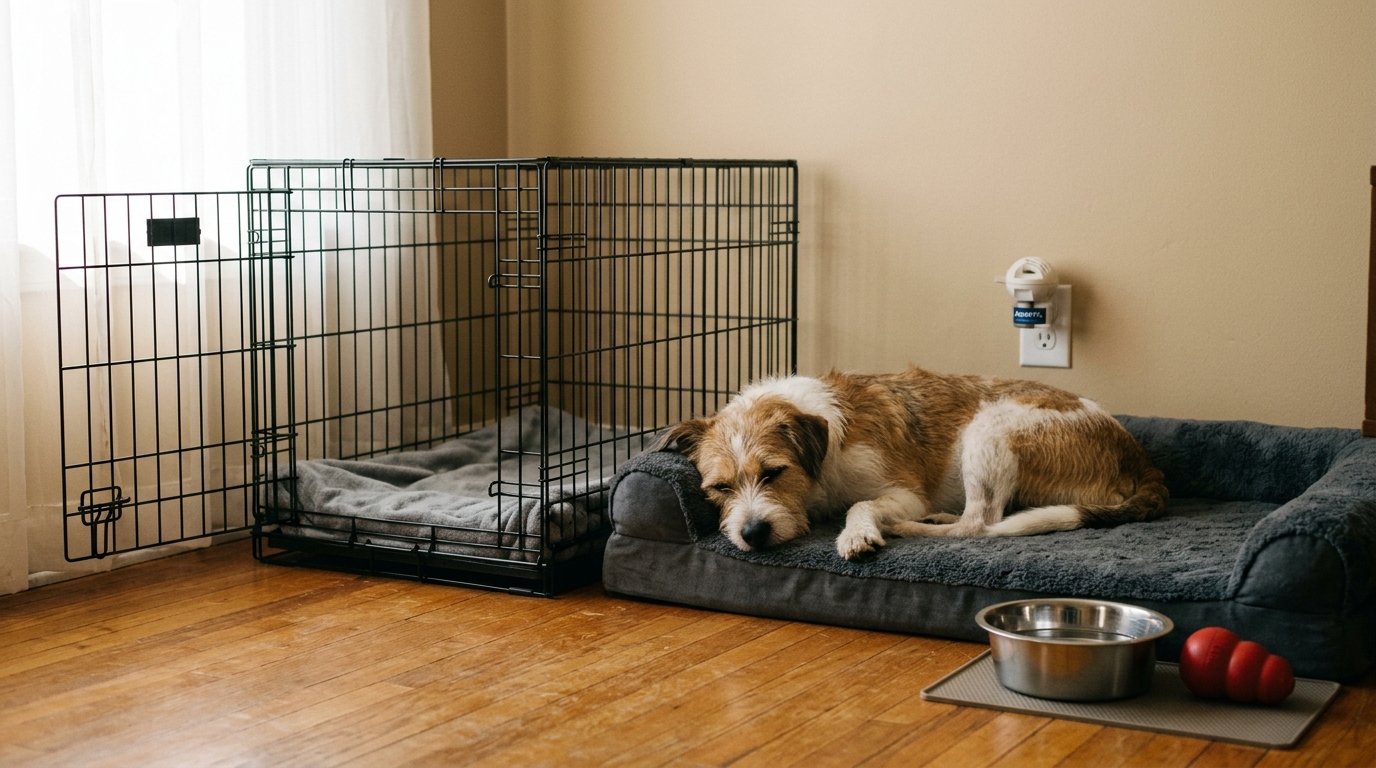
Primary Clinical Directive for Doorbell Acoustic Startle, Territorial Entryway Reactivity & Visitor Greeting Management: Deconstruct front-door arrivals into two separate protocols: (1) Immediate Physical Containment for real-life visitors—secure dogs behind a tall hall gate or inside a bedroom with a frozen stuffed Kong and keep cats in a quiet sanctuary room with vertical hiding spots until guests are seated; and (2) Sub-Threshold Acoustic Counterconditioning during calm off-hours—record your doorbell chime at 10% volume on your phone and pair the sound 20 times with an immediate scatter of high-value treats on a mat 15 feet away from the front door.
Entryway Spatial Compression, Contagious Multi-Pet Arousal & Approach-Avoidance Conflict
From an ethological standpoint, residential front foyers violate every rule of peaceful canine and feline social greeting. Natural canine greetings occur in wide open space along curved lateral arcs (“J-curves”) with averted gaze and sniffing of the ground; residential hallways force a head-on, linear confrontation in a 1-meter-wide chute with zero lateral escape routes. In multi-pet homes, this spatial compression combines with social facilitation (pack allelomimetic behavior): when one dog barks at the door knock, sympathetic arousal spreads instantaneously to companion dogs and cats, frequently triggering redirected inter-dog aggression right against the closed front door.
Furthermore, traditional obedience attempts at the door—shouting “No bark! Sit! Stay!” while a guest walks through the door—fail because fear and territorial vigilance are autonomic emotional states, not operant disobedience. Suppressing vocal barking while forcing the dog to remain close to the intimidating visitor increases internal sympathetic tension. True counterconditioning changes the underlying emotional prediction of the doorbell chime from “Threat invading territory!” to “Cue to sprint away from the door to my kitchen mat for a meat party!”
- The Lure-and-Trap Stranger Bite Mechanism: When a fearful dog takes a treat directly from a guest’s outstretched hand, the appetizing food temporarily overrides fear at 2 feet; the instant the treat is swallowed, the dog finds itself trapped inside its critical flight distance and snaps at the retreating hand.
- Incompatible Stationing Behavior: A dog physically cannot charge the front door and bark at the mail slot while simultaneously trotting 20 feet away into the kitchen to eat diced chicken from a remote dispenser or snuffle mat.
- Feline Acoustic Startle & Idiopathic Cystitis: Unpredictable houseguests, booming voices, and disrupted litter-box corridors are primary neurogenic triggers for Feline Idiopathic Cystitis (FIC) and stress hematuria within 24 to 72 hours of a dinner party.
- Double-Barrier Air-Lock Containment: Installing a freestanding or wall-mounted walk-through pet gate 6 to 8 feet back from the front door creates a physical air-lock that prevents both cat door-darting and canine jumping on arriving guests.
Emergency Triage Matrix: Clinical Presentation & Required Response
| Triage Level | Clinical Signs & Presentation | Immediate Action Protocol |
|---|---|---|
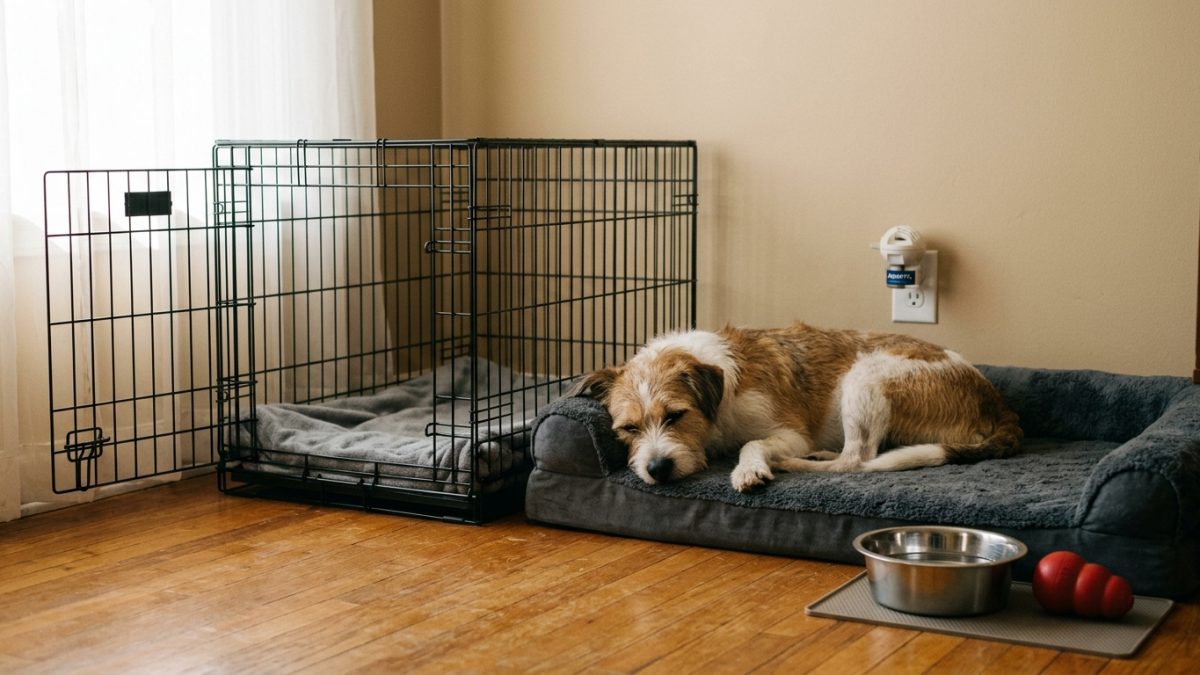
| Tier 1: Strict Two-Door Isolation (Contractors, Children & Fearful/Bite-History Pets) | Dog has a history of growling, lunging, or nipping at visitors; cat panics or bolts toward exterior doors; or visiting children/repair crews will be entering and exiting repeatedly. | Place pets inside a closed interior bedroom behind two physical barriers (crate/gate + closed latched door) with white noise, water, litter, and a long-lasting chew 15 minutes before guests arrive; zero direct guest interaction. |
| Tier 2: High-Excitement Jumping & Multi-Dog Entryway Barking | Friendly but over-aroused dogs charge the door, bark in chorus, body-slam each other in the foyer, and jump exuberantly on arriving guests. | Separate multi-dog pairs behind a hallway gate before opening the door; instruct guests to ignore the dogs completely (no eye contact, no talking, no touching) until all four paws are calm and guests are seated. |
| Tier 3: Conditioned “Doorbell = Go to Mat” & Three-Second Consent Greetings | Dog hears doorbell chime and automatically trots away from the foyer to its designated kitchen mat; cat remains relaxed on an elevated perch. | Toss treats onto the mat behind the dog (or have seated guests toss treats past the dog to remove pressure) and apply the 3-second consent rule for voluntary petting. |
Acoustic Desensitization Protocols, Remote Treat Dispensers & The Three-Second Guest Rule
To recondition the doorbell or door-knock reflex, temporarily disable the live hardwired doorbell (place a polite “Baby/Puppy Sleeping — Please Text Upon Arrival, Do Not Knock” sign over the button) so random delivery drivers do not ruin your training gradient. Record the doorbell sound on a smartphone and reduce playback volume to 10 percent. Stand beside your dog’s mat 15 feet from the door, play the faint chime once, pause 0.5 seconds, and scatter 5 high-value meat treats onto the mat. Repeat 8 times per session across 5 days, raising volume by 10 percent only when the dog’s ears perk happily toward the mat rather than stiffening toward the door.
When introducing a calm, vetted dog to seated adult guests, coach your visitors BEFORE they enter the house. Guests must sit down, keep their hands in their laps, avert direct eye contact, and never reach toward the dog. If you use food during greetings, you (or the seated guest without looking at the dog) must toss the treat 3 to 4 feet PAST the dog—so eating the treat rewards moving away from the stranger and relieves spatial pressure.
- The “Throw-Past” Pressure Relief Technique: Tossing a treat behind a cautious dog allows the dog to gain a reward while increasing safe distance from the guest, building genuine confidence to re-approach voluntarily.
- The Three-Second Petting Consent Test: If a dog or cat approaches a seated guest and rubs against their leg or offers a curved soft body, the guest may stroke the chest or shoulder (never the top of the head) for 3 seconds, then stop and pull their hands back; if the pet moves away, the greeting is over.
- Remote Electronic Treat Dispensers (e.g., Pet Tutor / Furbo / Manner Minder): Placing a remote-controlled treat dispenser on the kitchen mat lets the handler press a button at the front door that chimes and dispenses food in the kitchen, pulling the dog away from the threshold.
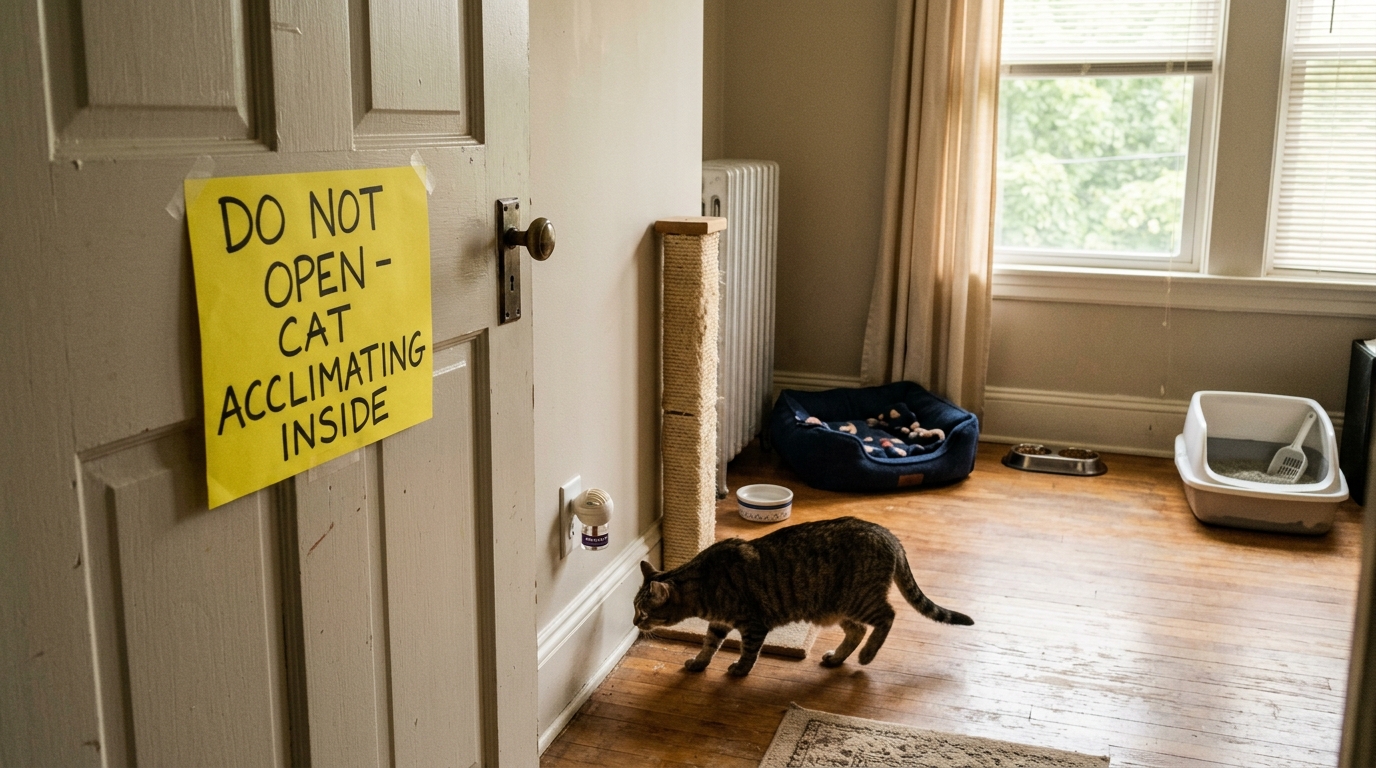
- Feline Guest Sanctuary Preparation: Plug in an F3 synthetic feline facial pheromone diffuser 48 hours before hosting guests and move your cat’s litter box, water fountain, and carrier into a locked quiet bedroom before the first guest rings.
Strict Rule S1 Clinical Red Flags: Doorbell Acoustic Startle, Territorial Entryway Reactivity & Visitor Greeting Management
Critical safety boundaries for Canine & Feline (Canis lupus familiaris & Felis catus — Multi-Pet & Busy Households) caregivers:
- Zero Bark Collars (Citronella, Ultrasonic, or Electric Shock) at the Front Door: Never place a shock, vibration, or citronella spray bark collar on a dog that barks at visitors; when a dog sees a visitor and receives an aversive shock or blast of spray, the dog associates the pain directly with the arriving guest, rapidly escalating territorial barking into severe human-directed bite aggression.
- Zero Forced Holding of Pets for Children to Hug or Pet: Never hold a dog by the collar or restrain a cat in your lap so a visiting child can pet or hug them; removing the animal’s ability to walk away removes its safety valve and is a primary trigger for pediatric facial dog bites.
Clinical Preparation & Biosecurity Action Checklist
- Install a sturdy walk-through metal pet gate across the interior hallway leading to your front door to create a permanent double-barrier air-lock.
- Post a polite “Do Not Knock or Ring — Please Text/Leave Packages” weatherproof placard over the doorbell while conducting acoustic desensitization.
- Keep a sealed “Visitor Emergency Jar” of shelf-stable freeze-dried meat treats on a shelf beside the mat Station so every knock is immediately paired with a scatter.
- Text your household greeting rules (“Please ignore the dog—no eye contact, talking, or reaching—for the first 5 minutes”) to visitors before they arrive.
Related Clinical Guides & Triage Protocols
Peer-Reviewed Clinical References & Evidence Grounding
- Human directed aggression in domestic dogs: behavioral contexts, stranger approach, and punishment-induced escalation (opens in new tab) (Applied Animal Behaviour Science (2014) — Peer-reviewed study by Herron, Shofer & Reisner indexed on NCBI PubMed (PMID: 24299544).)
- Environmental stressors and visitor disruption as triggers for feline lower urinary tract signs and stress behaviors (opens in new tab) (Journal of Feline Medicine and Surgery (2017) — Peer-reviewed feline behavioral medicine study indexed on NCBI PubMed (PMID: 28438632).)
- AAHA Canine and Feline Behavior Management Guidelines: Environmental Management and Counterconditioning for Territorial Reactivity (opens in new tab) (American Animal Hospital Association clinical guidelines on safe household management.)
- AVMA Dog Bite Prevention Guidelines: Visitor Etiquette, Child Supervision, and Canine Consent Signals (opens in new tab) (American Veterinary Medical Association public health and clinical safety standards on visitor interactions.)
Source transparency
Reference mix for this guide
Source labels classify the institutional category of the references cited above.