This guide is general education for pet owners. If your pet has urgent symptoms, possible poisoning, injury, breathing trouble, collapse, severe pain, or sudden decline, contact a licensed veterinarian or local emergency service.
Dosages must be calculated by a licensed veterinarian based on species, weight, and bloodwork. Never administer human medications or self-adjust prescription doses for pets.
Editorial standard
How this guide was prepared
An emergency kit has one job: keep ordinary care and safe containment working when the household must leave quickly or services are disrupted. Build it before an alert, and separate what can stay packed from medication, refrigerated items, phones, and carriers that remain in daily use.
Clinical Quick Answer & Immediate Actions
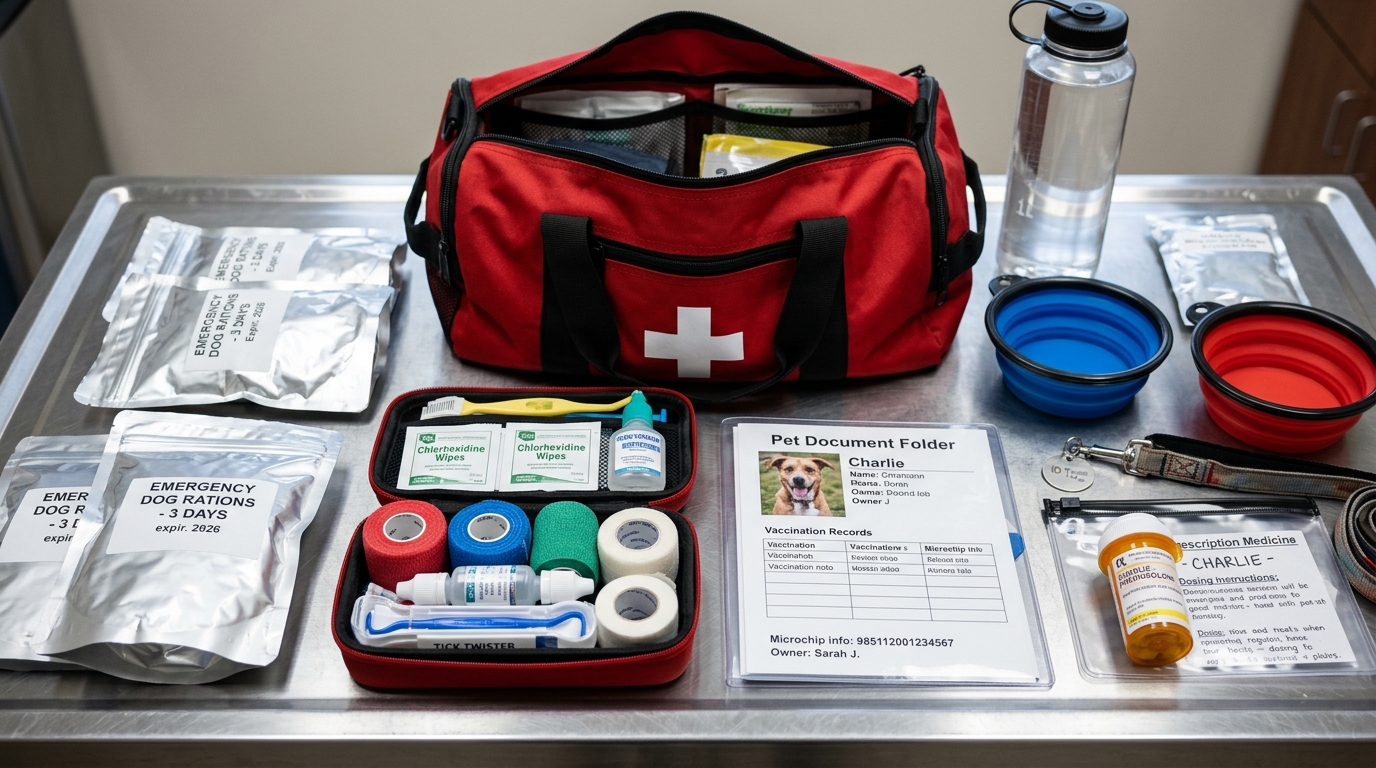
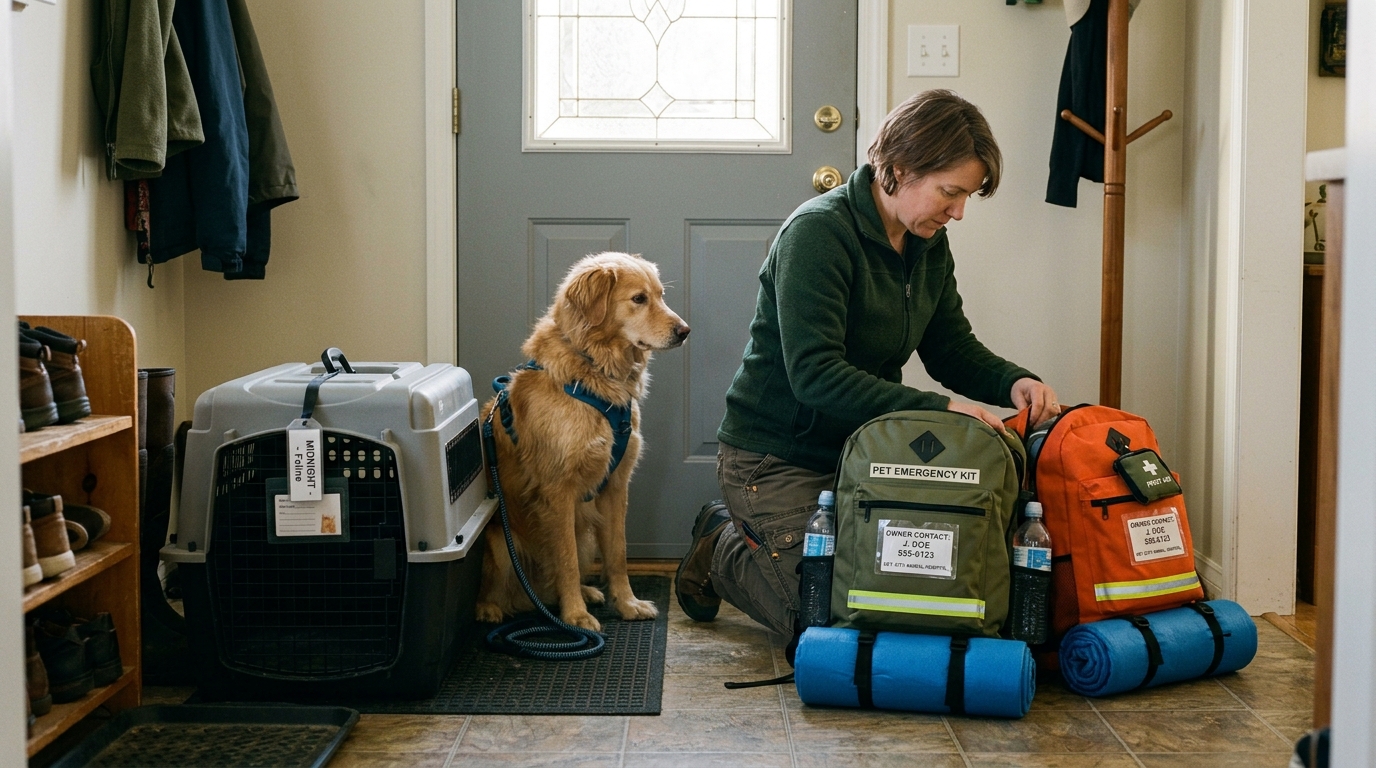
A veterinary-approved pet emergency kit ensures survival during sudden evacuations, natural disasters, and household crises. The kit combines essential sustenance (7-day food and water supply), vital medical documentation and microchip data in waterproof storage, and clinical first-aid bandaging gear organized in a grab-and-go container.
This is a preparedness plan, not a symptom guide or a treatment box. If a pet is ill or injured, contact a veterinary clinic or emergency service and follow its instructions. Do not delay that call or departure to finish packing, find every record, or make the bag complete.
Build three layers before buying extras
Start with the event each layer must survive. A compact go bag supports the first part of an evacuation. A shelter-in-place reserve supports a longer interruption at home. A daily-grab list names the essential items that cannot safely live in either container. This prevents a large disaster bin from becoming too heavy to move while the medication used every morning is left behind.
| Layer | Job | Typical contents | Owner test |
|---|---|---|---|
| Go bag | Leave within minutes and care for the pet through the first handoff or overnight stop. | Immediate food and water, bowls, waste supplies, light bedding, copies of records, contact card, spare lead, and carrier labels. | One assigned person can carry it while another moves the animal. |
| Shelter-in-place reserve | Continue routine care when roads, water, power, shops, or deliveries are interrupted. | Rotated food and water, litter, sanitation supplies, bedding, and the household’s approved medication-continuity plan. | The supply covers the locally recommended period without relying on a shop opening. |
| Daily-grab items | Collect essential items that are used, charged, refrigerated, controlled, or too bulky to duplicate. | Current medicine, phone, refrigerated product, active carrier, mobility equipment, and the pet. | A short red card on the bag lists each item and its exact location. |
Choose quantities from local emergency guidance, the number and species of animals, climate, storage space, prescription-diet needs, and realistic destination access. CDC and Ready.gov preparedness guidance includes food, water, medicine, records, identification, carriers or leads, and sanitation; it does not make one container size correct for every household.
Make the go bag fast, labeled, and physically possible
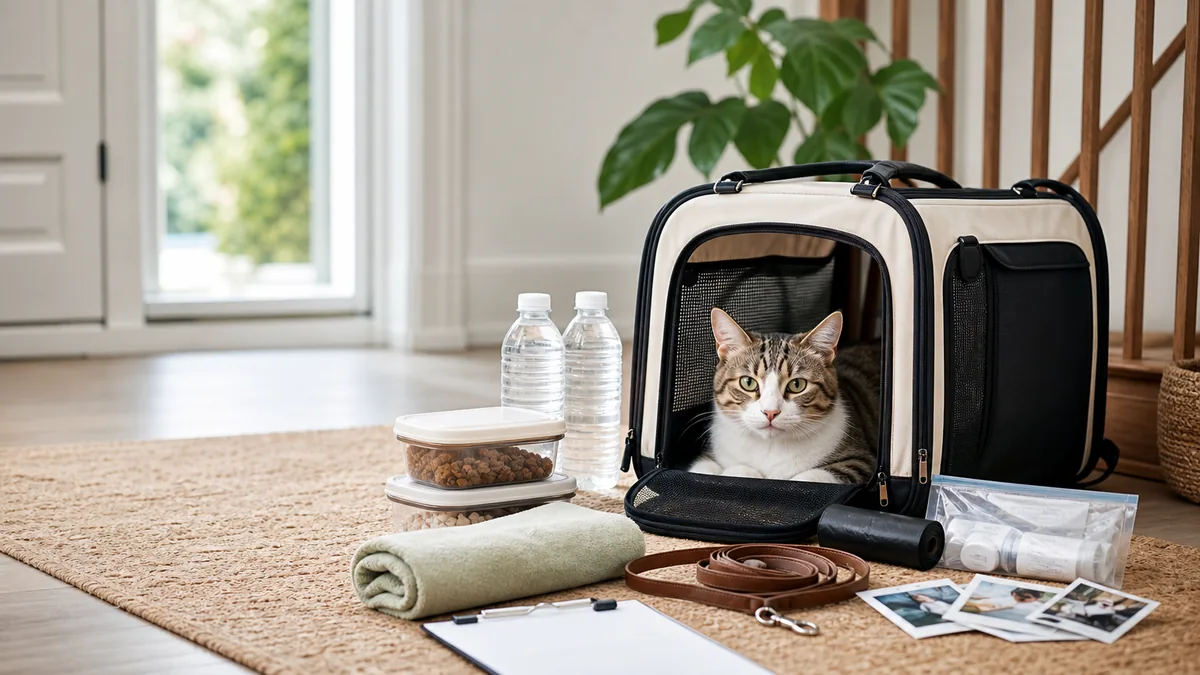
Pack the items that would be hardest to obtain during the first hours: familiar food in protected packaging, potable water, bowls, waste bags, cat litter and a compact tray, absorbent material, paper towels, a small washable comfort item, a flashlight, and a current contact card. Include a manual can opener when the food requires one. Do not add so many duplicates that the bag cannot be lifted with the pet also in hand.
Use separate, labeled inner pouches for each animal. Identify food, medication paperwork, sanitation, and records by touch or color so a caregiver does not empty the entire bag in a dark car or crowded reception area. Record the packed quantity and the date it must be replaced. Keep food protected from moisture and pests, and never leave the kit in a hot vehicle or damp shed.
Make labels readable in the conditions where the bag will be used. Put the animal’s name, species, caregiver contact, and any handling warning on the carrier and each pouch. Use large high-contrast print, a simple color or tactile mark, and a duplicate card in a waterproof sleeve. Test whether someone who did not pack the bag can identify each pouch with one hand and limited light. Do not rely on a phone or tiny type; medication details remain on the original container and current record.
Place the bag on the planned exit route without blocking that route. Households using stairs, public transport, wheelchairs, or more carriers than adults should split the load or pre-arrange help. A kit that only works when everyone and every doorway behaves perfectly has not passed its design test.
Plan sheltering in place as a supply chain
The home reserve is not merely a larger go bag. List the services your pet depends on: drinking water, refrigeration, electricity for equipment, waste disposal, prescription food, medication refills, climate control, and access to a toilet area. Then identify which disruption would end safe sheltering at home.
Store an appropriate reserve of the pet’s usual food and water and rotate it through normal use. Keep litter, pads, waste bags, cleaning material, and sealed waste storage suitable for the number of animals. If a medicine, food, or device depends on refrigeration or power, ask the prescribing clinic or manufacturer for a written storage and outage plan; do not invent a temperature workaround during the emergency.
Keep the reserve above likely flood level and away from heat, chemicals, and pests. Mark the earliest expiry where it can be seen without opening every container. The decision to remain at home still follows local evacuation orders, building conditions, and the needs of people in the household; owning supplies is not evidence that the location is safe.
Protect daily medication without repacking it unsafely
Keep prescription products in original labeled containers. The kit should hold a current medication record with the animal’s name, product and strength, label directions, prescribing clinic, pharmacy, storage requirement, refill information, allergies, and the clinic-approved plan for disruption. It should not hold loose unidentified tablets or rewritten doses.
Ask the clinic in advance how much backup supply can legally and safely be maintained, how early refills can be requested, and what to do if access, refrigeration, a dose, or a destination changes. Do not change the amount, interval, route, formulation, or storage condition without veterinary direction. Put the active container’s location on the daily-grab card and assign one person to collect it.
For multiple animals, separate each medication record and include a clear photograph or physical description so a substitute caregiver cannot confuse patients. Add written authority for the person permitted to discuss care or approve treatment when the owner is unreachable, subject to local clinic and legal requirements.
Carry records that work when the phone does not
Keep a waterproof paper set and a secure digital copy available from another device. Include recent photographs, microchip number and registry contact, vaccination or health records relevant to local facilities, regular and emergency clinic details, insurance information, medical summary, diet, handling cautions, and ownership or caregiver authorization where applicable.
Use a one-page summary at the front. A shelter or clinic should not have to search years of records to find current medicine, a major condition, the owner’s contact, or the animal’s identity. Date the summary and remove superseded pages. Protect sensitive information: carry what supports identification and care rather than exposing an entire unfiltered record on the outside of a carrier.
Check microchip and tag contacts after a move or phone-number change. Printed photos remain useful when a battery, network, or login fails. Include one photo showing the pet with the owner when proof of relationship could help after separation.
Assign containment and movement animal by animal
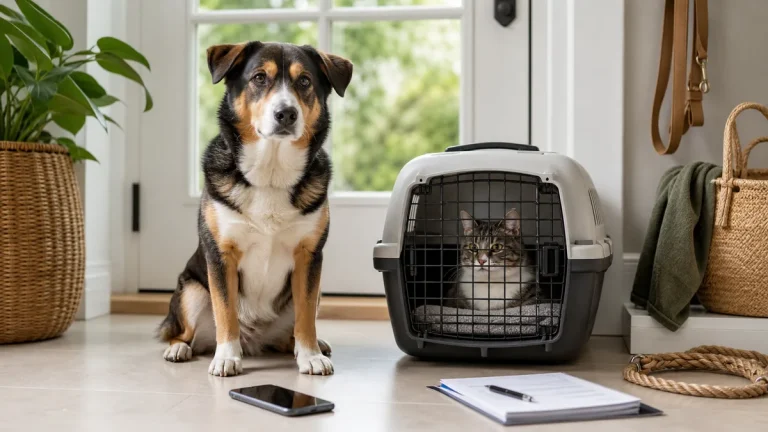
Every cat and small dog needs a secure, ventilated carrier that closes correctly. Larger dogs need an intact lead and well-fitting collar or harness plus a defined vehicle or evacuation containment plan. Multi-pet households should not assume animals that share space calmly at home can share one carrier under alarm, crowding, smoke, or unfamiliar handling.
Label each carrier without blocking ventilation. Inspect doors, latches, zips, handles, anchor points, leads, and identification. Store a towel or light bedding that adds traction and familiar scent without creating overheating or crowding. Assign who closes each room, attaches each lead, loads each carrier, carries the go bag, and checks the final head count.
Practice voluntary carrier entry and calm movement before a crisis. The drill is about access and equipment, not forcing a frightened animal through repeated rehearsals. If handling, mobility, respiratory, or behavior needs make ordinary containment difficult, arrange a veterinarian-informed or qualified behavior plan in advance.
Verify destinations instead of assuming pets are accepted
List several destinations outside the immediate hazard area: official shelters, hotels, friends or family, boarding facilities, and veterinary facilities. For each, record the current phone number, route, species and number limits, size or breed rules, required documents, fees, owner-access rules, and whether animals remain with owners. Recheck during an actual event because capacity and policy can change.
A general pet-friendly label does not answer whether the destination can accept two cats, a large dog, an assistance animal, an animal using refrigerated medicine, or a pet that cannot be housed near others. Identify a backup if roads close, a site fills, people and pets are separated, or the household needs accessible transport. Ready.gov and Red Cross preparedness guidance specifically encourage planning where pets can go because many public shelters and facilities have limits.
Store destination information offline and include one out-of-area contact who can coordinate when local networks are overloaded. Keep the go bag useful across several destinations; do not rely on one hotel, route, or shelter remaining available.
Rotate supplies and run a timed drill
Review the kit at least on a regular household schedule and after any move, new animal, diagnosis, medication change, diet change, carrier replacement, or contact change. Food, water, batteries, records, medication planning, latches, labels, and destination details age at different rates, so write an individual next-check date for each rather than trusting one distant annual reminder.
- Read the daily-grab card and collect only those items without opening the prepared pouches.
- Secure every animal in its assigned containment and complete a visual head count.
- Move animals and bags through the primary exit to the vehicle or agreed assembly point.
- Repeat with the backup exit or transport plan.
- Record time, blocked routes, hiding behavior, excessive weight, missing keys, failed latches, poor carrier fit, and vehicle-space conflicts.
- Correct the plan, replace anything used, and set the next review date.
Run one drill against a likely disruption, not just a clear-day exit. For a summer power outage, test water, carrier access, cooling, and clinic-approved storage instructions without leaving medicine in a hot car. For a winter storm or flooded route, test the backup exit, transport, and destination contact. Record any missing safe temperature, charging point, accessible vehicle, or pet-accepting destination as a stop decision and correct it before the next review.
A drill passes when the household can account for every animal, move the required load, and reach the next safe step without improvising essential roles. Speed alone is not the goal. Stop if an animal becomes highly distressed and redesign the preparation rather than turning practice into a struggle.
When to contact a veterinarian: the kit yields to triage
The kit does not determine whether a new sign, injury, or exposure is urgent. The medical disclaimer explains this guide’s limits; contact a veterinary clinic or emergency service for symptom decisions. Follow the clinic’s instructions even when that means leaving without optional supplies.
Do not give an unapproved product, induce vomiting, apply a treatment, or delay transport because an item in the bag appears relevant. Records and packaging can help only when they are already accessible and collecting them causes no delay. Preparation serves triage; it never competes with it.
Clinical Practice Tool: Pet Emergency Kit Checklist
Assemble and audit your household evacuation grab-and-go bag using our complete, free printable Pet Emergency Kit Checklist for dogs and cats. Download and print your copy of the Pet Emergency Kit Checklist, or explore all practical pet care guides in the NewsPet Resource Center.
Frequently Asked Questions
What critical medical items must be included in a pet emergency disaster kit?
Include a 14-day supply of daily medications, printed medical and rabies certificates, digital copies of microchip numbers, sterile bandages, antiseptic wash, saline eye rinse, an extra harness/leash, and a muzzle.
How much drinking water should be stored for pets in an emergency supply?
Store at least 1 gallon of water per pet per day for a minimum 72-hour period (ideally a 7-day supply), keeping water in clean food-grade containers away from direct heat and chemical vapors.
Why should caregivers pack a photographic printout of themselves with their pet?
In disaster evacuation shelters, photographic proof of ownership showing you alongside your pet verifies custody and facilitates reunification if you become separated during evacuations.
Sources
Sources checked: September 8, 2026.
- CDC: Build a Pet Disaster Preparedness Kit
- CDC: Be Prepared: Pet Safety in Emergencies
- Ready.gov: Prepare Your Pets for Disasters
- American Red Cross: Pet Disaster Preparedness and Recovery
- AVMA: Pets and Disasters Emergency Planning
Emergency Triage Matrix: Clinical Presentation & Required Response
| Triage Level | Clinical Signs & Presentation | Immediate Action Protocol |
|---|---|---|
| Tier 1: Acute Disaster Evacuation | Immediate environmental threat (wildfire, hurricane, flash flood, structural damage, toxic chemical spill) requiring rapid evacuation with full mobile survival gear. | Secure pets in rigid carriers or leashes, grab pre-packed emergency kit, and evacuate immediately to designated pet-friendly disaster shelters. |
| Tier 2: Home Shelter-in-Place Disruption | Severe weather or municipal utility failure resulting in prolonged power, water, or heating outages (> 48 hours) while sheltering in place at home. | Deploy potable water reserves, utilize battery-operated thermal blankets or cooling wraps, and maintain chronic prescription medication schedules. |
| Tier 3: Routine Maintenance & Refresh | Scheduled semi-annual emergency kit audit, checking medication expiration dates, food freshness, and updating vaccination and microchip documentation. | Rotate food and water supplies every 6 months, verify microchip contact details in national registries, and inspect first-aid materials for seal integrity. |
Rule S1 Boundaries & Emergency Preparedness Safety Rules
Emergency supplies must be curated safely to prevent medication errors and toxic contamination during crises:
- NEVER store or administer expired prescription medications: Antibiotics and liquid pharmaceuticals undergo chemical degradation over time, losing therapeutic efficacy and forming nephrotoxic breakdown products.
- NEVER include human over-the-counter pain relievers in a pet kit: Stowing human NSAIDs or acetaminophen alongside pet supplies risks catastrophic dosing errors during high-stress evacuation situations.
- NEVER rely on improvised duct tape or electrical tape for bandaging: Non-medical industrial adhesives cause severe epidermal skin tearing, lack elasticity, and induce circumferential tissue ischemia.
- NEVER leave pets unsecured in evacuation shelters or vehicles: Displaced, terrified animals frequently bolt when startled; sturdy carriers for cats and escape-proof harnesses for dogs are mandatory.
Master Pet Emergency & Evacuation Packing Checklist
- 7-Day Food & Water Supply: sealed dry kibble or pop-top canned food, manual can opener, collapsible bowls, and 1 gallon of potable water per pet per day.
- Waterproof Document Pouch: copies of vaccination certificates, rabies tags, microchip numbers with registry phone lines, and veterinary medical records.
- Prescription Medications: 2-week supply of essential maintenance medications (insulin, cardiac drugs, seizure medications) clearly labeled with dosing instructions.
- Veterinary First-Aid Gear: sterile gauze pads, self-adherent cohesive wrap (Vetrap), medical adhesive tape, blunt bandage scissors, digital thermometer, and saline flush.
- Restraint & Transport Equipment: sturdy, well-ventilated carrier for each cat, nylon slip leash and basket muzzle for dogs, and recent printed photos of pet with owner.
Related Clinical Guides & Tools
Peer-Reviewed Clinical References & Evidence Grounding
- PMID: 28985897: Head Trauma (Vet Clin North Am Small Anim Pract, 2018) (opens in new tab)
- PMID: 34059256: Working Dog Dentistry (Vet Clin North Am Small Anim Pract, 2021) (opens in new tab)
- PMID: 41319038: 2025 FelineVMA feline oral health and dental care guidelines (J Feline Med Surg, 2025) (opens in new tab)
- Cornell Feline Health Center — Veterinary Clinical & Diagnostic Resources (opens in new tab)
Printable tools
Download the matching worksheet
Source transparency
Reference mix for this guide
Source labels describe the type of organization behind each reference; they are not a claim that any outside organization reviewed this article.
- CDC: Build a Pet Disaster Preparedness Kit Government or public agency · cdc.gov
- CDC: Be Prepared: Pet Safety in Emergencies Government or public agency · cdc.gov
- Ready.gov: Prepare Your Pets for Disasters Government or public agency · ready.gov
- American Red Cross: Pet Disaster Preparedness and Recovery Animal welfare nonprofit · redcross.org
- AVMA: Pets and Disasters Emergency Planning Veterinary organization · avma.org
- Puppy Socialization Without Overwhelm: A Vet-Safe Reference source · newspet.net
- Dog Body Language Chart: 9 Stress Signs Before a B Reference source · newspet.net
- Reward-Based Dog Training: Force-Free Steps & Reference source · newspet.net