This guide is general education for pet owners. If your pet has urgent symptoms, possible poisoning, injury, breathing trouble, collapse, severe pain, or sudden decline, contact a licensed veterinarian or local emergency service.
Editorial standard
How this guide was prepared
Canine dystocia—defined as the inability of a pregnant bitch to expel neonates through the birth canal without external assistance—is one of the most time-critical obstetrical and surgical emergencies in veterinary medicine. Normal whelping progresses smoothly through coordinated hormonal cascades and myometrial contractions. However, when dystocia develops, both maternal and neonatal lives hang precariously in the balance. Fetal mortality escalates exponentially with every passing hour of obstructed labor, as placental gas exchange fails, umbilical cords become compressed, and amniotic fluid becomes contaminated with meconium. Furthermore, prolonged obstructed labor subjects the dam to catastrophic complications, including uterine rupture, massive internal pelvic hemorrhage, hypocalcemia (eclampsia), and overwhelming systemic sepsis. Recognizing the clinical thresholds that distinguish normal labor from obstructive dystocia is essential to ensure immediate life-saving surgical intervention.
Quick Answer: Identifying a Whelping Emergency (Dystocia)
If your pregnant dog experiences strong, continuous abdominal contractions for more than 30 minutes without producing a puppy, or if more than 2 hours elapse between puppies with weak or absent straining, she is in dystocia. The appearance of dark green or blackish vaginal discharge (uteroverdin) BEFORE the first puppy is born is an absolute red-flag emergency indicating premature placental detachment and fetal oxygen deprivation. Transport the mother immediately to a 24-hour veterinary hospital for emergency ultrasound fetal heart rate assessment and probable emergency Cesarean section (C-section).
The Three Stages of Normal Canine Labor
To accurately identify pathological labor, caregivers must understand the physiological stages of canine parturition:
Stage 1 (Cervical Dilation): Lasting 6 to 12 hours (occasionally up to 24 hours in first-time mothers), progesterone levels plunge, causing the cervix to soften and dilate. The dam displays marked restlessness, panting, shivering, anorexia, vomiting, and vigorous nesting behavior. A reliable physiological indicator is a transient drop in rectal body temperature below 99.0°F (often reaching 97.0°F to 98.0°F) occurring roughly 24 hours before active labor begins.
Stage 2 (Active Expulsion of Puppies): Strong, visible myometrial and abdominal wall contractions actively push puppies through the pelvic canal. A normal puppy is typically delivered within 10 to 30 minutes of strong straining. Puppies are delivered head-first (anterior presentation) in approximately 60 percent of births and tail-first (posterior presentation) in 40 percent; both presentations are completely normal.
Stage 3 (Placental Expulsion): Expulsion of fetal membranes and placentas typically occurs within 5 to 15 minutes following each puppy, although dams may occasionally deliver two puppies followed by two placentas. Stage 2 and Stage 3 alternate until the entire litter is delivered.
Clinical Emergency Triage Matrix
| Triage Tier | Clinical Presentation | Required Action |
|---|---|---|
| Tier 1: Immediate Obstetrical Emergency (0-1h) | Dark green (uteroverdin) discharge before the birth of the first puppy; strong, violent abdominal straining for >30 minutes without delivering a fetus; puppy visibly stuck in the vulva for >15 minutes; foul-smelling purulent discharge; maternal collapse or seizures (eclampsia). | Call the emergency hospital immediately to prepare the surgical suite and neonatal incubator. Transport mother gently on clean towels. Immediate ultrasound fetal heart rate evaluation, IV catheterization, and emergency C-section required. |
| Tier 2: Urgent Labor Arrest (1-3h) | More than 2 to 3 hours have elapsed since the last puppy was delivered, and known puppies remain in utero (confirmed by X-ray); mother is resting quietly with weak or absent contractions (secondary uterine inertia). | Proceed directly to an emergency veterinary clinic. Digital vaginal examination and abdominal radiography are required to assess fetal positioning and determine if medical management (IV calcium/oxytocin) or surgery is indicated. |
| Tier 3: Normal Parturition Progress (Normal Nursing) | Puppies born every 20 to 60 minutes; mother bright, cleaning pups vigorously, and nursing comfortably; clear to light red lochia discharge; normal maternal respiration between deliveries. | Continue monitoring from a quiet, respectful distance in a warm room (75-80°F for neonates). Ensure all puppies latch onto nipples and keep an accurate record of birth times and delivered placentas. |
Dangerous Home Pitfalls: What NOT to Do (Rule S1)
- NEVER administer oxytocin or calcium injections at home: Oxytocin is a powerful myometrial stimulant. If administered when a puppy is oversized, malpositioned, or physically wedged in the pelvic canal, the violent contractions will rupture the uterine wall, causing catastrophic maternal internal hemorrhage and fetal demise. Oxytocin must only be administered by a veterinarian after obstructive dystocia is ruled out by radiography.
- NEVER pull forcefully on a stuck puppy by a single leg or tail: Pulling on a single limb dislocates joints, fractures delicate bones, or avulses spinal nerves. If a puppy is partially delivered, apply gentle, steady traction in a downward arc toward the mother’s hocks ONLY during an active maternal contraction, using a clean warm cloth around the puppy’s ribcage.
- NEVER apply petroleum jelly, oils, or household lubricants inside the vagina: Non-sterile household lubricants introduce dangerous bacterial pathogens, trigger acute chemical vaginitis, and interfere with surgical sterile fields if emergency laparotomy is required. Use only sterile, water-soluble medical lubricants.
- NEVER let a stalled labor continue overnight: Caregivers often assume a resting mother will simply resume labor in the morning. Leaving puppies trapped in an inert uterus overnight guarantees 100 percent neonatal mortality and results in maternal toxic shock from decomposing fetal tissue.
Etiology: Maternal Inertia vs Fetal Obstruction
Veterinary obstetrics categorizes dystocia into maternal or fetal etiologies:
Maternal Causes (Uterine Inertia): Uterine inertia—the failure of the uterine muscle to contract with sufficient force—accounts for over 75 percent of maternal dystocia cases. In Primary Uterine Inertia, the myometrium fails to initiate strong labor, often due to an exceptionally small litter (one or two puppies failing to produce sufficient hormonal signals), an excessively large litter causing overstretching of the uterine wall, or metabolic hypocalcemia. In Secondary Uterine Inertia, the uterine muscle becomes exhausted after successfully delivering several puppies against prolonged resistance.
Fetal Causes (Fetopelvic Disproportion & Malposition): Fetal causes arise when the fetus is physically too large to pass through the maternal pelvic canal. This is extraordinarily prevalent in brachycephalic breeds (such as English Bulldogs, French Bulldogs, and Boston Terriers), where broad, flattened fetal skull conformations routinely exceed maternal pelvic dimensions, resulting in mandatory elective C-section rates approaching 80 to 90 percent. Fetal malpositions—such as transverse presentations, lateral neck flexion, or simultaneous engagement of two puppies in the pelvic brim—create complete mechanical impaction.
Frequently Asked Questions
What does green discharge (uteroverdin) mean during whelping?
Uteroverdin is a dark green pigment produced by the marginal hematomas of the canine zonary placenta. Its appearance indicates that the placenta has physically separated from the uterine wall. If green discharge appears AFTER a puppy has been delivered, it is completely normal. However, if green or dark blackish discharge appears BEFORE the first puppy is born, it indicates premature placental separation; the unborn puppy has lost its maternal oxygen supply and will suffocate within 1 to 2 hours unless delivered immediately.
How does a veterinarian determine if a Cesarean section is needed?
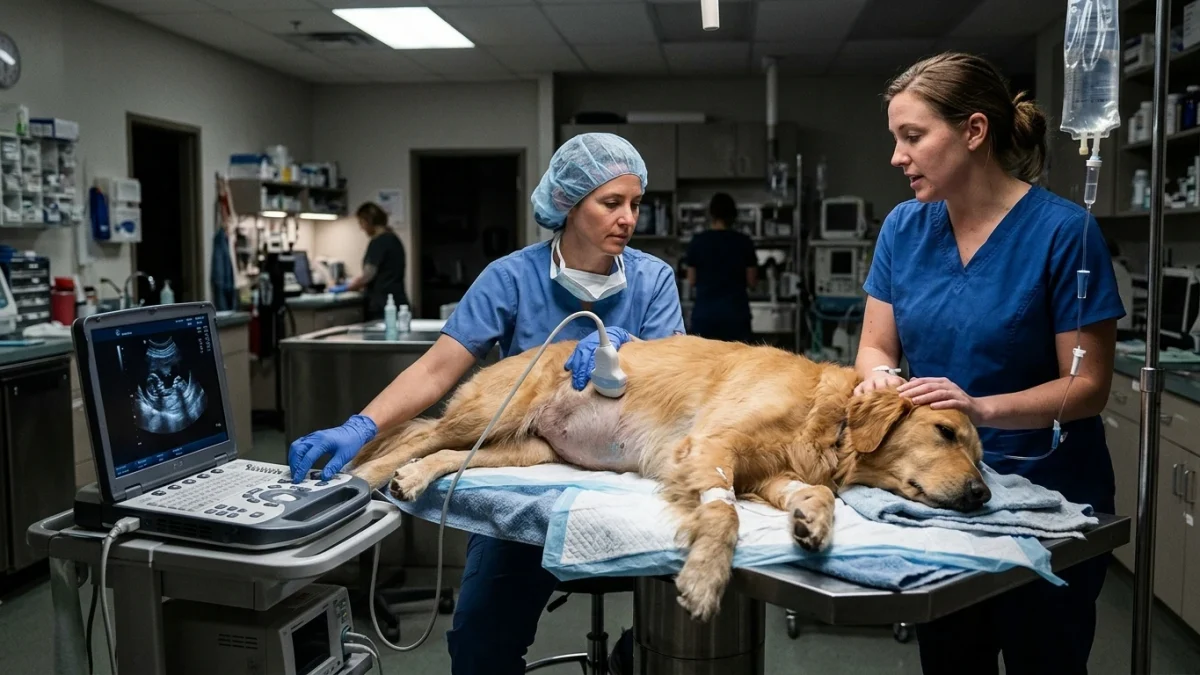
The veterinarian performs point-of-care abdominal ultrasonography to assess fetal viability and measure fetal heart rates. Normal fetal heart rates range between 180 and 220 beats per minute. A fetal heart rate dropping below 160 bpm indicates moderate fetal distress, while a heart rate under 140 bpm signals severe hypoxia and demands immediate emergency surgical Cesarean delivery. Digital pelvic examination and radiography also verify if a puppy is physically obstructed in the birth canal.
What is postpartum eclampsia (milk fever)?
Eclampsia is an acute, life-threatening metabolic emergency caused by severe hypocalcemia (calcium depletion) resulting from heavy lactation, most commonly seen in small-breed dogs nursing large litters 1 to 4 weeks postpartum. Signs include stiff gait, facial rubbing, severe muscle tremors, restlessness, panting, and seizures. Treatment requires emergency, slow intravenous administration of calcium gluconate under continuous electrocardiographic monitoring.
Scientific Sources and Literature
- Bergström A, et al. “Incidence and breed predilections of dystocia and risk factors for cesarean section in 182,342 insured Swedish bitches.” Journal of the American Veterinary Medical Association. PMID: 26031465
- Traas AM. “Surgical management of canine and feline dystocia: Cesarean section and ovariohysterectomy.” Veterinary Clinics of North America: Small Animal Practice. PMID: 30129210
- Lopate C. “Estimation of gestational age and assessment of canine fetal maturation and viability using ultrasonography.” Theriogenology. PMID: 28987145
Caregiver Emergency Whelping Action Checklist
- Record labor milestones: track exact times of temperature drop, onset of active straining, and birth of each puppy.
- Inspect discharge color: alert the veterinarian immediately if dark green discharge appears before puppy #1.
- Monitor contraction intensity: calculate minutes of active straining; if continuous hard pushing exceeds 30 minutes without a pup, stop waiting.
- Never inject oxytocin or calcium at home; avoid catastrophic uterine rupture.
- If a puppy is lodged, gently support it with a warm cloth and guide downward only during an active contraction.
- Transport mother and already-delivered puppies in a warm, padded, draft-free crate to an emergency veterinary hospital.
Source transparency
Reference mix for this guide
Source labels describe the type of organization behind each reference; they are not a claim that any outside organization reviewed this article.
- Dog Pyometra & Uterine Infection Triage Reference source · newspet.net
- Kitten Diarrhea & Fading Syndrome Emergency Reference source · newspet.net
- Dog Bleeding Wound & Hemorrhage First Aid Reference source · newspet.net
- Dog Shaking & Lethargic Differential Triage Reference source · newspet.net
- PMID: 26031465 Government or public agency · pubmed.ncbi.nlm.nih.gov
- PMID: 30129210 Government or public agency · pubmed.ncbi.nlm.nih.gov
- PMID: 28987145 Government or public agency · pubmed.ncbi.nlm.nih.gov