This guide is general education for pet owners. If your pet has urgent symptoms, possible poisoning, injury, breathing trouble, collapse, severe pain, or sudden decline, contact a licensed veterinarian or local emergency service.
Dosages must be calculated by a licensed veterinarian based on species, weight, and bloodwork. Never administer human medications or self-adjust prescription doses for pets.
Editorial standard
How this guide was prepared
Canine pyometra is a severe, life-threatening bacterial infection of the uterus that predominantly afflicts unspayed adult and geriatric female dogs during the luteal (metestrus or diestrus) phase of their reproductive cycle. Following estrus (heat), prolonged exposure to elevated circulating progesterone induces cystic endometrial hyperplasia, stimulates uterine gland secretions, and inhibits local myometrial contractility. Concurrently, progesterone exerts a potent immunosuppressive effect within the reproductive tract. This altered physiological environment permits ascending opportunistic bacteria—most commonly Escherichia coli originating from the normal perineal and colonic microflora—to colonize the uterine horns. As bacterial proliferation accelerates, purulent exudate accumulates, releasing massive quantities of lipopolysaccharide endotoxins into systemic circulation and culminating in severe endotoxemia, immune complex glomerulonephritis, and septic shock.
Quick Answer: Identifying a Canine Pyometra Emergency
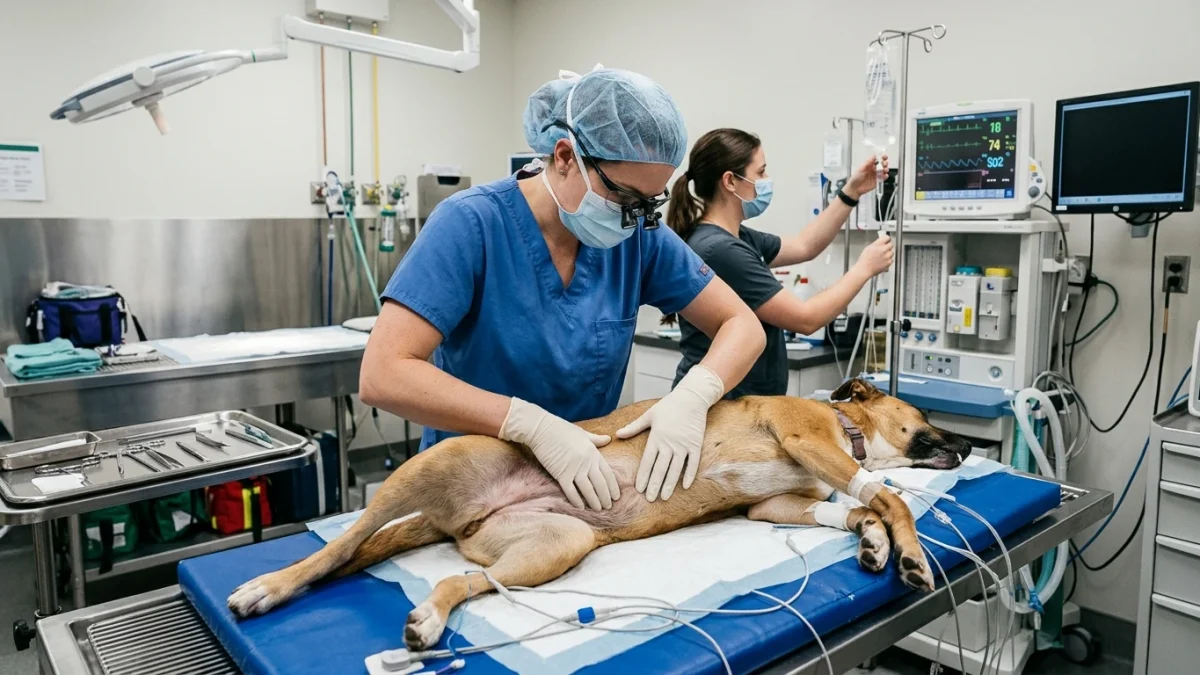
If an intact (unspayed) female dog becomes severely lethargic, drinks excessive amounts of water, vomits, or displays foul-smelling creamy or bloody discharge from her vulva roughly 2 to 8 weeks after her heat cycle, suspect pyometra immediately. In “closed pyometra”—where the cervix remains tightly shut—no discharge is visible, but the dog exhibits rapid abdominal distension, severe pain, and circulatory collapse. Emergency ovariohysterectomy (surgical removal of the infected uterus and ovaries) combined with intravenous fluid resuscitation is the gold standard, life-saving cure.
Differentiating Open vs Closed Pyometra: The Critical Prognostic Factor
Veterinary emergency clinicians classify pyometra into two primary presentations based on cervical patency:
Open-Cervix Pyometra: When the cervical canal remains relaxed and patent, accumulated purulent exudate continuously drains from the uterus through the vagina. Caregivers typically notice copious foul-smelling, purulent, reddish-brown, or creamy discharge staining the dog’s fur, bedding, or flooring. Although open pyometra remains a serious systemic infection, the ongoing drainage prevents catastrophic intrauterine pressure buildup, providing a slightly wider diagnostic window for planned emergency stabilization.
Closed-Cervix Pyometra: When the cervix remains tightly closed, purulent exudate is entirely trapped within the expanding uterine horns. Because there is no external discharge, caregivers frequently fail to recognize the reproductive origin of the illness until the dog reaches advanced septic shock. As the infected fluid volume escalates, the uterine walls stretch paper-thin. Bacterial endotoxins rapidly enter the bloodstream, producing acute fever or subnormal temperature, persistent vomiting, severe dehydration, and extreme lethargy. Without immediate surgical decompression, the uterine wall undergoes ischemic necrosis and ruptures into the abdominal cavity.
Clinical Emergency Triage Matrix
| Triage Tier | Clinical Presentation | Required Action |
|---|---|---|
| Tier 1: Immediate Critical Emergency (0-2h) | Intact female dog with severe abdominal distension, collapse, or inability to rise; pale dry gums with prolonged capillary refill time (>2 seconds); persistent vomiting; hypothermia (<99.0°F) or high fever (>103.5°F); no discharge visible (closed pyometra suspicion). | Call the emergency hospital immediately to prepare the surgical theater and intensive care unit. Transport the dog gently without abdominal pressure. Immediate IV catheterization, crystalloid volume expansion, and emergency exploratory laparotomy required. |
| Tier 2: Urgent Veterinary Care (2-6h) | Copious foul-smelling vaginal discharge (creamy, grey, or bloody); marked lethargy and anorexia; excessive water intake (polydipsia) and frequent urination (polyuria); recent heat cycle within the past 2 months. | Proceed directly to an emergency veterinary clinic or full-service hospital for immediate abdominal ultrasound, complete blood count, and surgical scheduling. |
| Tier 3: Same-Day Clinical Evaluation (6-12h) | Mild decrease in appetite and mild lethargy in an intact female dog 4 to 8 weeks post-heat, with normal pink mucous membranes, absence of vaginal discharge, and non-painful abdomen upon gentle palpation. | Keep the dog rested indoors. Schedule an urgent outpatient veterinary visit for vaginal cytology, blood chemistry, and abdominal ultrasound to rule out early cystic endometrial hyperplasia. |
Dangerous Home Pitfalls: What NOT to Do (Rule S1)
- NEVER attempt home vaginal douching or cleansing: Introducing water, antiseptic washes, or syringes into the vaginal vault forces bacteria deeper into the cervical canal and increases the likelihood of ascending peritonitis.
- NEVER press, palpate, or squeeze the abdomen: In closed pyometra, the uterine walls are necrotic, heavily inflamed, and stretched to bursting capacity. Even gentle caregiver palpation can rupture the uterus, spilling bacterial endotoxins into the peritoneal cavity.
- NEVER administer leftover antibiotics or human medications: Oral antibiotics cannot penetrate the thick, avascular, pus-filled uterine lumen in concentrations sufficient to sterilize the organ. Delaying surgery while waiting for oral pills to work leads to fatal sepsis. Human NSAIDs or paracetamol cause lethal organ toxicity.
- NEVER assume a dog without vaginal discharge is safe: Closed pyometra is far more lethal than open pyometra precisely because the absence of visible discharge creates a false sense of security while endotoxemia silently destroys renal and cardiac function.
Endotoxemia and Systemic Complications: Why Renal Failure Occurs
The severity of pyometra stems not merely from localized uterine tissue damage, but from systemic endotoxemia. The cell walls of Gram-negative bacteria like E. coli contain lipopolysaccharides (LPS). When bacteria die and lyse inside the uterus, massive amounts of LPS enter the bloodstream. LPS binds to circulating toll-like receptors, triggering an overwhelming release of pro-inflammatory cytokines, including tumor necrosis factor-alpha (TNF-α) and interleukins.
Endotoxins directly impair renal physiology through two distinct mechanisms. First, LPS damages the antidiuretic hormone (ADH) receptors in the renal collecting tubules, rendering the kidneys incapable of concentrating urine. This produces severe, rapid nephrogenic diabetes insipidus, which explains why dogs with pyometra exhibit extreme compensatory polydipsia (excessive water drinking) and polyuria. Second, circulating antigen-antibody complexes deposit within the renal glomeruli, precipitating acute immune complex glomerulonephritis and prerenal azotemia. Without rapid surgical removal of the infected organ and IV fluid therapy, irreversible acute kidney injury ensues.
Frequently Asked Questions
Can pyometra be treated medically without surgery?
While medical protocols using prostaglandins (such as PGF2α) and progesterone-receptor blockers (aglepristone) combined with prolonged systemic antibiotics exist for valuable breeding bitches with open-cervix pyometra, medical management carries a high recurrence rate (exceeding 60 to 70 percent on subsequent cycles) and significant risk of uterine rupture. Medical management is strictly contraindicated in closed pyometra or unstable, septic patients. Emergency surgical ovariohysterectomy remains the definitive, permanent cure.
How does an emergency veterinarian confirm pyometra?
Veterinarians diagnose pyometra through point-of-care abdominal ultrasonography, which reveals fluid-filled, enlarged, convoluted uterine horns with thickened cystic walls. Concurrent complete blood counts typically show a marked leukocytosis (extremely elevated white blood cell count with a regenerative left shift) or, in overwhelming sepsis, profound leukopenia. Serum biochemistry evaluates blood urea nitrogen (BUN) and creatinine to gauge renal impairment.
Can a spayed dog ever develop pyometra?
Yes, a condition known as “stump pyometra” can occur in spayed female dogs if a portion of uterine tissue was left behind during an incomplete ovariohysterectomy, combined with residual ovarian tissue (ovarian remnant syndrome) that continues to produce progesterone. The remaining uterine stump can become infected and requires surgical excision of both the infected stump and the remnant ovarian tissue.
Scientific Sources and Literature
- Hagman R. “Pyometra in small animals: an update on clinical aspects, diagnosis, and treatment.” Veterinary Clinics of North America: Small Animal Practice. PMID: 25555431
- Jitpean S, et al. “Outcome of clinical cases of open and closed cervix pyometra in dogs treated surgically.” Acta Veterinaria Scandinavica. PMID: 30873617
- Hensel NC, et al. “Evaluation of risk factors for mortality in dogs with pyometra: 119 cases (2000-2015).” Journal of the American Veterinary Medical Association. PMID: 29938841
Caregiver Emergency Pyometra Action Checklist
- Confirm reproductive history: note the exact date of your dog’s last heat cycle (typically 2 to 8 weeks prior).
- Inspect vulva and bedding: document any foul odor, creamy pus, or reddish-brown discharge.
- Monitor drinking and urination: record excessive water consumption or frequent large-volume urination.
- Check gum color and capillary refill time: alert the veterinary clinic if gums are pale, tacky, or grayish.
- Avoid applying physical pressure to the abdomen; transport the dog using a flat blanket or supportive gurney.
- Proceed directly to a 24-hour emergency veterinary hospital equipped for blood chemistry, ultrasound, and emergency surgery.
Source transparency
Reference mix for this guide
Source labels describe the type of organization behind each reference; they are not a claim that any outside organization reviewed this article.
- Dog Shaking & Lethargic Differential Triage Reference source · newspet.net
- Dog Vomiting: Home Monitoring vs Emergency Red Flags Reference source · newspet.net
- Dog Blood in Urine & Hematuria Triage Reference source · newspet.net
- Dog Sudden Collapse & Internal Bleeding Triage Reference source · newspet.net
- PMID: 25555431 Government or public agency · pubmed.ncbi.nlm.nih.gov
- PMID: 30873617 Government or public agency · pubmed.ncbi.nlm.nih.gov
- PMID: 29938841 Government or public agency · pubmed.ncbi.nlm.nih.gov