This guide is general education for pet owners. If your pet has urgent symptoms, possible poisoning, injury, breathing trouble, collapse, severe pain, or sudden decline, contact a licensed veterinarian or local emergency service.
Editorial standard
How this guide was prepared
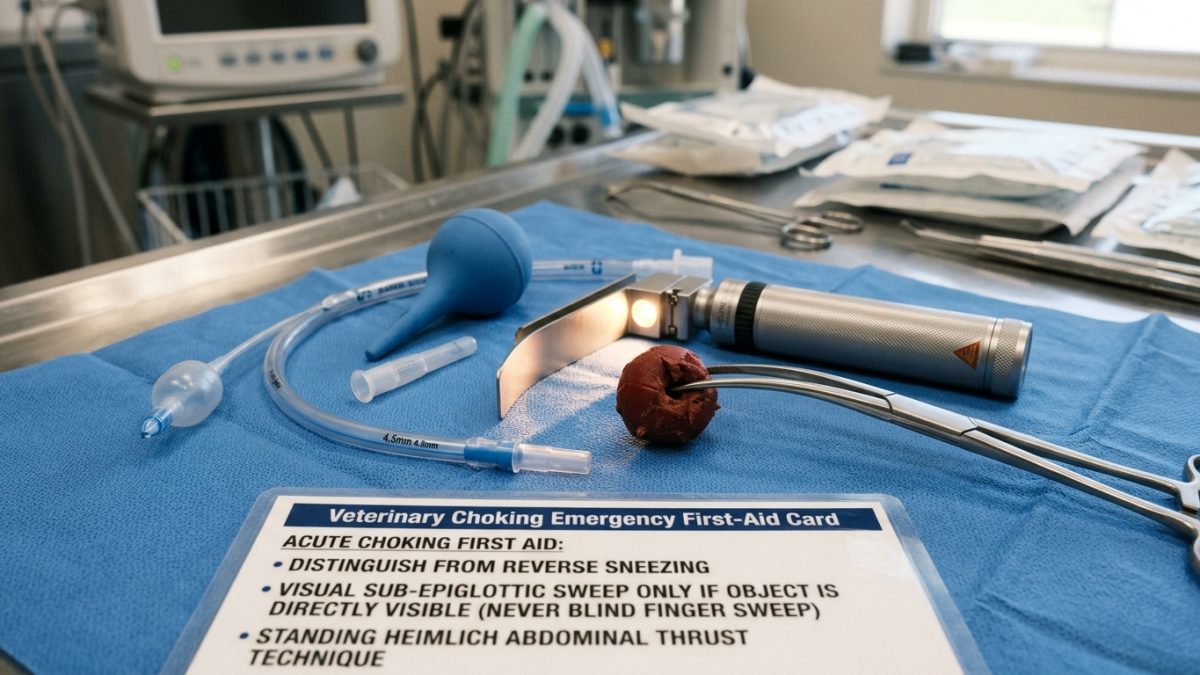
A smooth rubber ball slightly smaller than a tennis ball (such as a standard racquetball or Chuck-It small/medium ball), a piece of sticky rawhide, a round bone chunk, or a large chunk of hard kibble can lodge tightly inside a dog’s pharynx directly over the epiglottis and rima glottidis during a mid-catch inhalation—creating a complete, rapidly fatal mechanical airway seal. Because brain hypoxia causes unconsciousness within 90 to 180 seconds of total tracheal occlusion, a choking dog cannot wait for a 15-minute drive to the clinic before mechanical dislodgement is attempted. At the same time, owners must instantly distinguish true life-threatening airway obstruction from benign reverse sneezing or kennel cough—because performing vigorous abdominal Heimlich thrusts on a dog that is simply coughing or reverse-sneezing can rupture the spleen, lacerate the liver, or fracture ribs.
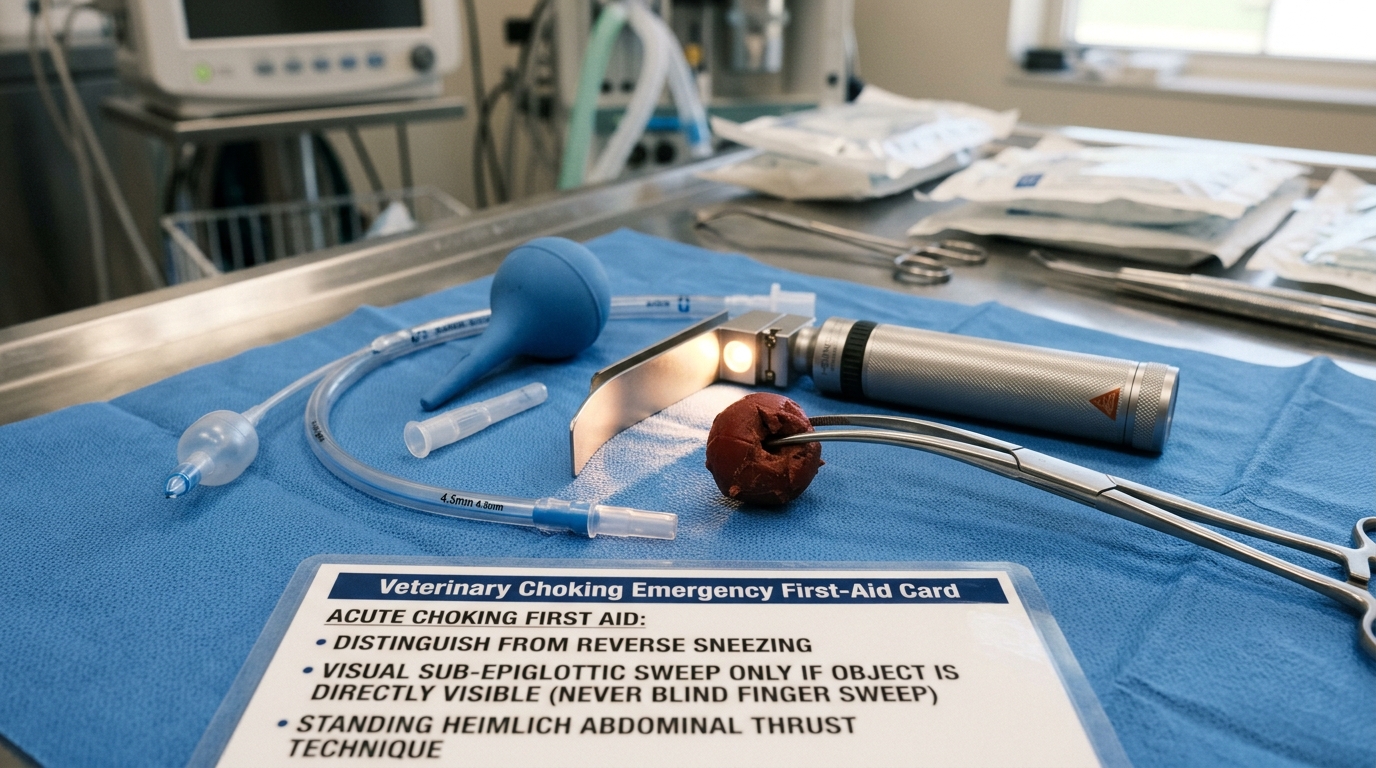
Clinical Quick Answer & Immediate Stabilization Protocol
Primary Clinical Directive for Acute Laryngopharyngeal Foreign-Body Airway Obstruction (Choking) & Post-Obstruction Pulmonary Edema: First verify true choking in 3 seconds: if the pet is making loud honking coughs or snorting through its nose with pink gums, AIR IS MOVING—do NOT perform Heimlich thrusts (transport to a vet). Perform emergency airway clearance ONLY if the pet cannot breathe or bark, is frantically pawing at its mouth, has a silent chest or high-pitched squeaking stridor, displays blue/gray (cyanotic) gums, or collapses: (1) For a Ball Wedged in the Throat—lay the dog on its back (or straddle from behind), place both thumbs externally on the outside of the neck right behind the V-angle of the lower jawbone (larynx), and push firmly UPWARD and FORWARD toward the mouth to pop the ball out like a Pez dispenser; (2) If Not a Ball / External Push Fails—lift the hind legs like a wheelbarrow (gravity inversion) and deliver 5 sharp upward-and-forward abdominal thrusts just behind the ribcage (or 5 firm interscapular back blows).
The Smooth-Ball Vacuum Seal, Hyoid Bone Anatomy & Negative-Pressure Pulmonary Edema (NPPE)
Medium-to-large dogs catching a smooth, non-porous 2-to-2.5-inch rubber ball mid-stride frequently suffer the deadliest form of canine choking. As the heavy wet ball strikes the caudal pharynx during a deep inspiratory gasp, negative intrathoracic pressure sucks the ball backward over the epiglottis into the funnel-shaped laryngopharynx. Saliva coats the rubber surface, creating an airtight suction seal. Every subsequent desperate inspiratory effort pulls the rubber sphere tighter into the laryngeal vestibule. Reaching into the mouth with fingers fails completely because wet rubber offers zero grip surface and downward finger pressure drives the ball tighter into the glottis.
Even when a caregiver successfully pops a choking object out at home within two minutes, a hidden secondary crisis frequently develops 30 minutes to 12 hours later: Negative-Pressure Pulmonary Edema (NPPE). While the pet was fighting desperately to inhale against a blocked upper airway (the Müller maneuver), extreme negative intrathoracic pressures (exceeding -50 to -100 cmH2O) physically pull fluid out of the pulmonary capillaries directly into the alveolar air spaces. Simultaneously, forceful pharyngeal trauma bruises the arytenoid cartilages and soft palate, causing progressive post-obstructive laryngeal edema that can re-close the airway hours after the ball is gone.
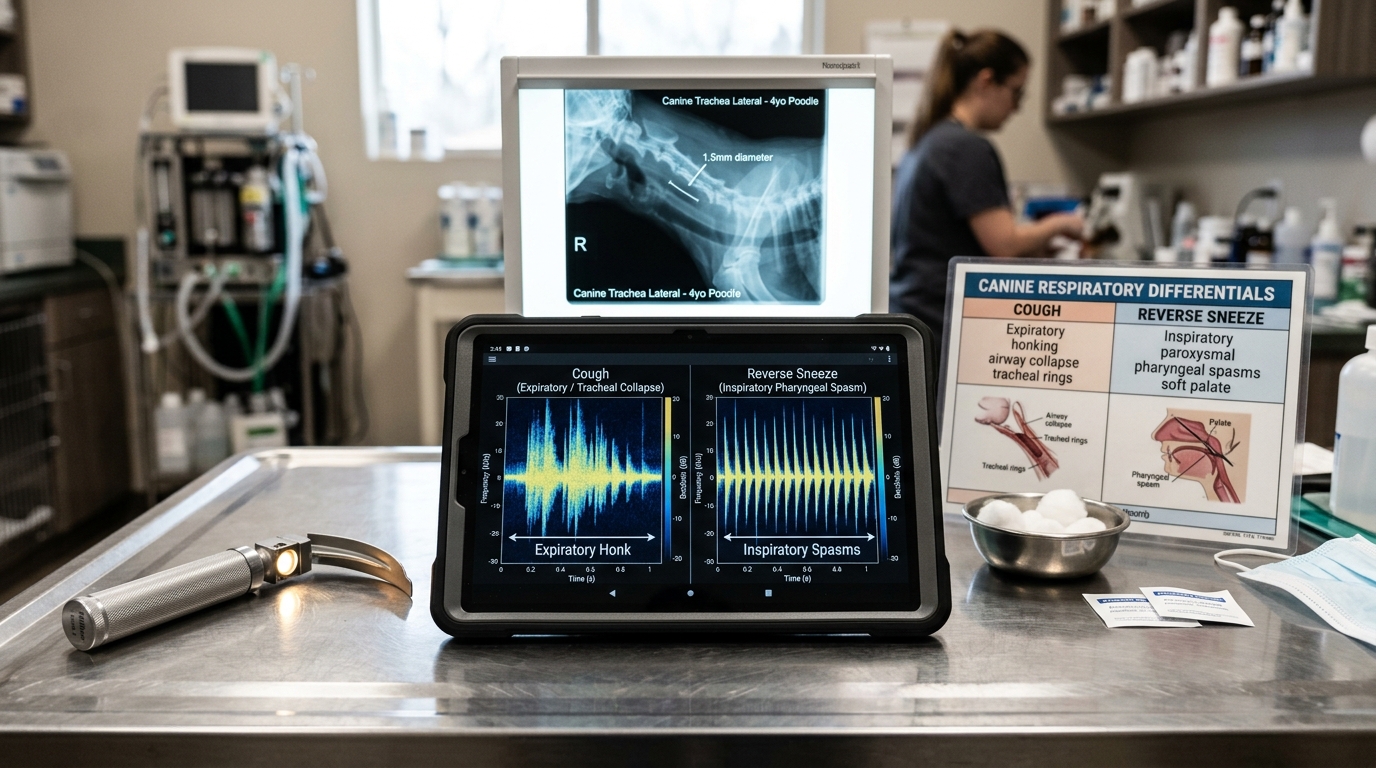
- True Choking vs. Reverse Sneezing vs. Kennel Cough: In reverse sneezing (mechanoreceptor soft-palate spasm), the dog stands with elbows wide and makes loud rapid snorting INHALATIONS through the nose with normal pink gums and returns to normal in 60 seconds; in kennel cough, the dog produces loud dry hacking EXHALATIONS ending in white foam; in true choking, the animal is panicked, silent or high-pitched stridorous, cannot swallow or bark, and turns blue (cyanotic) within 60–90 seconds.
- Why Caregivers Must Know the Hyoid Apparatus: Healthy dogs and cats possess a jointed bony framework (the hyoid apparatus) at the base of the tongue and larynx that feels like a firm wishbone or small bone deep in the throat; panicked owners doing blind finger sweeps have tragically mistaken the normal hyoid bone for a “stuck chicken bone” and pulled on it, causing fatal laryngeal avulsion.
- Why Tennis Balls Must Have Two Breathing Holes or Oversized Diameter: Standard 2.5-inch tennis balls compress easily between the molar jaws of Retrievers, German Shepherds, and Boxers and shoot straight into the throat; always use balls larger than the dog’s full jaw gape (3+ inches) with two opposing air-flow holes drilled through the core.
- Feline Linear vs. Obstructive Foreign Bodies: In cats, true tracheal choking is less common than sublingual string entanglement (sewing thread or tinsel looped under the base of the tongue), which mimics gagging/choking and requires immediate veterinary exam without ever pulling on the string.
Emergency Triage Matrix: Clinical Presentation & Required Response
| Triage Level | Clinical Signs & Presentation | Immediate Action Protocol |
|---|---|---|
| Tier 1: Complete Airway Obstruction / Cyanosis / Syncope (0–2 Minutes Immediate Action) | Pet cannot breathe, cough, or vocalize; frantically claws at mouth/neck; eyeballs bulge in terror; gums and tongue turn blue-purple or gray (cyanosis); or pet collapses unconscious. | Execute the External Two-Thumb Throat Push immediately (if a ball/chunk is palpable behind the jaw angle) followed by Wheelbarrow Inversion + 5 Abdominal Heimlich Thrusts and 5 Interscapular Back Blows; if the pet becomes unconscious and the object pops out, give 2 rescue breaths nose-to-mouth and rush to a veterinary ER. |
| Tier 2: Partial Obstruction / Post-Dislodgement Triage / Esophageal Gagging (0–1 Hour) | Object was successfully popped out at home, OR pet is breathing with pink gums while repeatedly retching, drooling blood-tinged saliva, pawing at the jaw, and refusing water after chewing a bone/stick. | Do NOT perform abdominal thrusts if the pet is breathing with pink gums; transport immediately to an emergency veterinarian for sedated oral/pharyngeal exam (checking for a bone wedged across the upper hard palate molars or esophageal entrance) and oxygen/steroid observation for NPPE. |
| Tier 3: Benign Paroxysmal Reverse Sneezing Episode | Alert dog stands still with neck extended and produces a 30-second bout of loud nasal snorting inhalations with 100% pink gums, then wags its tail and resumes normal activity. | Stroke the throat gently and briefly cover one nostril for 2 seconds to trigger a swallow reflex that resets the soft palate; monitor and film an episode for your next routine vet visit. |
Step-by-Step External Throat Push Mechanics, Modified Heimlich Thrusts & Post-Choking ICU Care
When a ball or smooth object blocks a dog’s airway, execute the External Retropharyngeal Push (developed by veterinary emergency specialists): Step 1—Lay the dog directly onto its back on the floor (dorsal recumbency, cradling its spine between your knees) or stand over a standing dog from behind if it is still upright. Step 2—Place both of your thumbs on the outside of the dog’s throat, directly in the soft hollow behind the back edge of the lower jawbone (mandible) and behind the firm lump of the larynx (where you can feel the round ball bulging). Step 3—Press both thumbs firmly INWARD and push forcefully UPWARD/FORWARD toward the dog’s nose/mouth along the jawline. This external mechanical lever pushes the underside of the ball out of the laryngeal funnel and pops it straight out of the open mouth without putting your fingers inside the jaws.
If the obstructing object is not a palpable external ball (e.g., a piece of meat, rawhide, or small toy inside a small dog or cat), use Gravity Inversion + Modified Heimlich: for a small dog or cat, hold the pet with its spine against your chest (or suspend it gently hips-up with the head pointing toward the floor), make a fist with one hand wrapped by the other hand just behind the last rib in the soft mid-abdomen, and pull sharply INWARD and UPWARD toward the spine/head 5 times—followed by 5 firm open-palm blows flat between the shoulder blades. Check the mouth after each cycle of 5 thrusts.
- Check Across the Roof of the Mouth (Hard Palate Bone Wedge): When a dog paws frantically at its mouth and drools while still breathing normally with pink gums, a flat piece of bone or stick is frequently wedged horizontally like a bridge between the upper left and right fourth premolar teeth across the roof of the mouth—requiring brief veterinary sedation to pop free safely.
- Rescue Breathing After Unconscious Obstruction Clearance: If a choking pet loses consciousness before the object is dislodged, clear the object, extend the head and neck straight, close the jaws tightly with your hands, seal your mouth over both nostrils, and blow 2 steady breaths (1 second each, watching the chest rise) at a rate of 10 to 12 breaths per minute during transport.
- Mandatory ER Visit After Successful Home Heimlich: Even if your dog seems 100% cheerful five minutes after coughing up a ball, go to the veterinary ER; forceful abdominal thrusts can cause delayed splenic hematoma rupture, and post-obstructive pulmonary edema (NPPE) causes pink frothy coughing and hypoxia 2 to 12 hours later.
- Retire Hazardous Chew Geometries Today: Discard all smooth balls under 3 inches in diameter without dual airflow holes, rawhide strips that soften into slimy plugs, and round marrow ring bones that slide over the lower jaw.
Strict Rule S1 Clinical Red Flags: Acute Laryngopharyngeal Foreign-Body Airway Obstruction (Choking) & Post-Obstruction Pulmonary Edema
Critical safety boundaries for Canine & Feline (Canis lupus familiaris & Felis catus — All Breeds & Sizes) caregivers:
- Zero Blind Finger Sweeps or Pulling on the Bony Hyoid Apparatus: Never shove your fingers blindly into the throat of a conscious choking pet or tug on hard anatomical structures deep in the pharynx; you risk severe hand bites, impacting a ball deeper into the larynx, or fracturing the hyoid bone.
- Zero Heimlich Abdominal Thrusts on a Pet That Is Actively Coughing With Pink Gums: If a dog or cat is forcefully coughing, gagging, or reverse-sneezing while maintaining pink gums, air is moving through the trachea; performing abdominal thrusts on a non-obstructed pet risks internal organ rupture and rib fractures.
Clinical Preparation & Biosecurity Action Checklist
- Test every ball in your home against the “Jaw-Gape & Dual-Hole Rule”: discard any smooth ball small enough to fit completely behind your dog’s canine teeth or lacking two pass-through air holes.
- Practice locating the external angle of your dog’s lower jaw and larynx gently during calm evening petting so you know the exact thumb position for the External Throat Push.
- Supervise 100% of edible chew sessions (bully sticks, dental chews) and use a locking bully-stick holder clamp so your dog cannot swallow the final 2-inch stub whole.
- Transport your pet to a veterinary emergency hospital after any true choking or Heimlich episode for thoracic auscultation, pulse oximetry, and abdominal screening.
Related Clinical Guides & Triage Protocols
Peer-Reviewed Clinical References & Evidence Grounding
- RECOVER evidence and knowledge gap analysis on veterinary CPR: airway obstruction management and basic life support in dogs and cats (opens in new tab) (Journal of Veterinary Emergency and Critical Care (2012) — RECOVER Consensus Guidelines by Fletcher et al. indexed on NCBI PubMed (PMID: 22691009).)
- Noncardiogenic post-obstructive (negative-pressure) pulmonary edema in dogs and cats following upper airway obstruction (opens in new tab) (Journal of Veterinary Emergency and Critical Care (2018) — Peer-reviewed clinical study indexed on NCBI PubMed (PMID: 29237530).)
- AVMA First Aid Guidelines for Pet Owners: Choking, Airway Foreign Bodies, Modified Heimlich Maneuver, and Bite Safety (opens in new tab) (American Veterinary Medical Association emergency airway triage guidelines.)
- Merck Veterinary Manual: Upper Airway Obstruction and Pharyngeal Foreign Bodies in Small Animals (opens in new tab) (Verified veterinary clinical reference on laryngeal foreign bodies, stridor triage, and post-obstructive pulmonary edema.)
Source transparency
Reference mix for this guide
Source labels classify the institutional category of the references cited above.