Editorial standard
How this guide was prepared
Bringing a newly adopted dog into a home with a resident cat—or introducing a new cat to an established canine household—carries high stakes: a single mismanaged first meeting in the living room can trigger a cat to bolt in panic, activating the dog’s hardwired predatory chase reflex (“predatory drift”) within a fraction of a second. Even dogs that lived peacefully with a confident, non-fleeing cat in a previous home can chase an unfamiliar cat that hisses and darts across the hardwood floor. Successful multi-species integration is never achieved by holding a cat in your arms and letting a dog sniff its tail on day one; it is achieved through a disciplined, multi-week protocol of olfactory familiarization, vertical escape engineering, and harnessed “Look-At-That” disengagement behind tall physical barriers.
Clinical Quick Answer & Immediate Stabilization Protocol
Primary Clinical Directive for Interspecies Predatory Drift Risk, Territorial Intrusion & Multi-Pet Integration Triage: Follow a strict 4-Phase Gate-Locked Integration Protocol: Phase 1 (Days 1–5: Olfactory Basecamp)—keep the new pet in a closed sanctuary room with zero visual contact while swapping scented bedding and feeding meals 4 feet on opposite sides of the solid closed door; Phase 2 (Days 6–14: Double-Barrier Visual Look-and-Dismiss)—install a tall metal gate in the doorway with the dog wearing a Y-harness and 6-foot leash, marking (“Yes!”) and feeding the dog every time it glances at the cat and looks back at you; Phase 3 (Weeks 3–4: Tethered Parallel Resting)—keep the dog on a leash beside you on the sofa while the cat explores freely with unobstructed access to high shelves; and Phase 4—supervised off-leash sessions only after the dog reliably ignores the cat’s rapid movement.
Predatory Motor Sequence vs. Social Curiosity & The Ethology of Feline Flight Triggers
A critical clinical distinction in veterinary behavior is differentiating canine social arousal (which is noisy, bouncy, and communicative—featuring play bows, loose sweeping tails, and bark vocalizations) from predatory motor activation (which is quiet, rigid, laser-focused, and autonomic). When a fast-moving small mammal (a bolting 4 kg cat) darts laterally across a dog’s visual field, the sudden horizontal motion stimulates retinal motion-detection circuits projecting directly to the midbrain periaqueductal gray and striatum. If the dog locks into a silent, lowered-head freeze, quivers, salivates, or stops hearing its name and refuses high-value meat right in front of its nose, the interaction has shifted from social curiosity into predatory fixation.
From the feline perspective, a dog’s normal friendly greeting habits—trotting directly up to sniff the perineal area with heavy footsteps and wagging tail—violate every feline social boundary and mimic an acute predator attack. If the cat has no elevated vertical perch or small cat-sized escape portal, the cornered cat must either launch a defensive claw swipe at the dog’s cornea or sprint blindly across the room—the exact kinetic trigger that ignites canine chasing.
- Silent Stalk vs. Bouncy Greeting Differential: A dog that whines softly while staring unblinkingly with a high, stiff, vibrating tail tip and closed mouth is displaying high-risk predatory arousal, NOT friendly affection.
- The Rule of Two Physical Barriers: During Phases 1 and 2, always maintain two independent barriers between an untested dog and cat (e.g., a tall bolted walk-through gate PLUS a leash attached to the dog’s Y-harness, or a closed crate door PLUS a closed room door).
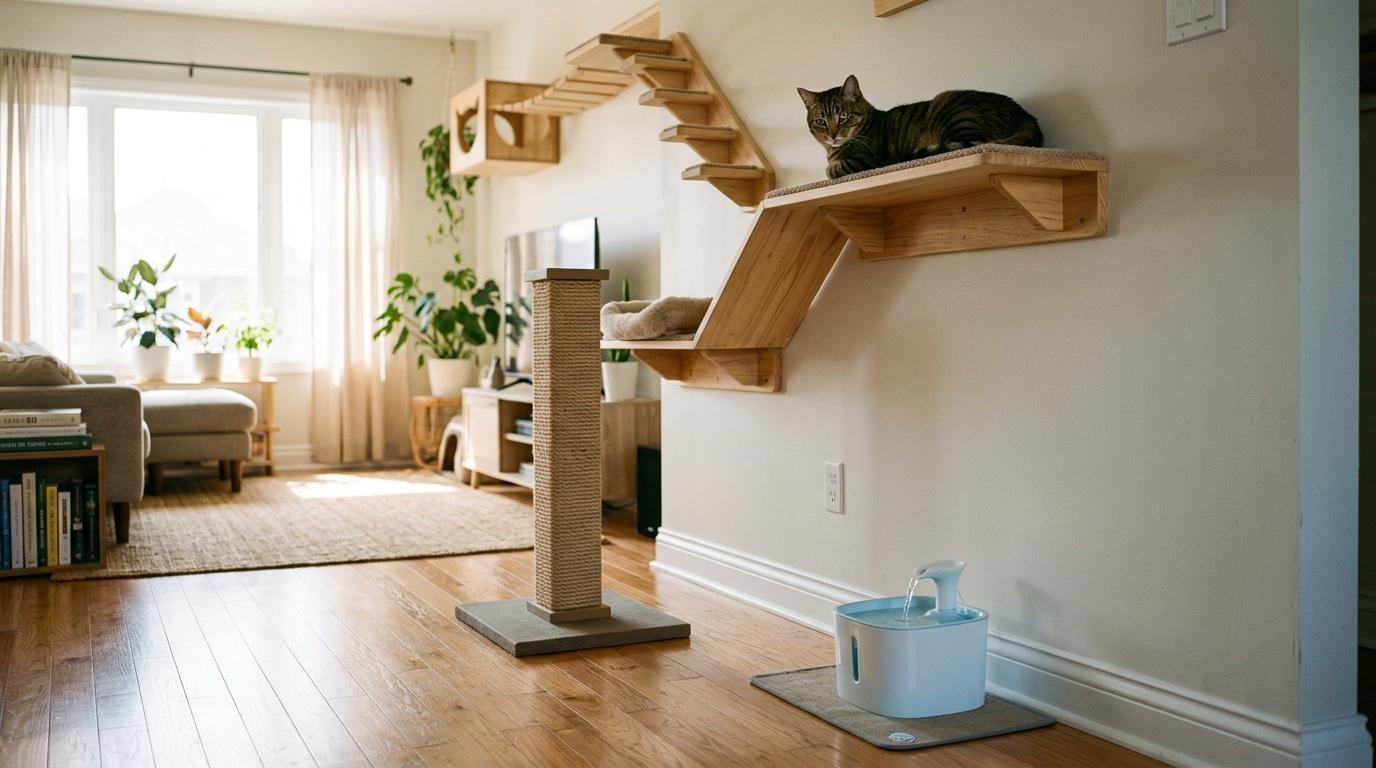
- Vertical Highway & Micro-Portal Engineering: Every room shared by a dog and cat must provide at least two elevated perches (>5 feet high) and a door strap latch (Door Buddy) or 6×6-inch cat door into a dog-free safe zone.
- Why Cats Control the Timeline: Never carry the cat into the dog’s room to force an interaction; the dog’s focus is trained to remain on the handler while the cat chooses its own distance and elevation.
Emergency Triage Matrix: Clinical Presentation & Required Response
| Triage Level | Clinical Signs & Presentation | Immediate Action Protocol |
|---|---|---|
| Tier 1: Predatory Fixation / Chase / Grab-Bite Red Flags | Dog exhibits silent rigid stare, trembling, salivating, lunging at the baby gate when the cat jumps, attempting to bite through barriers, or refuses high-value roast meat whenever the cat is visible. | Halt visual exposure immediately; close the solid bedroom door, institute strict two-barrier lock-and-rotate household management (and basket-muzzle conditioning for any visual assessments), and consult a board-certified veterinary behaviorist (DACVB) to evaluate permanent safety. |
| Tier 2: Over-Exuberant Bouncing, Whining or Feline Hissing/Hiding | Dog whines, play-bows excitedly, or pulls on the leash toward the gate; or the cat flattens its ears, hisses, stops using its litter box, and refuses to leave under the bed. | Drop back one full phase; drape a towel over the bottom half of the baby gate, increase distance between the dog and the gate to 15 feet, and reward the dog strictly for lying down and looking away from the doorway. |
| Tier 3: Automatic Disengagement (“Cat Moves = Look at Handler for Chicken”) | Cat jumps off a cat tree or trots across the room; the dog glances briefly at the cat with soft ears and immediately turns its head to the handler for a treat or keeps chewing its mat. | Maintain a dragging light house-line on the dog’s harness during supervised shared-room time and continue separating both pets behind closed doors whenever humans leave the house or sleep. |
The Four-Phase Scent-to-Sight Integration Protocol & “Cat Motion = Look at Me” Conditioning
During Phase 1 (Closed-Door Scent & Site Swapping, Days 1–5), house the newcomer in a dedicated sanctuary room equipped with all core resources (litter box, water, vertical cat tree, hiding cubbies). Twice daily, rub a clean soft sock gently over the cat’s cheeks (collecting F3 facial pheromones) and place the sock on the floor in the living room while tossing 5 pieces of roast chicken around it for the dog—pairing the cat’s scent with calm, nose-down foraging. Once a day, close the dog securely in the bedroom or yard and let the cat explore the empty living room for 30 minutes to deposit territorial scent markers and map escape routes before ever seeing the dog.
During Phase 2 (Harnessed Gate Sessions, Days 6–14), exercise the dog first with a long-line sniff walk so baseline arousal is low. Fit the dog with a Y-harness and 6-foot leash, sit 12 to 15 feet back from the tall metal doorway gate, and open the solid door so the cat can view the room through the gate bars if it chooses. Play the “Auto-Disengage” game: the exact millisecond your dog looks toward the cat at the gate, click or say “Yes!” and deliver a piece of chicken right at your knee (away from the gate). If the cat jumps or trots away, rapid-fire 3 consecutive treats at your knee so sudden feline motion becomes the dog’s cue to turn TOWARD you rather than chase.
- Standard Pressure-Mounted Plastic Baby Gates Are Insufficient: Large dogs easily knock down low 28-inch pressure gates, and cats jump over them; install an extra-tall (36-to-41-inch) hardware-mounted metal walk-through gate with vertical bars spaced <2.25 inches apart.
- Protect the Cat’s Litter Box & Food From Canine Raiding: Dogs naturally scavenge high-protein cat food and cat feces (coprophagia); positioning a cat’s litter box where a dog can corner the cat mid-elimination causes immediate feline house-soiling and stress cystitis.
- The Dragging House-Line Phase: When transitioning from gated sessions to same-room sessions in Weeks 3–4, leave a 6-foot handleless biothane drag line attached to the dog’s harness so you can step on or pick up the line peacefully without reaching for a collar.
- Total Separation When Home Alone: Even after two months of peaceful supervised sofa naps, always close a solid door between dogs and cats whenever no adult human is home.
Strict Rule S1 Clinical Red Flags: Interspecies Predatory Drift Risk, Territorial Intrusion & Multi-Pet Integration Triage
Critical safety boundaries for Canine & Feline (Canis lupus familiaris & Felis catus — Newly Adopted Multi-Pet Homes) caregivers:
- Zero Unprotected “Let Them Work It Out” Face-to-Face Releases: Never drop a new dog and cat into the same room off-leash to “see what happens”; a single predatory grab-and-shake bite causes fatal feline thoracic trauma or spinal fracture in under 2 seconds.
- Zero Shock Collar Punishment When the Dog Looks at the Cat: Never shock, swat, or yell at a dog for looking at the cat; associating the cat’s presence with neck pain makes the dog view the cat as an aversive threat, triggering explosive attacks the moment the collar is off.
Clinical Preparation & Biosecurity Action Checklist
- Install a tall (36+ inch) walk-through metal pet gate at the sanctuary room doorway and set up at least two 5-foot-high feline perches in the main living room before day one.
- Keep the dog’s food bowls and high-value chews 100% picked up, and place the cat’s food, water, and litter boxes inside a room protected by a dog-proof door strap or elevated counter.
- Train the dog that any rapid movement or sound from the cat is an automatic cue to whip its head toward you for a jackpot meat reward.
- Close a solid interior door between your dog and cat every single time you leave the house, shower, or go to sleep at night during the first 3 to 6 months.
Related Clinical Guides & Triage Protocols
Peer-Reviewed Clinical References & Evidence Grounding
- Cats and dogs living in the same household: interspecies communication, environmental setup, and behavioral welfare factors (opens in new tab) (PLOS ONE (2018) — Peer-reviewed study by Thomson, Hall & Mills indexed on NCBI PubMed (PMID: 29793613).)
- AAFP and ISFM Environmental Needs Guidelines: Safe Territory, Vertical Space, and Multi-Species Resource Separation (opens in new tab) (Journal of Feline Medicine and Surgery (2013) — Consensus guideline by Ellis et al. indexed on NCBI PubMed (PMID: 23449859).)
- AAHA Canine and Feline Behavior Management Guidelines: Predatory Behavior Assessment and Multi-Pet Household Introductions (opens in new tab) (American Animal Hospital Association clinical guidelines on interspecies safety and desensitization.)
- Merck Veterinary Manual: Predatory Aggression vs. Social Arousal and Inter-Species Introduction Protocols (opens in new tab) (Verified veterinary reference on canine predatory motor sequences and household containment.)
Source transparency
Reference mix for this guide
Source labels classify the institutional category of the references cited above.