This guide is general education for pet owners. If your pet has urgent symptoms, possible poisoning, injury, breathing trouble, collapse, severe pain, or sudden decline, contact a licensed veterinarian or local emergency service.
Editorial standard
How this guide was prepared
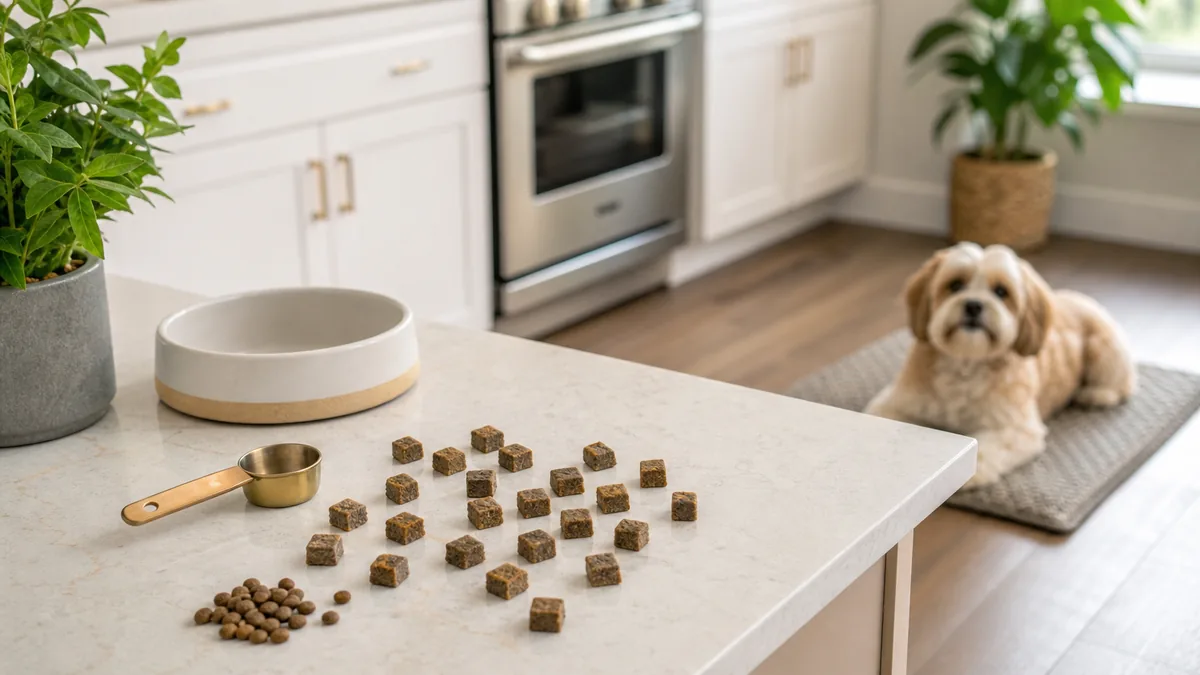
A training pouch can be nearly empty at the end of a single neighborhood walk while quietly delivering more than a third of a dog’s total daily caloric allowance. Dog owners often focus intently on measuring morning and evening kibble bowls with precision, yet overlook the compounding energy delivered through training bites, dental chews, medication delivery cheese, and spontaneous family treats. In clinical veterinary practice, unmeasured treats represent the leading hidden contributor to canine obesity and secondary metabolic diseases.
Clinical Quick Answer & Immediate Actions
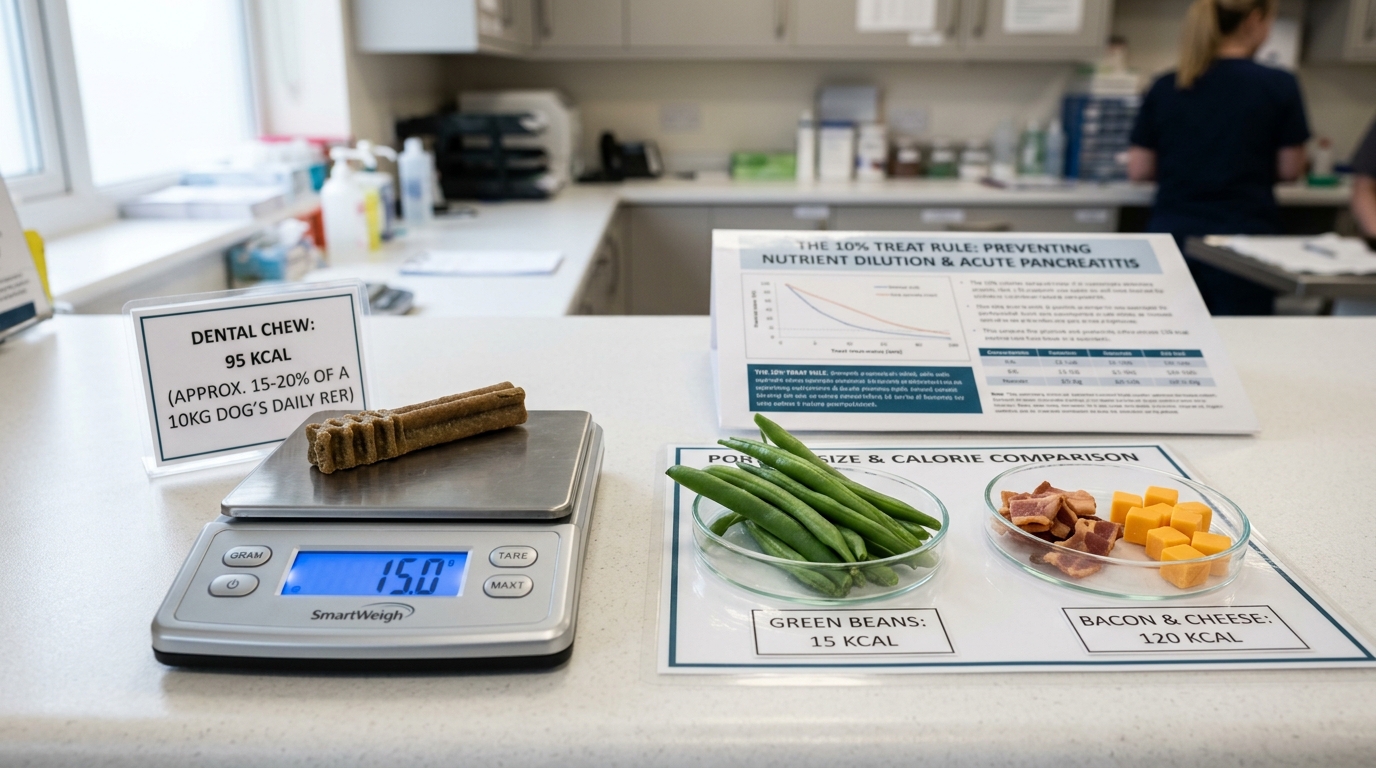
To prevent obesity and micronutrient deficiencies, treats and table foods should never exceed 10 percent of your dog’s total daily caloric allowance (Maintenance Energy Requirement, or MER). Commercial complete pet foods are carefully formulated to provide complete balanced nutrition; excessive treat consumption dilutes essential amino acids, vitamins, and minerals while accelerating adipose tissue gain and joint degradation.
Managing rewards requires viewing every edible bite as part of a single daily energy budget. By learning the true caloric density of common treats, portioning rewards into pea-sized bites, and implementing a household “reward bank,” you can sustain motivated positive reinforcement training while protecting your dog’s lean body mass and long-term joint health.
Why Hidden Treat Calories Drive Canine Obesity
The biological impact of treat calories is dramatically magnified in small and medium-sized dogs due to their lower baseline daily energy requirements. A typical 10-pound (4.5 kg) terrier requires approximately 250 to 300 total calories per day to maintain healthy body condition. When a family member offers that dog a single 2-inch marrow biscuit or a single dental chew containing 90 to 100 calories, that solitary treat accounts for 35% to 40% of the dog’s entire daily food allowance.
To put this in human perspective, giving a 10-pound dog an ounce of cheddar cheese (roughly 115 kcal) is physiologically equivalent to an adult human consuming two and a half full-sized cheeseburgers on top of their standard three daily meals.
The Danger of Nutrient Dilution
Commercial dog foods are formulated with precise ratios of essential amino acids, fatty acids, vitamins, and minerals calibrated to the food’s caloric density. When treats exceed 10% of daily calories, they crowd out the complete diet—a pathological phenomenon called nutrient dilution. Over months, dogs on high-treat diets develop subclinical deficiencies in essential nutrients like zinc, vitamin E, and calcium, despite appearing visibly overweight or gaining body fat.
Caloric Breakdown of Common Dog Treats & Table Foods
To make informed training decisions, owners must understand the dramatic caloric variation between standard commercial treats, human foods, and low-calorie clinical alternatives:
| Treat or Reward Item | Typical Serving Size | Average Caloric Content | Clinical Risk & Nutrition Impact |
|---|---|---|---|
| Bully Stick (6-inch) | 1 stick | 85 – 100 kcal | Extremely calorie-dense; represents 15-30% of daily calories for medium dogs. |
| Bully Stick (12-inch) | 1 stick | 175 – 220 kcal | Can exceed half the daily caloric budget for small-to-medium breeds. |
| Peanut Butter (Smooth) | 1 level tablespoon | 95 – 105 kcal | Very high fat; frequent trigger for canine acute pancreatitis. Ensure xylitol-free! |
| Commercial Dental Chew | 1 medium chew | 75 – 115 kcal | Often treated as a “tooth brush” rather than food; carries substantial starch calories. |
| Hot Dog Slice | 1 standard frankfurter | 140 – 160 kcal | High sodium, saturated nitrates, and concentrated fat; cut into 30+ tiny slivers if used. |
| Cheddar Cheese Cube | 1-inch cube (1 oz) | 110 – 115 kcal | Dense dairy fat and lactose; frequently causes osmotic diarrhea in sensitive dogs. |
| Freeze-Dried Beef Liver | 1 medium cube (5g) | 18 – 25 kcal | Excellent single-ingredient value, but must be broken into 4-6 smaller crumb pieces. |
| Fresh Baby Carrot | 1 whole baby carrot | 4 – 5 kcal | High fiber, low calorie, excellent natural crunch; highly recommended for weight control. |
| Steamed Green Beans | 1/2 cup | 15 – 18 kcal | Gold-standard filler and reward; high moisture and dietary fiber with near-zero fat. |
| Cucumber Slices | 1/2 cup (sliced) | 8 kcal | 96% water content; outstanding refreshing summer reward for overweight dogs. |
| Air-Popped Plain Popcorn | 1 cup (no oil/salt) | 30 kcal (roughly 0.3 kcal per kernel) | Lightweight volume reward ideal for scatter feeding and high-repetition cues. |
High-Repetition Training Without Caloric Overload
Modern positive reinforcement dog training relies on frequent marker-and-reward delivery cycles. During an intensive 15-minute training class or loose-leash walk, a handler might reward a dog 30 to 60 times. If using standard store-bought training biscuits averaging 15 calories each, that single session delivers 450 to 900 calories—vastly exceeding the entire daily requirement of most pet dogs!
The Pea-Sized Rule
Behavioral research demonstrates that dogs evaluate the frequency and timing of reinforcement, not the physical mass of the food morsel. A dog receives the exact same dopamine surge from a treat the size of a split pea as they do from an entire meat patty. By cutting soft commercial treats into tiny 2mm to 3mm cubes (roughly the size of a grain of rice or a green pea), you achieve dramatic caloric reductions:
| Training Scenario (50 Repetitions) | Treat Portioning Strategy | Total Calories Delivered | Dietary Outcome |
|---|---|---|---|
| Uncut Commercial Soft Chews | Whole treats (12 kcal each) | 600 kcal | Severe overfeeding; triggers gastrointestinal upset and rapid fat accumulation. |
| Halved Commercial Treats | Cut in half (6 kcal each) | 300 kcal | Still exceeds 10% daily limit for almost all dogs under 60 lbs. |
| Pea-Sized Diced Morsels | Cut into eighths (0.75 kcal each) | 37.5 kcal | Safe, controlled training volume that easily fits within healthy daily margins. |
| Measured Daily Kibble | Subtracted from breakfast bowl | 0 extra kcal | Zero additional calories; preserves perfect macronutrient and micronutrient balance. |
The Household Reward Bank System
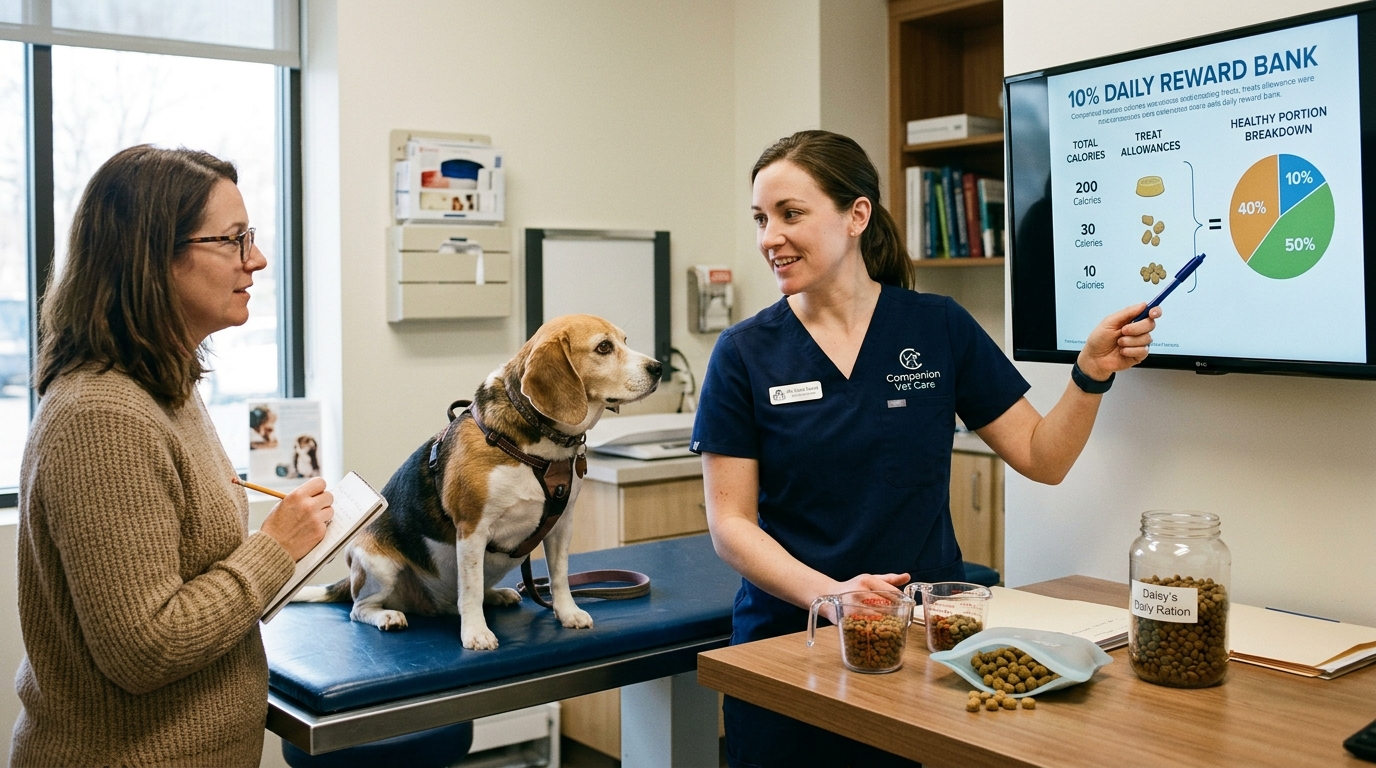
In multi-person households, well-intentioned family members often inadvertently double or triple a pet’s food intake. The partner gives a breakfast treat, the child shares a cheese stick, the dog walker dispenses biscuits on the midday walk, and grandparents deliver bedtime snacks. Because no single person tracks the full picture, the dog steadily gains weight.
How to Set Up the Daily Reward Bank
- Calculate the 10% Allowance: Check with your veterinarian or look at your dog food bag to find your dog’s daily maintenance calories. If your dog requires 600 kcal/day, their maximum supplemental treat allowance is 60 kcal.
- Pre-Portion Every Morning: Every morning, place exactly 60 kcal of treats into a single, labeled clear glass jar or airtight container on the kitchen counter labeled “Today’s Reward Bank.”
- Universal Household Rule: Every caregiver, walker, and family member must take treats exclusively from this designated jar. When the container is empty, food rewards are finished for the day.
- Subtract Kibble for High-Energy Days: On days scheduled for agility classes or intensive outdoor training, scoop one-quarter of the dog’s measured kibble from their dinner bowl and pour it directly into your training pouch.
Non-Food Reinforcers: High-Value Alternatives
Food is a powerful motivator, but relying exclusively on edibles limits training versatility and compounds weight concerns. Dogs find diverse real-world experiences intensely reinforcing:
- Environmental Sniffing Releases (“Go Sniff”): Sniffing lowers canine heart rates and satisfies instinctual predatory seeking drives. Releasing a dog to sniff a fascinating tree trunk or grass patch is one of the highest-value rewards for loose-leash walking.
- Interactive Play and Tug: A brief 10-second game of tug with a braided fleece rope or chasing a soft rubber ball provides high-arousal positive reinforcement without a single calorie.
- Functional Real-Life Rewards: Unlocking doors to go outside, clipping off the leash in a fenced dog park, or inviting the dog onto the couch can serve as powerful rewards for calm waiting and impulse control.
- Social Praise and Tactile Engagement: Long, gentle chest strokes or enthusiastic verbal praise can reinforce calm behavior when delivered in a quiet, grounded manner.
High-Fat Treats and the Threat of Acute Pancreatitis
Beyond chronic weight gain, rich and fatty treats pose an acute medical emergency: canine pancreatitis. The canine pancreas produces digestive enzymes that remain inactive until reaching the duodenum. Ingesting sudden, concentrated doses of fat (such as bacon strips, hot dogs, lamb trimmings, sausage, or buttered table scraps) triggers premature activation of trypsinogen within pancreatic acinar cells. The activated digestive enzymes begin auto-digesting the pancreas itself, precipitating agonizing abdominal pain, systemic inflammation, shock, and organ failure.
Veterinary Escalation Boundary: When to Seek Medical Attention
If your dog develops persistent vomiting, watery or bloody diarrhea, profound lethargy, or severe abdominal tenderness after eating fatty treats, contact a veterinarian immediately to evaluate for acute pancreatitis or obstruction. Immediate hospitalization with intravenous fluid resuscitation, multimodal analgesia, and antiemetic therapy is essential to prevent systemic sepsis and shock.
Additionally, if your dog swallows a whole bully stick, dental chew, or rawhide fragment without chewing, monitor closely for gagging, excessive drooling, or unproductive retching, which indicate an acute esophageal or gastric foreign body requiring urgent veterinary endoscopic removal.
Clinical Practice Tool: Pet Food Label Comparison Worksheet
Calculate treat calorie allowances accurately so rewards never exceed 10% of daily intake with our Pet Food Label Comparison Worksheet. Download and print your copy of the Pet Food Label Comparison Worksheet, or explore all practical pet care guides in the NewsPet Resource Center.
Frequently Asked Questions
What percentage of a dog’s daily caloric intake can safely come from treats?
Treats, chews, and human food scraps must never exceed 10 percent of a dog’s total daily caloric allowance. Exceeding this threshold unbalances nutritional profiles and accelerates canine obesity.
What healthy low-calorie human foods can be used as training treats?
Fresh green beans, unseasoned canned pumpkin, raw baby carrots, and seedless apple slices provide high-fiber, vitamin-rich rewards with negligible caloric density.
How do commercial dental chews factor into a dog’s daily calorie count?
Many large commercial dental chews contain 100 to 200 calories (equivalent to 15 to 25 percent of a medium dog’s total daily allowance). When giving dental chews, subtract the equivalent caloric portion from evening kibble.
Sources
Sources checked: September 8, 2026.
- WSAVA: Global Nutrition Committee Guidelines and Caloric Management Tools
- Pet Nutrition Alliance: Calorie Calculator and Nutritional Screening Guidelines
- Tufts Clinical Nutrition Service (Petfoodology): Treat Options Without Unbalancing the Diet
- American College of Veterinary Internal Medicine (ACVIM): Clinical Consensus on Canine Pancreatitis
- AAFCO: Understanding Pet Food Labels and Caloric Density Statements
Emergency Triage Matrix: Clinical Presentation & Required Response
| Triage Level | Clinical Signs & Presentation | Immediate Action Protocol |
|---|---|---|
| Tier 1: Immediate Emergency (0–2 Hours) | Acute choking, cyanosis, gagging, or complete esophageal obstruction immediately following ingestion of large chews, bully sticks, or dental bones. | Immediate emergency veterinary transport; emergency endoscopic retrieval or surgical intervention to relieve complete airway or esophageal obstruction. |
| Tier 2: Urgent Veterinary Care (Same-Day) | Severe abdominal pain (prayer position), acute persistent vomiting, and depression after consuming high-fat table scraps or greasy chews (acute pancreatitis). | Urgent veterinary hospital admission; pancreatic lipase immunoreactivity (cPLI) testing, abdominal ultrasonography, and intensive IV fluid support. |
| Tier 3: Home Monitoring & Scheduled Care | Gradual weight gain or body condition score (BCS) creeping above 5/9 due to excessive training treats, without acute distress or gastrointestinal upset. | Calculate precise Resting Energy Requirement (RER), restrict treats to under 10% of total daily calories, and substitute high-calorie treats with low-calorie vegetables (e.g., green beans). |
Rule S1 Boundaries & High-Calorie Treat Precautions
Safe reward management requires strict observance of nutritional and mechanical limits:
- NEVER exceed the 10 percent daily caloric ceiling for treats: Exceeding 10% displaces complete and balanced commercial food, causing progressive nutritional deficiencies in calcium, trace minerals, and essential vitamins.
- NEVER feed high-fat table scraps or processed human meats: Fatty trimmings, bacon, sausages, and fried meats trigger severe acute canine pancreatitis, resulting in pancreatic necrosis and systemic inflammatory shock.
- NEVER give hard chews that cannot be indented with a fingernail: Antlers, real animal bones, and hard nylon chews frequently cause catastrophic slab fractures of the maxillary fourth premolar teeth.
- NEVER leave dogs unattended with rawhide chews or bully sticks: Dogs frequently swallow softened end-pieces whole, leading to life-threatening esophageal obstruction or gastrointestinal foreign body impaction.
Caregiver Daily Calorie & Treat Management Checklist
- Calculate your dog’s daily Resting Energy Requirement (RER = 70 × [body weight in kg]0.75) and establish the 10% treat budget.
- Check the caloric density (kcal/treat) on packaging; do not guess reward values without checking manufacturer labels.
- Deduct the treat caloric total directly from the morning and evening kibble portions to maintain neutral energy balance.
- Cut commercial training rewards into pea-sized micro-bites (1 to 2 kcal each) for repetitive behavioral conditioning.
- Incorporate veterinarian-approved low-calorie alternatives like fresh cucumber slices, plain air-popped carrots, or steamed green beans.
Related Clinical Guides & Tools
Peer-Reviewed Clinical References & Evidence Grounding
- PMID: 33653534: Canine and Feline Obesity Management (Vet Clin North Am Small Anim Pract, 2021) (opens in new tab)
- PMID: 18656844: Pet food safety: dietary protein (Top Companion Anim Med, 2008) (opens in new tab)
- PMID: 15025191: Nutritional requirements of the critically ill patient (Clin Tech Small Anim Pract, 2004) (opens in new tab)
- wsava.org (opens in new tab)
WSAVA 10% Treat Calorie Allowance Calculator
Calculate your pet's daily Resting Energy Requirement (RER) and maximum recommended 10% treat calorie budget based on WSAVA clinical nutrition consensus.
Printable tools
Download the matching worksheet
Source transparency
Reference mix for this guide
Source labels describe the type of organization behind each reference; they are not a claim that any outside organization reviewed this article.
- WSAVA: Global Nutrition Committee Guidelines and Caloric Management Tools Veterinary organization · wsava.org
- Pet Nutrition Alliance: Calorie Calculator and Nutritional Screening Guidelines Reference source · petnutritionalliance.org
- Tufts Clinical Nutrition Service (Petfoodology): Treat Options Without Unbalancing the Diet Academic or extension · sites.tufts.edu
- American College of Veterinary Internal Medicine (ACVIM): Clinical Consensus on Canine Pancreatitis Veterinary organization · acvim.org
- AAFCO: Understanding Pet Food Labels and Caloric Density Statements Pet food standards · aafco.org
- Puppy Socialization Without Overwhelm: A Vet-Safe Reference source · newspet.net
- Dog Body Language Chart: 9 Stress Signs Before a B Reference source · newspet.net
- Reward-Based Dog Training: Force-Free Steps & Reference source · newspet.net