This guide is general education for pet owners. If your pet has urgent symptoms, possible poisoning, injury, breathing trouble, collapse, severe pain, or sudden decline, contact a licensed veterinarian or local emergency service.
Editorial standard
How this guide was prepared
Bloody diarrhea in a young, unvaccinated or incompletely vaccinated puppy is considered a life-threatening medical emergency requiring immediate veterinary intervention. While adult dogs may occasionally develop bloody stool from less critical issues, a puppy passing liquid, foul-smelling, bloody feces is at extreme risk for canine parvovirus, a highly contagious and often fatal disease if left untreated.
Quick Answer: What to Do If Your Puppy Has Bloody Diarrhea
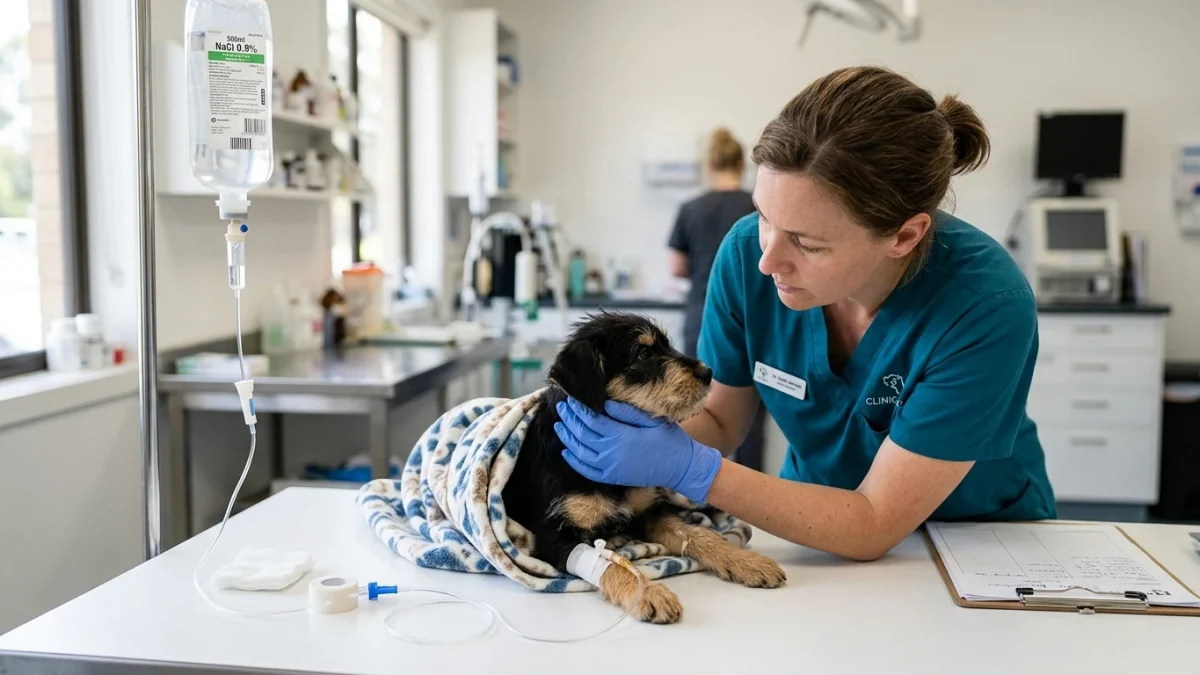
If your puppy under six months of age experiences sudden bloody diarrhea, you must proceed directly to a veterinary clinic or 24-hour emergency hospital. Contact the clinic ahead of time to inform them that you are bringing in a suspected parvovirus case so they can prepare an isolation protocol. An immediate fecal SNAP test is required to confirm or rule out parvovirus. Without aggressive intravenous fluid therapy and supportive care, puppies can succumb to dehydration and sepsis within 48 to 72 hours.
The Parvovirus Kill Chain: How 48 Hours Become Fatal
Canine parvovirus is an exceptionally destructive pathogen that targets rapidly dividing cells within the puppy’s body. The virus initiates a devastating two-front attack.
First, the virus attacks the intestinal crypt epithelium, destroying the lining of the gastrointestinal tract. Stripping the gut lining in this manner eliminates the puppy’s ability to absorb nutrients and water, while simultaneously allowing intestinal bacteria to leak directly into the bloodstream. Such massive tissue destruction results in the characteristic profuse, foul-smelling, bloody diarrhea and persistent vomiting.
Second, parvovirus invades the bone marrow and lymphoid tissues, suppressing the production of white blood cells (lymphocytes and neutrophils). The resulting profound immunosuppression leaves the puppy completely defenseless against the bacteria leaking from their compromised gut. The combination of rapid fluid loss, overwhelming bacterial infection (septicemia), and systemic shock creates a lethal cascade. Without aggressive veterinary intervention—primarily intensive intravenous fluid resuscitation—the mortality rate for puppies with parvovirus exceeds 90 percent. However, with appropriate hospital treatment, survival rates can reach 80 to 95 percent.
Parvovirus vs. AHDS (HGE): The Critical Differential
A primary clinical distinction must be made between canine parvovirus and Acute Hemorrhagic Diarrhea Syndrome (AHDS), historically referred to as Hemorrhagic Gastroenteritis (HGE). Both conditions produce dramatic, raspberry-jam-like bloody diarrhea, but their risk profiles and physiological mechanisms differ significantly.
Age and Vaccination Status: Parvovirus predominantly affects puppies between six weeks and six months of age, particularly those that are unvaccinated or have incomplete vaccination series. Acute hemorrhagic diarrhea syndrome typically occurs in small-breed adult dogs, such as Miniature Schnauzers, Yorkshire Terriers, and Dachshunds.
Immune System Impact: The viral infection causes severe leukopenia (dangerously low white blood cell counts) due to bone marrow suppression. The syndrome does not cause systemic immunosuppression; instead, bloodwork in AHDS patients usually reveals extreme hemoconcentration—an abnormally high packed cell volume (PCV) due to massive fluid loss into the gut.
Disease Course: While both require veterinary stabilization and intravenous fluids, dogs with AHDS often respond rapidly to 24 to 48 hours of IV fluid therapy and typically recover without the severe septic complications associated with parvovirus. The disease requires strict isolation, broad-spectrum antibiotics, anti-nausea medications, and sometimes days of intensive hospital care.
To understand more about general diarrhea presentation in adult dogs, review our guide on acute vs. chronic diarrhea.
The Dehydration Death Spiral in Puppies
Puppies possess exceptionally low body mass and limited fluid reserves compared to adult dogs. When a puppy experiences simultaneous vomiting and diarrhea, they enter a dehydration death spiral that accelerates exponentially.
Recognizing the physical signs of severe dehydration is critical. Caregivers can assess skin turgor by gently lifting the skin between the puppy’s shoulder blades; in a well-hydrated puppy, the skin snaps back immediately. In a dehydrated puppy, the skin remains tented or returns to position slowly. Other alarming indicators include profoundly sunken eyes, lethargy so severe the puppy cannot lift their head, and tacky, dry gums that may appear pale or muddy in color rather than a healthy, vibrant pink.
If your puppy is vomiting water immediately after drinking, oral hydration is no longer effective. They require intravenous fluids bypassed directly into the circulatory system. For additional context on dangerous vomiting patterns, consult our vomiting evaluation guide.
Emergency Triage Matrix
| Triage Tier | Clinical Presentation | Required Action |
|---|---|---|
| Tier 1: Immediate Emergency (0-2h) | Unvaccinated or incompletely vaccinated puppy with liquid bloody diarrhea, repeated vomiting, extreme lethargy, pale gums, inability to stand. | Proceed to the nearest veterinary emergency hospital immediately. Phone ahead for parvovirus isolation intake. Do not delay. |
| Tier 2: Same-Day (12-24h) | Fully vaccinated adult dog presenting with sudden bloody, raspberry-jam diarrhea, but remains alert, responsive, and is not vomiting. | Contact your primary veterinarian for an urgent same-day appointment to evaluate for AHDS or other acute colitis. |
| Tier 3: Home Monitoring | Adult dog with a single episode of soft stool containing a small streak of bright red blood, otherwise completely normal energy and appetite. | Monitor closely for 12 to 24 hours. Transition to a bland veterinary diet. Seek care if diarrhea worsens, becomes entirely liquid blood, or if vomiting begins. |
Environmental Decontamination: The Persistent Threat
Canine parvovirus is notoriously resilient. It is a non-enveloped virus, meaning it lacks the fragile lipid outer layer that makes many other viruses susceptible to standard household cleaners. The virus can survive in the environment—on floors, clothing, bowls, and in soil—for months to over a year, withstanding freezing temperatures and extreme heat.
If a puppy is diagnosed with parvovirus, complete environmental decontamination is mandatory to prevent infection of future canine residents. Standard household disinfectants and alcohol-based cleaners are entirely ineffective. Indoor non-porous surfaces must be thoroughly cleaned of all organic matter (feces, vomit) and then saturated with a properly diluted bleach solution. The standard veterinary protocol requires a 1:30 dilution of regular household bleach (approximately one-half cup of bleach per gallon of water). The solution must remain in wet contact with the surface for a minimum of 10 to 15 minutes to effectively destroy the viral particles.
Outdoor environments, particularly lawns and soil, are nearly impossible to fully decontaminate. Sunlight and environmental degradation will eventually reduce the viral load, but contaminated yards should be considered a high-risk zone for unvaccinated puppies for at least six to twelve months.
Dangerous Home Pitfalls: What NOT to Do (Rule S1)
In a panic, well-meaning caregivers often attempt home remedies that can be fatal to a sick puppy. Adhere strictly to the following veterinary mandates:
- NEVER administer human anti-diarrheal medications: Do not give Pepto-Bismol, Kaopectate, or any bismuth subsalicylate product to a puppy. These medications contain salicylate, which is closely related to aspirin and can cause severe toxicity, gastrointestinal ulceration, and exacerbate bleeding.
- NEVER restrict water from a dehydrated puppy: While you may temporarily remove food for a few hours if a puppy is actively vomiting, never withhold access to water from a puppy experiencing fluid loss through diarrhea.
- NEVER adopt a “wait and see” approach: Bloody diarrhea in an unvaccinated puppy is never a self-limiting condition. Delaying veterinary care by 12 hours can be the difference between survival and death.
- NEVER skip or delay vaccination boosters: Puppies require a series of vaccinations because maternal antibodies interfere with vaccine efficacy. A puppy is not fully protected until they have completed their entire primary series, usually at 16 weeks of age.
Aggressive, immediate medical intervention is the only proven method to combat canine parvovirus and severe acute hemorrhagic diarrhea syndrome. The speed of your response dictates your puppy’s chance of survival.
Sources
- “Canine Parvovirus Enteritis: A Review of Diagnosis, Management, and Prevention” – JVIM 2019. PubMed: https://pubmed.ncbi.nlm.nih.gov/30747012/
- “Acute Hemorrhagic Diarrhea Syndrome in Dogs: Clinical Presentation and Outcome” – JVIM 2014. PubMed: https://pubmed.ncbi.nlm.nih.gov/24655055/
- “Survival Rates and Prognostic Factors for Canine Parvoviral Enteritis” – JAVMA 2012. PubMed: https://pubmed.ncbi.nlm.nih.gov/22747651/
Caregiver Safety Checklist
- Confirm the puppy’s vaccination history and exact age.
- Assess the stool: note volume, frequency, and presence of frank blood or raspberry-jam consistency.
- Monitor for concurrent vomiting and extreme lethargy.
- Call the nearest emergency veterinary clinic and state you have a suspected parvovirus case.
- Transport the puppy immediately, keeping them warm and isolated from other dogs.
Source transparency
Reference mix for this guide
Source labels describe the type of organization behind each reference; they are not a claim that any outside organization reviewed this article.
- https://pubmed.ncbi.nlm.nih.gov/30747012/ Government or public agency · pubmed.ncbi.nlm.nih.gov
- https://pubmed.ncbi.nlm.nih.gov/24655055/ Government or public agency · pubmed.ncbi.nlm.nih.gov
- https://pubmed.ncbi.nlm.nih.gov/22747651/ Government or public agency · pubmed.ncbi.nlm.nih.gov