This guide is general education for pet owners. If your pet has urgent symptoms, possible poisoning, injury, breathing trouble, collapse, severe pain, or sudden decline, contact a licensed veterinarian or local emergency service.
Editorial standard
How this guide was prepared
Battery ingestion represents one of the most perilous, time-sensitive foreign body and toxicological emergencies encountered in canine practice. Whether a dog chews and swallows a small coin-sized lithium button battery from a remote control, key fob, or hearing aid, or punctures a standard cylindrical alkaline battery (AAA, AA, 9V) from a household toy, the consequences can be devastating within hours. Unlike inert foreign bodies that may sit harmlessly in the stomach for days, batteries represent an immediate double threat: intense electrochemical tissue destruction and severe caustic chemical burns. When a disc battery becomes lodged against the moist, conductive mucosal lining of the esophagus, it completes an electrical circuit that hydrolyzes local tissue fluids into concentrated hydroxide ions, generating rapid liquefactive necrosis. In as little as two hours, this process can burn through the esophageal wall, causing catastrophic mediastinitis, tracheoesophageal fistulas, or fatal aortic hemorrhage. Immediate veterinary diagnosis and endoscopic or surgical extraction are paramount.
Quick Answer: Immediate Actions for a Dog That Swallowed a Battery
If your dog chewed or swallowed any type of battery, treat it as an emergency regardless of whether they show symptoms. Do not attempt home vomiting remedies. Check the dog’s mouth for black powdery residue, burns, or greyish-white mucosal blanching. Transport your dog immediately to an emergency veterinary facility equipped with radiography and flexible endoscopy. Emergency veterinarians perform two-view radiographs to locate the battery (button batteries display a distinctive “double-rim” or “halo” sign). If the battery is lodged in the esophagus, it must be removed endoscopically under general anesthesia within 1 to 2 hours to prevent life-threatening perforation.
Pathophysiology: Electrical Discharge vs Caustic Leakage
Veterinary emergency clinicians encounter two distinct injury mechanisms depending on the battery type and whether its casing was punctured:
1. Disc/Button Batteries (Electrochemical Liquefactive Necrosis): Even a brand-new or partially discharged button battery contains sufficient residual charge to generate an external electrical current between its negative and positive poles when immersed in conductive gastrointestinal secretions. This current hydrolyzes water molecules into hydrogen gas and concentrated hydroxide ions ($2text{H}_2text{O} + 2e^- to text{H}_2 + 2text{OH}^-$). The resulting localized pH surges to 12 or 13 within minutes. High alkaline pH dissolves tissue proteins and collagen via liquefactive necrosis, melting through the esophagus far faster than acidic burns, which produce coagulative necrosis and protective eschars.
2. Cylindrical Alkaline Batteries (Caustic Potassium Hydroxide Burns): Cylindrical alkaline batteries contain concentrated potassium hydroxide (KOH) or sodium hydroxide. If a dog bites or punctures the steel casing before swallowing, caustic gel leaks into the oral cavity, pharynx, and stomach. This inflicts deep, corrosive burns characterized by mucosal blackening, deep ulcerations, and stricture formation during healing.
3. Heavy Metal Toxicity: If a punctured battery remains in the acidic environment of the stomach for an extended period, gastric acid dissolves the casing, releasing heavy metals including zinc, nickel, cadmium, or lithium, triggering secondary systemic organ toxicity and hemolytic anemia.
Clinical Emergency Triage Matrix
| Triage Tier | Clinical Presentation | Required Action |
|---|---|---|
| Tier 1: Esophageal Lodgement & Active Necrosis (0-2h) | Witnessed ingestion of a button battery within the past 2 hours; persistent gagging, exaggerated swallowing motions (dysphagia); drooling thick, ropy saliva; coughing up bloody froth; pawing at the throat or mouth; acute distress. | Transport immediately to an emergency hospital with 24-hour endoscopy and surgical capabilities. Keep the dog calm. Esophageal impaction requires emergent endoscopic basket or snare retrieval within 120 minutes to prevent fatal esophageal perforation. |
| Tier 2: Gastric Lodgement or Chewed Casing (2-6h) | Punctured battery casing swallowed; black chemical powder or gray corrosive burns visible on the tongue or gums; vomiting dark, coffee-ground-like fluid; abdominal splinting and discomfort; battery confirmed in the stomach on radiograph. | Proceed directly to an emergency veterinary clinic. Rapid endoscopic retrieval from the stomach prevents caustic gastric ulceration, pyloric outflow obstruction, and heavy metal dissolution. Administer veterinarian-prescribed mucosal protectant slurries. |
| Tier 3: Intact Cylindrical Battery in Small Intestine (>6h) | Radiograph demonstrates an intact, unpunctured AA or AAA battery that has successfully traversed the pylorus into the duodenum; pet is asymptomatic, alert, and comfortable; no signs of perforation. | Hospitalize for continuous radiographic serial monitoring. If the battery progresses smoothly through the colon without signs of mechanical obstruction or casing degradation, it may pass in the stool under close veterinary supervision; otherwise, surgical enterotomy is required. |
Dangerous Home Pitfalls: What NOT to Do (Rule S1)
- NEVER induce vomiting with hydrogen peroxide or table salt: Chemical burns already weaken the esophageal lining. Violent vomiting drives corrosive battery contents back up the wounded esophagus, frequently triggering instantaneous esophageal wall rupture and fatal pleural contamination. Table salt ingestion induces fatal hypernatremic encephalopathy.
- NEVER administer vinegar, lemon juice, or chemical neutralizers: Attempting to neutralize an alkali base with an acid generates a powerful exothermic reaction. The extreme heat released inside the stomach or esophagus produces severe thermal tissue coagulation and accelerates perforation.
- NEVER force-feed bread, mashed potatoes, or bulky foods: Trying to “cushion” a lodged battery by forcing dense food down the dog’s throat often wedges the battery tighter against the esophageal mucosa, compounding the electrical burn and creating a complete airway-adjacent obstruction.
- NEVER assume an old “dead” battery is harmless: A discarded battery that can no longer power an electronic device still holds ample electrical charge to generate concentrated hydroxide ions and burn through an animal’s esophageal tissue in under two hours.
Diagnostic Standards: The Radiographic “Halo Sign”
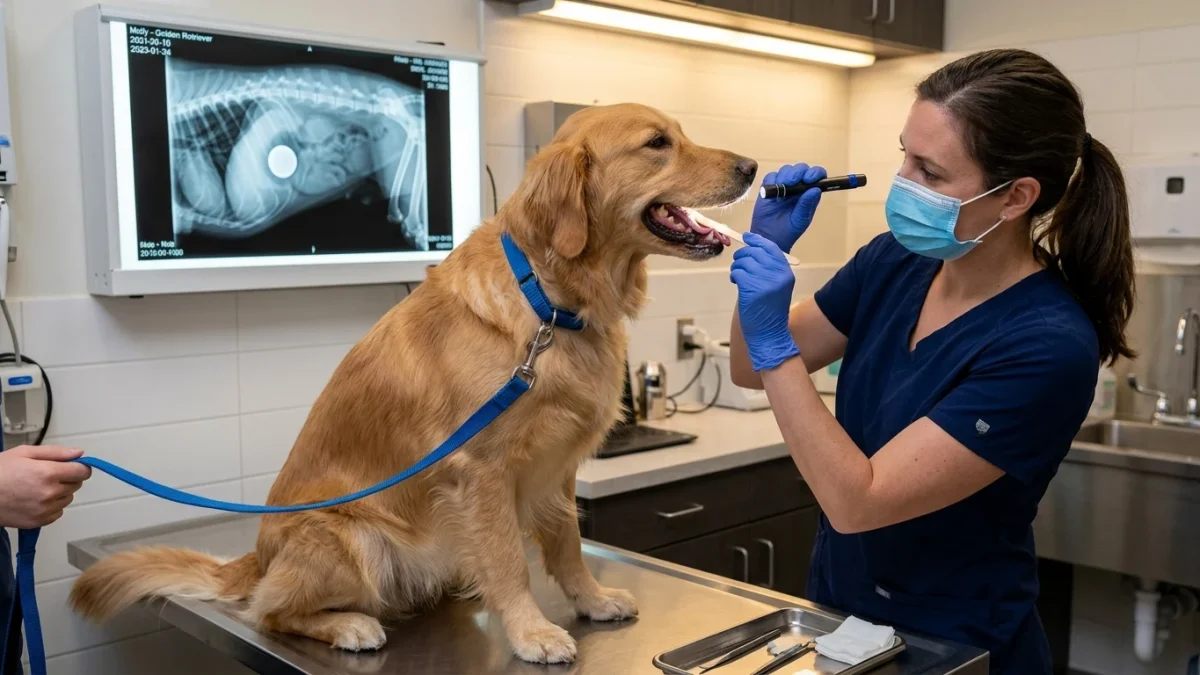
Upon hospital arrival, survey orthogonal radiographs (right lateral and ventrodorsal views) of the entire neck, thorax, and abdomen are obtained immediately. Radiographs confirm whether a battery was ingested, determine its precise anatomical position, and assess for signs of pneumomediastinum or pneumoperitoneum (indicative of rupture).
On high-resolution digital radiographs, button batteries display pathognomonic radiological signatures that distinguish them from harmless coins:
- The Double-Rim (Halo) Sign: In an anterior-posterior (ventrodorsal) radiographic projection, a button battery exhibits a distinctive double-ring concentric shadow due to the difference in diameter between the positive can and negative cap. Coins show a single, solid radiopaque circle.
- The Step-Off Sign: In a lateral radiographic projection, the interface where the battery cap crimps into the battery body creates a sharp “step-off” or beveled ledge, confirming a multi-component battery structure.
Endoscopic Extraction and Medical Decontamination
When a battery is identified in the esophagus or stomach, emergency flexible endoscopy is the treatment of choice. Under general endotracheal anesthesia, the endoscopist visualizes the mucosa and deploys a retrieval basket, foreign body forceps, or Roth Net to safely grasp the battery and withdraw it through the protective gastroesophageal sphincter.
Following successful retrieval, the clinician thoroughly evaluates the mucosal lining for circumferential burns. Post-extraction medical management focuses on mucosal healing and stricture prevention:
1. Mucosal Coating Slurries: Oral sucralfate suspension binds selectively to negatively charged, ulcerated mucosal proteins, forming an insoluble protective paste that shields raw tissue from stomach acid and digestive enzymes.
2. Acid Suppression Therapy: Intravenous proton pump inhibitors (such as pantoprazole) are administered to keep intragastric pH elevated, suppressing acid reflux into the injured esophagus.
3. Stricture Surveillance: Severe circumferential esophageal burns heal by fibrous contracture over 2 to 6 weeks, forming cicatricial strictures that impede solid food transit. Patients require soft or liquid diets and long-term veterinary monitoring for regurgitation.
Frequently Asked Questions
How quickly can a button battery burn through a dog’s esophagus?
Significant mucosal ulceration begins within 15 minutes of esophageal impaction, and full-thickness liquefactive necrosis with complete wall perforation can occur in as little as 2 hours. This rapid timeline is why button battery ingestion is classified as a Tier 1 emergency requiring immediate hospital intervention.
What should I do if my dog chewed an alkaline battery and has black powder in its mouth?
Immediately flush the dog’s oral cavity gently with copious amounts of clean, room-temperature tap water or saline to rinse away loose corrosive alkali residue. Direct the dog’s muzzle slightly downward so it does not swallow the rinse water. Do not induce vomiting, and transport the dog immediately to an emergency clinic for complete oral and gastrointestinal evaluation.
Can a swallowed battery pass safely through the digestive tract on its own?
If an intact, undamaged cylindrical battery reaches the stomach and passes into the intestines without lodging, it may occasionally transit through the gastrointestinal tract and emerge in the stool. However, this must only occur under strict radiographic hospital surveillance. If the battery becomes lodged in the stomach or intestines, delays in extraction lead to severe pressure necrosis, chemical leakage, and life-threatening bowel perforation.
Scientific Sources and Literature
- Brown DC, et al. “Clinical findings, endoscopic intervention, and outcome in dogs following battery ingestion: 28 cases.” Journal of Veterinary Emergency and Critical Care. PMID: 29959648
- Tanaka K, et al. “Electrochemical mechanisms of esophageal mucosal injury induced by button batteries in domestic animals.” Veterinary Surgery. PMID: 28414436
- Bischoff K. “Caustic and corrosive agent ingestions in companion animals: pathophysiology, diagnosis, and long-term stricture management.” Veterinary Clinics of North America: Small Animal Practice. PMID: 31215160
Caregiver Emergency Battery Action Checklist
- Examine the source device: identify whether the missing battery is a lithium disc/button or alkaline cylindrical cell.
- Inspect the dog’s mouth: check for gray or black chemical staining, drooling, or oral ulcerations.
- Gently rinse the oral cavity with cool water, tilting the head downward to prevent swallowing the rinse fluid.
- NEVER induce vomiting with hydrogen peroxide, salt, or home remedies.
- NEVER administer vinegar, lemon juice, or chemical neutralizers.
- Withhold all solid foods and bulky meals; keep the stomach clear for emergency anesthesia.
- Transport the pet immediately to a 24-hour veterinary surgical and endoscopic facility.
Source transparency
Reference mix for this guide
Source labels describe the type of organization behind each reference; they are not a claim that any outside organization reviewed this article.
- Dog Swallowed Chicken Bone & Sharp Object Guide Reference source · newspet.net
- Toxic Foods & Plants Emergency Ingestion Guide Reference source · newspet.net
- Dog Vomiting: Home Monitoring vs Emergency Red Flags Reference source · newspet.net
- Dog Bleeding Wound & Hemorrhage First Aid Reference source · newspet.net
- PMID: 29959648 Government or public agency · pubmed.ncbi.nlm.nih.gov
- PMID: 28414436 Government or public agency · pubmed.ncbi.nlm.nih.gov
- PMID: 31215160 Government or public agency · pubmed.ncbi.nlm.nih.gov