
This guide is general education for pet owners. If your pet has urgent symptoms, possible poisoning, injury, breathing trouble, collapse, severe pain, or sudden decline, contact a licensed veterinarian or local emergency service.
Editorial standard
How this guide was prepared
Pet food packaging is engineered to market to human psychology, but the critical biological data needed to evaluate your pet’s nutrition is found in small print on the back and side panels. Front-of-bag claims such as “human-grade,” “ancestral,” “holistic,” and “premium” are unregulated marketing buzzwords that convey no guaranteed nutritional superiority. To evaluate whether a commercial diet supports your pet’s metabolic health, you must read the label through a regulatory and clinical framework.

Clinical Quick Answer & Immediate Actions
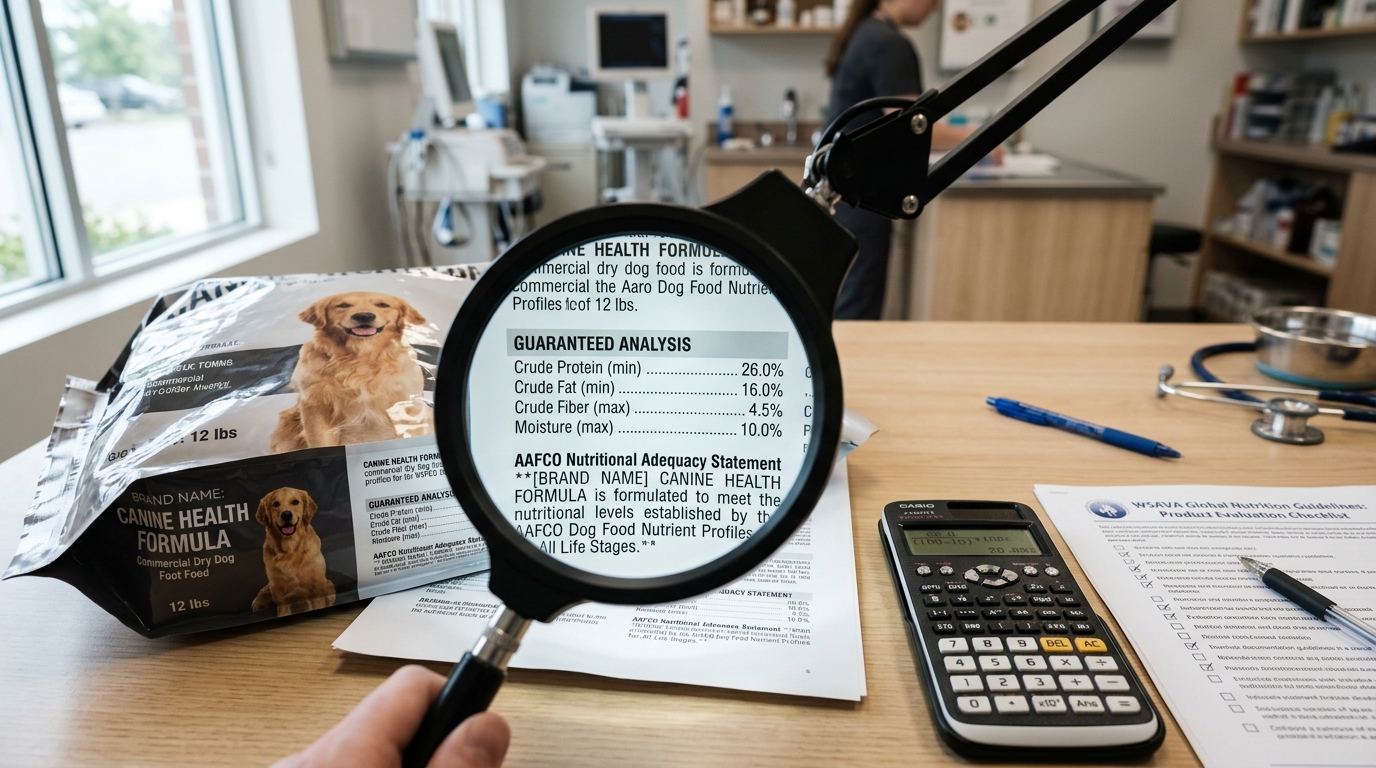
Reading a commercial pet food label requires looking past human-targeted marketing buzzwords and focusing on the legally regulated sections: the AAFCO Nutritional Adequacy Statement, the Guaranteed Analysis, and the specific Life Stage designation. Always confirm whether the food was validated through feeding trials or laboratory formulation, and convert wet and dry food nutrient values to a dry matter basis (DMB) before comparing protein, fat, or fiber percentages.
By learning to decode the Association of American Feed Control Officials (AAFCO) adequacy statement, convert the Guaranteed Analysis into a Dry Matter Basis, and identify deceptive manufacturing tactics like ingredient splitting, you can choose foods based on verified nutritional science rather than advertising narratives.
1. Decode the Front Panel: Legal Product Naming Rules
In the United States and many global jurisdictions adhering to AAFCO model regulations, the exact wording of a pet food’s title legally dictates the minimum percentage of the named meat ingredient inside the product. Manufacturers use these four strict naming rules:
| AAFCO Naming Rule | Example Product Name | Required Meat Percentage | Clinical Reality for Pet Parents |
|---|---|---|---|
| The 95% Rule | “Beef for Dogs” or “Chicken Cat Food” | At least 95% of total ingredients (excluding added water for processing), or 70% including water. | Simple, single-ingredient canned or fresh foods. The named animal protein comprises virtually the entire recipe. |
| The 25% “Dinner” Rule | “Chicken Dinner,” “Salmon Recipe,” “Lamb Formula,” or “Turkey Platter” | At least 25% of total ingredients (excluding water), or roughly 10% including water. | Any qualifying descriptor (Dinner, Formula, Entrée, Feast, Recipe) drops the mandatory meat content down to one-quarter of the food. |
| The 3% “With” Rule | “Dog Food with Real Salmon” or “Cat Stew with Turkey” | At least 3% of the total product must be the named ingredient. | The word “with” is a major marketing loophole. A food called “Dog Food with Real Beef” only needs to contain 3% beef. |
| The “Flavor” Rule | “Beef Flavor Dog Food” or “Tuna Flavored Feline Pouch” | 0% minimum meat required; must only produce a detectable flavor profile during palatability testing. | The product may contain no actual beef or tuna meat at all, utilizing animal digests, broths, or synthetic flavorings instead. |
2. The Nutritional Adequacy Statement: The Most Critical Sentence
The AAFCO statement (or Statement of Nutritional Adequacy) is the single most crucial piece of text on any pet food package. By law, it must appear on complete commercial pet foods, usually printed in tiny font on the back or bottom panel. It answers three clinical questions: Is the food complete and balanced? Which life stage is it for? And how was that adequacy substantiated?
Three Categories of Life Stage
- Adult Maintenance: Formulated to sustain non-reproducing adult animals with normal activity levels. It provides baseline nutrient minimums without excess calories or minerals.
- Growth and Reproduction: Formulated with elevated protein, fat, calcium, phosphorus, and essential fatty acids (DHA) to support rapidly developing kittens, puppies, and pregnant or lactating mothers.
- All Life Stages: By definition, any food labeled for “All Life Stages” must meet the nutritional minimums for Growth and Reproduction. Feeding an All Life Stages food to a sedentary, neutered adult dog or indoor senior cat can easily contribute to excessive caloric intake, obesity, and mineral imbalances.
Large-Breed Puppy Nuance
If you are raising a puppy whose adult weight is projected to exceed 70 pounds, you must check for a specific qualifying phrase in the AAFCO statement: “[Product Name] is formulated to meet the nutritional levels established by the AAFCO Dog Food Nutrient Profiles for growth/all life stages including growth of large size dogs (70 lbs. or more as an adult).” If it states “except for growth of large size dogs,” the food contains excessive or uncontrolled calcium and phosphorus levels that can trigger developmental orthopedic diseases such as osteochondritis dissecans (OCD) and hypertrophic osteodystrophy (HOD).
Formulation vs. Feeding Trials
Adequacy is substantiated through two distinct methodologies:
- “Formulated to meet…”: The manufacturer calculated nutrient values using computer software and ingredient database averages, or sent a batch to a laboratory for chemical assay. While compliant, it does not evaluate nutrient bioavailability, intestinal digestibility, or long-term palatability.
- “Animal feeding tests using AAFCO procedures substantiate…”: The gold standard in veterinary nutrition. The food was fed to live cohorts of animals under strict veterinary clinical monitoring, blood panels, and physical examinations over several months. This proves real-world biological digestibility and nutrient absorption.
3. Ingredient Lists and Deceptive Splitting Tactics
By regulation, ingredients must be listed in descending order by weight prior to cooking and processing. While this seems straightforward, manufacturers utilize legal food labeling techniques that can mislead consumers about the true primary protein source.
The Moisture Fallacy: Whole Meat vs. Meat Meal
Fresh whole meats (such as “Deboned Chicken,” “Fresh Beef,” or “Salmon”) contain approximately 70% to 75% natural water by weight. When the raw meat slurry is extruded through high-heat processing into dry kibble, virtually all that water is evaporated. Consequently, fresh chicken that weighed 30 pounds before cooking may contribute only 6 to 8 pounds of dry protein in the finished kibble.
In contrast, “Chicken Meal” or “Lamb Meal” has already undergone commercial rendering, cooking, and dehydration. It contains less than 10% moisture and roughly 65% concentrated bioavailable protein. When evaluated on a dry matter basis, a diet listing “Chicken Meal” as the second ingredient often provides substantially more animal protein than a food listing fresh “Deboned Chicken” as the first ingredient.
Exposing Ingredient Splitting
Ingredient splitting is a formulation strategy used to manipulate the order of the ingredient list. Because ingredients are sorted by pre-cooking weight, a manufacturer can divide a single botanical ingredient into multiple smaller sub-components so that meat remains listed in the coveted number-one spot:
| Split Ingredient Listing | Aggregated True Composition | Consumer Perception vs. Reality |
|---|---|---|
| 1. Deboned Chicken (22%) 2. Whole Peas (14%) 3. Pea Flour (12%) 4. Pea Protein (10%) | Total Legumes = 36% Total Chicken (wet) = 22% (drops to ~6% dry) | The buyer believes chicken is the primary ingredient. In reality, the diet is overwhelmingly composed of pulse legumes. |
| 1. Salmon (20%) 2. Brewers Rice (12%) 3. Rice Bran (10%) 4. Rice Flour (9%) | Total Rice = 31% Total Salmon (wet) = 20% (drops to ~5% dry) | Rice is split into three milling fractions to conceal that grain carbohydrates dominate the formula. |
4. Guaranteed Analysis vs. Dry Matter Basis (DMB) Calculation
The Guaranteed Analysis panel provides minimum percentages for crude protein and crude fat, and maximum percentages for crude fiber and moisture. However, these numbers represent an “As-Fed” basis, including all water content. Comparing a dry kibble (10% moisture) to a canned wet food (78% moisture) directly from the label creates a false comparison:
- Dry Kibble on Label: Crude Protein = 26%, Moisture = 10%
- Canned Food on Label: Crude Protein = 8.5%, Moisture = 78%
At first glance, the dry kibble appears to have triple the protein of the canned food. To determine the true biological protein density, you must calculate the nutrient levels on a Dry Matter Basis (DMB) by mathematically removing water:
The 2-Step DMB Formula
- Calculate Total Dry Matter:
Dry Matter % = 100% - Moisture % - Calculate Nutrient on Dry Matter Basis:
Nutrient (DMB) % = (Nutrient % As-Fed / Dry Matter %) * 100
Worked Clinical Comparison
| Step | Dry Kibble Calculation | Canned Wet Food Calculation |
|---|---|---|
| 1. Dry Matter Calculation | 100% – 10% Moisture = 90% Dry Matter | 100% – 78% Moisture = 22% Dry Matter |
| 2. Protein DMB Calculation | (26% Protein / 90%) * 100 = 28.8% Protein (DMB) | (8.5% Protein / 22%) * 100 = 38.6% Protein (DMB) |
| Clinical Verdict | Contains 28.8% protein once water is removed. | Contains 38.6% protein on a dry matter basis—substantially higher than the kibble! |
5. Caloric Density and True Feeding Portions
Commercial pet foods are legally required to list caloric density, reported as metabolizable energy (ME) in kilocalories per kilogram (kcal/kg) and kilocalories per familiar household measuring unit (such as kcal/cup or kcal/can).
Standard feeding guidelines printed on commercial bags are generic estimates calculated for active, intact adult animals. For neutered, indoor pets living sedentary urban lifestyles, following bag guidelines frequently results in 20% to 30% caloric overfeeding, directly driving canine and feline obesity.
- Use an 8-Ounce Measuring Cup: Always use a standardized 8-ounce kitchen measuring cup or, ideally, weigh food daily in grams on a digital kitchen scale. A standard drinking mug can hold 30% more kibble than an 8-ounce cup, unintentionally inflating daily calories.
- The 10% Treat Rule: All daily treats, dental chews, table scraps, and training rewards must comprise no more than 10% of your pet’s total daily caloric allowance to avoid diluting essential micronutrients.
6. Beyond the Bag: The WSAVA Manufacturer Audit
The World Small Animal Veterinary Association (WSAVA) Global Nutrition Committee recommends evaluating the pet food manufacturer itself rather than relying solely on packaging claims. Contact customer service or review the brand’s published documentation against these core quality standards:
- Veterinary Expertise: Does the company employ full-time clinical specialist veterinary nutritionists (Diplomates of the ACVN/ECVCN) or PhD animal nutritionists on staff to formulate their diets?
- Manufacturing Ownership: Does the company own and operate its own certified manufacturing facilities, or do they outsource production to third-party contract co-packers?
- Quality Control and Lot Testing: Does the manufacturer implement strict Hazard Analysis Critical Control Point (HACCP) programs and test each ingredient batch and finished lot for salmonella, mycotoxins, heavy metals, and nutrient compliance before warehouse release?
- Published Research: Has the manufacturer published peer-reviewed nutritional research studies in indexed veterinary science journals?
Veterinary Escalation Boundary: When to Consult Your Veterinarian
If your pet experiences chronic loose stools, vomiting, unexplained weight loss, or persistent skin itching after transitioning foods, contact a veterinarian promptly to schedule a full clinical and dietary evaluation. Sudden gastrointestinal distress, refusal to eat for over 24 hours, or rapid abdominal distension are clinical red flags that require immediate veterinary triage.
Always consult your primary care veterinary team before transitioning pets with underlying metabolic conditions—including chronic kidney disease, congestive heart failure, diabetes mellitus, recurrent urinary stones, or pancreatitis—as these patients require targeted therapeutic clinical diets with tightly controlled nutrient profiles.
Clinical Practice Tool: Pet Food Label Comparison Worksheet
Evaluate guaranteed analysis percentages, protein quality, and calorie density side-by-side using our free printable Pet Food Label Comparison Worksheet. Download and print your copy of the Pet Food Label Comparison Worksheet, or explore all practical pet care guides in the NewsPet Resource Center.
Frequently Asked Questions
What is an AAFCO nutritional adequacy statement on pet food?
An AAFCO statement confirms whether a pet food is formulated to provide complete and balanced nutrition for a specific life stage (such as growth/reproduction, adult maintenance, or all life stages), verified either through nutritional formulation or feeding trials.
How do I compare protein on a dry matter basis?
To compare canned wet food and dry kibble accurately, convert guaranteed analysis percentages to Dry Matter (DM) basis: divide the reported nutrient percentage by the dry matter percentage (100% minus the moisture percentage) and multiply by 100.
What does ingredient splitting mean on a pet food label?
Ingredient splitting occurs when manufacturers divide a single ingredient (such as peas or corn) into multiple sub-components (like pea flour, pea protein, and whole peas) so that meat can appear first on the ingredient list by weight before cooking.
Are grain-free pet foods healthier for dogs and cats?
Not necessarily. Unless a pet has a medically diagnosed grain allergy, grains provide essential digestible carbohydrates and fiber. In dogs, certain boutique, exotic-ingredient, or grain-free diets high in legumes have been investigated by the FDA for potential associations with diet-associated dilated cardiomyopathy (DCM).
Sources
Sources checked: September 8, 2026.
- FDA Center for Veterinary Medicine: Pet Food Labels and Claims
- AAFCO: Reading Pet Food Labels and Nutritional Adequacy Statements
- WSAVA: Global Nutrition Committee Guidelines and Savvy Pet Owner Guide
- Tufts Clinical Nutrition Service (Petfoodology): How to Read a Pet Food Label
- Cornell University Riney Canine Health Center: How to Read a Dog Food Label
Emergency Triage Matrix: Clinical Presentation & Required Response
| Triage Level | Clinical Signs & Presentation | Immediate Action Protocol |
|---|---|---|
| Tier 1: Immediate Emergency (0–2 Hours) | Acute tetany, pathological bone fractures in a growing puppy, or sudden blindness/dilated pupils in a cat fed unsupplemented vegan or specialty boutique food. | Immediate emergency hospital transport; evaluation of ionized calcium and taurine levels, ECG monitoring, and critical nutritional stabilization. |
| Tier 2: Urgent Veterinary Care (Same-Day) | Chronic unformed stool, poor hair coat, severe muscle loss, or unexplained lethargy after switching to a boutique or non-standard commercial diet. | Veterinary dietary evaluation; serum chemistry profile, gastrointestinal panel (cobalamin, folate, cPLI/fPLI), and structured dietary reassessment. |
| Tier 3: Home Monitoring & Scheduled Care | Healthy adult dog or cat with normal BCS, good stool quality, and vigorous energy eating a verified complete and balanced commercial diet. | Verify the AAFCO statement annually, adjust portion sizes according to body condition scoring, and transition diets slowly over 7 to 10 days when switching brands. |
Rule S1 Boundaries & Label Reading Misconceptions
Veterinary clinical standards require careful interpretation of nutritional claims:
- NEVER feed food labeled ‘intermittent or supplemental use only’ as a primary diet: Products bearing this designation lack essential micro-nutrients (taurine, calcium, trace minerals) and will induce severe clinical deficiencies within weeks if fed exclusively.
- NEVER compare wet and dry foods using the ‘As-Fed’ Guaranteed Analysis: Canned food containing 78% moisture appears to have low protein (e.g., 10%) on an as-fed basis, but provides over 45% protein on a dry matter basis; always calculate DMB.
- NEVER assume marketing terms like ‘holistic’, ‘human-grade’, or ‘premium’ have legal definitions: These terms are unregulated advertising phrases with zero veterinary or regulatory nutritional standards enforced by AAFCO or the FDA.
- NEVER feed an adult maintenance diet to growing large-breed puppies or pregnant queens: Large-breed puppies require precise calcium-to-phosphorus limits to prevent developmental orthopedic diseases (hip dysplasia, osteochondrosis); adult diets fail these safety profiles.
Caregiver Pet Food Label Audit Checklist
- Locate the AAFCO Nutritional Adequacy Statement and confirm it states ‘complete and balanced’ for your pet’s exact life stage.
- Verify whether nutritional adequacy was proven via AAFCO Feeding Trials or formulated to meet AAFCO Nutrient Profiles.
- Convert the Guaranteed Analysis values to Dry Matter Basis (DMB = % As-Fed Nutrient ÷ [100 – % Moisture] × 100) before comparing foods.
- Inspect the first three to five ingredients to verify named whole animal proteins (e.g., deboned chicken, salmon meal) rather than non-specific generic fats or fillers.
- Confirm the manufacturer provides a toll-free contact number, employs full-time veterinary nutritionists, and owns their manufacturing facilities.
Related Clinical Guides & Tools
Peer-Reviewed Clinical References & Evidence Grounding
- PMID: 33769611: International veterinary canine dyskinesia task force ECVN consensus statement: Terminology and classification (J Vet Intern Med, 2021) (opens in new tab)
- PMID: 38351524: Defining sepsis in small animals (J Vet Emerg Crit Care (San Antonio), 2024) (opens in new tab)
- PMID: 38474142: Canine Mammary Tumors: Classification, Biomarkers, Traditional and Personalized Therapies (Int J Mol Sci, 2024) (opens in new tab)
- Merck Veterinary Manual — Small Animal Clinical Medicine & Emergency Reference (opens in new tab)
WSAVA 10% Treat Calorie Allowance Calculator
Calculate your pet's daily Resting Energy Requirement (RER) and maximum recommended 10% treat calorie budget based on WSAVA clinical nutrition consensus.
Printable tools
Download the matching worksheet
Source transparency
Reference mix for this guide
Source labels describe the type of organization behind each reference; they are not a claim that any outside organization reviewed this article.
- FDA Center for Veterinary Medicine: Pet Food Labels and Claims Government or public agency · fda.gov
- AAFCO: Reading Pet Food Labels and Nutritional Adequacy Statements Pet food standards · aafco.org
- WSAVA: Global Nutrition Committee Guidelines and Savvy Pet Owner Guide Veterinary organization · wsava.org
- Tufts Clinical Nutrition Service (Petfoodology): How to Read a Pet Food Label Academic or extension · sites.tufts.edu
- Cornell University Riney Canine Health Center: How to Read a Dog Food Label Academic or extension · vet.cornell.edu
- Foods Dogs & Cats Cannot Eat: Toxic List & Reference source · newspet.net
- Pet Food Recalls: How to Check Lot Codes & Res Reference source · newspet.net
- Raw Pet Food Risks: What to Know Before Feeding Ra Reference source · newspet.net