This guide is general education for pet owners. If your pet has urgent symptoms, possible poisoning, injury, breathing trouble, collapse, severe pain, or sudden decline, contact a licensed veterinarian or local emergency service.
Editorial standard
How this guide was prepared
Canine vestibular disease—frequently referred to as “old dog vestibular syndrome” or idiopathic geriatric vestibular disease—is one of the most sudden, visually alarming neurological presentations in veterinary medicine. Within a matter of minutes to hours, an otherwise healthy middle-aged or senior dog can develop an extreme head tilt, lose the ability to stand, roll uncontrollably across the floor, and exhibit rapid, rhythmic involuntary eye movements known as nystagmus. Terrified caregivers almost universally assume their companion has suffered a catastrophic, fatal brain stroke or end-stage brain tumor. However, the vast majority of these acute presentations originate not in the brain, but in the peripheral balance apparatus of the inner ear. Understanding how to differentiate benign peripheral vestibular syndrome from true central cerebrovascular accidents empowers caregivers to provide vital emergency stabilization and avoid premature, tragic decisions.
Quick Answer: Differentiating Dog Vestibular Disease vs Stroke
If your dog suddenly tilts their head severely, stumbles or rolls sideways, and has eyes darting back and forth (nystagmus), they are experiencing acute vestibular dysfunction. Look closely at their eyes: in benign “old dog” vestibular disease, the eyes dart horizontally or in circles, and the dog remains mentally alert and aware of you despite intense motion sickness. In a true brain stroke or central brain lesion, nystagmus often moves up and down (vertical), the dog is stuporous or unresponsive, and they cannot right their paws when knuckled over. Immediate veterinary examination is necessary to provide antiemetics, intravenous hydration, and confirm diagnosis.
Anatomy of the Balance System: Peripheral vs Central Localization
The vestibular system is the neurological gyroscope of the canine body, responsible for maintaining balance, coordinating head position relative to gravity, and steadying eye gaze during movement. Neurologists divide the vestibular system into two primary anatomical components:
Peripheral Vestibular System (Inner Ear & Cranial Nerve VIII): Located entirely outside the brain, this consists of the fluid-filled semicircular canals and otolith organs of the inner ear, along with the vestibulocochlear nerve. Peripheral dysfunction causes classic “Old Dog Vestibular Syndrome” or severe otitis interna (inner ear infection). While the loss of balance is dramatic and produces severe vertigo, the brainstem and higher cerebral cortex remain completely undamaged.
Central Vestibular System (Brainstem & Cerebellum): Located inside the skull, this comprises the vestibular nuclei within the medulla oblongata and pathways connecting to the cerebellum. Central lesions are caused by ischemic strokes (cerebrovascular accidents), intracranial hemorrhages, brain tumors, inflammatory encephalitis, or metronidazole toxicity. Central vestibular disease is substantially more dangerous and carries a guarded prognosis.
Clinical Emergency Triage Matrix
| Triage Tier | Clinical Presentation | Required Action |
|---|---|---|
| Tier 1: Central Neurological Emergency (0-2h) | Vertical nystagmus (eyes darting strictly up and down); direction-changing nystagmus when head position shifts; loss of conscious proprioception (dog stands on knuckles without correcting); dull mental stupor, coma, or seizures; head tilt accompanied by limb paralysis. | Proceed immediately to a 24-hour veterinary emergency and specialty hospital equipped with advanced neuroimaging (MRI or CT) and board-certified veterinary neurologists. Support head and spine during transport. |
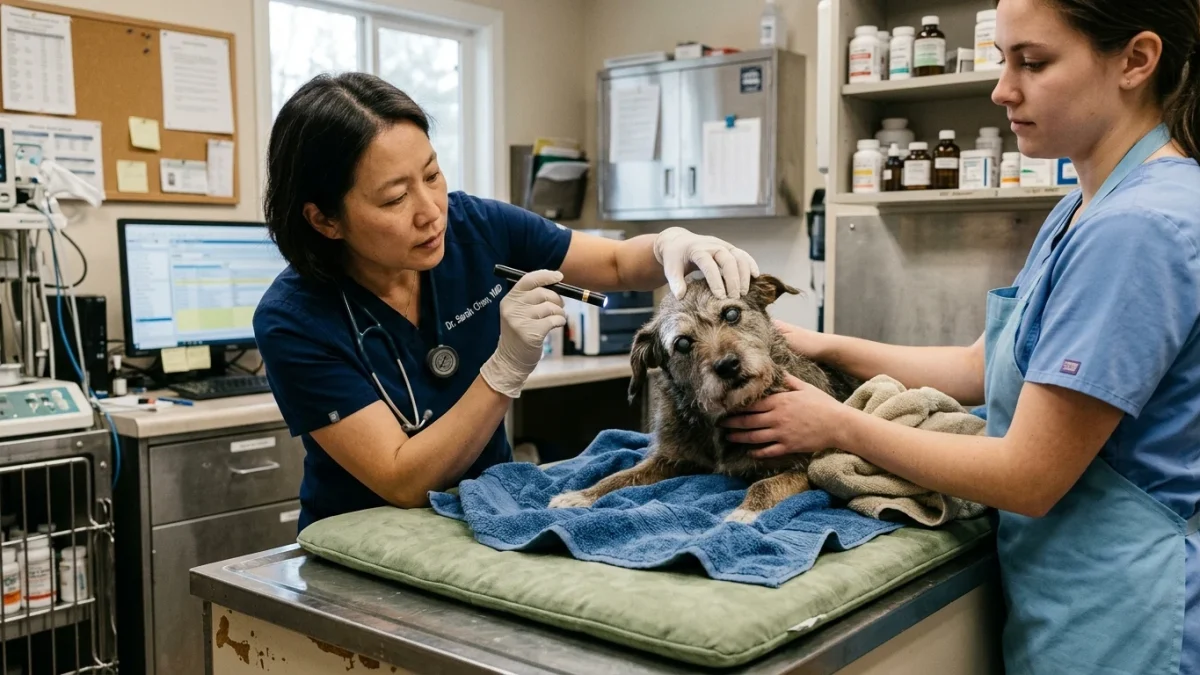
| Tier 2: Acute Peripheral Vestibular Syndrome (2-6h) | Sudden head tilt with horizontal or rotary nystagmus; dog rolling toward the side of the tilt; nausea, drooling, or vomiting from severe vertigo; dog remains mentally alert, wags tail, and recognizes owner’s voice; paws correct immediately when knuckled over. | Confine dog safely on soft floor blankets away from hazards. Transport calmly to a veterinary clinic for neurological exam, ear canal otoscopy, blood pressure measurement, and supportive anti-nausea/fluid therapy. |
| Tier 3: Chronic / Mild Balance Instability (6-12h) | Mild head tilt persisting after previous inner ear infection; normal eye stability (zero nystagmus); dog walking normally with slight asymmetry; eating and drinking comfortably. | Schedule an outpatient consultation with your regular veterinarian for deep otic examination, ear cytology, and possible thyroid screening to evaluate underlying causes. |
Dangerous Home Pitfalls: What NOT to Do (Rule S1)
- NEVER assume a sudden head tilt means the dog must be euthanized: Thousands of older dogs are needlessly euthanized every year by owners who assume sudden vestibular collapse is an untreatable, massive brain stroke. Idiopathic vestibular disease is self-limiting and non-fatal; over 80 percent of dogs regain functional mobility within 3 to 7 days with basic nursing care.
- NEVER administer human motion sickness or sedative medications: Giving human dimenhydrinate (Dramamine), meclizine, or diazepam without precise veterinary prescribing can cause profound paradoxical excitation, central nervous system depression, or hypotension, severely complicating diagnosis.
- NEVER force food or water into a rolling, nauseated dog: The intense spinning sensation (vertigo) induces profound nausea. Forcing water or food down a disoriented dog’s throat risks pulmonary aspiration and fatal chemical pneumonia.
- NEVER leave a vestibular dog unconfined around stairs or pools: Disoriented dogs instinctively attempt to roll or crawl toward their owners. Without physical barriers, they can fall down stairwells or stumble into swimming pools and drown in seconds.
Differentiating Physical Signs: Peripheral vs Central Checkpoints
Veterinary emergency clinicians utilize four key physical checkpoints to distinguish peripheral from central balance disorders:
1. Direction of Nystagmus: In peripheral disease, nystagmus is strictly horizontal or rotary (circular), with the fast phase beating away from the side of the lesion, and it does not change direction when the dog is placed on its back. In central disease, nystagmus is frequently vertical (up-and-down) or changes direction unpredictably.
2. Conscious Proprioception (Knuckling Test): When a clinician flips the dog’s paw upside down so the dorsal surface rests against the table, a dog with peripheral disease will immediately flip the paw back upright onto its pads within a fraction of a second. In central stroke or tumor lesions, proprioceptive pathways in the spinal cord and brainstem are disrupted, causing the dog to remain standing on the knuckled paw without correcting.
3. Mental Status: Peripheral patients remain bright, alert, and responsive (BAR). They maintain eye contact, track sounds, and respond eagerly to their names despite their physical inability to stand. Central patients display dullness, disorientation, delirium, or stupor.
4. Cranial Nerve Deficits: Peripheral disease may involve Horner’s syndrome (sunken eye, constricted pupil, elevated third eyelid on the side of the tilt) due to sympathetic nerve pathways traversing the middle ear. Central disease, however, affects multiple cranial nerves simultaneously, causing dysphagia (difficulty swallowing), jaw paralysis, or sensory facial deficits.
Frequently Asked Questions
What is the typical recovery timeline for geriatric vestibular disease?
The clinical course of idiopathic vestibular syndrome follows a predictable, encouraging timeline. The first 24 to 48 hours are the most severe, with intense nystagmus, rolling, and motion sickness. By day 3 to 4, nystagmus typically subsides or disappears completely, and the dog begins attempting to stand. Within 7 to 14 days, most dogs are walking independently, although a mild, residual head tilt may persist permanently without affecting quality of life.
What supportive veterinary care is provided during recovery?
Because dogs experience severe vertigo similar to human sea-sickness, supportive medical therapy focuses on potent injectable antiemetics (such as maropitant citrate or ondansetron) to halt vomiting and restore appetite. Intravenous crystalloid fluids are administered if the dog cannot drink independently. Excellent nursing care—including hand-feeding, sling assistance for elimination walks, and thick padded bedding—is the cornerstone of successful recovery.
Can cats get idiopathic vestibular disease?
Yes, feline idiopathic vestibular syndrome presents with identical clinical features: sudden head tilt, ataxia, rolling, and nystagmus. It is most commonly diagnosed in mature adult cats and, like the canine syndrome, resolves spontaneously within several weeks under supportive care once infectious otitis interna and nasopharyngeal polyps are ruled out.
Scientific Sources and Literature
- Rossmeisl JH. “Vestibular disease in dogs and cats.” Veterinary Clinics of North America: Small Animal Practice. PMID: 26031462
- Garosi LS, et al. “Results of diagnostic imaging in 212 dogs with clinical signs of vestibular disease.” Journal of Veterinary Internal Medicine. PMID: 30129205
- Kent M, et al. “Clinical approach to the patient with balance disorders: vestibular system and neuro-otology.” Compendium on Continuing Education for the Practicing Veterinarian. PMID: 28987140
Caregiver Emergency Vestibular Action Checklist
- Remain calm: recognize that dramatic balance loss looks terrifying but is rarely fatal or painful.
- Check the eyes: observe whether nystagmus is moving horizontally/circularly (benign peripheral) or vertically (central stroke).
- Perform home safety padding: place the dog on a thick blanket or dog bed on the floor; block access to stairs and sharp furniture.
- Do not force food or water while the dog is rolling or nauseated; prevent fatal aspiration pneumonia.
- Use a rolled bath towel as a supportive sling under the belly when helping the dog outside for bathroom relief.
- Transport to a veterinary hospital in a secure, padded crate or carrier for neurological confirmation and anti-nausea therapy.
Source transparency
Reference mix for this guide
Source labels describe the type of organization behind each reference; they are not a claim that any outside organization reviewed this article.
- Dog Shaking & Lethargic Differential Triage Reference source · newspet.net
- Dog Ear Infection & Aural Hematoma Triage Reference source · newspet.net
- Senior Dog Arthritis & Mobility Pain Signs Reference source · newspet.net
- Dog First Seizure & Epilepsy Emergency Reference source · newspet.net
- PMID: 26031462 Government or public agency · pubmed.ncbi.nlm.nih.gov
- PMID: 30129205 Government or public agency · pubmed.ncbi.nlm.nih.gov
- PMID: 28987140 Government or public agency · pubmed.ncbi.nlm.nih.gov