This guide is general education for pet owners. If your pet has urgent symptoms, possible poisoning, injury, breathing trouble, collapse, severe pain, or sudden decline, contact a licensed veterinarian or local emergency service.
Editorial standard
How this guide was prepared
Acute foreign body airway obstruction—commonly known as choking—is one of the most frightening, hyper-acute emergencies a pet owner can witness. When an object such as a rubber ball, rawhide chew, bone fragment, chew toy, or small stone lodges tightly in the pharynx, larynx, or proximal trachea, the animal’s airway is physically sealed. Within seconds, complete mechanical occlusion arrests alveolar ventilation, causing rapid arterial hypoxemia and carbon dioxide retention (hypercapnia). The animal experiences sheer panic and air hunger. As the pet generates violent, negative intrathoracic inspiratory efforts against the blocked glottis, marked hydrostatic pressure gradients develop across pulmonary capillaries, predisposing the animal to severe, life-threatening non-cardiogenic pulmonary edema. Immediate, decisive first-aid action is required to restore airflow before irreversible anoxic brain injury or cardiac arrest occurs.
Quick Answer: Immediate First Aid for a Choking Dog or Cat
If your pet is silently gasping, pawing frantically at their mouth, turning blue at the tongue, or collapsing, they are choking. First, carefully open the mouth by pressing the upper lips over the teeth; if an object is clearly visible at the back of the tongue, gently sweep it out with a hooked finger. If the object cannot be reached immediately, perform the veterinary Heimlich maneuver: for standing dogs, place your arms around their abdomen behind the ribcage, make a fist, and deliver 4 to 5 firm upward and forward thrusts toward the chest. Transport your pet immediately to an emergency veterinary facility for oxygen therapy and laryngeal examination.
Differentiating True Choking from Coughing and Reverse Sneezing
Caregivers frequently confuse benign respiratory events with life-threatening choking emergencies. Distinguishing these presentations prevents dangerous, unnecessary interventions:
True Choking (Mechanical Airway Obstruction): The defining characteristic of true choking is the absence of normal vocalization or cough sound. The animal is silent or produces faint, high-pitched squeaks. They paw desperately at their face, extend their neck horizontally, display wide bulging panic-stricken eyes, and exhibit exaggerated abdominal heave without chest airflow. Within 60 to 90 seconds, the tongue and gums turn dusky cyanotic blue or purple, followed by collapse and loss of consciousness.
Coughing and Gagging (Kennel Cough / Hairball): A dog with kennel cough or a cat retching a hairball generates loud, forceful hacking, honking, or retching sounds. Air is moving vigorously through the respiratory tract. Mucous membranes remain healthy pink, and the pet is alert and capable of walking.
Reverse Sneezing (Pharyngeal Spasm): Common in small and brachycephalic dogs, reverse sneezing produces a series of rapid, loud, snorting inspiratory gasps lasting 30 to 60 seconds. While visually alarming, the dog stands completely still with a stiff posture, gums remain pink, and the episode resolves spontaneously without hypoxia.
Clinical Emergency Triage Matrix
| Triage Tier | Clinical Presentation | Required Action |
|---|---|---|
| Tier 1: Complete Airway Obstruction (0-5 min) | Silent gasping with zero airflow; cyanotic blue or purple tongue and gums; frantically pawing at mouth; collapse or loss of consciousness; dilated pupils. | Open mouth to inspect airway. If object is visible, sweep it out. If not, execute 4-5 Heimlich abdominal thrusts immediately. If unconscious, begin rescue chest compressions. Transport to emergency hospital with phone alert while en route. |
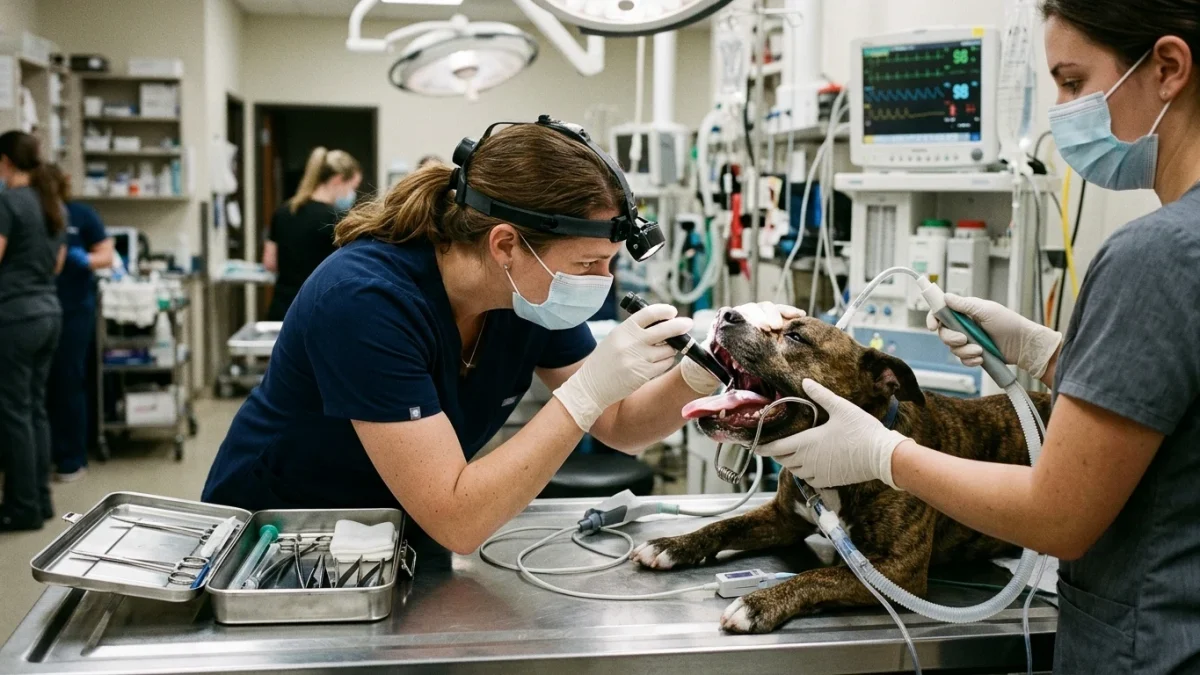
| Tier 2: Partial Airway Obstruction (5-30 min) | Audible harsh inspiratory stridor (high-pitched whistling); persistent violent gagging; pet conscious, highly anxious, pacing; gums dusky dark pink or slightly pale. | Do not stress or restrain the animal tightly. Provide flow-by oxygen if available. Keep head extended and transport immediately to an emergency hospital for sedation, direct laryngoscopy, and endoscopic extraction. |
| Tier 3: Resolved Choking Episode (Post-Extraction) | Object successfully dislodged at home; pet breathing comfortably with normal pink gums and clear lung sounds; mild coughing or throat clearing. | Schedule an urgent veterinary consultation within 2 to 4 hours. All choking victims require chest radiographs to evaluate for non-cardiogenic pulmonary edema and laryngeal trauma. |
Dangerous Home Pitfalls: What NOT to Do (Rule S1)
- NEVER perform blind finger sweeps down the throat: Inserting your fingers blindly into the pharynx almost invariably pushes spherical balls or chew fragments deeper into the rima glottidis, transforming a partial obstruction into complete fatal asphyxiation. In their frantic panic, an oxygen-deprived pet will also clamp their jaws shut reflexively, causing catastrophic bite trauma to the caregiver.
- NEVER use household tools (pliers, tweezers, kitchen tongs): Metal tools lack tactile feedback and slip easily against wet objects, tearing the delicate pharyngeal mucosa, puncturing the soft palate, or fracturing dental crowns.
- NEVER compress the floating ribs or lower ribcage directly: In delivering Heimlich thrusts, force must be directed strictly to the soft abdomen immediately behind the last rib. Squeezing the lower ribcage fractures ribs and causes fatal lacerations of the liver or spleen.
- NEVER assume the pet is out of danger after dislodging the object: Even after the foreign body is cleared, animals frequently develop delayed non-cardiogenic pulmonary edema 2 to 12 hours later due to severe negative pressure barotrauma during choking. Professional veterinary thoracic examination is mandatory.
Step-by-Step Veterinary Heimlich Maneuver Protocol
When an object cannot be cleared by gentle direct visualization, perform the veterinary Heimlich maneuver tailored to the animal’s physical size:
For Medium to Large Dogs (Standing): Stand behind the dog straddling their spine, or kneel behind them. Wrap your arms around the abdomen, positioning your hands immediately caudal to (behind) the last rib. Form a fist with one hand and grasp it with your other hand. Deliver 4 to 5 quick, firm upward and forward thrusts toward the dog’s shoulders. The sudden elevation of intra-abdominal pressure pushes the diaphragm cranial into the thoracic cavity, generating a burst of positive airway pressure that expels the object like a cork from a bottle.
For Small Dogs and Cats: Hold the pet against your chest with their back resting against your stomach and their head facing upward. Place the knuckles of your fist into the soft indentation just beneath the sternum and ribcage. Deliver 3 to 4 gentle but firm inward and upward thrusts using two fingers or a small fist, taking care not to crush delicate cartilaginous structures.
For Unconscious Recumbent Pets: Lay the pet on their right side on a firm flat surface. Place one hand on the spine to brace the body, and place the palm of your other hand immediately behind the last rib. Push firmly inward and forward toward the neck. Follow with 2 to 3 firm chest compressions over the widest part of the ribcage to generate expelled airflow, then open the mouth to check if the object has been dislodged into the oral cavity.
Frequently Asked Questions
What is non-cardiogenic pulmonary edema after choking?
When an animal makes desperate, violent inspiratory efforts against a completely blocked airway, extreme negative pressure is generated inside the thoracic cavity and alveoli. This massive pressure vacuum pulls fluid directly from pulmonary capillaries into the alveolar air spaces, flooding the lungs with proteinaceous edema fluid. Even after the physical obstruction is removed, the animal can drown internally within hours unless treated with supplemental oxygen, diuretics, and intensive respiratory care.
What should I do if a round rubber ball is lodged in my dog’s throat?
Smooth rubber balls are the most dangerous choking objects because saliva makes them slippery and creates an airtight suction seal against the larynx. If Heimlich thrusts fail, use external manual elevation: place your thumbs on the outside of the dog’s throat beneath the ball and push upward and forward through the skin of the neck toward the mouth while an assistant opens the jaws. If this fails, immediate emergency tracheostomy performed by a veterinarian is the sole life-saving option.
Can cats choke on strings or yarn?
While cats rarely choke on large solid toys, they frequently ingest linear foreign bodies like thread, yarn, or tinsel. Often, one end becomes tangled around the base of the tongue while the remainder travels down the esophagus. If you see string under your cat’s tongue, NEVER pull it; pulling saw-like string cuts through intestinal tissue and creates perforating peritonitis. Seek immediate veterinary surgical intervention.
Scientific Sources and Literature
- Fletcher DJ, et al. “RECOVER evidence and knowledge gap analysis on veterinary CPR: Airway, ventilation, and emergency foreign body obstruction.” Journal of Veterinary Emergency and Critical Care. PMID: 24792448
- Rozanski EA. “Emergency management of upper airway obstruction in dogs and cats.” Veterinary Clinics of North America: Small Animal Practice. PMID: 28987128
- Levy NA, et al. “Negative pressure pulmonary edema in dogs: pathophysiology and clinical presentation in 18 cases.” Journal of Small Animal Practice. PMID: 31057435
Caregiver Emergency Choking Action Checklist
- Assess airflow immediately: determine if the pet is making vocal cough sounds or gasping in absolute silence.
- Open mouth carefully: pull upper lips over teeth to protect your fingers; visually inspect the back of the oral cavity with a flashlight.
- Remove foreign material ONLY if directly visible and graspable with a hooked finger; never sweep blindly.
- Perform size-appropriate Heimlich abdominal thrusts: deliver 4 to 5 firm forward and upward compressions behind the last rib.
- If pet collapses, check for dislodged object, clear mouth, and initiate emergency chest compressions.
- Transport immediately to a 24-hour veterinary emergency hospital for oxygenation, laryngeal assessment, and pulmonary edema monitoring.
Source transparency
Reference mix for this guide
Source labels describe the type of organization behind each reference; they are not a claim that any outside organization reviewed this article.
- Dog Swallowed Chicken Bone & Sharp Object Emergency Reference source · newspet.net
- Cat Open-Mouth Breathing & Respiratory Distress Reference source · newspet.net
- Dog Coughing & Gagging: Tracheal vs Cardiac Triage Reference source · newspet.net
- Dog Bleeding Wound & Hemorrhage First Aid Reference source · newspet.net
- PMID: 24792448 Government or public agency · pubmed.ncbi.nlm.nih.gov
- PMID: 28987128 Government or public agency · pubmed.ncbi.nlm.nih.gov
- PMID: 31057435 Government or public agency · pubmed.ncbi.nlm.nih.gov