
This guide is general education for pet owners. If your pet has urgent symptoms, possible poisoning, injury, breathing trouble, collapse, severe pain, or sudden decline, contact a licensed veterinarian or local emergency service.
Editorial standard
How this guide was prepared
Pet insurance plans are difficult to compare from a premium and a coverage label because the important differences appear when a claim is processed. Compare the same plausible events across each policy and record what is excluded, how owner payment is calculated, which limit applies, when coverage begins, and what may change at renewal.

Clinical Quick Answer & Immediate Actions
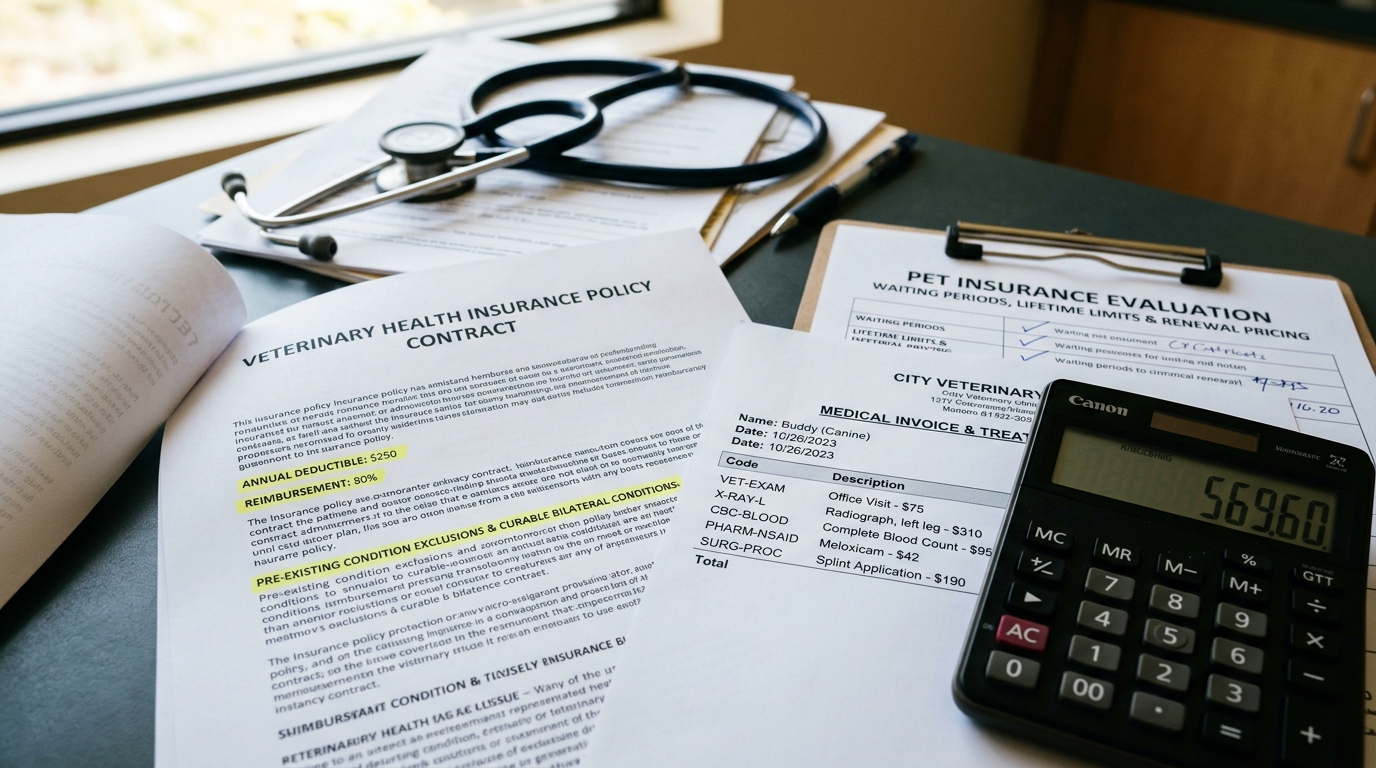
Pet health insurance is a vital financial mechanism that bridges the gap between gold-standard advanced veterinary medicine and economic euthanasia during critical medical crises. Modern emergency and specialty care—including surgical decompression for spinal disc disease, intensive care ventilation for aspiration pneumonia, hemodialysis, and MRI/CT diagnostic imaging—routinely ranges from $3,000 to over $10,000. Evaluating policies requires clinical scrutiny across five structural parameters: Pre-Existing Condition Definitions (temporary curable vs permanent chronic exclusions based on past medical charts), Bilateral Condition Clauses (excluding a contralateral cruciate ligament tear or cherry eye if the first side showed signs prior to enrollment), Deductible Models (annual vs per-incident deductibles), Reimbursement Calculations (reimbursement based on actual veterinary invoice vs restricted ‘usual and customary’ benefit schedules), and Specific Waiting Periods (14-day illness waits vs 6-month orthopedic waiting windows).
Policy wording, schedules, endorsements, applications, and renewal documents control the result. Terms and consumer protections vary by location, so treat examples as questions for the actual contract rather than predictions that an insurer will approve a future claim.
Choose claim scenarios before comparing prices
Use scenarios that expose different parts of the policy. Keep the veterinary event and invoice pattern identical across plans so a lower premium does not hide a narrower definition or limit.
| Scenario | Policy questions it exposes | Owner cash-flow question |
|---|---|---|
| New accident soon after enrollment | Accident waiting period, effective date, excluded events, examination fees, diagnostics, treatment, rehabilitation, and per-event or annual limits. | Must the clinic be paid first, and how much deductible, co-payment, or non-covered care remains? |
| Recurring signs with older records | Definition of pre-existing condition, bilateral or related-condition wording, symptom history, curable-condition rules, medical-record review, and appeal process. | Can the household fund assessment while eligibility is uncertain? |
| Long treatment spanning renewal | Annual or lifetime limits, condition sublimits, deductible reset, reimbursement basis, renewal changes, age-based terms, and continuing-condition treatment. | What changes when a new policy year starts or the premium rises? |
Give every plan the same hypothetical invoice sheet. One arithmetic-only example might total 1,200 local currency units: 100 for the examination, 300 for diagnostics, 700 for treatment, and 100 for medication. These figures are not expected prices. They are fixed worksheet inputs that prevent a reviewer from quietly giving one plan a cheaper event while comparing policy mechanics.
Add a fourth scenario only when it reflects a real concern, such as dental illness, prescription food, behavioral treatment, travel, or a breed-related condition. Do not assume those categories are included or excluded; find the relevant definition and benefit section.
Read exclusions and pre-existing-condition definitions together
An exclusion list may name conditions, treatments, body systems, preventive care, breeding, elective procedures, or activities. A definition section can broaden the effect by treating symptoms, related conditions, or conditions on the opposite side of the body as connected. Read both before marking a scenario covered.
Record the policy’s exact definition of pre-existing condition and the look-back period, if any. Check whether the wording refers to diagnosis, signs or symptoms, treatment, veterinary advice, or what a reasonable owner could have known. Ask how temporary or curable conditions are treated and whether a symptom-free period changes eligibility.
Provide medical history accurately. Do not omit earlier signs to improve a quote. If the insurer offers a medical-record review or an exclusion decision before a claim, ask for the result in writing and keep it with the policy. A sales statement is not a guaranteed claim decision.
Calculate reimbursement from the policy’s own sequence
Plans can apply eligible-charge rules, deductibles or excesses, reimbursement percentages, co-payments, fee schedules, and limits in different orders. Use a simple hypothetical invoice and follow the sequence described in the contract. Mark any step that is unclear instead of choosing the most favorable interpretation.
Check whether the deductible is annual, per condition, per claim, or another structure; whether it resets; and whether age changes the owner share. Confirm what amount the reimbursement percentage applies to and whether examination fees, taxes, dispensing fees, or prescribed items are eligible.
For a hypothetical Policy A, suppose the contract treats all 1,200 units as eligible, applies the remaining 200-unit annual deductible first, then reimburses 80 percent. The eligible balance after the deductible is 1,000, so the illustrated reimbursement is 800 and the owner total is 400. Record the 200 deductible and 200 co-payment separately because they may behave differently on a later claim. Use this sequence only if Policy A actually states it.
For a hypothetical Policy B, suppose the 100-unit examination is excluded, a 100-unit per-claim excess is subtracted from the remaining 1,100, and 90 percent would otherwise reimburse 900. If the relevant per-incident limit is 750, the illustrated reimbursement stops at 750 and the owner total is 450. A policy that applies the percentage, excess, fee schedule, or limit in another order needs a different calculation. Resolve the order from the wording or a written insurer explanation.
Then calculate the owner’s total: non-covered items, deductible, co-payment, amount above a benefit schedule, amount above a limit, and any clinic payment due before reimbursement. This is the figure that belongs in the household budget, not the advertised reimbursement percentage alone.
Map every limit to a scenario and a time period
Separate the overall annual or lifetime limit from per-condition, per-incident, category, treatment, or time limits. A high headline maximum can coexist with a small sublimit for diagnostics, rehabilitation, dental illness, medication, or another category.
Add remaining-limit columns to the worksheet. If Policy A has only 500 units left in the applicable annual limit when the same invoice occurs, its earlier 800-unit arithmetic result would be capped at 500, leaving 700 to the owner before considering payment timing. Repeat this check for every overall limit and sublimit; do not assume the largest number on the schedule governs the scenario.
For ongoing care, ask what happens when a condition crosses the policy anniversary. Does the limit refresh, stop after a time period, remain capped for the animal’s life, or depend on uninterrupted renewal? Check whether the deductible resets and whether claims from one event are grouped.
Use the long-treatment scenario to total owner payments over more than one policy period. Do not describe structures such as lifetime or time-limited as universally better; the wording and the household’s risk tolerance determine the tradeoff.
Put waiting periods and effective dates on a calendar
Record the application date, acceptance date, policy start, payment date, and separate waiting periods for accidents, illnesses, or named conditions. Coverage may not begin merely because a premium was paid or a quote was issued. Check how symptoms first noticed during a wait are treated later.
Place the identical events on that calendar. For example, mark an accident on day ten and first illness signs on day thirty-five, then compare each date with the policy’s stated effective date and separate waits. Move no date to make a plan look better. The worksheet should say eligible, in a waiting period, or unresolved according to the actual wording, never predict that a later claim will be paid.
Also record any examination, record-submission, vaccination, preventive-care, or enrollment requirements. If replacing a policy, do not cancel the existing plan until the new insurer has confirmed acceptance, effective dates, and how current or previous signs will be classified. A gap or new application can change pre-existing-condition treatment.
Compare renewal as a new decision, not an automatic repeat
Premiums, deductibles, co-payments, limits, definitions, endorsements, and available coverage can change subject to the contract and local rules. Some changes may relate to age, location, claims experience, veterinary costs, product changes, or other rating factors. The policy documents for the new term are the source of truth.
At renewal, rerun the three scenarios with the new schedule and wording. Compare the new documents with the prior version, save both, and ask for unexplained changes in writing. Consider the consequence of switching: conditions that developed under the current plan may be treated as pre-existing by a new plan.
Keep a renewal change log with the old clause, new clause, effective date, and scenario affected. Recalculate the same invoice rather than comparing premium movement alone. If a deductible resets, a limit shrinks, or a continuing condition receives different treatment, the log makes the owner-payment and switching consequences visible without assuming the present insurer or a replacement plan will accept a future claim.
A cheaper renewal alternative is not automatically interchangeable. Confirm the underwriter, administrator, complaint path, regulator or ombudsman where applicable, and cancellation terms for the actual location.
Test the claim workflow before care is urgent
- Who submits the claim, and by what deadline?
- Which medical records, invoices, clinical notes, estimates, or signatures are required?
- Does the owner normally pay first, or can an eligible clinic be paid directly?
- How are preauthorization and estimates handled, and do they guarantee payment?
- How are missing information, partial payment, denial, appeal, and complaint reviewed?
- Which contact details and policy number should another caregiver have?
Create a claim and complaint record before it is needed: submission date, documents sent, reference number, promised response date, decision, clause cited, appeal deadline, and each written reply. Also record the insurer, underwriter, administrator, and applicable external complaint body for the owner’s location. This is process evidence, not utilize to guarantee approval, and the current policy documents remain the final authority.
Save blank forms, current contact channels, the policy schedule, and complete veterinary records where a trusted person can find them. Ask the clinic about clinical and payment options separately from asking the insurer about eligibility; neither should be represented as the other’s final decision.
Choose the plan alongside the household budget
Insurance transfers some eligible risk; it does not fund routine care, exclusions, deductibles, co-payments, amounts above limits, transport, or every immediate clinic payment. Compare the premium with the reserve still required under each scenario. Self-funding or a hybrid may suit some households, but each leaves a different exposure if a large bill arrives early.
Run a cash-flow version of each scenario. Write the amount the clinic may require on the day, the funds available without delaying household essentials, the earliest possible claim submission, the policy’s stated processing information, and the balance remaining if reimbursement is partial or denied. Then add the next premium and routine-care payments. A plan can produce a lower eventual owner share yet still fail the household’s first-payment test, so keep accessible reserves in the comparison. Repeat the calculation with reimbursement arriving later than hoped and with one disputed item removed; both versions show whether routine care and housing remain funded while the claim is unresolved. Record whether the reserve can fund a second clinic deposit before the first claim resolves without interrupting routine care.
Use the monthly dog budget model or the monthly cat care budget to test premiums and owner payments against recurring care and contingency funds. The final output should be a one-page comparison showing the same scenarios, exact policy clauses, owner payment, timing, renewal risk, and unresolved questions for every plan.
Never delay urgent veterinary contact while trying to predict a claim. Seek care based on the animal’s needs, discuss estimates and payment with the clinic, and let the insurer make coverage decisions through its documented process.
Clinical Practice Tool: Monthly Pet Budget Planner
Compare pet insurance premiums, deductibles, and reimbursement options accurately with our free printable Monthly Pet Budget Planner. Download and print your copy of the Monthly Pet Budget Planner, or explore all practical pet care guides in the NewsPet Resource Center.
Sources
Sources checked: September 8, 2026.
- NAIC: Pet Insurance
- MoneyHelper: Pet Insurance
- Association of British Insurers: Pet Insurance
- AVMA: Do You Need Pet Insurance?
- CFPB: Understanding Pet Insurance
Emergency Triage Matrix: Clinical Presentation & Required Response
| Triage Level | Clinical Signs & Presentation | Immediate Action Protocol |
|---|---|---|
| Tier 1: Immediate Emergency (0–2 Hours) | Pet in critical shock requiring immediate life-saving surgery or ICU resuscitation (gastric dilatation-volvulus / bloat, polytrauma vehicular fracture, urinary blockage, septic peritonitis) where emergency estimates exceed $4,000–$8,000. | Do not delay immediate emergency medical authorization while waiting for insurance approval; authorize emergency resuscitation, inform hospital of policy details, and request an itemized clinical invoice and SOAP notes upon stabilization. |
| Tier 2: Urgent Veterinary Care (Same-Day) | Pet diagnosed with a severe progressive or chronic illness (e.g., cranial cruciate ligament rupture, lymphoma, diabetic ketoacidosis, chronic kidney disease) requiring advanced staging, ultrasound, and lifelong pharmacotherapy. | Submit clinical medical history and pre-authorization requests to your insurer; verify whether bilateral orthopedic exclusions apply, and request direct-pay to the veterinary hospital if supported. |
| Tier 3: Home Monitoring & Scheduled Care | Healthy juvenile or young adult pet with clean medical history, zero documented pre-existing clinical notes, and normal physical examination status. | Enroll in comprehensive accident-and-illness coverage immediately before pre-existing symptoms or clinical chart notes develop; clear all waiting periods while the pet remains healthy. |
Rule S1 Boundaries & Insurance Economic Rules
Managing veterinary health insurance requires adherence to clinical realities:
- NEVER postpone life-saving emergency veterinary care while awaiting insurance pre-authorization: Medical triage takes absolute priority over financial reimbursement; pet insurance operates primarily as a reimbursement model, and delaying surgery for GDV or hemorrhage is fatal.
- NEVER conceal past medical history or omit previous clinic visits on insurance applications: Insurance underwriting audits complete lifetime medical records upon the first major claim; undisclosed past symptoms result in immediate retroactive claim denial and policy cancellation.
- NEVER cancel an existing insurance policy before a new policy clears all waiting periods: Switching providers restarts all waiting periods (often 6 months for orthopedics) and permanently reclassifies all previously treated medical issues as uninsurable pre-existing conditions.
- NEVER assume wellness preventative care (vaccines, flea prevention) is covered under standard accident/illness policies: Core insurance covers unexpected emergency accidents and illnesses; routine dental scaling, spay/neuter, and preventative immunizations require separate optional wellness riders.
Caregiver Pet Insurance Evaluation & Policy Audit Checklist
- Obtain complete copies of your pet’s lifetime veterinary medical records from all prior clinics to review what pre-existing chart notes exist.
- Verify the deductible structure: select an ‘Annual Aggregate Deductible’ rather than a ‘Per-Incident Deductible’ to maximize payout for multiple health issues.
- Confirm reimbursement basis: choose a policy that reimburses a flat percentage (80% or 90%) of the ‘Actual Veterinary Bill’ rather than a capped benefit schedule.
- Examine the bilateral condition clause: clarify whether a future tear of the opposite knee (cranial cruciate ligament) is covered if one knee has a history.
- Audit waiting periods: note exact calendar dates for accident coverage (typically 24–48 hours), illness coverage (typically 14 days), and orthopedic conditions (typically 6 months).
- Check for direct-pay arrangements: verify whether the insurance company offers direct settlement to veterinary emergency hospitals to avoid paying high costs out-of-pocket.
Related Clinical Guides & Tools
Peer-Reviewed Clinical References & Evidence Grounding
- PMID: 33769611: International veterinary canine dyskinesia task force ECVN consensus statement: Terminology and classification (J Vet Intern Med, 2021) (opens in new tab)
- PMID: 38351524: Defining sepsis in small animals (J Vet Emerg Crit Care (San Antonio), 2024) (opens in new tab)
- PMID: 38474142: Canine Mammary Tumors: Classification, Biomarkers, Traditional and Personalized Therapies (Int J Mol Sci, 2024) (opens in new tab)
- mdpi.com (opens in new tab)
Printable tool
Download the matching worksheet
Source transparency
Reference mix for this guide
Source labels describe the type of organization behind each reference; they are not a claim that any outside organization reviewed this article.
- NAIC: Pet Insurance Reference source · content.naic.org
- MoneyHelper: Pet Insurance Reference source · moneyhelper.org.uk
- Association of British Insurers: Pet Insurance Reference source · abi.org.uk
- AVMA: Do You Need Pet Insurance? Veterinary organization · avma.org
- CFPB: Understanding Pet Insurance Government or public agency · consumerfinance.gov
- Separation Anxiety in Dogs: What to Do First (Calm Reference source · newspet.net
- Cat Litter Box Problems: Causes & Solutions (V Reference source · newspet.net
- Foods Dogs & Cats Cannot Eat: Toxic List & Reference source · newspet.net