Editorial standard
How this guide was prepared
Welcoming an adult cat into an established multi-cat household brings profound companionship, but ambiguous medical backgrounds or incomplete shelter intake certificates frequently confront caregivers with clinical dilemmas: Should core boosters be administered immediately? Does over-vaccination pose immunologic hazards? And how can clinicians definitively safeguard resident cats against lethal retroviral transmission, specifically Feline Leukemia Virus (FeLV) and Feline Immunodeficiency Virus (FIV)?
- Mandatory Pre-Introduction Retroviral Screening: In-clinic ELISA SNAP testing for Feline Leukemia Virus (FeLV) p27 antigen and Feline Immunodeficiency Virus (FIV) antibodies is mandatory before allowing any tactile contact or shared resource access with resident felines. FeLV transmits readily through saliva during mutual grooming, shared food dishes, and bite wounds.
- Core FVRCP Immunization Architecture: FVRCP protects against three severe feline viral pathogens: Feline Panleukopenia Virus (FPV), Feline Herpesvirus-1 (FHV-1), and Feline Calicivirus (FCV). An adult rescue feline with unverified vaccination history requires two subcutaneous doses spaced 3 to 4 weeks apart to establish an effective memory immune response.
- Strict Adherence to AAFP Anatomical Injection Sites: To mitigate the morbidity of Feline Injection-Site Sarcomas (FISS), the American Association of Feline Practitioners (AAFP) strictly prohibits vaccine administration between the shoulder blades. FVRCP must be administered in the right distal forelimb; FeLV in the left distal hindlimb; and Rabies in the right distal hindlimb.
Feline Injection-Site Sarcoma (FISS) Prevention: The American Association of Feline Practitioners (AAFP) established strict anatomical injection guidelines to ensure that if a localized vaccine-associated soft tissue sarcoma develops, curative surgical margins with wide amputation remain clinically feasible. Injections between the scapulae (interscapular space) or along the dorsum of the neck are strictly prohibited. FVRCP must be injected subcutaneously into the right forelimb distal to the elbow; FeLV into the left hindlimb distal to the stifle; and Rabies into the right hindlimb distal to the stifle. Furthermore, if a newly vaccinated feline demonstrates severe systemic lethargy, persistent vomiting, facial swelling, or respiratory distress within 24 hours of administration, seek immediate emergency veterinary medical attention.
Decoding Shelter Vaccination Records & Retroviral Sero-Status
Interpreting shelter documentation for an adult feline requires clinical scrutiny. Rescue cats often receive an entry dose of multivalent vaccine upon impoundment, but rarely complete an appropriately spaced booster series prior to adoption:
- Distinguishing Point-in-Time Vaccines from Full Protection: A single shelter FVRCP injection stimulates an initial IgM primary antibody surge but does not produce long-lived memory T-cell populations without a scheduled secondary booster 3 to 4 weeks later. Without this booster, protective titers diminish rapidly.
- The Window Period for FeLV and FIV Testing: Point-of-care ELISA tests detect circulating FeLV p27 antigen and FIV antibodies. However, recently exposed cats may test false-negative if viral replication or seroconversion has not yet occurred. Felines with outdoor histories should be re-tested 60 days following intake if initial exposure risk cannot be ruled out.
- Humoral Antibody Titer Testing (VacciCheck): For mature adult felines with unknown backgrounds, senior cats, or cats with chronic renal disease, veterinarians can perform in-clinic semiquantitative virus neutralization titer testing. This assesses existing circulating IgG titers against Panleukopenia, Herpesvirus, and Calicivirus, helping determine whether biological revaccination is genuinely required.
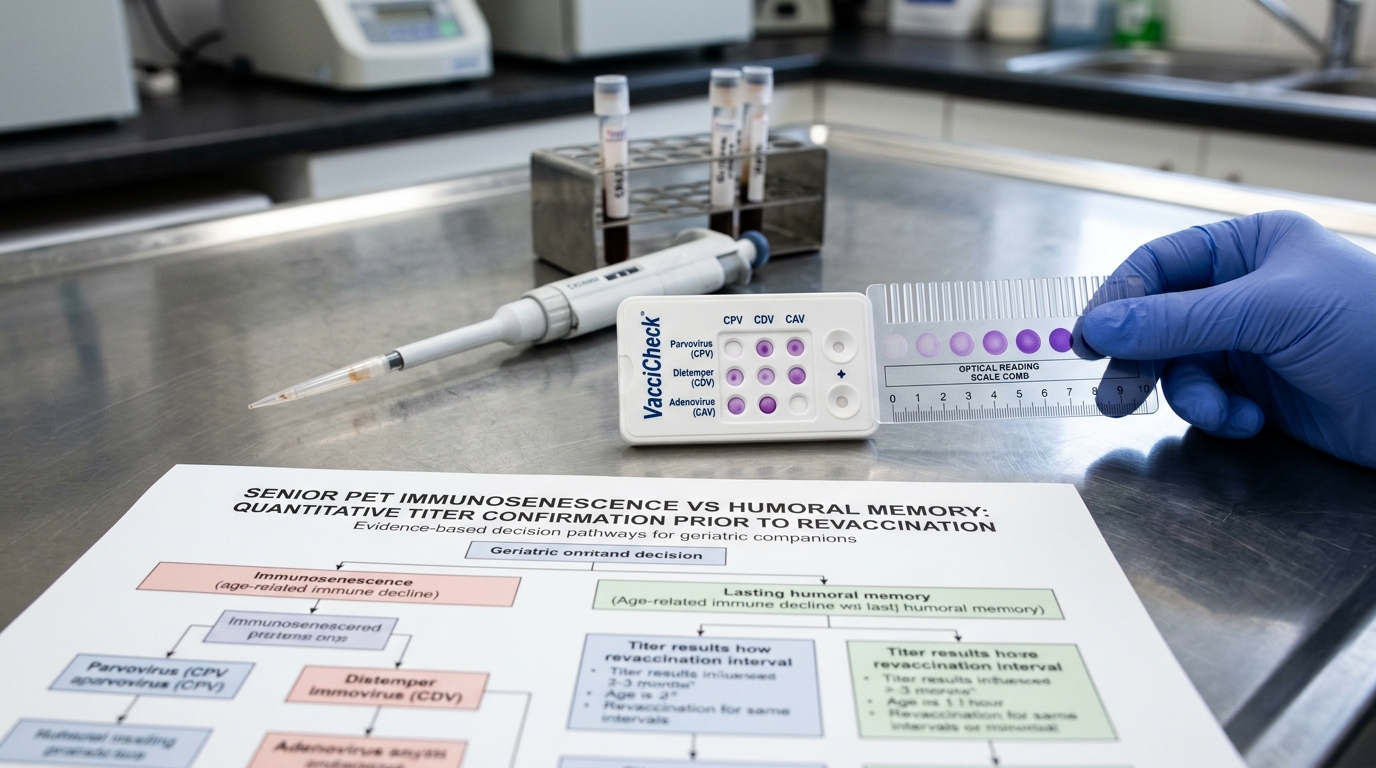
AAFP Adult Feline Intake Vaccination Architecture
The AAFP and WSAVA divide feline biologicals into core (mandatory for all cats regardless of lifestyle) and non-core (lifestyle- and exposure-dependent) categories:
| Vaccine Biological | Target Pathogens & Clinical Pathology | Primary Protocol (Unknown History) | Booster Interval Protocol |
|---|---|---|---|
| FVRCP (Core) | Feline Panleukopenia (viral parvoviral enteritis), Herpesvirus-1 (rhinotracheitis), and Calicivirus (ulcerative stomatitis). | Two subcutaneous doses administered 3 to 4 weeks apart. | Booster at 12 months post-initial series, followed by triennial (every 3 years) revaccination for adult indoor cats. |
| Rabies (Core by Statute) | Fatal rhabdoviral encephalomyelitis with 100% case fatality and vital zoonotic public health implications. | Single subcutaneous dose administered at intake examination. | Revaccination at 1 year, followed by annual or triennial intervals depending on recombinant canarypox vs. killed product label. |
| FeLV (Non-Core / Risk-Based) | Feline Leukemia Retrovirus causing bone marrow aplasia, severe immunosuppression, and multicentric lymphosarcoma. | Two doses administered 3 to 4 weeks apart following confirmed negative SNAP ELISA antigen screening. | Annual revaccination for felines with outdoor access or cohabiting with FeLV-discordant housemates. |
| Chlamydia felis / Bordetella (Non-Core) | Severe bacterial conjunctivitis and secondary upper respiratory tract infections. | Administered only in multi-cat breeding catteries or shelter outbreak environments with active clinical transmission. | Annual revaccination only when high-density environmental exposure warrants continued mucosal protection. |
Core vs Non-Core Immunizations: The Multi-Cat Adopter Matrix
In multi-cat environments, vaccination decisions must consider not only the incoming feline but also the immune status and vulnerability of existing household cats:
| Household Factor | Clinical Risk Assessment | Recommended Vaccination & Housing Strategy |
|---|---|---|
| Resident Senior or Immunocompromised Cat | High susceptibility to viral upper respiratory flares (FHV-1) and chronic shedding. | Ensure all resident felines have up-to-date FVRCP boosters; maintain 21-day quarantine before introducing the new adult cat. |
| Indoor-Only Lifestyle With Enclosed Screen Patio | Negligible direct contact with feral vectors; low FeLV risk but potential vector exposure (bats/Rabies). | Maintain core FVRCP and statutory Rabies vaccination; FeLV booster may be discontinued after initial series based on risk audit. |
| Supervised Outdoor Leash Walking or Catio Access | Moderate risk of direct contact with neighborhood cats through wire mesh or fencing. | Maintain annual FeLV vaccination alongside core FVRCP and Rabies to prevent horizontal salivary transmission. |
Targeted Questions for Your Cat’s Vaccination Consultation
Maximizing the safety and efficacy of your cat’s immunization appointment involves structured clinician-caregiver dialogue:
- “Will the clinic administer a non-adjuvanted recombinant canarypox vaccine (such as Purevax) rather than an adjuvanted killed product to minimize chronic localized injection-site inflammation?”
- “Can we document the exact anatomical limb site and product serial lot numbers in the permanent medical discharge notes for my personal records?”
- “Given this cat’s adult dentition and mature demeanor, is an in-clinic antibody titer test (VacciCheck) appropriate before we administer a third FVRCP booster?”
- “How long should I maintain physical barrier separation between this new cat and my resident felines after the final vaccination booster to ensure peak protective titers?”
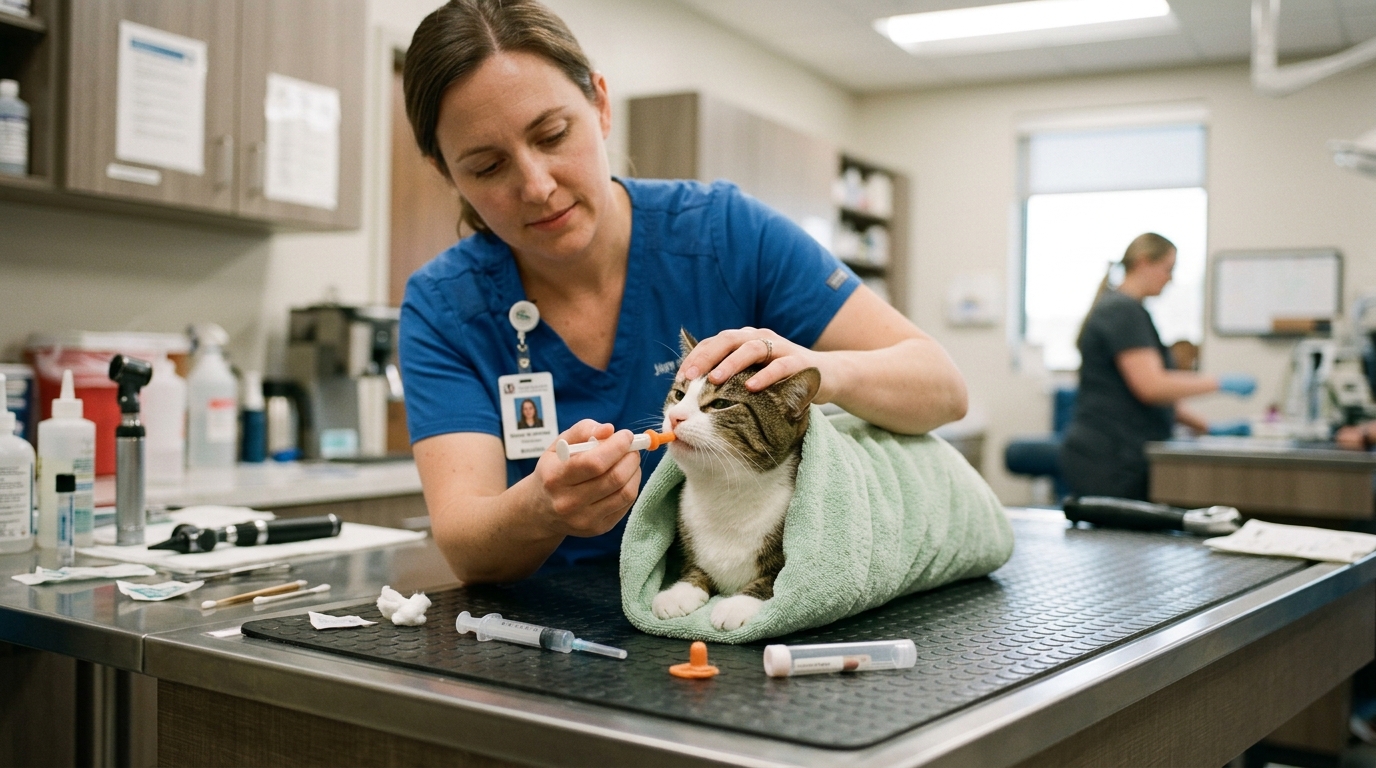
Low-Stress Fear-Free Handling During Preventive Injections
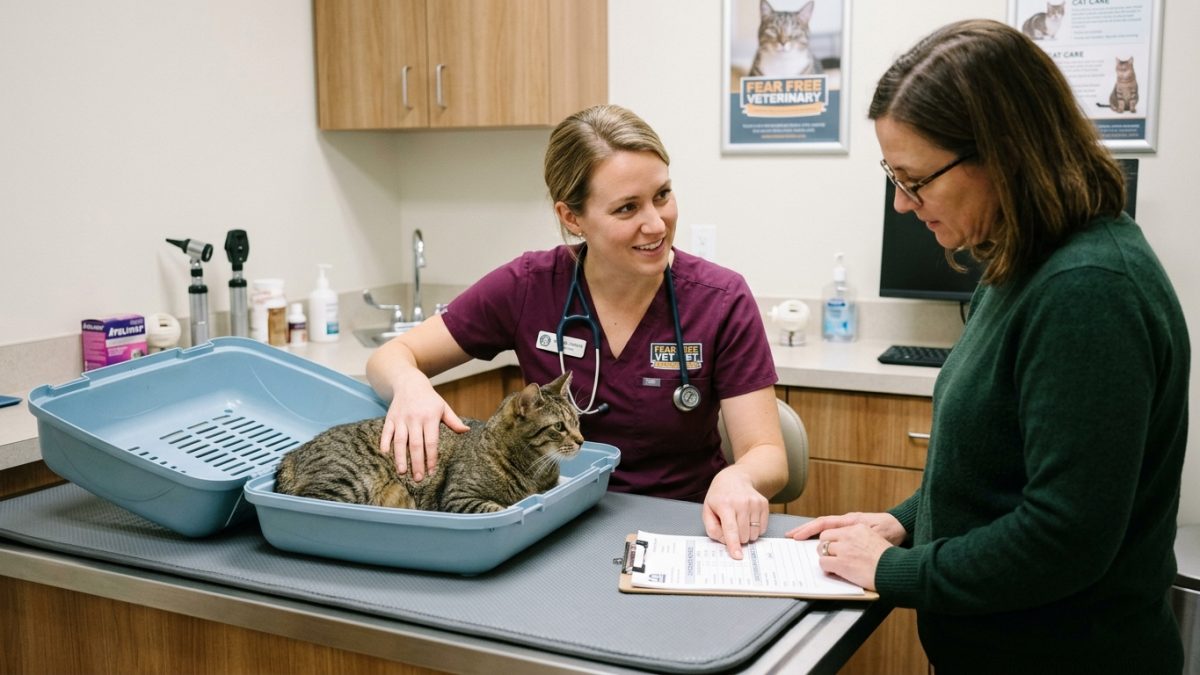
Adult rescue cats frequently manifest severe autonomic stress responses when transported to clinical facilities. Heightened sympathetic arousal elevates circulating serum catecholamines, increases core body temperature, and can trigger stress-induced hyperglycemia that confounds diagnostic testing. Utilizing Fear-Free clinical techniques optimizes the vaccination experience:
- Synthetic Facial Pheromones (Feliway Classic): Spraying carrier bedding 15 to 20 minutes before transport binds to feline vomeronasal receptors, promoting neurochemical comfort and decreasing autonomic agitation.
- Gentle Towel Swaddling (“Cat Burrito”): Wrapping the feline snugly in a soft, non-slip towel provides secure proprioceptive deep-pressure touch while exposing only the target limb for distal subcutaneous administration.
- Pre-Visit Anxiolytic Support (Gabapentin): For cats demonstrating severe clinical fear or examination fractiousness, oral gabapentin (10 to 20 milligrams per kilogram administered 2 to 3 hours prior to transport) significantly diminishes neurosensory anxiety without depressing cardiopulmonary reflexes.
Dangerous Post-Vaccine Home Interventions (Rule S1)
Caregivers must avoid dangerous self-prescribed medications following veterinary appointments:
- Absolute Contraindication of Human Antipyretics (Acetaminophen / Tylenol): Felines are constitutionally deficient in the hepatic enzyme UDP-glucuronosyltransferase. Administering even a fraction of a human acetaminophen tablet causes catastrophic methemoglobinemia, severe facial edema, acute hepatic necrosis, and rapid death. Never administer human pain relievers to manage mild post-vaccine fever.
- Prohibition of Human NSAIDs (Ibuprofen, Naproxen): Human nonsteroidal anti-inflammatory drugs trigger irreversible acute tubular necrosis and life-threatening gastrointestinal perforation in felines.
- Expected Normal Post-Vaccinal Responses vs. Adverse Events: Mild lethargy, transient localized tenderness at the injection limb, and reduced appetite lasting under 24 hours are normal physiological reflections of interferon release. Persistent vomiting, facial angioedema, respiratory distress, or hypothermia require immediate emergency care.
Red-Flag Triage Matrix: Post-Vaccination Observation in New Adoptions
Caregivers should monitor their newly adopted feline closely during the initial 48 hours post-vaccination using this clinical severity matrix:
| Observed Post-Vaccine Symptom | Severity Urgency Tier | Pathophysiological Mechanism | Required Clinical Action Protocol |
|---|---|---|---|
| Facial Angioedema, Urticaria, or Respiratory Dyspnea | Tier 1: Immediate Emergency | Acute Type I hypersensitivity (anaphylactic degranulation of tissue mast cells). | Transport immediately to emergency clinic for intramuscular epinephrine, oxygen, and antihistamines. |
| Repeated Persistent Vomiting & Profound Collapse | Tier 1: Immediate Emergency | Systemic vascular collapse or severe gastrointestinal anaphylaxis. | Immediate emergency veterinary resuscitation and intravenous fluid support. |
| Firm Subcutaneous Nodule at Injection Site (< 2 cm) | Tier 3: Routine Monitoring (3-2-1 Rule) | Localized sterile inflammatory granuloma or macrophage antigen aggregation. | Record date and size; monitor using the AAFP 3-2-1 rule (escalate if present after 3 months, > 2 cm, or grows after 1 month). |
| Mild Lethargy & Sleepiness for 12 to 24 Hours | Tier 4: Expected Physiological Response | Endogenous pyrogen release and immune system memory cell activation. | Provide a warm, quiet, undisturbed sanctuary room with easily accessible fresh water and palatable food. |
Frequently Asked Questions
What is the AAFP 3-2-1 rule for feline injection-site lumps?
The American Association of Feline Practitioners recommends performing an incisional biopsy or aspirate of any post-vaccine subcutaneous lump if it fulfills any of three criteria: (1) it persists for 3 months or longer after the injection; (2) it is larger than 2 centimeters in diameter; or (3) it continues to increase in size 1 month after vaccination. This vigilant protocol ensures early diagnosis of rare FISS neoplasms when curative surgical removal is still viable.
Can an indoor adult cat skip the Rabies vaccine?
No. In almost all jurisdictions, rabies vaccination for domestic cats is legally mandated by statute. Furthermore, indoor cats face accidental escape risks, and rabid wildlife (particularly bats) frequently enter residential homes through chimneys, open windows, or attic vents. Because rabies is a fatal, non-treatable zoonotic disease with 100% case fatality, continuous immunization is vital.
Should I separate my newly adopted vaccinated cat from my other cats?
Yes. Maintain complete physical separation in a dedicated quarantine room for at least 14 to 21 days. This quarantine allows the newly administered vaccines to generate protective antibody titers (which take 10 to 14 days) while isolating your resident cats from any subclinical upper respiratory viruses or shedding enteric parasites the new cat may be incubating.
Peer-Reviewed Clinical References & Evidence Grounding
- AAHA/AAFP Feline Vaccination Guidelines: Stone AES, et al. 2020 AAHA/AAFP Feline Vaccination Guidelines. Journal of Feline Medicine and Surgery. 2020;22(9):813-830. PubMed PMID: 33003952
- WSAVA Vaccination Guidelines for Dogs and Cats: Day MJ, et al. Guidelines for the Vaccination of Dogs and Cats. Journal of Small Animal Practice. 2024. WSAVA Resource Centre
- Feline Injection-Site Sarcoma Guidelines: Hartmann K, et al. Feline Injection-Site Sarcoma: ABCD Guidelines on Prevention and Management. Journal of Feline Medicine and Surgery. 2015;17(7):606-613. PubMed PMID: 26101312
- AAFP Retrovirus Management Guidelines: Little S, et al. 2020 AAFP Feline Retrovirus Testing and Management Guidelines. Journal of Feline Medicine and Surgery. 2020;22(1):5-30. PubMed PMID: 31916872
Printable tools
Download the matching worksheet
Source transparency
Reference mix for this guide
Source labels describe the type of organization behind each reference; they are not a claim that any outside organization reviewed this article.
- Vaccination Conversations for Multi-Pet Homes Reference source · newspet.net
- Indoor Cat Home: Territory, Enrichment & Routines Reference source · newspet.net
- Multi-Cat Conflict Tracker Reference source · newspet.net
- Veterinary Visit Preparation Sheet Veterinary organization · newspet.net
- PubMed PMID: 33003952 Government or public agency · pubmed.ncbi.nlm.nih.gov
- WSAVA Resource Centre Veterinary organization · wsava.org
- PubMed PMID: 26101312 Government or public agency · pubmed.ncbi.nlm.nih.gov
- PubMed PMID: 31916872 Government or public agency · pubmed.ncbi.nlm.nih.gov